


Eagle Nebula

| Emission nebula | |
|---|---|
| H II region | |
 Three-colour composite mosaic image of the Eagle Nebula, with north at top. Credit: ESO | |
| Observation data: J2000.0 epoch | |
| Right ascension | 18h 18m 48s[1] |
| Declination | −13° 49′[1] |
| Distance | 5,700±400 ly (1,740±130[2] pc) |
| Apparent magnitude (V) | 6.4[3] |
| Apparent dimensions (V) | 70 x 50 arcmins[citation needed] |
| Constellation | Serpens |
| Physical characteristics | |
| Radius | 70×55 (cluster 15)[citation needed] ly |
| Absolute magnitude (V) | -8.21[citation needed] |
| Notable features | 1–2 million years old[citation needed] |
| Designations | Messier 16, NGC 6611,[1] Sharpless 49, RCW 165, Cr 375, Gum 83, Star Queen Nebula |
The Eagle Nebula (catalogued as Messier 16 or M16, and as NGC 6611, and also known as the Star Queen Nebula) is a young open cluster of stars in the constellation Serpens, discovered by Jean-Philippe de Cheseaux in 1745–46. Both the "Eagle" and the "Star Queen" refer to visual impressions of the dark silhouette near the center of the nebula,[4][5] an area made famous as the "Pillars of Creation" imaged by the Hubble Space Telescope. The nebula contains several active star-forming gas and dust regions, including the aforementioned Pillars of Creation. The Eagle Nebula lies in the Sagittarius Arm of the Milky Way.
Characteristics
[edit]
The Eagle Nebula is part of a diffuse emission nebula, or H II region, which is catalogued as IC 4703. This region of active current star formation is about 5700 light-years distant. A spire of gas that can be seen coming off the nebula in the northeastern part is approximately 9.5 light-years or about 90 trillion kilometers long.[6]
The cluster associated with the nebula has approximately 8100 stars, which are mostly concentrated in a gap in the molecular cloud to the north-west of the Pillars.[7] The brightest star (HD 168076) has an apparent magnitude of +8.24, easily visible with good binoculars. It is actually a binary star formed of an O3.5V star plus an O7.5V companion.[8] This star has a mass of roughly 80 solar masses, and a luminosity up to 1 million times that of the Sun. The cluster's age has been estimated to be 1–2 million years.[9]
The descriptive names reflect impressions of the shape of the central pillar rising from the southeast into the central luminous area. The name "Star Queen Nebula" was introduced by Robert Burnham, Jr., reflecting his characterization of the central pillar as the Star Queen shown in silhouette.[5]
"Pillars of Creation" region
[edit](animation; 0:15; 11 November 2022)
Images produced by Jeff Hester and Paul Scowen using the Hubble Space Telescope in 1995 greatly improved scientific understanding of processes inside the nebula. One of these became famous as the "Pillars of Creation", depicting a large region of star formation. Its small dark pockets are believed to be protostars (Bok globules). The pillar structure resembles that of a much larger instance in the Soul Nebula of Cassiopeia, imaged with the Spitzer Space Telescope in 2005[10] equally characterized as "Pillars of Star Creation".[11] or "Pillars of Star Formation".[12] These columns – which resemble stalagmites protruding from the floor of a cavern – are composed of interstellar hydrogen gas and dust, which act as incubators for new stars. Inside the columns and on their surface astronomers have found knots or globules of denser gas, called EGGs ("Evaporating Gaseous Globules"). Stars are being formed inside some of these.
X-ray images from the Chandra observatory compared with Hubble's "Pillars" image have shown that X-ray sources (from young stars) do not coincide with the pillars, but rather randomly dot the nebula.[13] Any protostars in the pillars' EGGs are not yet hot enough to emit X-rays.[citation needed]
Evidence from the Spitzer Space Telescope originally suggested that the pillars in M16 may be threatened by a "past supernova". Hot gas observed by Spitzer in 2007 suggested they were already – likely – being disturbed by a supernova that exploded 8,000 to 9,000 years ago. Due to the distance the main blast of light would have reached Earth for a brief time 1,000 to 2,000 years ago. A more slowly moving, theorized, shock wave would have taken a few thousand years to move through the nebula and would have blown away the delicate pillars. However, in 2014 the pillars were imaged a second time by Hubble, in both visible light and infrared light. The images being 20 years later provided a new, detailed account of the rate of evaporation occurring within the pillars. No supernova is evidenced within them, and it is estimated in some form they still exist – and will appear for at least 100,000 more years.
Gallery
[edit]-
 Locator of well-known areas in the nebula
 -
 The "Pillars of Creation" within the Eagle Nebula
 -
 Detail of the HST image
 -
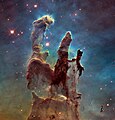 A higher-resolution HST image of the "Pillars of Creation" was taken 20 years after the original.
 -

-
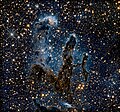 HST infrared view
 -
 The "Black Pillar" spire on the eastern perimeter is about 9.5 light-years long.
 -
 Open cluster within the Eagle Nebula
 -
 Northwestern part of the region, well away from the centre
 -
 Starless version edit of the M16 Eagle Nebula, showing also the Pillars of Creation. Image total exposure of 15 hours, taken from a Bortle 7 in Nicosia, Cyprus
 -
 The Eagle Nebula captured in the SHO Hubble palette with 3nm filters
 -
![The "Pillars of Creation" captured by JWST NIRCam[14]](//upload.wikimedia.org/wikipedia/commons/thumb/b/b4/Pillars_of_Creation_%28NIRCam_Image%29.png/69px-Pillars_of_Creation_%28NIRCam_Image%29.png)
-
 Eagle Nebula ("Pillars" in circle; WISE; 11 November 2022


![The "Pillars of Creation" captured by JWST NIRCam[14]](/wiki/File:Pillars_of_Creation_(NIRCam_Image).png)

See also
[edit]References
[edit]- ^ a b c "M 16". SIMBAD. Centre de données astronomiques de Strasbourg. Retrieved 2006-11-16.
- ^ Kuhn, Michael A.; Hillenbrand, Lynne A.; Sills, Alison; Feigelson, Eric D.; Getman, Konstantin V. (2018). "Kinematics in Young Star Clusters and Associations with Gaia DR2". The Astrophysical Journal. 870 (1): 32. arXiv:1807.02115. Bibcode:2019ApJ...870...32K. doi:10.3847/1538-4357/aaef8c. S2CID 119328315.
- ^ "Messier 16". SEDS Messier Catalog. Retrieved 21 July 2024.
- ^ Martin MacPhee (8 July 2014). "The awesome beauty of M16, the Eagle Nebula". EarthSky. Retrieved 25 September 2015.
- ^ a b Robert Burnham Jr. (1978). Burnham's Celestial Handbook. Dover. pp. 1786, 1788. ISBN 978-0-486-23673-5.
- ^ "The Eagle has risen: Stellar spire in the Eagle Nebula". 25 April 2005. Retrieved 9 May 2021.
- ^ Kuhn, M. A.; et al. (2015). "The Spatial Structure of Young Stellar Clusters. II. Total Young Stellar Populations". Astrophysical Journal. 802 (1): 60. arXiv:1501.05300. Bibcode:2015ApJ...802...60K. doi:10.1088/0004-637X/802/1/60. S2CID 119309858.
- ^ Sana, H.; Gosset, E.; Evans, C. J. (2009). "The massive star binary fraction in young open clusters – II. NGC 6611 (Eagle Nebula)". Monthly Notices of the Royal Astronomical Society. 400 (3): 1479–1492. arXiv:0909.0486. Bibcode:2009MNRAS.400.1479S. doi:10.1111/j.1365-2966.2009.15545.x. S2CID 14271184.
- ^ Hillenbrand, Lynne A.; Massey, Philip; Strom, Stephen E.; Merrill, K. Michael (1993). "NGC 6611: A cluster caught in the act". The Astronomical Journal. 106: 1906. Bibcode:1993AJ....106.1906H. doi:10.1086/116774.
- ^ "Spitzer Captures Cosmic "Mountains Of Creation"". Spacedaily.com. Retrieved 2012-04-01.
- ^ Nemiroff, R.; Bonnell, J., eds. (16 September 2008). "W5: Pillars of Star Creation". Astronomy Picture of the Day. NASA.
- ^ Nemiroff, R.; Bonnell, J., eds. (20 November 2011). "W5: Pillars of Star Formation". Astronomy Picture of the Day. NASA.
- ^ "Chandra, Photo Album, The Eagle Nebula (M16), 15 Feb 07". Chandra.harvard.edu. Retrieved 2012-04-01.
- ^ Overbye, Dennis (19 October 2022). "Webb Telescope Captures New View of 'Pillars of Creation' - The NASA space observatory's infrared eye finds out what's going on within the cloudy cosmic nursery". The New York Times. Retrieved 21 October 2022.
External links
[edit]
- The Eagle Nebula on WikiSky: DSS2, SDSS, GALEX, IRAS, Hydrogen α, X-Ray, Astrophoto, Sky Map, Articles and images
- The Eagle's EGGs – ESO Photo Release
- ESO: An Eagle of Cosmic Proportions incl. Photos & Animations
- ESO: VST Captures Three-In-One incl. Photos & Animations
- Messier 16, SEDS Messier pages
- Spacetelescope.org, Hubble telescope images on M16
- Darkatmospheres.com, Eagle Nebula M16 (wide)
- NASA.gov, APOD February 8, 2009 picture Eagle Nebula
- Szymanek, Nik; Lawrence, Pete; Crowther, Paul; Merrifield, Michael. "M16 – Eagle Nebula". Deep Sky Videos. Brady Haran.
- Eagle Nebula (Messier 16) at Constellation Guide
| List |
|  |
|---|---|---|
| See also | ||


