


Phoenix canariensis
| Phoenix canariensis | |
|---|---|

| |
Scientific classification 
| |
| Kingdom: | Plantae |
| Clade: | Tracheophytes |
| Clade: | Angiosperms |
| Clade: | Monocots |
| Clade: | Commelinids |
| Order: | Arecales |
| Family: | Arecaceae |
| Genus: | Phoenix |
| Species: | P. canariensis
|
| Binomial name | |
| Phoenix canariensis | |
Phoenix canariensis, the Canary Island date palm or pineapple palm, is a species of flowering plant in the palm family Arecaceae, native to the Canary Islands off the coast of Northwestern Africa. It is a relative of Phoenix dactylifera, the true date palm. It is the natural symbol of the Canary Islands, together with the canary Serinus canaria.[2] Mature P. canariensis are often used in ornamental landscaping and are collected and transplanted to their new planting location. A Canary Island date palm with 10 m (30 ft) of trunk is about 60 years of age.
Description[edit]
Phoenix canariensis is a large, solitary palm, 10–20 m (33–66 ft) tall, occasionally growing to 40 m (131 ft). The leaves, typically around 75 to 125 in number (but the record is for a tree on the French Riviera which bore 443 green, fresh leaves at one time),[3] are pinnate, 4–6 m (13–20 ft) long, with 80–100 leaflets on each side of the central rachis. The fruit is an oval, yellow to orange drupe 2 cm (0.79 in) long and 1 cm (0.39 in) in diameter, and containing a single large seed; the fruit pulp is edible, but not the best of dates.[4]
Names[edit]
Common names in English include Canary Island date palm and pineapple palm. The common name in Spanish-speaking countries and in the Canary Islands is palmera canaria.
Cultivation[edit]

The Canary Island date palm is typically cultivated in wet-winter or Mediterranean climates, but also in wet-summer or humid subtropical climates such as eastern Australia and the southeastern United States. Even several instances are known of cultivated Canary Island date palms in high-latitude oceanic climates, such as Ireland, the UK, and the Channel Islands.[5] It can be cultivated where temperatures rarely fall below −10 or −12 °C (14 or 10 °F) for extended periods, although it will require some protection if cold periods are longer than normal. It is a slowly growing tree, exclusively propagated by seed.
The palm is easily recognized through its crown of leaves and trunk characteristics. Seeing Canary Island date palms pruned and trimmed to enhance the appearance is not uncommon.[6] When pruned, the bottom of the crown, also called the nut, appears to have a pineapple shape.
The Canary Island date palm is susceptible to Fusarium wilt, a fungal disease commonly transmitted through contaminated seed, soil, and pruning tools. Spread of the disease can be reduced when pruning tools are disinfected before use on this palm.[7] In some parts of its cultivated range it is attacked by the invasive South American palm weevil, Rhynchophorus palmarum. Adult weevils are preferentially attracted to chemicals emitted by injured or damaged palms. The weevil larvae burrow into the crown then feast on the sugar-rich apical bud, which provides a path for bacterial or fungal pests. This typically kills the apical bud after some time, either due to secondary infection by pathogens or due to heavy infestation of larvae. This then causes the leaves to droop, turn brown and die.[1]
P. canariensis has gained the Royal Horticultural Society's Award of Garden Merit.[8][9]
Use in landscaping[edit]
The Canary Island date appears in many notable examples of landscaping, particularly in the American state of California. The Canary Island date palm, according to legend, was first planted in what is now San Diego in 1769 by Spanish missionary Junípero Serra, a founder of the California mission system.[10] Though this story is likely false, Spanish missionaries did cultivate true date palms, rather than Canary Island date palms, in California in the late 1700s for the fruit.[11] However, a Canary Island date palm was famously known as "The Serra Palm"—the palm supposedly planted by Junipero Serra in San Diego—before the tree's death in 1957.[10]
Other famous plantings of the Canary Island date palm in California include the campus of Stanford University, which contains 600 Canary Island date palms in its Mediterranean-inspired campus. Stanford's entrance, Palm Drive, is one example of extensive use of the Canary Island date palm in landscaping, including 166 of the species along the stretch leading to the campus.[12] Oracle Park in San Francisco—the stadium of the Major League Baseball team, the San Francisco Giants, is another notable example of the Canary Island date palm in Californian landscaping, containing a host of the species at the stadium's entrance and beyond left field.[13]
Other uses[edit]
In the Canary Islands, the sap of this date palm is used to make palm syrup. La Gomera is the only island where the syrup is produced in the Canary Islands.
Invasiveness[edit]
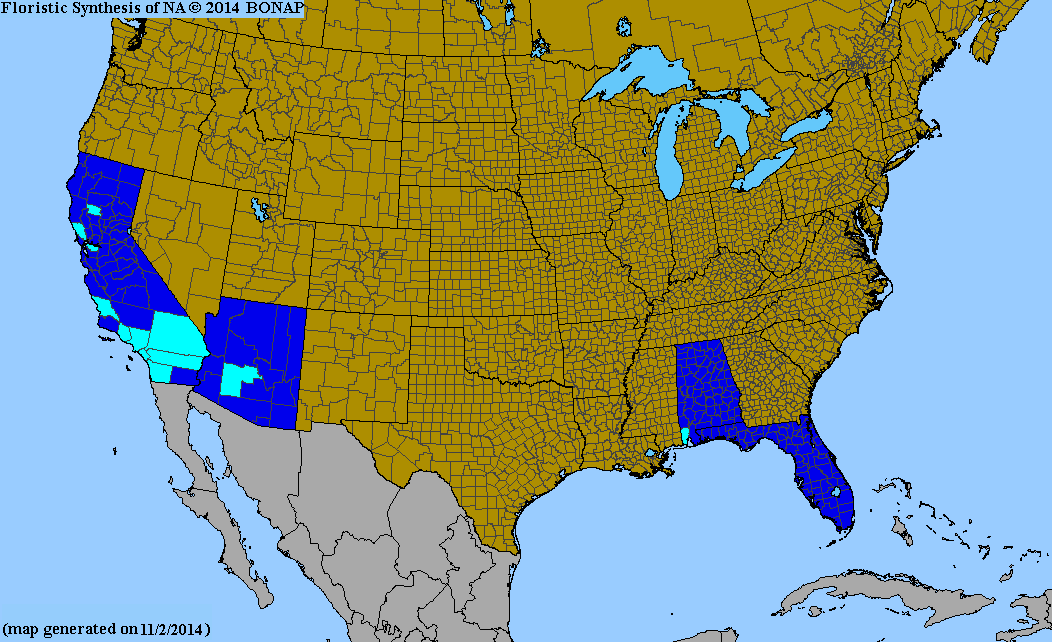
In some areas, P. canariensis has proven to be an invasive plant. In Bermuda and the United States (Florida and California), it is considered naturalised (lives wild in a region where it is not indigenous). It has also spread in some areas of peninsular Spain, Portugal, Italy, Croatia, Greece, North Africa, Middle East, Australia, and New Zealand.[14][15][16] It is listed as invasive (naturalized) in coastal southern California.[17] In Auckland, New Zealand, the palm has itself become a host for the naturalised Australian strangler fig, Ficus macrophylla.
Gallery[edit]
-

-

-

-

-
 P. canariensis (Canary Island date palm) collection at South Coast Wholesale Nursery, San Diego, California
 -
 Mature Canary island date palm in Melbourne, Florida
 -
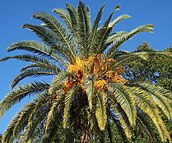 P. canariensis fruit in Northern Florida
 -
 Tall, old Canary Island date palm in Phoenix, Arizona
 -
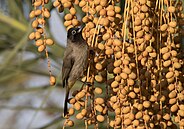 Close-up of fruit
 -
 Canary Island date palm growing in Hatteras, North Carolina, about its northern limit unprotected on the East Coast of the United States
 -
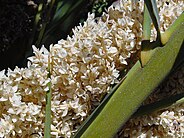 Close-up of flowers
 -
 Bark
Bark


See also[edit]
References[edit]
- ^ Beech, E. (2017). "Phoenix canariensis". IUCN Red List of Threatened Species. 2017: e.T13416997A13417001. doi:10.2305/IUCN.UK.2017-3.RLTS.T13416997A13417001.en.
- ^ Símbolos de la naturaleza para las Islas Canarias [Natural Symbols for the Canary Islands] (Ley 7/1991) (in Spanish). Vol. 151. 30 April 1991. pp. 20946–20947 – via BOE.
- ^ anonymous (September 4, 1920). "<not recorded>". Gardener's Chronicle. 68 (third series) (<not stated>): 124.
- ^ Little, Elbert L. (1994) [1980]. The Audubon Society Field Guide to North American Trees: Western Region (Chanticleer Press ed.). Knopf. p. 324. ISBN 0394507614.
- ^ Carter, Michael A. F. "Palms in the Channel Islands". The European Palm Society. Retrieved 12 December 2013.
- ^ "Canary Island Date Palm – Phoenix canariensis – A–E – Palm Blog". realpalmtrees.com. Retrieved 19 January 2018.
- ^ Elliott, Monica. "Fusarium Wilt of Canary Island Date Palm". UF/IFAS Extension Service. Retrieved 2016-11-21.
- ^ "RHS Plant Selector – Phoenix canariensis". Apps.rhs.org.uk. Royal Horticultural Society. Retrieved 8 February 2021.
- ^ "AGM Plants – Ornamental" (PDF). Royal Horticultural Society. July 2017. p. 77. Retrieved 25 April 2018.
- ^ a b Trent, Heidi; Seymour, Joey (2010). "Examining California's First Palm Tree: The Serra Palm". Journal of San Diego History.
- ^ Zona, Scott (2008). "The horticultural history of the Canary Island Date Palm (Phoenix canariensis)". Garden History.
- ^ magazine, STANFORD (2013-09-01). "High and Mighty". stanfordmag.org. Retrieved 2023-05-22.
- ^ Farmer, Jared (2013). Trees in Paradise: a California History. Norton and Company.
- ^ "World Checklist of Selected Plant Families: Royal Botanic Gardens, Kew". Apps.kew.org. Retrieved 19 January 2018.
- ^ "Bonap" (PNG). Bonap.net. 2004. Retrieved 19 January 2018.
- ^ "Phoenix canariensis – Species Page – APA: Alabama Plant Atlas". Floraofalabama.org. Retrieved 19 January 2018.
- ^ "Cal-IPC: Phoenix canariensis". Archived from the original on 2016-05-26. Retrieved 2016-06-27.
External links[edit]

- "Phoenix canariensis in the wild". Principes (Journal of the International Palm Society). 42 (2). April 1998. Retrieved 18 May 2008.