


Plagues of Egypt

In the Book of Exodus, the Plagues of Egypt (Hebrew: מכות מצרים) are ten disasters that Yahweh inflicts on the Egyptians to convince the Pharaoh to emancipate the enslaved Israelites, each of them confronting the Pharaoh and one of his Egyptian gods;[1] they serve as "signs and marvels" given by Yahweh in response to the Pharaoh's taunt that he does not know Yahweh: "The Egyptians shall know that I am the LORD".[2]: 117 These Plagues are recited by Jews during the Passover Seder.[3]
The consensus of modern scholars is that the Torah does not give an accurate account of the origins of the Israelites and that, while a small group of proto-Israelites may have originated from Egypt, it did not happen in the massive way that the Tanakh describes.[4][5]: 81 [6]: 6–7 Some scholars have suggested that the story of the Plagues of Egypt might have been inspired by natural phenomena like epidemics, although these theories are considered uncertain.[7][8]
List of the disasters
[edit]
The Nile becomes a river of blood
[edit]This is what the LORD says: By this you will know that I am the LORD: With the staff that is in my hands I will strike the water of the Nile, and it will be changed into blood. The fish in the Nile will die, and the river will stink and the Egyptians will not be able to drink its water.
— Exodus 7:17–18[9]
The Hebrew Bible's Book of Exodus says that Aaron turned the Nile to blood by striking it with his staff. Pharaoh's magicians used their secret arts to also strike the Nile, creating a second layer of blood. In addition to the Nile, all water that was held in reserve, such as jars, was also transformed into blood. The Egyptians were forced to dig alongside the bank of the Nile, which still had pure water. One week passed before the plague dissipated.[3]
Frogs emerge from the Nile and infest Egypt
[edit]
This is what the great LORD says: Let my people go, so that they may worship me. If you refuse to let them go, I will plague your whole country with frogs. The Nile will teem with frogs. They will come up into your palace and your bedroom and onto your bed, into the houses of your officials and on your people, and into your ovens and kneading troughs. The frogs will go up on you and your people and all your officials.
— Exodus 8:1–4[10]
Exodus states that God ordered frogs to emerge from the Nile, which then jumped around virtually everywhere in Egypt. The magicians attempted to produce frogs from their secret arts, conjuring up a second wave of frogs. Even the private quarters of Pharaoh was infested with frogs. Three days passed before all the frogs died. The Egyptians had to do much work to rid themselves of the corpses, and the land stank of frog for long afterwards. When the decision came for Pharaoh about the slaves, the Lord hardened his heart and Pharaoh decided that the slaves would not be freed.
Lice emerge from the ground and infest Egypt
[edit]"And the LORD said [...] Stretch out thy rod, and smite the dust of the land, that it may become lice throughout all the land of Egypt." [...] When Aaron stretched out his hand with the rod and struck the dust of the ground, lice came upon men and animals. All the dust throughout the land of Egypt became lice.
— Exodus 8:16–17[11]
Wild animals or flies harm Egyptians and their livestock
[edit]The fourth plague of Egypt was of creatures capable of harming people and livestock. Exodus states that the plagues only came against the Egyptians and did not affect the Hebrews. Pharaoh asked Moses to remove this plague and promised to grant the Israelites their freedom. However, after the plague was gone, Pharaoh refused to keep his promise, as his heart was hardened by God.
Various sources use either "wild animals" or "flies".[12][13][14][15]
Mass death of Egyptian livestock to pestilence
[edit]This is what the LORD, the God of the Hebrews, says: Let my people go, so that they may worship me. If you refuse to let them go and continue to hold them back, the hand of the LORD will bring a terrible plague on your livestock in the field—on your horses and donkeys and camels and on your cattle and sheep and goats.
— Exodus 9:1–3[16]
Boils infect Egyptians and their livestock
[edit]
Then the LORD said to Moses and Aaron, "Take handfuls of soot from a furnace and have Moses toss it into the air in the presence of Pharaoh. It will become fine dust over the whole land of Egypt, and festering boils will break out on men and animals throughout the land."
— Exodus 9:8–9[17]
Thunderstorm of hail and fire
[edit]This is what the LORD, the God of the Hebrews, says: Let my people go, so that they may worship me, or this time I will send the full force of my plagues against you and against your officials and your people, so you may know that there is no one like me in all the earth. For by now I could have stretched out my hand and struck you and your people with a plague that would have wiped you off the earth. But I have raised you up for this very purpose, that I might show you my power and that my name might be proclaimed in all the earth. You still set yourself against my people and will not let them go. Therefore, at this time tomorrow I will send the worst hailstorm that has ever fallen on Egypt, from the day it was founded till now. Give an order now to bring your livestock and everything you have in the field to a place of shelter, because the hail will fall on every man and animal that has not been brought in and is still out in the field, and they will die. [...] The LORD sent thunder and hail, and lightning flashed down to the ground. So the LORD rained hail on the land of Egypt; hail fell and lightning flashed back and forth. It was the worst storm in all the land of Egypt since it had become a nation.
— Exodus 9:13–24[18]
Locust swarm
[edit]This is what the LORD, the God of the Hebrews, says: 'How long will you refuse to humble yourself before me? Let my people go, so that they may worship me. If you refuse to let them go, I will bring locusts into your country tomorrow. They will cover the face of the ground so that it cannot be seen. They will devour what little you have left after the hail, including every tree that is growing in your fields. They will fill your houses and those of all your officials and all the Egyptians—something neither your fathers nor your forefathers have ever seen from the day they settled in this land till now.
— Exodus 10:3–6[19]
Three days of total darkness
[edit]
Then the LORD said to Moses, "Stretch out your hand toward the sky so that darkness will spread over Egypt—darkness that can be felt." So Moses stretched out his hand toward the sky, and total darkness covered all Egypt for three days. No one could see anyone else or leave his place for three days.
— Exodus 10:21–23[20]
Death of every Egyptian's firstborn son
[edit]This is what the LORD says: "About midnight I will go throughout Egypt. Every firstborn son in Egypt will die, from the firstborn son of Pharaoh, who sits on the throne, to the firstborn of the slave girl, who is at her hand mill, and all the firstborn of the cattle as well. There will be loud wailing throughout Egypt—worse than there has ever been or ever will be again."
— Exodus 11:4–6[21]
Before this final plague, God commands Moses to tell the Israelites to mark a lamb's blood above their doors in order that the Angel of Death will pass over them (i.e., that they will not be touched by the death of the firstborn). Pharaoh orders the Israelites to leave, taking whatever they want, and asks Moses to bless him in the name of the Lord. The passage goes on to state that the passover sacrifice recalls the time when the LORD "passed over the houses of the Israelites in Egypt".[22]
Composition and theology
[edit]
Scholars are in broad agreement that the publication of the Torah took place in the mid-Persian period (the 5th century BCE).[23] The Book of Deuteronomy, composed in stages between the 7th and 6th centuries,[24] mentions the "diseases of Egypt" (Deuteronomy 7:15 and 28:60). John Van Seters contends that this refers to something that afflicted the Israelites, not the Egyptians, and that Deuteronomy never specifies the plagues.[25] Graham Davies, however, questions Van Seters' interpretation and argues that several verses in the book (e.g. Deuteronomy 6:22; 11:2–3) seem to clearly allude to a plague tradition.[26]
The traditional number of ten plagues is not actually mentioned in Exodus, and other sources differ; Psalms 78 and 105 seem to list only seven or eight plagues and order them differently.[1] It appears that originally there were only seven, to which were added the third, sixth, and ninth, bringing the count to ten.[27]: 83–84
In this final version, the first nine plagues form three triads, each of which God introduces by informing Moses of the main lesson it will teach.[2]: 117 In the first triad, the Egyptians begin to experience the power of God;[2]: 118 in the second, God demonstrates that he is directing events;[2]: 119 and in the third, the incomparability of Yahweh is displayed.[2]: 117 Overall, the plagues are "signs and marvels" given by the God of Israel to answer Pharaoh's taunt that he does not know Yahweh: "The Egyptians shall know that I am the LORD".[2]: 117
Historicity
[edit]Secular Scholars broadly agree that the Exodus is not a historical account and that, while a small group of proto-Israelites may have originated from Egypt, it did not happen in the massive way the Bible describes.[28][5]: 81 [6]: 6–7 Some scholars also hold that the Israelites originated in Canaan and from the Canaanites, although others disagree.[29] The Ipuwer Papyrus, written no earlier than the late Twelfth Dynasty of Egypt (c. 1991–1803 BCE),[30] has been put forward in popular literature as confirmation of the biblical account, most notably because of its statement that "the river is blood" and its frequent references to servants running away; however, these arguments ignore the many points on which Ipuwer contradicts Exodus, such as Asiatics arriving in Egypt rather than leaving and the fact that the "river is blood" phrase probably refers to the red sediment colouring the Nile during disastrous floods, or is simply a poetic image of turmoil.[31] Attempts to find natural explanations for the plagues (e.g., a volcanic eruption to explain the "darkness" plague) have been dismissed by biblical scholars on the grounds that their pattern, timing, rapid succession, and above all, control by Moses mark them as supernatural.[5]: 90 [2]: 117–118
Artistic representation
[edit]Visual art
[edit]
In visual art, the plagues have generally been reserved for works in series, especially engravings. Still, relatively few depictions in art emerged compared to other religious themes until the 19th century, when the plagues became more common subjects, with John Martin and Joseph Turner producing notable canvases. This trend probably reflected a Romantic attraction to landscape and nature painting, for which the plagues were suited, a Gothic attraction to morbid stories, and a rise in Orientalism, wherein exotic Egyptian themes found currency. Given the importance of noble patronage throughout Western art history, the plagues may have found consistent disfavor because the stories emphasize the limits of a monarch's power, and images of lice, locusts, darkness, and boils were ill-suited for decoration in palaces and churches.[citation needed]
Music
[edit]Perhaps the most successful artistic representation of the plagues is Handel's oratorio Israel in Egypt, which, like his perennial favorite, "Messiah", takes a libretto entirely from scripture. The work was especially popular in the 19th century because of its numerous choruses, generally one for each plague, and its playful musical depiction of the plagues. For example, the plague of frogs is performed as a light aria for alto, depicting frogs jumping in the violins, and the plague of flies and lice is a light chorus with fast scurrying runs in the violins.[32]
Documentaries
[edit]- The Exodus Decoded (2006)
Films
[edit]- The Ten Commandments (1923)
- The Moon of Israel (1924)
- The Ten Commandments (1956)
- The Abominable Dr. Phibes (1971)
- The Seventh Sign (1988)
- Moses (1995)
- The Prince of Egypt (1998)
- Magnolia (1999)
- The Mummy (1999)
- The Reaping (2007)
- Exodus: Gods and Kings (2014)
- Seder-Masochism (2018)
Gallery
[edit]-
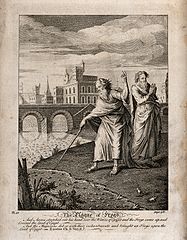 The Second Plague: Frogs came up and covered the Sand of Egypt
 -
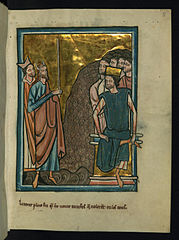 The Third Plague:
 -
 The Fourth Plague: The Plague of Flies, James Jacques Joseph Tissot, Jewish Museum, New York
 -
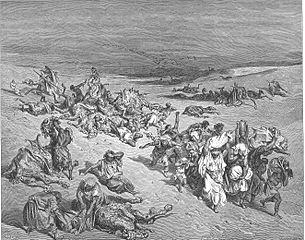 The Fifth Plague: Pestilence of livestock, by Gustave Doré
 -
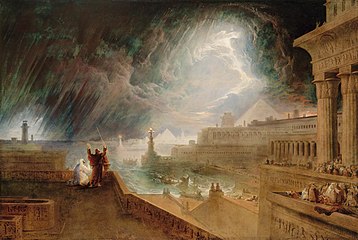 The Seventh Plague: John Martin (1823)
 -
 The Eighth Plague: "The Plague of Locusts", illustration from the 1890 Holman Bible
 -
 The Ninth Plague: Darkness by Gustave Doré

_-_Walters_W1065R_-_Full_Page.jpg)


See also
[edit]References
[edit]- ^ a b Greifenhagen, F.V. (2000). "Plagues of Egypt". In Freedman, David Noel; Myers, Allen C. (eds.). Eerdmans Dictionary of the Bible. Amsterdam University Press. p. 1062. ISBN 9789053565032.
- ^ a b c d e f g Tigay, Jeffrey H. (2004). "Exodus". In Berlin, Adele; Brettler, Marc Zvi (eds.). The Jewish Study Bible. Oxford University Press.
- ^ a b "08. The Meaning of the Ten Plagues – Peninei Halakha". Retrieved April 1, 2024.
- ^ Faust 2015, p. 476.
- ^ a b c Moore, Megan Bishop; Kelle, Brad E. (2011). Biblical History and Israel's Past. Eerdmans. ISBN 9780802862600.
- ^ a b Meyers, Carol (2005). Exodus. Cambridge University Press. ISBN 9780521002912.
- ^ Collins 2005, p. 45.
- ^ Davies 2020, p. 491–493.
- ^ Exodus 7:17–18
- ^ Exodus 8:1–4
- ^ Exodus 8:16–17
- ^ "The Ten Plagues". Chabad.org. Archived from the original on April 2, 2020. Retrieved April 8, 2020.
- ^ "Exodus 8 – LXX Bible". Bible Study Tools. Archived from the original on April 22, 2019. Retrieved April 22, 2019.
- ^ "Philo: On the Life of Moses, I". Early Jewish Writings. Archived from the original on April 18, 2019. Retrieved April 22, 2019.
- ^ "Beasts or Bugs?". The BAS Library. August 24, 2015. Archived from the original on April 22, 2019. Retrieved April 22, 2019.
- ^ Exodus 9:1–3
- ^ Exodus 9:8–9
- ^ Exodus 9:13–24
- ^ Exodus 10:3–6
- ^ Exodus 10:21–23
- ^ Exodus 11:4–6
- ^ Exodus 12:27
- ^ Römer, Thomas (2007). The so-called Deuteronomistic history : a sociological, historical, and literary introduction. London: T & T Clark. ISBN 978-0-567-03212-6. OCLC 80331961.
- ^ Rogerson, John W. (2003b). "Deuteronomy". In Dunn, James D. G.; Rogerson, John William (eds.). Eerdmans Commentary on the Bible. Eerdmans. p. 154. ISBN 9780802837110.
- ^ Van Seters, John (2015). The Pentateuch: A Social Science Commentary. Bloomsbury. p. 124. ISBN 9780567658807.
- ^ Davies 2020b, pp. 107–108.
- ^ Johnstone, William D. (2003). "Exodus". In Dunn, James D. G.; Rogerson, John William (eds.). Eerdmans Commentary on the Bible. Eerdmans. ISBN 9780802837110.
- ^ Faust 2015, p.476: "While there is a consensus among scholars that the Exodus did not take place in the manner described in the Bible, surprisingly most scholars agree that the narrative has a historical core, and that some of the highland settlers came, one way or another, from Egypt".
- ^ Faust 2015, pp. 472–473.
- ^ Willems 2010, p. 83.
- ^ Enmarch, Roland (2011). "The Reception of a Middle Egyptian Poem: The Dialogue of Ipuwer and the Lord of All". In Collier, M.; Snape, S. (eds.). Ramesside Studies in Honour of K. A. Kitchen (PDF). Rutherford. pp. 173–175. Archived from the original (PDF) on March 3, 2016. Retrieved October 1, 2017.
- ^ Leon, Donna (2011). Handel's Bestiary: In Search of Animals in Handel's Operas. Grove Press. ISBN 978-0802195616.
Further reading
[edit]- Collins, John J. (2005). The Bible After Babel: Historical Criticism in a Postmodern Age. Eerdmans. ISBN 9780802828927.
- Davies, Graham I. (2020). Exodus 1-18: A Critical and Exegetical Commentary: Volume 1: Chapters 1-10. International Critical Commentary. Bloomsbury Publishing. ISBN 978-0-567-68869-9.
- Davies, Graham I. (2020b). Exodus 1-18: A Critical and Exegetical Commentary: Volume 2: Chapters 11-18. International Critical Commentary. Bloomsbury Publishing. ISBN 978-0-567-68872-9.
- Faust, Avraham (2015). "The Emergence of Iron Age Israel: On Origins and Habitus". In Thomas E. Levy; Thomas Schneider; William H. C. Propp (eds.). Israel's Exodus in Transdisciplinary Perspective: Text, Archaeology, Culture, and Geoscience. Springer. ISBN 978-3-319-04768-3.
- Redmount, Carol A. (2001) [1998]. "Bitter Lives: Israel In And Out of Egypt". In Coogan, Michael D. (ed.). The Oxford History of the Biblical World. Oxford University Press. ISBN 9780199881482.
- Rendsburg, Gary A. (2015). "Moses the Magician". In Thomas E. Levy; Thomas Schneider; William H. C. Propp (eds.). Israel's Exodus in Transdisciplinary Perspective: Text, Archaeology, Culture, and Geoscience. Springer. ISBN 978-3-319-04768-3.
External links
[edit] Media related to Plagues of Egypt at Wikimedia Commons
- Kabbalah and the 10 Plagues (www.kabbalaonline.org)

