


Planck units

In particle physics and physical cosmology, Planck units are a system of units of measurement defined exclusively in terms of four universal physical constants: c, G, ħ, and kB (described further below). Expressing one of these physical constants in terms of Planck units yields a numerical value of 1. They are a system of natural units, defined using fundamental properties of nature (specifically, properties of free space) rather than properties of a chosen prototype object. Originally proposed in 1899 by German physicist Max Planck, they are relevant in research on unified theories such as quantum gravity.
The term Planck scale refers to quantities of space, time, energy and other units that are similar in magnitude to corresponding Planck units. This region may be characterized by particle energies of around 1019 GeV or 109 J, time intervals of around 5×10−44 s and lengths of around 10−35 m (approximately the energy-equivalent of the Planck mass, the Planck time and the Planck length, respectively). At the Planck scale, the predictions of the Standard Model, quantum field theory and general relativity are not expected to apply, and quantum effects of gravity are expected to dominate. One example is represented by the conditions in the first 10−43 seconds of our universe after the Big Bang, approximately 13.8 billion years ago.
The four universal constants that, by definition, have a numeric value 1 when expressed in these units are:
- c, the speed of light in vacuum,
- G, the gravitational constant,
- ħ, the reduced Planck constant, and
- kB, the Boltzmann constant.
Variants of the basic idea of Planck units exist, such as alternate choices of normalization that give other numeric values to one or more of the four constants above.
Introduction
Any system of measurement may be assigned a mutually independent set of base quantities and associated base units, from which all other quantities and units may be derived. In the International System of Units, for example, the SI base quantities include length with the associated unit of the metre. In the system of Planck units, a similar set of base quantities and associated units may be selected, in terms of which other quantities and coherent units may be expressed.[1][2]: 1215 The Planck unit of length has become known as the Planck length, and the Planck unit of time is known as the Planck time, but this nomenclature has not been established as extending to all quantities.
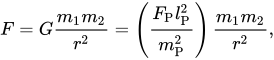
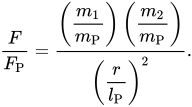
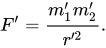
All Planck units are derived from the dimensional universal physical constants that define the system, and in a convention in which these units are omitted (i.e. treated as having the dimensionless value 1), these constants are then eliminated from equations of physics in which they appear. For example, Newton's law of universal gravitation, can be expressed as: Both equations are dimensionally consistent and equally valid in any system of quantities, but the second equation, with G absent, is relating only dimensionless quantities since any ratio of two like-dimensioned quantities is a dimensionless quantity. If, by a shorthand convention, it is understood that each physical quantity is the corresponding ratio with a coherent Planck unit (or "expressed in Planck units"), the ratios above may be expressed simply with the symbols of physical quantity, without being scaled explicitly by their corresponding unit: This last equation (without G) is valid with F′, m1′, m2′, and r′ being the dimensionless ratio quantities corresponding to the standard quantities, written e.g. F′ ≘ F or F′ = F/FP, but not as a direct equality of quantities. This may seem to be "setting the constants c, G, etc., to 1" if the correspondence of the quantities is thought of as equality. For this reason, Planck or other natural units should be employed with care. Referring to "G = c = 1", Paul S. Wesson wrote that, "Mathematically it is an acceptable trick which saves labour. Physically it represents a loss of information and can lead to confusion."[3]
History and definition

The concept of natural units was introduced in 1874, when George Johnstone Stoney, noting that electric charge is quantized, derived units of length, time, and mass, now named Stoney units in his honor. Stoney chose his units so that G, c, and the electron charge e would be numerically equal to 1.[4] In 1899, one year before the advent of quantum theory, Max Planck introduced what became later known as the Planck constant.[5][6] At the end of the paper, he proposed the base units that were later named in his honor. The Planck units are based on the quantum of action, now usually known as the Planck constant, which appeared in the Wien approximation for black-body radiation. Planck underlined the universality of the new unit system, writing:[5]
... die Möglichkeit gegeben ist, Einheiten für Länge, Masse, Zeit und Temperatur aufzustellen, welche, unabhängig von speciellen Körpern oder Substanzen, ihre Bedeutung für alle Zeiten und für alle, auch ausserirdische und aussermenschliche Culturen nothwendig behalten und welche daher als »natürliche Maasseinheiten« bezeichnet werden können.
... it is possible to set up units for length, mass, time and temperature, which are independent of special bodies or substances, necessarily retaining their meaning for all times and for all civilizations, including extraterrestrial and non-human ones, which can be called "natural units of measure".
Planck considered only the units based on the universal constants , , , and to arrive at natural units for length, time, mass, and temperature.[6] His definitions differ from the modern ones by a factor of , because the modern definitions use rather than .[5][6]


| Name | Dimension | Expression | Value (SI units) |
|---|---|---|---|
| Planck length | length (L) | 1.616255(18)×10−35 m[7] | |
| Planck mass | mass (M) | 2.176434(24)×10−8 kg[8] | |
| Planck time | time (T) | 5.391247(60)×10−44 s[9] | |
| Planck temperature | temperature (Θ) | 1.416784(16)×1032 K[10] |


Unlike the case with the International System of Units, there is no official entity that establishes a definition of a Planck unit system. Some authors define the base Planck units to be those of mass, length and time, regarding an additional unit for temperature to be redundant.[note 1] Other tabulations add, in addition to a unit for temperature, a unit for electric charge, so that either the Coulomb constant [12][13][14] or the vacuum permittivity [15] is normalized to 1. Thus, depending on the author's choice, this charge unit is given by for , or for . Some of these tabulations also replace mass with energy when doing so.[15] In SI units, the values of c, h, e and kB are exact and the values of ε0 and G in SI units respectively have relative uncertainties of 1.6×10⁻¹⁰[16] and 2.2×10⁻⁵.[17] Hence, the uncertainties in the SI values of the Planck units derive almost entirely from uncertainty in the SI value of G.






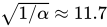
Compared to Stoney units, Planck base units are all larger by a factor , where is the fine-structure constant.[18]

Derived units
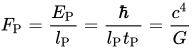
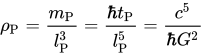
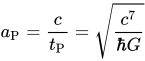
In any system of measurement, units for many physical quantities can be derived from base units. Table 2 offers a sample of derived Planck units, some of which are seldom used. As with the base units, their use is mostly confined to theoretical physics because most of them are too large or too small for empirical or practical use and there are large uncertainties in their values.
| Derived unit of | Expression | Approximate SI equivalent |
|---|---|---|
| area (L2) | 2.6121×10−70 m2 | |
| volume (L3) | 4.2217×10−105 m3 | |
| momentum (LMT−1) | 6.5249 kg⋅m/s | |
| energy (L2MT−2) | 1.9561×10⁹ J | |
| force (LMT−2) | 1.2103×1044 N | |
| density (L−3M) | 5.1550×1096 kg/m3 | |
| acceleration (LT−2) | 5.5608×1051 m/s2 |

Some Planck units, such as of time and length, are many orders of magnitude too large or too small to be of practical use, so that Planck units as a system are typically only relevant to theoretical physics. In some cases, a Planck unit may suggest a limit to a range of a physical quantity where present-day theories of physics apply.[19] For example, our understanding of the Big Bang does not extend to the Planck epoch, i.e., when the universe was less than one Planck time old. Describing the universe during the Planck epoch requires a theory of quantum gravity that would incorporate quantum effects into general relativity. Such a theory does not yet exist.
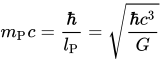
Several quantities are not "extreme" in magnitude, such as the Planck mass, which is about 22 micrograms: very large in comparison with subatomic particles, and within the mass range of living organisms.[20]: 872 Similarly, the related units of energy and of momentum are in the range of some everyday phenomena.
Significance
Planck units have little anthropocentric arbitrariness, but do still involve some arbitrary choices in terms of the defining constants. Unlike the metre and second, which exist as base units in the SI system for historical reasons, the Planck length and Planck time are conceptually linked at a fundamental physical level. Consequently, natural units help physicists to reframe questions. Frank Wilczek puts it succinctly:
We see that the question [posed] is not, "Why is gravity so feeble?" but rather, "Why is the proton's mass so small?" For in natural (Planck) units, the strength of gravity simply is what it is, a primary quantity, while the proton's mass is the tiny number 1/13 quintillion.[21]
While it is true that the electrostatic repulsive force between two protons (alone in free space) greatly exceeds the gravitational attractive force between the same two protons, this is not about the relative strengths of the two fundamental forces. From the point of view of Planck units, this is comparing apples with oranges, because mass and electric charge are incommensurable quantities. Rather, the disparity of magnitude of force is a manifestation of that the proton charge is approximately the unit charge but the proton mass is far less than the unit mass in a system that treats both forces as having the same form.
When Planck proposed his units, the goal was only that of establishing a universal ("natural") way of measuring objects, without giving any special meaning to quantities that measured one single unit. In 1918, Arthur Eddington suggested that the Planck length could have a special significance for understanding gravitation, but this suggestion was not influential.[22][23] During the 1950s, multiple authors including Lev Landau and Oskar Klein argued that quantities on the order of the Planck scale indicated the limits of the validity of quantum field theory. John Archibald Wheeler proposed in 1955 that quantum fluctuations of spacetime become significant at the Planck scale, though at the time he was unaware of Planck's unit system.[22][24] In 1959, C. A. Mead showed that distances that measured of the order of one Planck length, or, similarly, times that measured of the order of Planck time, did carry special implications related to Heisenberg's uncertainty principle:[25]
An analysis of the effect of gravitation on hypothetical experiments indicates that it is impossible to measure the position of a particle with error less than 𝛥𝑥 ≳ √𝐺 = 1.6 × 10⁻³³ cm, where 𝐺 is the gravitational constant in natural units. A similar limitation applies to the precise synchronization of clocks.
Planck scale
In particle physics and physical cosmology, the Planck scale is an energy scale around 1.22×1028 eV (the Planck energy, corresponding to the energy equivalent of the Planck mass, 2.17645×10⁻⁸ kg) at which quantum effects of gravity become significant. At this scale, present descriptions and theories of sub-atomic particle interactions in terms of quantum field theory break down and become inadequate, due to the impact of the apparent non-renormalizability of gravity within current theories.[19]
Relationship to gravity
At the Planck length scale, the strength of gravity is expected to become comparable with the other forces, and it has been theorized that all the fundamental forces are unified at that scale, but the exact mechanism of this unification remains unknown.[26] The Planck scale is therefore the point at which the effects of quantum gravity can no longer be ignored in other fundamental interactions, where current calculations and approaches begin to break down, and a means to take account of its impact is necessary.[27] On these grounds, it has been speculated that it may be an approximate lower limit at which a black hole could be formed by collapse.[28]
While physicists have a fairly good understanding of the other fundamental interactions of forces on the quantum level, gravity is problematic, and cannot be integrated with quantum mechanics at very high energies using the usual framework of quantum field theory. At lesser energy levels it is usually ignored, while for energies approaching or exceeding the Planck scale, a new theory of quantum gravity is necessary. Approaches to this problem include string theory and M-theory, loop quantum gravity, noncommutative geometry, and causal set theory.[29]
In cosmology
In Big Bang cosmology, the Planck epoch or Planck era is the earliest stage of the Big Bang, before the time passed was equal to the Planck time, tP, or approximately 10−43 seconds.[30] There is no currently available physical theory to describe such short times, and it is not clear in what sense the concept of time is meaningful for values smaller than the Planck time. It is generally assumed that quantum effects of gravity dominate physical interactions at this time scale. At this scale, the unified force of the Standard Model is assumed to be unified with gravitation. Immeasurably hot and dense, the state of the Planck epoch was succeeded by the grand unification epoch, where gravitation is separated from the unified force of the Standard Model, in turn followed by the inflationary epoch, which ended after about 10−32 seconds (or about 1011 tP).[31]
Table 3 lists properties of the observable universe today expressed in Planck units.[32][33]
| Property of present-day observable universe |
Approximate number of Planck units |
Equivalents |
|---|---|---|
| Age | 8.08 × 1060 tP | 4.35 × 10¹⁷ s or 1.38 × 10¹⁰ years |
| Diameter | 5.4 × 1061 lP | 8.7 × 1026 m or 9.2 × 10¹⁰ light-years |
| Mass | approx. 1060 mP | 3 × 1052 kg or 1.5 × 10²² solar masses (only counting stars) 1080 protons (sometimes known as the Eddington number) |
| Density | 1.8 × 10−123 mP⋅lP−3 | 9.9 × 10⁻²⁷ kg⋅m−3 |
| Temperature | 1.9 × 10⁻³² TP | 2.725 K temperature of the cosmic microwave background radiation |
| Cosmological constant | ≈ 10−122 l −2 P |
≈ 10−52 m−2 |
| Hubble constant | ≈ 10−61 t −1 P |
≈ 10−18 s−1 ≈ 102 (km/s)/Mpc |
After the measurement of the cosmological constant (Λ) in 1998, estimated at 10−122 in Planck units, it was noted that this is suggestively close to the reciprocal of the age of the universe (T) squared. Barrow and Shaw proposed a modified theory in which Λ is a field evolving in such a way that its value remains Λ ~ T−2 throughout the history of the universe.[34]
Analysis of the units
Planck length
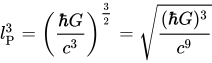
The Planck length, denoted ℓP, is a unit of length defined as:It is equal to 1.616255(18)×10−35 m[7] (the two digits enclosed by parentheses are the estimated standard error associated with the reported numerical value) or about 10−20 times the diameter of a proton.[35] It can be motivated in various ways, such as considering a particle whose reduced Compton wavelength is comparable to its Schwarzschild radius,[35][36][37] though whether those concepts are in fact simultaneously applicable is open to debate.[38] (The same heuristic argument simultaneously motivates the Planck mass.[36])

The Planck length is a distance scale of interest in speculations about quantum gravity. The Bekenstein–Hawking entropy of a black hole is one-fourth the area of its event horizon in units of Planck length squared.[11]: 370 Since the 1950s, it has been conjectured that quantum fluctuations of the spacetime metric might make the familiar notion of distance inapplicable below the Planck length.[24][39][22] This is sometimes expressed by saying that "spacetime becomes a foam at the Planck scale".[40] It is possible that the Planck length is the shortest physically measurable distance, since any attempt to investigate the possible existence of shorter distances, by performing higher-energy collisions, would result in black hole production. Higher-energy collisions, rather than splitting matter into finer pieces, would simply produce bigger black holes.[41]
The strings of string theory are modeled to be on the order of the Planck length.[42][43] In theories with large extra dimensions, the Planck length calculated from the observed value of can be smaller than the true, fundamental Planck length.[11]: 61 [44]
Planck time
The Planck time, denoted tP, is defined as: This is the time required for light to travel a distance of 1 Planck length in vacuum, which is a time interval of approximately 5.39×10−44 s. No current physical theory can describe timescales shorter than the Planck time, such as the earliest events after the Big Bang.[30] Some conjectures state that the structure of time need not remain smooth on intervals comparable to the Planck time.[45]

Planck energy
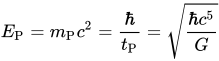
The Planck energy EP is approximately equal to the energy released in the combustion of the fuel in an automobile fuel tank (57.2 L at 34.2 MJ/L of chemical energy). The ultra-high-energy cosmic ray observed in 1991 had a measured energy of about 50 J, equivalent to about 2.5×10⁻⁸ EP.[46][47]
Proposals for theories of doubly special relativity posit that, in addition to the speed of light, an energy scale is also invariant for all inertial observers. Typically, this energy scale is chosen to be the Planck energy.[48][49]
Planck unit of force
The Planck unit of force may be thought of as the derived unit of force in the Planck system if the Planck units of time, length, and mass are considered to be base units.It is the gravitational attractive force of two bodies of 1 Planck mass each that are held 1 Planck length apart. One convention for the Planck charge is to choose it so that the electrostatic repulsion of two objects with Planck charge and mass that are held 1 Planck length apart balances the Newtonian attraction between them.[50]

Some authors have argued that the Planck force is on the order of the maximum force that can occur between two bodies.[51][52] However, the validity of these conjectures has been disputed.[53][54]
Planck temperature
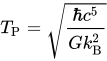
The Planck temperature TP is 1.416784(16)×1032 K.[10] At this temperature, the wavelength of light emitted by thermal radiation reaches the Planck length. There are no known physical models able to describe temperatures greater than TP; a quantum theory of gravity would be required to model the extreme energies attained.[55] Hypothetically, a system in thermal equilibrium at the Planck temperature might contain Planck-scale black holes, constantly being formed from thermal radiation and decaying via Hawking evaporation. Adding energy to such a system might decrease its temperature by creating larger black holes, whose Hawking temperature is lower.[56]
Nondimensionalized equations
Physical quantities that have different dimensions (such as time and length) cannot be equated even if they are numerically equal (e.g., 1 second is not the same as 1 metre). In theoretical physics, however, this scruple may be set aside, by a process called nondimensionalization. The effective result is that many fundamental equations of physics, which often include some of the constants used to define Planck units, become equations where these constants are replaced by a 1.
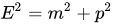
Examples include the energy–momentum relation (which becomes ) and the Dirac equation (which becomes ).



Alternative choices of normalization
As already stated above, Planck units are derived by "normalizing" the numerical values of certain fundamental constants to 1. These normalizations are neither the only ones possible nor necessarily the best. Moreover, the choice of what factors to normalize, among the factors appearing in the fundamental equations of physics, is not evident, and the values of the Planck units are sensitive to this choice.
The factor 4π is ubiquitous in theoretical physics because in three-dimensional space, the surface area of a sphere of radius r is 4πr2. This, along with the concept of flux, are the basis for the inverse-square law, Gauss's law, and the divergence operator applied to flux density. For example, gravitational and electrostatic fields produced by point objects have spherical symmetry, and so the electric flux through a sphere of radius r around a point charge will be distributed uniformly over that sphere. From this, it follows that a factor of 4πr2 will appear in the denominator of Coulomb's law in rationalized form.[32]: 214–15 (Both the numerical factor and the power of the dependence on r would change if space were higher-dimensional; the correct expressions can be deduced from the geometry of higher-dimensional spheres.[11]: 51 ) Likewise for Newton's law of universal gravitation: a factor of 4π naturally appears in Poisson's equation when relating the gravitational potential to the distribution of matter.[11]: 56
Hence a substantial body of physical theory developed since Planck's 1899 paper suggests normalizing not G but 4πG (or 8πG) to 1. Doing so would introduce a factor of 1/4π (or 1/8π) into the nondimensionalized form of the law of universal gravitation, consistent with the modern rationalized formulation of Coulomb's law in terms of the vacuum permittivity. In fact, alternative normalizations frequently preserve the factor of 1/4π in the nondimensionalized form of Coulomb's law as well, so that the nondimensionalized Maxwell's equations for electromagnetism and gravitoelectromagnetism both take the same form as those for electromagnetism in SI, which do not have any factors of 4π. When this is applied to electromagnetic constants, ε0, this unit system is called "rationalized". When applied additionally to gravitation and Planck units, these are called rationalized Planck units[57] and are seen in high-energy physics.[58]
The rationalized Planck units are defined so that c = 4πG = ħ = ε0 = kB = 1.
There are several possible alternative normalizations.
Gravitational constant
In 1899, Newton's law of universal gravitation was still seen as exact, rather than as a convenient approximation holding for "small" velocities and masses (the approximate nature of Newton's law was shown following the development of general relativity in 1915). Hence Planck normalized to 1 the gravitational constant G in Newton's law. In theories emerging after 1899, G nearly always appears in formulae multiplied by 4π or a small integer multiple thereof. Hence, a choice to be made when designing a system of natural units is which, if any, instances of 4π appearing in the equations of physics are to be eliminated via the normalization.
- Normalizing 4πG to 1 (and therefore setting G = 1/4π):
- Gauss's law for gravity becomes Φg = −M (rather than Φg = −4πM in Planck units).
- Eliminates 4πG from the Poisson equation.
- Eliminates 4πG in the gravitoelectromagnetic (GEM) equations, which hold in weak gravitational fields or locally flat spacetime. These equations have the same form as Maxwell's equations (and the Lorentz force equation) of electromagnetism, with mass density replacing charge density, and with 1/4πG replacing ε0.
- Normalizes the characteristic impedance Zg of gravitational radiation in free space to 1 (normally expressed as 4πG/c).[note 2]
- Eliminates 4πG from the Bekenstein–Hawking formula (for the entropy of a black hole in terms of its mass mBH and the area of its event horizon ABH) which is simplified to SBH = πABH = (mBH)2.
- Setting 8πG = 1 (and therefore setting G = 1/8π). This would eliminate 8πG from the Einstein field equations, Einstein–Hilbert action, and the Friedmann equations, for gravitation. Planck units modified so that 8πG = 1 are known as reduced Planck units, because the Planck mass is divided by √8π. Also, the Bekenstein–Hawking formula for the entropy of a black hole simplifies to SBH = (mBH)2/2 = 2πABH.
See also
- cGh physics
- Dimensional analysis
- Doubly special relativity
- Trans-Planckian problem
- Zero-point energy
Explanatory notes
- ^ For example, both Frank Wilczek and Barton Zwiebach do so,[1][11]: 54 as does the textbook Gravitation.[2]: 1215
- ^ General relativity predicts that gravitational radiation propagates at the same speed as electromagnetic radiation.[59]: 60 [60]: 158
References
- ^ a b Wilczek, Frank (2005). "On Absolute Units, I: Choices". Physics Today. 58 (10). American Institute of Physics: 12–13. Bibcode:2005PhT....58j..12W. doi:10.1063/1.2138392.
- ^ a b Misner, Charles W.; Thorne, Kip S.; Wheeler, John A. (1973). Gravitation. New York. ISBN 0-7167-0334-3. OCLC 585119.
{{cite book}}: CS1 maint: location missing publisher (link) - ^ Wesson, P. S. (1980). "The application of dimensional analysis to cosmology". Space Science Reviews. 27 (2): 117. Bibcode:1980SSRv...27..109W. doi:10.1007/bf00212237. S2CID 120784299.
- ^ Barrow, J. D. (1 March 1983). "Natural Units Before Planck". Quarterly Journal of the Royal Astronomical Society. 24: 24. Bibcode:1983QJRAS..24...24B. ISSN 0035-8738. Archived from the original on 20 January 2022. Retrieved 16 April 2022.
- ^ a b c Planck, Max (1899). "Über irreversible Strahlungsvorgänge". Sitzungsberichte der Königlich Preußischen Akademie der Wissenschaften zu Berlin (in German). 5: 440–480. Archived from the original on 17 November 2020. Retrieved 23 May 2020. pp. 478–80 contain the first appearance of the Planck base units, and of the Planck constant, which Planck denoted by b. a and f in this paper correspond to the k and G in this article.
- ^ a b c Tomilin, K. A. (1999). Natural Systems of Units. To the Centenary Anniversary of the Planck System (PDF). Proceedings Of The XXII Workshop On High Energy Physics And Field Theory. pp. 287–296. Archived from the original (PDF) on 12 December 2020. Retrieved 31 December 2019.
- ^ a b "2022 CODATA Value: Planck length". The NIST Reference on Constants, Units, and Uncertainty. NIST. May 2024. Retrieved 18 May 2024.
- ^ "2022 CODATA Value: Planck mass". The NIST Reference on Constants, Units, and Uncertainty. NIST. May 2024. Retrieved 18 May 2024.
- ^ "2022 CODATA Value: Planck time". The NIST Reference on Constants, Units, and Uncertainty. NIST. May 2024. Retrieved 18 May 2024.
- ^ a b "2022 CODATA Value: Planck temperature". The NIST Reference on Constants, Units, and Uncertainty. NIST. May 2024. Retrieved 18 May 2024.
- ^ a b c d e Zwiebach, Barton (2004). A First Course in String Theory. Cambridge University Press. ISBN 978-0-521-83143-7. OCLC 58568857.
- ^ Deza, Michel Marie; Deza, Elena (2016). Encyclopedia of Distances. Springer. p. 602. ISBN 978-3662528433. Archived from the original on 6 March 2021. Retrieved 9 September 2020.
- ^ Elert, Glenn. "Blackbody Radiation". The Physics Hypertextbook. Archived from the original on 3 March 2021. Retrieved 22 February 2021.
- ^ Pavšic, Matej (2001). The Landscape of Theoretical Physics: A Global View. Fundamental Theories of Physics. Vol. 119. Dordrecht: Kluwer Academic. pp. 347–352. arXiv:gr-qc/0610061. doi:10.1007/0-306-47136-1. ISBN 978-0-7923-7006-2. Archived from the original on 5 September 2021. Retrieved 31 December 2019.
- ^ a b Zeidler, Eberhard (2006). Quantum Field Theory I: Basics in Mathematics and Physics (PDF). Springer. p. 953. ISBN 978-3540347620. Archived (PDF) from the original on 19 June 2020. Retrieved 31 May 2020.
- ^ "2022 CODATA Value: vacuum electric permittivity". The NIST Reference on Constants, Units, and Uncertainty. NIST. May 2024. Retrieved 18 May 2024.
- ^ "2022 CODATA Value: Newtonian constant of gravitation". The NIST Reference on Constants, Units, and Uncertainty. NIST. May 2024. Retrieved 18 May 2024.
- ^ Ray, T. P. (1981). "Stoney's Fundamental Units". Irish Astronomical Journal. 15: 152. Bibcode:1981IrAJ...15..152R.
- ^ a b Zee, Anthony (2010). Quantum Field Theory in a Nutshell (second ed.). Princeton University Press. pp. 172, 434–435. ISBN 978-0-691-14034-6. OCLC 659549695.
Just as in our discussion of the Fermi theory, the nonrenormalizability of quantum gravity tells us that at the Planck energy scale ... new physics must appear. Fermi's theory cried out, and the new physics turned out to be the electroweak theory. Einstein's theory is now crying out.
- ^ Penrose, Roger (2005). The Road to Reality. New York: Alfred A. Knopf. ISBN 978-0-679-45443-4.
- ^ Wilczek, Frank (2001). "Scaling Mount Planck I: A View from the Bottom". Physics Today. 54 (6): 12–13. Bibcode:2001PhT....54f..12W. doi:10.1063/1.1387576.
- ^ a b c Gorelik, Gennady (1992). "First Steps of Quantum Gravity and the Planck Values". In Eisenstaedt, Jean; Kox, Anne J. (eds.). Studies in the History of General Relativity: Based on the proceedings of the 2nd International Conference on the History of General Relativity, Luminy, France, 1988. Boston: Birkhäuser. pp. 364–379. ISBN 0-8176-3479-7. OCLC 24011430. Archived from the original on 25 April 2019.
- ^ Stachel, John (1986). "Eddington and Einstein". In Ullmann-Margalit, Edna (ed.). The Prism of Science. Boston Studies in the Philosophy of Science. Vol. 95. Springer. pp. 225–250. doi:10.1007/978-94-009-4566-1_18. ISBN 978-90-277-2161-7.
- ^ a b Wheeler, J. A. (January 1955). "Geons". Physical Review. 97 (2): 511–536. Bibcode:1955PhRv...97..511W. doi:10.1103/PhysRev.97.511.
- ^ Mead, Chester Alden (10 August 1964). "Possible Connection Between Gravitation and Fundamental Length". Physical Review. 135 (3B). American Physical Society: B849–B862. Bibcode:1964PhRv..135..849M. doi:10.1103/PhysRev.135.B849.
- ^ Witten, Ed (2002). "Quest For Unification". arXiv:hep-ph/0207124.
- ^ Bingham, Robert (4 October 2006). "Can experiment access Planck-scale physics?". CERN Courier. Archived from the original on 30 November 2020. Retrieved 4 November 2021.
- ^ Hawking, Stephen W. (1975). "Particle Creation by Black Holes". Communications in Mathematical Physics. 43 (3): 199–220. Bibcode:1975CMaPh..43..199H. doi:10.1007/BF02345020. S2CID 55539246. Archived from the original on 5 July 2014. Retrieved 20 March 2022.
- ^ Rovelli, Carlo (2008). "Quantum gravity". Scholarpedia. 3 (5): 7117. Bibcode:2008SchpJ...3.7117R. doi:10.4249/scholarpedia.7117.
- ^ a b Schombert, James. "Birth of the Universe". HC 441: Cosmology. University of Oregon. Archived from the original on 28 November 2018. Retrieved 20 March 2022. Discusses "Planck time" and "Planck era" at the very beginning of the Universe
- ^ Kolb, Edward W.; Turner, Michael S. (1994). The Early Universe. Basic Books. p. 447. ISBN 978-0-201-62674-2. Archived from the original on 6 March 2021. Retrieved 10 April 2010.
- ^ a b Barrow, John D. (2002). The Constants of Nature: From Alpha to Omega – The Numbers that Encode the Deepest Secrets of the Universe. Pantheon Books. ISBN 0-375-42221-8.
- ^ Barrow, John D.; Tipler, Frank J. (1986). The Anthropic Cosmological Principle (1st ed.). Oxford University Press. ISBN 978-0-19-282147-8. LCCN 87028148.
- ^ Barrow, John D.; Shaw, Douglas J. (2011). "The value of the cosmological constant". General Relativity and Gravitation. 43 (10): 2555–2560. arXiv:1105.3105. Bibcode:2011GReGr..43.2555B. doi:10.1007/s10714-011-1199-1. S2CID 55125081.
- ^ a b Baez, John (2001). "Higher-Dimensional Algebra and Planck-Scale Physics". In Callender, Craig; Huggett, Nick (eds.). Physics Meets Philosophy at the Planck Scale. Cambridge University Press. pp. 172–195. ISBN 978-0-521-66280-2. OCLC 924701824. Archived from the original on 8 July 2021. Retrieved 20 March 2022.
- ^ a b Adler, Ronald J. (2010). "Six easy roads to the Planck scale". American Journal of Physics. 78 (9): 925–932. arXiv:1001.1205. Bibcode:2010AmJPh..78..925A. doi:10.1119/1.3439650. S2CID 55181581.
- ^ Siegel, Ethan (26 June 2019). "What Is The Smallest Possible Distance In The Universe?". Starts with a Bang. Forbes. Archived from the original on 18 September 2021. Retrieved 26 June 2019.
- ^ Faraoni, Valerio (November 2017). "Three new roads to the Planck scale". American Journal of Physics. 85 (11): 865–869. arXiv:1705.09749. Bibcode:2017AmJPh..85..865F. doi:10.1119/1.4994804. ISSN 0002-9505. S2CID 119022491. Archived from the original on 30 December 2017. Retrieved 9 April 2022.
Like all orders of magnitude estimates, this procedure is not rigorous since it extrapolates the concepts of black hole and of Compton wavelength to a new regime in which both concepts would probably lose their accepted meanings and would, strictly speaking, cease being valid. However, this is how one gains intuition into a new physical regime.
- ^ Regge, T. (1 January 1958). "Gravitational fields and quantum mechanics". Il Nuovo Cimento. 7 (2): 215–221. Bibcode:1958NCim....7..215R. doi:10.1007/BF02744199. ISSN 1827-6121. S2CID 123012079. Archived from the original on 24 March 2022. Retrieved 22 March 2022.
- ^ Mermin, N. David (May 2009). "What's bad about this habit". Physics Today. 62 (5): 8–9. Bibcode:2009PhT....62e...8M. doi:10.1063/1.3141952. ISSN 0031-9228. Archived from the original on 22 March 2022. Retrieved 22 March 2022.
- ^ Carr, Bernard J.; Giddings, Steven B. (May 2005). "Quantum Black Holes" (PDF). Scientific American. 292 (5): 48–55. Bibcode:2005SciAm.292e..48C. doi:10.1038/scientificamerican0505-48. PMID 15882021. S2CID 10872062. Archived from the original (PDF) on 14 February 2019.
- ^ Manoukian, Edouard B. (2016). Quantum Field Theory II: Introductions to Quantum Gravity, Supersymmetry and String Theory. Graduate Texts in Physics. Cham: Springer International Publishing. p. 187. doi:10.1007/978-3-319-33852-1. ISBN 978-3-319-33851-4. Archived from the original on 24 March 2022. Retrieved 22 March 2022.
- ^ Schwarz, John H. (December 2021). "From the S Matrix to String Theory". Geoffrey Chew: Architect of the Bootstrap. World Scientific. pp. 72–83. doi:10.1142/9789811219832_0013. ISBN 978-981-12-1982-5. S2CID 245575026.
- ^ Hossenfelder, Sabine (December 2013). "Minimal Length Scale Scenarios for Quantum Gravity". Living Reviews in Relativity. 16 (1): 2. arXiv:1203.6191. Bibcode:2013LRR....16....2H. doi:10.12942/lrr-2013-2. ISSN 2367-3613. PMC 5255898. PMID 28179841.
- ^ Wendel, Garrett; Martínez, Luis; Bojowald, Martin (19 June 2020). "Physical Implications of a Fundamental Period of Time". Physical Review Letters. 124 (24): 241301. arXiv:2005.11572. Bibcode:2020PhRvL.124x1301W. doi:10.1103/PhysRevLett.124.241301. PMID 32639827. S2CID 218870394.
- ^ "HiRes – The High Resolution Fly's Eye Ultra High Energy Cosmic Ray Observatory". www.cosmic-ray.org. Archived from the original on 15 August 2009. Retrieved 21 December 2016.
- ^ Bird, D. J.; Corbato, S. C.; Dai, H. Y.; Elbert, J. W.; Green, K. D.; Huang, M. A.; Kieda, D. B.; Ko, S.; Larsen, C. G.; Loh, E. C.; Luo, M. Z.; Salamon, M. H.; Smith, J. D.; Sokolsky, P.; Sommers, P.; Tang, J. K. K.; Thomas, S. B. (March 1995). "Detection of a cosmic ray with measured energy well beyond the expected spectral cutoff due to cosmic microwave radiation". The Astrophysical Journal. 441: 144. arXiv:astro-ph/9410067. Bibcode:1995ApJ...441..144B. doi:10.1086/175344. S2CID 119092012.
- ^ Judes, Simon; Visser, Matt (4 August 2003). "Conservation laws in "doubly special relativity"". Physical Review D. 68 (4): 045001. arXiv:gr-qc/0205067. Bibcode:2003PhRvD..68d5001J. doi:10.1103/PhysRevD.68.045001. ISSN 0556-2821. S2CID 119094398.
- ^ Hossenfelder, Sabine (9 July 2014). "The Soccer-Ball Problem". Symmetry, Integrability and Geometry: Methods and Applications. 10: 74. arXiv:1403.2080. Bibcode:2014SIGMA..10..074H. doi:10.3842/SIGMA.2014.074. S2CID 14373748. Archived from the original on 19 March 2022. Retrieved 16 April 2022.
- ^ Kiefer, Claus (2012). Quantum Gravity. International series of monographs on physics. Vol. 155. Oxford University Press. p. 5. ISBN 978-0-191-62885-6. OCLC 785233016.
- ^ de Sabbata, Venzo; Sivaram, C. (1993). "On limiting field strengths in gravitation". Foundations of Physics Letters. 6 (6): 561–570. Bibcode:1993FoPhL...6..561D. doi:10.1007/BF00662806. S2CID 120924238.
- ^ Gibbons, G. W. (2002). "The Maximum Tension Principle in General Relativity". Foundations of Physics. 32 (12): 1891–1901. arXiv:hep-th/0210109. Bibcode:2002FoPh...32.1891G. doi:10.1023/A:1022370717626. S2CID 118154613.
- ^ Jowsey, Aden; Visser, Matt (3 February 2021). "Counterexamples to the maximum force conjecture". Universe. 7 (11): 403. arXiv:2102.01831. Bibcode:2021Univ....7..403J. doi:10.3390/universe7110403.
- ^ Afshordi, Niayesh (1 March 2012). "Where will Einstein fail? Leasing for Gravity and cosmology". Bulletin of the Astronomical Society of India. 40 (1). Astronomical Society of India, NASA Astrophysics Data System: 5. arXiv:1203.3827. Bibcode:2012BASI...40....1A. OCLC 810438317.
However, for most experimental physicists, approaching energies comparable to Planck energy is little more than a distant fantasy. The most powerful accelerators on Earth miss Planck energy of 15 orders of magnitude, while ultra high energy cosmic rays are still 9 orders of magnitude short of Mp.
- ^
Reeves, Hubert (1991). The Hour of Our Delight. W. H. Freeman Company. p. 117. ISBN 978-0-7167-2220-5.
The point at which our physical theories run into most serious difficulties is that where matter reaches a temperature of approximately 1032 degrees, also known as Planck's temperature. The extreme density of radiation emitted at this temperature creates a disproportionately intense field of gravity. To go even farther back, a quantum theory of gravity would be necessary, but such a theory has yet to be written.
- ^ Shor, Peter W. (17 July 2018). "Scrambling Time and Causal Structure of the Photon Sphere of a Schwarzschild Black Hole". arXiv:1807.04363 [gr-qc].
- ^ Sorkin, Rafael (1983). "Kaluza-Klein Monopole". Phys. Rev. Lett. 51 (2): 87–90. Bibcode:1983PhRvL..51...87S. doi:10.1103/PhysRevLett.51.87.
- ^ Rañada, Antonio F. (31 October 1995). "A Model of Topological Quantization of the Electromagnetic Field". In M. Ferrero; Alwyn van der Merwe (eds.). Fundamental Problems in Quantum Physics. Springer. p. 271. ISBN 9780792336709. Archived from the original on 1 September 2020. Retrieved 16 January 2018.
- ^ Choquet-Bruhat, Yvonne (2009). General Relativity and the Einstein Equations. Oxford: Oxford University Press. ISBN 978-0-19-155226-7. OCLC 317496332.
- ^ Stavrov, Iva (2020). Curvature of Space and Time, with an Introduction to Geometric Analysis. Providence, Rhode Island: American Mathematical Society. ISBN 978-1-4704-6313-7. OCLC 1202475208.
External links
- Value of the fundamental constants, including the Planck units, as reported by the National Institute of Standards and Technology (NIST).
- The Planck scale: relativity meets quantum mechanics meets gravity from 'Einstein Light' at UNSW
| Central concepts | |||||||||
|---|---|---|---|---|---|---|---|---|---|
| Toy models | |||||||||
| Quantum field theory in curved spacetime | |||||||||
| Black holes | |||||||||
| Approaches |
| ||||||||
| Applications | |||||||||
See also:  Template:Quantum mechanics topics Template:Quantum mechanics topics | |||||||||

