


Thespesia populnea
| Portia tree | |
|---|---|

| |

| |
Scientific classification 
| |
| Kingdom: | Plantae |
| Clade: | Tracheophytes |
| Clade: | Angiosperms |
| Clade: | Eudicots |
| Clade: | Rosids |
| Order: | Malvales |
| Family: | Malvaceae |
| Genus: | Thespesia |
| Species: | T. populnea
|
| Binomial name | |
| Thespesia populnea | |
| Synonyms | |
| |
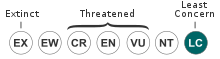
Thespesia populnea, commonly known as the portia tree (/ˈpɔːrʃə/),[4] Pacific rosewood,[5] Indian tulip tree, or milo,[6] among other names, is a species of flowering plant belonging to the mallow family, Malvaceae. It is a tree found commonly on coasts around the world.[7] Although it is confirmed to be native only to the Old World tropics, other authorities consider it to have a wider, possibly pantropical native distribution.[1] It is thought to be an invasive species in Florida and Brazil.[8][9]
Distribution[edit]
Thespesia populnea is native to tropical coastlines and is adapted for oceanic dispersal and growth in island environments. It is known from both coasts of Africa, tropical Asia, northern Australia, the Pacific Islands (including Hawaii), the tropical Pacific coast of the Americas from Mexico south to Colombia, the West Indies, and Florida in the United States. Its exact native distribution has been debated, with most authorities considering it to only be native to the Old World tropics,[10] some others such as Plants of the World Online including the Pacific Islands in its native range,[11][12] and others such as the IUCN Red List and the USDA also including the tropical Americas within its native range. The IUCN only considers T. populnea to be introduced and invasive in Florida.[1][13] It may also be invasive in northern Brazil.[9]
Like the related Hibiscus tiliaceus, it was one of the main sources of bast fibers for the production of cordage and wood for Austronesian outrigger ships and carving. Though the plant seeds can survive for months on sea currents, no remains of T. populnea have been recovered from Polynesia prior to the Austronesian expansion (c. 5,000 BP), thus it is regarded by some authors as a canoe plant, deliberately carried and introduced by Austronesian voyagers in the islands they settled.[14][15] However, it is still considered questionably indigenous to the Pacific islands, including Hawaii, by many other authorities.[1][11][12][16] In Hawaii, it is classified as a native species and is used in habitat restoration projects for the degraded Hawaiian tropical dry forests alongside the definitively native tree species Dodonaea viscosa and Cordia subcordata.[17][18][19]
Description[edit]

The Portia tree reaches a height of 6–10 m (20–33 ft) tall and its trunk can measure up to 20–30 cm (7.9–11.8 in) in diameter.[20] It grows at elevations from sea level to 275 m (902 ft)[21] in areas that receive 500–1,600 mm (20–63 in) of annual rainfall.[10] The Portia tree is able to grow in the wide range of soil types that may be present in coastal environments, including soils derived from quartz (sand), limestone, and basalt; it favours neutral soils (pH of 6–7.4).[20] Pollen grains are approximately 70 microns in diameter.
Uses[edit]
The heartwood of the Portia tree is dark reddish brown to chocolate brown and has a specific gravity of 0.55 to 0.89.[10]
Portia tree is known as milo or miro in Polynesian languages.[6] It is popular in Hawaii for woodworking (commonly turned into bowls)[22] because of the range of colours expressed (tan, through yellow, to red). The trees were regarded as sacred in Polynesian culture, and were commonly planted in marae sites along with trees like Ficus, Fagraea berteroana, Casuarina equisetifolia and Calophyllum inophyllum.[14][15] Traditionally it was planted in sacred groves and used for religious sculpture throughout eastern Polynesia. In Tahiti, Milo wood is used in the making of the to'ere (slotted wooden drum), used in traditional Tahitian tribal drumming. Makoʻi was used for the rongorongo tablets of Easter Island.[23] Since the advent of aluminium-hulled boats in the 20th century, Pitcairners have made regular trips to Henderson Island to harvest miro wood. Usually they venture to Henderson only once per year, but may make up to three trips if the weather is favourable. Pitcairners carve the wood into curios, from which they derive much of their income.[24]
In New Ireland, Portia wood is used to make hourglass drums. In Tonga, its bark is used to treat mouth infections among infants, and its wood is used to make canoes, house parts, and artwork.[25]
In Indonesia they are known as baru laut, baru pantai or waru lot. The Ambonese cook the leaves into a dish with vegetables.[26]
In South Asia, it is used to make the thavil, a Carnatic musical instrument of South India. The flower of the Portia tree played a part in Sri Lanka's independence movement, when it was sold on Remembrance Day by the Suriya-Mal Movement instead of the poppy to aid Sri Lankan ex-servicemen. The wood from the tree was used by early Tamil people to make instruments in ancient Tamilakam.[27] It can be used for the cellulose production from the plants [Singh et al. 2019].
In some parts of the world, such as Hawaii and southern India, T. populnea is considered an important species in habitat restoration projects for coastal dry forests.[17][19][28]
See also[edit]
References[edit]
- ^ a b c d Rivers, M.C.; Mark, J. (2017). "Thespesia populnea". IUCN Red List of Threatened Species. 2017: e.T61788175A61788179. doi:10.2305/IUCN.UK.2017-3.RLTS.T61788175A61788179.en. Retrieved 27 June 2022.
- ^ "Thespesia populnea". Germplasm Resources Information Network. Agricultural Research Service, United States Department of Agriculture. Retrieved 17 November 2009.
- ^ Thespesia populnea (L.) Sol. ex Corrêa — The Plant List
- ^ Yule, Henry, Sir. (1903). "PORTIA". In Crooke, William (ed.). The Hobson-Jobson Anglo-Indian dictionary. London. p. 727. ISBN 978-1870836111.
In S. India the common name of the Thespesia populnea, Lam. (N.O. Malvaceae), a favourite ornamental tree, thriving best near the sea. The word is a corruption of Tamil Puarassu, 'Flower-king; [puvarasu, from pu, 'flower,' arasu, 'peepul tree'].
{{cite encyclopedia}}: CS1 maint: location missing publisher (link) CS1 maint: multiple names: authors list (link) - ^ USDA, NRCS (n.d.). "Thespesia populnea". The PLANTS Database (plants.usda.gov). Greensboro, North Carolina: National Plant Data Team. Retrieved 9 December 2015.
- ^ a b "Milo". Te Māra Reo: The Language Garden. Benton Family Trust. 2023. Retrieved 17 June 2023.
- ^ Oudhia, P., 2007. Thespesia populnea (L.) Sol. ex Corrêa. [Internet] Record from PROTA4U. Louppe, D., Oteng-Amoako, A.A. & Brink, M. (Editors). PROTA (Plant Resources of Tropical Africa / Ressources végétales de l’Afrique tropicale), Wageningen, Netherlands.
- ^ "Thespesia populnea - Species Details". Atlas of Florida Plants. Retrieved 27 June 2022.
- ^ a b Santos, João Paulo Bispo; Fabricante, Juliano Ricardo (30 December 2018). "Biological invasion by Thespesia populnea in sites under fluviomarine influence". Neotropical Biology and Conservation. 13 (4): 356–360. doi:10.4013/nbc.2018.134.11. ISSN 2236-3777.
- ^ a b c Francis, John K. (1 January 2003). "Thespesia populnea (L.) Sol. ex Corrêa". Tropical Tree Seed Manual. Reforestation, Nurseries & Genetics Resources. Archived from the original (PDF) on 16 January 2009. Retrieved 20 February 2009.
- ^ a b "Thespesia populnea (L.) Sol. ex Corrêa | Plants of the World Online | Kew Science". Plants of the World Online. Retrieved 27 June 2022.
- ^ a b "Native Plants Hawaii - Viewing Plant : Thespesia populnea". nativeplants.hawaii.edu. Retrieved 27 June 2022.
- ^ "Thespesia populnea (portia tree)". www.cabi.org. Retrieved 27 June 2022.
- ^ a b Prebble, Matiu; Anderson, Atholl (2012). "The archaeobotany of Rapan rockshelter deposits" (PDF). In Anderson, Atholl; Kennett, Douglas J. (eds.). Taking the High Ground: The archaeology of Rapa, a fortified island in remote East Polynesia. terra australis. Vol. 37. ANU E Press. pp. 77–95. ISBN 9781922144256.
- ^ a b Dotte-Sarout, Emilie; Kahn, Jennifer G. (November 2017). "Ancient woodlands of Polynesia: A pilot anthracological study on Maupiti Island, French Polynesia". Quaternary International. 457: 6–28. Bibcode:2017QuInt.457....6D. doi:10.1016/j.quaint.2016.10.032.
- ^ "Bishop Museum - Ethnobotany Database". data.bishopmuseum.org. Retrieved 27 June 2022.
- ^ a b Ammondt, Selita A.; Litton, Creighton M.; Ellsworth, Lisa M.; Leary, James K. (8 June 2012). Ohlemüller, Ralf (ed.). "Restoration of native plant communities in a Hawaiian dry lowland ecosystem dominated by the invasive grass Megathyrsus maximus". Applied Vegetation Science. 16 (1): 29–39. doi:10.1111/j.1654-109X.2012.01208.x.
- ^ Ellsworth, Lisa M.; Litton, Creighton M.; Leary, James J. K. (24 August 2015). "Restoration impacts on fuels and fire potential in a dryland tropical ecosystem dominated by the invasive grass Megathyrsus maximus: Restoration impacts on fuels and fire". Restoration Ecology. 23 (6): 955–963. doi:10.1111/rec.12263. S2CID 85841084.
- ^ a b Powell, Kelly B.; Ellsworth, Lisa M.; Litton, Creighton M.; Oleson, Kirsten L. L.; Ammondt, Selita A. (1 October 2017). "Toward Cost-Effective Restoration: Scaling up Restoration in Ecosystems Degraded by Nonnative Invasive Grass and Ungulates 1". Pacific Science. 71 (4): 479–493. doi:10.2984/71.4.6. ISSN 0030-8870.
- ^ a b Friday, J. B.; Okano, Dana (April 2006). "Thespesia populnea (milo)" (PDF). The Traditional Tree Initiative. Retrieved 20 February 2009.
- ^ "Thespesia populnea". Hawaiian Ethnobotany Online Database. Bernice P. Bishop Museum. Retrieved 24 November 2020.
- ^ Nelson-Kaula, Kehauwealani; Ostertag, Rebecca; Flint Hughes, R; Dudley, Bruce D (July 2016). "Nutrient and Organic Matter Inputs to Hawaiian Anchialine Ponds: Influences of N-Fixing and Non-N-Fixing Trees" (PDF). Pacific Science. 70 (3): 333–347. doi:10.2984/70.3.5. S2CID 89149453.
- ^ Orliac, Catherine (October 2005). "The Rongorongo Tablets from Easter Island: Botanical Identification and 14C Dating". Archaeology in Oceania. 40 (3): 115–119. doi:10.1002/j.1834-4453.2005.tb00597.x.
- ^ Brooke, M. de L.; I. Hepburn; R.J. Trevelyan (2004). "Henderson Island World Heritage Site Management Plan 2004–2009" (PDF). Foreign and Commonwealth Office, London. p. 19. Archived from the original (PDF) on 19 July 2007. Retrieved 31 March 2009.
- ^ Pawley, Andrew; Osmond, Meredith (eds). 2008. The lexicon of Proto Oceanic: The culture and environment of ancestral Oceanic society. Volume 3: Plants. Pacific Linguistics 599. Canberra: Pacific Linguistics, Australian National University.
- ^ Heyne, Karel (1913). "Thespesia populnea". De nuttige planten van Nederlandsch-Indië (in Dutch). Bogor: Museum vor Economische Botanie & Ruygrok. pp. 207–8.
- ^ (Source: OED)
- ^ Aluri, Jacob Solomon Raju; Kunuku, Venkata Ramana; Chappidi, Prasada Rao; Kammarchedu, Bhushanam Jeevan Prasad; Samareddy, Sravan Kumar; Tripurana, Suneetha Rani; Manjeti, Santhi Kumari; Mocharla, Divyasree (1 December 2020). "Pollination Ecology of Indian Tulip Tree, Thespesia Populnea (L.) Sol. Ex Correa (Malvaceae), a Valuable Evergreen Tree Species for Coastal Ecorestoration". Transylvanian Review of Systematical and Ecological Research. 22 (3): 35–44. doi:10.2478/trser-2020-0016. ISSN 2344-3219.
Further reading[edit]
- "Thespesia populnea". Australian Native Hibiscus and Hibiscus-like Species.
External links[edit]


- "Milo". Canoe Plants of Ancient Hawaiʻi. Ka ʻImi Naʻauao O Hawaiʻi Nei.
- "Thespesia populnea (L.) Sol. Ex Corr". Database of Indian Plants. Pandanus Project.
- Images on Wikipedia commons
| Authority control databases: National |
|---|
