


Przeworsk culture

_-_kultura_%C5%82u%C5%BCycka.JPG)


The Przeworsk culture (Polish pronunciation: [ˈpʂɛvɔrsk]) was an Iron Age material culture in the region of what is now Poland, that dates from the 3rd century BC to the 5th century AD.[1] It takes its name from the town Przeworsk, near the village where the first artifacts were identified.
In its earliest form it was located in what is now central and southern Poland, in the upper Oder and Vistula basins. It later spread southwards, beyond the Carpathians, towards the headwaters of the Tisza river, and eastwards, past the Vistula, and towards the headwaters of the Dniester.
The earliest form of the culture was a northern extension of the Celtic La Tène material culture which influenced much of continental Europe in the Iron Age, but it was also influenced by other material cultures of the region, including the Jastorf culture to its west. To the east, the Przeworsk culture is associated with the Zarubintsy culture.
Influences
[edit]Scholars view the Przeworsk culture as an amalgam of a series of localized cultures. Although there is no evidence of an actual migration, the Przeworsk culture appears relatively suddenly, manifested as an adaptation of the Celtic La Tène culture technology from the southwest, and was quite distinct from the preceding Pomeranian culture and Cloche culture.[2]
To its northwest, the Przeworsk culture also shows significant contact with the Jastorf Culture, associated with the spread of early Germanic tribes and the early Suevian peoples. To the east, the Przeworsk culture is associated with the Zarubintsy culture in what is now northern Ukraine and southern Belarus, and the early Slavic peoples. Later in the 3rd and 4th centuries AD, much of this eastern area was subsequently absorbed by the Wielbark culture and Chernyakhov culture.[3]
Characteristics
[edit]The Przeworsk culture people lived in small, unprotected villages, populated each by a few dozen residents at most, made up of several houses, usually set partially below the ground level (semi-sunken), each covering an area of 8–22 square meters. They knew how to dig and build wells, so the settlements didn't have to be located near bodies of water. Thirteen 2nd century wells with variously constructed timber lined walls were found at a settlement in Stanisławice, Bochnia County.[4][5] Fields were being used for crop cultivation for a while and then as pastures, when animal excrement helped the soil regain fertility. Once iron share plows were introduced the fields were alternated between tillage and grazing.
Several or more settlements made up a micro-region, within which the residents cooperated economically and buried their dead in a common cemetery, but which was separated from other micro-regions by undeveloped areas. A number of such micro-regions possibly made up a tribe, with these separated by empty space. The tribes in turn, especially if they were culturally closely related, would at times form larger structures, such as temporary alliances for waging wars, or even early statehood forms.[6]
A Przeworsk culture turn of the millennium industrial complex for the extraction of salt from salt springs was discovered in Chabsk near Mogilno.[7]
Examinations of the burial grounds, of which even the largest used continuously over periods of up to several centuries, contains no more than several hundreds graves, shows that the overall population density was low.[8] The dead were cremated and the ashes sometimes placed in urns, which had the mid-part in the form of an engraved bulge. In the 1st century AD this was replaced with a sharp-profiled (with a horizontal ridge around the circumference) shape.
In Siemiechów a grave of a warrior who may have taken part in the Ariovistus expedition during the 70–50 BC period was found; it contains Celtic weapons and an Alpine region manufactured helmet used as an urn, together with local ceramics. The burial gifts were often, for unknown reasons, bent or broken, and then burned with the body. The burials range from "poor" to "rich", the latter ones supplied with fancy Celtic and then Roman imports, reflecting a considerably by this time developed social stratification.[6]
The main feature of the Przeworsk culture are burials. These were mostly cremations, with occasional inhumation. Warrior burials are notable, which often include horse-gear and spurs. Some burials are exceptionally rich, overshadowing the graves of Germanic groups further west, especially after 400 AD.[9] Pottery and metalwork are often rich and show a great variety [10]
Peoples
[edit]The Przeworsk culture was probably not exclusively connected with a single ancient ethnic or linguistic group. In classical ethnography, the culture was linked to a group of peoples known as the Lugii. Among specific Germanic peoples, the Przeworsk culture is often associated with the Vandals, although they were probably only one ethnic element within the culture. Also, the Przeworsk culture has been linked to the early Slavs,[11][12][13] with recent studies, which looked at the morphological features of skeletal remains, suggesting that populations of the Przeworsk, Wielbark, and Cherniakhovo cultures from the Roman period bore closer similarities to the early medieval West Slavs than to the medieval Germanic-speaking populations.[14][15] Another archaeological study rejected a connection with and continuity of the early Slavs.[16]
Decline
[edit]The culture's decline in the late 5th century coincides with the invasion of the Huns. Other factors may have included the social crisis that occurred as a result of the collapse of the Roman world and the trade contacts it maintained with peoples beyond its borders.[17] In the late 5/6th century, the early Slavic Prague-Korchak culture appears in the Vistula basin.
Gallery
[edit]-
 Gold belt buckles, c. 400 AD
 -
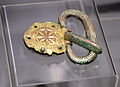 Belt buckle, c. 450 AD
 -
 Museum display and reconstruction
_Ancient_Germanic_belt_buckles,_Untersiebenbrunn_style,_Przeworsk_culture,_around_400_AD.jpg)


See also
[edit]References
[edit]- ^ "The Przeworsk culture is known largely from cemeteries, mainly of cremation burials."in: The Cambridge Ancient History t.13 p. 482, 1998; "the help of criteria organised on the basis of analysis of finds from Przeworsk culture territory in a comparison against material from the Rhine. (...)" in: Kultura przeworska a reńsko-wezerska strefa kulturowa. s. 199, by Artur Błażejewski, 2007
- ^ Andrzejowski 2010.
- ^ Heather (1998, p. 38)
- ^ Archaeological Motorway by Ryszard Naglik, Archeologia Żywa (Living Archeology), special English issue 2005
- ^ Archeological Museum in Kraków web site
- ^ a b U źródeł Polski, p. 100-105, Tadeusz Makiewicz
- ^ The Archaeology of the Transit Gas Pipeline by Kazimierz Adamczyk and Marek Gierlach, Archeologia Żywa (Living Archeology) special English issue 2005
- ^ U źródeł Polski, p. 101-103, Tadeusz Makiewicz
- ^ Vandals, Romans and Berbers. New Perspectives on Late Antique North Africa. A H Merrills. 2004, Ashgate. Page 35
- ^ "In the light of current studies the meander line on pottery of the Przeworsk culture developed from motives taken from Antiquity ornaments." in: Polish Archaeological Abstracts. Ossolineum, 1979
- ^ J. P. Mallory: Przeworsk culture. W: J. P. Mallory, D. Adams: Encyclopedia Of Indo-European Culture. Routledge, 1997, s. 470. ISBN 1-884964-98-2.
- ^ "Land and People, p.25" (PDF). Archived from the original (PDF) on September 26, 2007. Retrieved July 30, 2005.
- ^ Pronk-Tiethoff, Saskia. New York 2013. The Germanic loanwords in Proto-Slavic. "The Przeworsk Culture has most often been considered to be Germanic or of mixed Slavic and Germanic nature." Page 64.
- ^ Mielnik-Sikorska, Marta; Daca, Patrycja; Malyarchuk, Boris; Derenko, Miroslava; Skonieczna, Katarzyna; Perkova, Maria; Dobosz, Tadeusz; Grzybowski, Tomasz (14 January 2013). "The History of Slavs Inferred from Complete Mitochondrial Genome Sequences". PLOS ONE. 8 (1): e54360. Bibcode:2013PLoSO...854360M. doi:10.1371/journal.pone.0054360. PMC 3544712. PMID 23342138.
Based on the newest anthropological data it has been suggested that the area between the Oder and Vistula rivers witnessed continuity of human settlement between the Roman period and the early Middle Ages. Indeed, based on morphological features of skeletal materials it has been established that populations of the Przeworsk, Wielbark and Cherniakhovo cultures from the Roman period bear close similarities to the early medieval Western Slavs and not to the medieval Germanic-speaking populations. Furthermore, paleodemographic studies also point to the biological continuity of the populations inhabiting the Oder and Vistula basin in the Roman period and the early medieval Slavic populations of this region.
- ^ Piontek, Janusz (2020), "Etnogeneza Słowian jako problem badawczy w antropologii fizycznej", Journals.pan.pl: 173
- ^ Ziółkowski, Adam (2022). "Pollen, brooches, solidi and Restgermanen, or today's Poland in the Migration Period – Review of: A. Bursche, J. Hines, A. Zapolska (eds), The Migration Period between the Oder and the Vistula, East Central and Eastern Europe in the Middle Ages, 450–1450, Leiden – Boston 2020". Millennium. 19 (1): 173–196. doi:10.1515/mill-2022-0007. S2CID 253225324. Retrieved 27 January 2023.
One of its main results – the accordance between the palynological evidence of the change of environment (extensive reforestation and drastic reduction of anthropogenic indicators) and the archaeological reconstruction of the change of settlement (disappearance of the Przeworsk, Wielbark and other cultures of the Roman Period by the mid-fifth century) – conclusively confirms the often questioned verdict of a sudden severe depopulation of the lands between the Vistula and the Oder, similar to that revealed in the rest of Central/Eastern Europe (disappearance of the Elbe and Chernyakhiv-Sântana de Mureş cultures). An entirely new perspective opened by the project is the survival of enclaves with contacts all round the compass (the Eastern Empire, the Merovingian West, the Danubian lands, Scandinavia, the Western Balts). None of them yielded Slavonic material, even the longest-lived one recently discovered at Gąski-Wierzbiczany in Kujawy, evidently one of the main centres of the European Barbaricum and in the third and fourth century the Roman army's recruiting station, which continued till the early seventh century; this evidence (or lack of it) is the death-blow to the theory of a supposed continuity of settlement – and so of ethnicity, necessarily Slavonic – from the Bronze Age to the Middle Ages.
- ^ The Archaeology of early medieval Poland. A Buzko. Brill 2008. Page 62
Bibliography
[edit]
- Andrzejowski, Jacek (2010), "The Przeworsk Culture. A Brief Story (for the Foreigners)", in Lund Hansen; Bitner-Wróblewska (eds.), Worlds Apart? Contacts across the Baltic Sea in the Iron Age
- Cieśliński, Adam (2023). Die Przeworsk- und Wielbark-Kultur östlich der unteren Weichsel. Auswertung der Archivalien aus dem Nachlass von Herbert Jankuhn [The Przeworsk and Wielbark culture east of the lower Vistula. Analysis of the archival material from the legacy of Herbert Jankuhn]. Kiel/Hamburg: Wachholtz, ISBN 9783487167763.
- Cunliffe, Barry; Todd, Malcolm (2001), The Oxford Illustrated History of Prehistoric Europe, Oxford, ISBN 0-19-285441-0
- Heather, Peter (2006), The Fall of the Roman Empire: A New History of Rome and the Barbarians, Oxford University Press, ISBN 0-19-515954-3
- Mallory, James P.; Adams, Douglas Q. (1997), Encyclopedia of Indo-European Culture, Taylor & Francis, ISBN 1-884964-98-2
- Meyer, Michael; Łuczkiewicz, Piotr; Rauchfuß, Björn (eds) (2017). Eisenzeitliche Siedlungskeramik der Przeworsk-Kultur / Ceramika osadowa kulturyprzeworskiej z młodszego okresuprzedrzymskiego [Iron Age pottery of the Przeworsk culture]. Berlin: Edition Topoi, ISBN 978-3-9818369-1-2.
- Todd, Malcolm (1996-02-12), The Early Germans, Blackwell Publishing, ISBN 0-631-19904-7
