


Puff, the Magic Dragon

| "Puff, the Magic Dragon" | ||||
|---|---|---|---|---|
 | ||||
| Single by Peter, Paul and Mary | ||||
| from the album Moving | ||||
| B-side | "Pretty Mary" | |||
| Released | January 1963 | |||
| Recorded | 1962 | |||
| Genre | Pop, folk, Children’s music | |||
| Length | 3:20 | |||
| Label | Warner Bros. | |||
| Songwriter(s) | Leonard Lipton Peter Yarrow | |||
| Producer(s) | Albert Grossman | |||
| Peter, Paul and Mary singles chronology | ||||
| ||||
"Puff, the Magic Dragon" (or just "Puff") is a song written by Peter Yarrow of Peter, Paul and Mary from a poem by Leonard Lipton. It was made popular by Peter, Paul and Mary in a 1962 recording released in January 1963.
Lipton wrote a poem about a dragon in 1959,[1] and, when Yarrow found it, he wrote the lyrics to "Puff" based on the poem. After the song was released, Yarrow searched for Lipton to give him credit for the song.[2]
Lyrics
[edit]The lyrics for "Puff, the Magic Dragon" are based on a 1959 poem by Leonard Lipton, then a 19-year-old Cornell University student.[1] Lipton was inspired by an Ogden Nash poem titled "The Tale of Custard the Dragon", about a "realio, trulio little pet dragon".[3][4][5]
The lyrics tell a story of the ageless dragon, Puff, and his playmate, Jackie Paper, a little boy who grows up and moves on from the imaginary adventures of childhood, leaving a disheartened Puff on his own. The song's story takes place "by the sea" in the fictional land of "Honah Lee".
Lipton was friends with Yarrow's housemate when they were all students at Cornell. He used Yarrow's typewriter to get the poem out of his head. He then forgot about it until years later, when a friend called and told him Yarrow was looking for him, to give him credit for the lyrics. On making contact, Yarrow gave Lipton half the songwriting credit, and he received royalties to the song until his death in 2022.
Yarrow now sings the line "A dragon lives forever, but not so little boys" as "A dragon lives forever, but not so girls and boys", to be fair to boys and girls.[6] The original poem included a stanza about Puff finding another child to play with, but this was not incorporated into the song. The paper left in Yarrow's typewriter in 1959 has since been lost.[4]
Reception
[edit]Cash Box described it as "a charming folk tune, about a magic dragon, right-up-the-vocal-alley of the remarkably successful folksters."[7]
Speculation about drug references
[edit]After the song's initial success, speculation arose—as early as a 1964 article in Newsweek—that the song contained veiled references to smoking marijuana.[8] The word "paper" in the name of Puff's human friend Jackie Paper was said to be a reference to rolling papers, the words "by the sea" were interpreted as "by the C" (as in cannabis), the word "mist" stood for "smoke", the land of "Honahlee" stood for hashish, and "dragon" was interpreted as "draggin'" (i.e., inhaling smoke). Similarly, the name "Puff" was alleged to be a reference to taking a "puff" on a joint. The supposition was claimed to be common knowledge in a letter by a member of the public to The New York Times in 1984.[9][10]
The authors of the song have repeatedly rejected this interpretation and have strongly and consistently denied that they intended any references to drug use.[11] Both Lipton and Yarrow have stated, "'Puff, the Magic Dragon' is not about drugs."[12] Yarrow has frequently explained that the song is about the hardships of growing older and has no relationship to drug-taking.[13][14] He has also said that the song has "never had any meaning other than the obvious one" and is about the "loss of innocence in children."[15] He has dismissed the suggestion of it being associated with drugs as "sloppy research".[16]
In 1973, Peter Yarrow's bandmate, Paul Stookey of Peter, Paul and Mary, also defended the song's innocence in a novel way. He recorded a version of the song at the Sydney Opera House in March 1973 where he set up a fictitious trial scene.[17] The prosecutor of the trial claimed the song was about marijuana, but Puff and Jackie protested. The judge finally left the case to the "jury" (the Opera House audience) and said if they would sing along, the song would be acquitted. The audience joined in with Stookey and at the end of their sing-along, the judge declared the "case dismissed."[18]
Notable recordings and chart performance
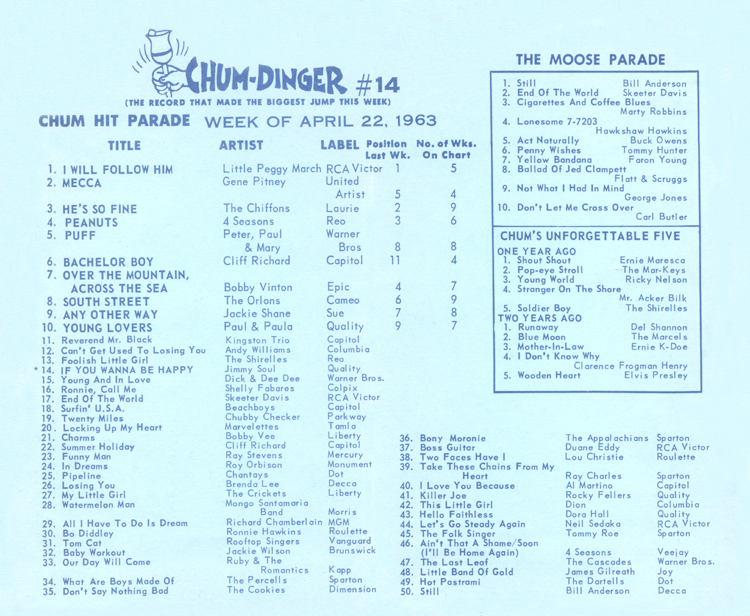
[edit]In 1961, Peter Yarrow joined Paul Stookey and Mary Travers to form Peter, Paul and Mary. The group incorporated the song into their live performances before recording it in 1962. The trio's 1962 recording of "Puff the Magic Dragon" entered the top 40 of the Billboard Hot 100 charts on March 30, 1963, and peaked at number two, kept out of the top spot by "I Will Follow Him" by Little Peggy March.[19] It topped Billboard's Adult Contemporary charts.[20] It also reached number ten on Billboard's R&B chart.[21] In Canada, the song reached number five in April 1963.[22]
Weekly charts[edit]
|
Year-end charts[edit]
|
Notable cover versions
[edit]During the autumn of 1966, Swedish pop band Fabulous Four, which included Lalla Hansson recorded the song; the session was produced by keyboardist Benny Andersson,[30][31][better source needed] later of ABBA fame.[32] Released as a single in November of that year, it was the group's first release on independent record label Hep House, started by Andersson's band Hep Stars, following Fabulous Four's departure from Fontana Records.[31][better source needed] The single, backed by a cover of Woody Guthrie's "This Land Is Your Land",[30] became a hit. It debuted at number one on Tio i Topp on 26 November 1966, staying there for three consecutive weeks before being replaced by Donovan's "Mellow Yellow".[33] On sales chart Kvällstoppen, the single reached number three on 20 December 1966.[34]
Adaptations
[edit]A 1978 animated television special, Puff the Magic Dragon, adapted the song. It was followed by two sequels, Puff the Magic Dragon in the Land of the Living Lies and Puff and the Incredible Mr. Nobody. In all three films, Burgess Meredith voiced Puff. In December 2016, it was announced that Fox Animation would produce a live-action/animation film based on the song with Mike Mitchell as director.[35] As of November 2020, the progress of this project had no updates, leading some fans to conclude that it has been quietly cancelled.[36] In September 1979, a picture-book based on the animated feature, written by Romeo Muller, known for his contributions to the Rankin-Bass holiday TV specials, was published by Avon Books.[37]
The song was adapted for a children's pantomime, which played at Sydney's Seymour Centre in 1983.[38]
A 2007 book adaptation of the song's lyrics by Yarrow, Lipton, and illustrator Eric Puybaret gives the story a happier ending with a young girl (presumed by reviewers to be Jackie Paper's daughter)[39] seeking out Puff to become her new companion. The lyrics remain unchanged from the Peter, Paul, and Mary version; the young girl is only seen in the pictures by illustrator Puybaret. On the last page of the book, she is introduced to Puff by an older Jackie Paper.
The tune was used by Versatec, a computer printer company, in the promotional LP Push the Magic Button for the song of the same name.[40]
American fabulist Robert Coover wrote about the later lives of Puff and Jackie Paper in "Sir John Paper Returns to Honah-Lee", the first story in his collection A Child Again (McSweeney's Books, 2005).[41]
Parodies
[edit]In the mid 1970s, an American Jewish band named Ruach created a parody version of the song entitled "Puff the Kosher Dragon". In the course of the song, Kosher Puff eats kosher food, has a bar mitzvah, fights anti-Semites, and finally marries and brings up his children as loyal members of the faith.[42] The Ruach song has been noted[43] as one of the first examples of a modern Jewish band using a popular secular tune.
Both tune and elements of the lyrics were adapted in the controversial parody "Barack the Magic Negro," written and recorded by Paul Shanklin for Rush Limbaugh's radio program, after the term was first applied to then presidential candidate Barack Obama by movie and culture critic David Ehrenstein. In a Los Angeles Times op-ed column of March 19, 2007, Yarrow condemned the act as "shocking and saddening in the extreme," stating that "taking a children's song and twisting it in such vulgar, mean-spirited way, is a slur to our entire country and our common agreement to move beyond racism… It is almost unimaginable to me that Chip Saltzman, who sent the CD [as a Christmas greeting to NRC members], would seriously be considered for the top post of the Republican National Committee. Puff, himself, if asked, would certainly agree."[44]
Vietnam War gunship
[edit]During the Vietnam War, the AC-47 Spooky gunship was nicknamed the "Dragon" or "Dragon ship" by the Americans because of its armament and firepower. The nickname soon caught on, and American troops began to call the AC-47 "Puff the Magic Dragon."[45] Robert Mason's Chickenhawk states, in reference to the Peter, Paul, and Mary song playing on a turntable: "'Puff the Magic Dragon' was making me uncomfortable. It was the saccharine song that had inspired the naming of the murderous Gatling-gun-armed C-47s. I couldn't listen."[46]
In popular culture
[edit]- The song is a favorite of Robert De Niro's character Jack Byrnes in the 2000 comedy film Meet the Parents. Ben Stiller's character Greg Focker makes light of the urban legend of the song being about drugs, which an irritated Jack has never heard.[47] In the film's sequel, Meet the Fockers, Jack has rigged his RV's horn to honk out the first notes of "Puff, the Magic Dragon".[48]
- Elon Musk, founder of SpaceX, said his Dragon spacecraft was named after "Puff, the Magic Dragon".[49]
- The Orlando Magic mascot is named "Stuff the Magic Dragon".[50]
- British comedian and magician John van der Put performs under the stage name "Piff the Magic Dragon"[51] and jokes (as Piff) about having a more famous brother named Steve.[52]
- A comic strip from Gary Larson's The Far Side published on January 13, 1993, shows a dragon coated black by an oil spill from a sinking tanker, with the caption "A tragedy occurs off the coast of a land called Honah-Lee".[53]
See also
[edit]
- List of Billboard Middle-Road Singles number ones of 1963
- "Lucy in the Sky with Diamonds", another song thought to be about the use of drugs, which was denied by its author
- "Crystal Blue Persuasion", also not about drugs according to its author
References
[edit]- ^ a b Lipton, Lenny. "Lenny Lipton". Lennylipton. Retrieved December 7, 2011.
- ^ "Puff The Magic Dragon by Peter, Paul and Mary". SongFacts. Retrieved May 31, 2017.
- ^ Nash, Ogden. "The Tale of Custard the Dragon". Harvard. Archived from the original on December 1, 2011. Retrieved December 7, 2011.
- ^ a b "Puff The Magic Dragon by Peter, Paul and Mary". Songfacts. Retrieved March 12, 2019.
- ^ Shannon, Bob; Javna, John (1986). Behind the Hits. Warner Books. ISBN 978-0446389372.
- ^ "Puff the Magic Dragon – Marijuana References in the Song Lyrics". 21 May 2000. Retrieved April 14, 2020.
- ^ "CashBox Record Reviews" (PDF). Cash Box. March 9, 1963. p. 50. Retrieved 2022-01-12.
- ^ "Puff the Magic Dragon and Marijuana". Snopes. 19 January 2001. Retrieved 2011-12-07.
- ^ "Magic Dragon's Not-So-Innocuous Puff". The NY Times. 1984-10-11. Retrieved 2011-12-07.
- ^ "Peter Yarrow - Biography". Internet Movie Database. Retrieved 2019-02-26.
- ^ Just A Minute With: Peter Yarrow, Reuters, 6 March 2008
- ^ "How 'Puff The Magic Dragon' Came To Be". Great Big Story. Retrieved 20 April 2017.
- ^ "Puff the Magic Dragon and Marijuana". Snopes.com. 2016-09-14. Retrieved 2016-09-27.
- ^ Konstantin, Phil, Kusi TV (interview), American Indian
- ^ "Puff the magic dragon", YouTube (live)
- ^ "Puff: Still Not a Drug Song". Chronogram.
- ^ Released in 1977 on the album "Real to Reel" and distributed by Sparrow Records
- ^ Noel Paul Stookey (1977). Reel to Reel (audio recording). Neworld Media.
- ^ "Top 100 Songs | Billboard Hot 100 Chart". Billboard.
- ^ Whitburn, Joel (2004). The Billboard Book of Top 40 Hits (8th ed.). New York: Billboard Books. p. 488. ISBN 0-8230-7499-4.
- ^ Whitburn, Joel (2004). Top R&B/Hip-Hop Singles: 1942-2004. Record Research. p. 458.
- ^ "CANAda's (TED KENNEDY) WEEKLY SINGLES CHART FROM 1963 - hitsofalldecades.com". hitsofalldecades.com. Archived from the original on 17 October 2018. Retrieved 17 January 2022.
- ^ "CHUM Hit Parade - April 22, 1963".
- ^ "flavour of new zealand - search lever". Flavourofnz.co.nz. Retrieved 26 April 2021.
- ^ Joel Whitburn's Top Pop Singles 1955–1990 - ISBN 0-89820-089-X
- ^ "Cash Box Top 100 5/11/63". Cashboxmagazine.com. Retrieved 26 April 2021.
- ^ "Top 100 Hits of 1963/Top 100 Songs of 1963". Musicoutfitters.com. Retrieved 26 April 2021.
- ^ "Top Adult Contemporary Songs of 1963 • Music VF, US & UK hits charts". Musicvf.com. Retrieved 26 April 2021.
- ^ "Cash Box YE Singles (Pop) 1963". Tropicalglen.com. Retrieved 26 April 2021.
- ^ a b "Puff the Magic Dragon / Fabulous Four". Svensk mediedatabas. Retrieved 1 December 2022.
- ^ a b Persson, Lennart (1984). Fabulous Four – Fabulous Four, 1965-68! (LP) (in Swedish). CSP Records. CLP 5003.
- ^ Palm, Carl Magnus (2001). Bright Lights, Dark Shadows: The Real Story of ABBA. London: Omnibuss. pp. 86–87. ISBN 978-0-7119-8389-2.
- ^ Hallberg, Eric; Henningsson, Ulf (2012). Eric Hallberg, Ulf Henningsson presenterar Tio i topp med de utslagna på försök: 1961–74 (2nd ed.). Premium Publishing. pp. 452–453. ISBN 978-91-89136-89-2.
- ^ Hallberg, Eric (1993). Eric Hallberg presenterar Kvällstoppen i P3: Sveriges Radios topplista över veckans 20 mest sålda skivor. Drift Musik. p. 325. ISBN 9163021404.
- ^ Fleming, Mike Jr. "Peter, Paul & Mary Tune 'Puff The Magic Dragon' In Fox Deal With 'Troll's Helmer Mike Mitchell". Deadline. Retrieved December 9, 2016.
- ^ "Puff The Magic Dragon Updates: Is The Animated Adventure Still Coming?". ScreenRant. 2020-11-14. Retrieved 2022-07-24.
- ^ "Display Ad: Children love what Camelot has". The New York Times. September 16, 1979. ProQuest 120730663.
- ^ "What's On For the School Hols [sic]", The Sydney Morning Herald
- ^ Goddard, Peter (2007-08-18). "New take on Puff the Magic Dragon". The Star. Retrieved 2011-12-07.
- ^ "Push the Magic Button", Archives (songlist), Computer History Museum[permanent dead link]
- ^ Prince, David (October 6, 2006). "Absolutely fabulist". The Santa Fe New Mexican. p. 100.
- ^ "Puff the Kosher Dragon". YouTube. Archived from the original on 2021-12-11.
- ^ Bryan Edelman, Marsha (2003). Discovering Jewish music. Jewish Publication Society. ISBN 9780827610279.
- ^ Yarrow, Peter (28 January 2009), "My Response to the Mean-Spirited "Barack the Magic Negro"", The Huffington Post
- ^ Pike, John (17 October 2016). "AC-47". GlobalSecurity.org. Retrieved 9 September 2019.
- ^ Mason, Robert (2005). Chickenhawk. Penguin Books. ISBN 9781101175156. OCLC 656959792. [page needed]
- ^ "Meet the Parents". www.learningfromlyrics.org.
- ^ "Meet the Fockers (2004) – Deep Focus Review – Movie Reviews, Critical Essays, and Film Analysis". Deep Focus Review. 6 December 2010.
- ^ Chow, Denise (December 8, 2010). "Millionaire private space capsule splashes: successful maiden voyage". Space.com. Retrieved May 15, 2014.
- ^ Agnes Torres Al-Shibibi (18 March 1989). "THE MAGIC'S LOVABLE DRAGON IS THE STUFF OF TEAM DREAMS". OrlandoSentinel.com.
- ^ "Cooperesque Piff brings magic act to the Westcountry". Western Morning News. 10 November 2012. Archived from the original on 23 September 2015. Retrieved 23 September 2015.
- ^ Mullinger, James (6 November 2012). "Comedian Of The Week: Piff The Magic Dragon". GQ-magazine.com. GQ. Archived from the original on 26 May 2019. Retrieved 12 July 2019.
- ^ Larson, Gary (w, a). The Far Side. The Yale Daily News (New Haven, Connecticut). January 13, 1993, Universal Press Syndicate, p. 5.
Further reading
[edit]
- Furlong, Tim (17 July 2009). "Puff the Magic... Stoner?". Philadelphia: WCAU. Retrieved 9 September 2019.
- Mikkelson, David (25 May 2007). "Puff the Magic Dragon and Marijuana". Snopes. Retrieved 9 September 2019. Disputes the drug-reference interpretation.

- 1962 songs
- 1963 singles
- Peter, Paul and Mary songs
- Glen Campbell songs
- English children's songs
- Works about dragons
- Songs about children
- Songs about fictional characters
- Fictional dragons
- Songs written by Peter Yarrow
- Songs based on poems
- Song recordings produced by Albert Grossman
- Warner Records singles
- Number-one singles in Sweden