


Roslagsbanan
| Roslag Railway (Lines 27/28/29) | |||
|---|---|---|---|
 | |||
| Overview | |||
| Native name | Roslagsbanan (Linje 27/28/29) | ||
| Owner | Storstockholms Lokaltrafik | ||
| Locale | Stockholm County, Sweden | ||
| Termini | |||
| Stations | 39 | ||
| Service | |||
| Type | Narrow-gauge railway, Commuter Rail | ||
| Services | 27 to Kårsta 28 to Österskär 29 to Näsbypark | ||
| Operator(s) | Transdev | ||
| Rolling stock | Current: X10p/UBxp/UBp, X15p | ||
| Daily ridership | 53,400 boardings (2019)[1] | ||
| History | |||
| Opened | 1885[2] | ||
| Technical | |||
| Line length | 65 km (40 mi)[3] | ||
| Number of tracks | 1 or 2 | ||
| Track gauge | 891 mm (2 ft 11+3⁄32 in)[4] | ||
| Electrification | 1,500 V DC from overhead catenary | ||
| Operating speed | 80 km/h (50 mph) | ||
| |||


Roslagsbanan is a narrow gauge commuter railway system in Roslagen, Stockholm County, Sweden. Its combined route length is 65 kilometres (40 miles) and there are 38 stations. It is built to the Swedish three foot (891 mm or 2 ft 11+3⁄32 in) gauge. The Storstockholms Lokaltrafik (SL) classifies it as "light rail" in its maps.[10]
The line starts in Stockholm at Stockholm East Station (Stockholms östra station, Stockholm Ö). It goes north and splits into three branch lines at the junction stations Djursholms Ösby and Roslags Näsby; the three branches terminate at Näsbypark, Österskär and Kårsta.
It is double track between Stockholm and Viggbyholm and between Rydbo and Åkersberga. The rest is single track, but the line to Vallentuna was being doubled in 2012[needs update] and Rydbo-Åkers Runö in 2013[needs update]. There are passing loops at some stations on the single track sections: at Altorp, Hägernäs, Österskär, Visinge, Täby kyrkby, Ormsta, Lindholmen and Kårsta.
Following a 2017 agreement between the Swedish state, Stockholm County, and the affected municipalities, the line will be extended to the centrally located underground hub T-Centralen, with construction to begin in approximately 2022.[11]
History[edit]
 | This section needs additional citations for verification. (March 2017) |
The present Roslagsbanan was once just the southern part of a large narrow gauge system throughout Roslagen and eastern Uppland, connecting Stockholm and Uppsala with ports, smaller towns and parts of the countryside and used for both freight and passenger transport.
In 1885 the line from Stockholm East Station to Rimbo was opened, today the longest branch of Roslagsbanan. It was originally built and operated by the private enterprise Stockholm-Rimbo Järnväg (SRJ). In 1909 SRJ changed its name to Stockholm–Roslagens Järnvägar (with the same abbreviation) following the take-over of companies running adjacent lines.
Roslagsbanan is one of the oldest electrified railway lines for public transport in Europe. The first Stockholm–Djursholm suburban section, Djursholmsbanan, was electrified in 1892,[3] and at the time continued into the city center by way of the tram network, ending at Engelbrektsplan next to Humlegården.[citation needed]
In the beginning of the 20th century and well into the 1950s, Djursholms Ösby, a branch station on Roslagsbanan, was one of the busiest railway stations in Sweden with trains stopping every three minutes with three different branches dividing from there, transporting people and goods.[citation needed]
In the years following World War II, more and more of Swedish railways were nationalised through Statens Järnvägar (SJ), a fate also shared by Roslagsbanan. In 1969 Stockholm County took control over the Stockholm–Rimbo network (now referred to as 'Roslagsbanan') from SJ with the public transport company SL managing the railway.[citation needed]
In 1960 the Djursholmsbanan tracks to Engelbrektsplan were closed, making Stockholm East Station the system's terminus, thus passengers wishing to travel on with the Stockholm metro have had to transfer to the adjacent Tekniska högskolan metro station since 1973. One of the two Djursholm branches (Eddavägslinjen) was closed by SL in 1976.[12]
When SL took over the railway it had many problems. It was narrow gauge and not connected to the rest of the rail network in any way. It was slow, being outperformed by busses, especially to the areas near the end of line, and it was mostly single-track and had low capacity. Because of this there was a strong political interest to close the railway and replace it with buses and a metro line to Täby. The public opinion was much against this and after a referendum in 1980 the county decided to save the Roslagsbanan and invest in new trains and modernize the infrastructure and formed a new company SLJ to run Roslagsbanan. Despite this the northernmost portion, Kårsta–Rimbo was closed in 1981, and the plan was to close the part Lindholmen–Kårsta as well, but it was temporarily kept due to the poor roads in the area which would be problematic for bus transport. Even though the roads have been improved the line to Kårsta is still in use today and there are currently no plans to close it. In January 2010 the Frescati station was closed to avoid congestion and the Universitetet station was moved 500 metres (550 yards) north to better serve Stockholm University.[citation needed]
Ownership and present use[edit]

The railway, owned by the Stockholm County Council through the public transport company Storstockholms Lokaltrafik (SL), is not part of the nationally owned network. It is the only narrow gauge railway in Sweden still in use for commercial traffic.[13]
Roslagsbanan is part of the Stockholm public transport system. It is operated under contract by Transdev Sverige AB from 15 April 2022.[14] Transdev took over operations from Arriva Sverige who had operated the network since 7 January 2013.[15] Arriva Sverige in turn took over took over from the previous contracted company Roslagståg AB, which was a joint venture by the Danish DSB and Tågkompaniet.
Despite its age and non-standard gauge, it is one of the most used railways in Sweden. Since the late 1980s, the railway has constantly but slowly been upgraded to a modern standard with modernised rolling stock, higher platforms and straighter and double tracks allowing for increased speeds and more departures.
There are 15 departures to and from Stockholms Östra during the morning and evening peak hours respectively.[16] In 2019, the railway had a ridership of 53,400 boardings per day.[1]
Future[edit]
Roslagsbanan is to be diverted to a new terminus at T-Centralen via a new tunnel from Universitetet station to Odenplan station, and then parallel to the Stockholm City Line. This will allow passengers to commute faster within the city, as T-Centralen is served by all lines of the Stockholm Metro, all lines of the Stockholm Commuter Rail, as well as Spårväg City and is connected to Stockholm Central Station. When the extension is completed, Stockholms östra will become obsolete and close down. The stretch of track from Universitetet to the old terminus will be dismantled to make way for 500 apartments. The line will gain much more importance, and a further 1,500 flats are planned to be built along the line in Täby and Vallentuna municipalities, aiming to ease the ongoing housing crisis in Stockholm. The project is estimated to cost 7 billion kronor and is expected to be completed by 2026.[17][18]
A feasibility study into extending the Roslagsbanan to Arlanda Airport was completed in 2010, followed by a public consultation in 2012.[19]
Network[edit]

The stations along Roslagsbanan are marked with a J symbol, which stands for the generic term järnvägsstation ("railway station") and is similar to the T symbol used by the Stockholm underground railway stations (tunnelbanestation) and the S used for tram stops (spårvägshållplats).
Roslagsbanan is now used by Storstockholms Lokaltrafik (SL) for commuter transport. The present network comprises most of the southern part of what was once a much bigger network, made up of privately owned railways all over Roslagen, connecting Stockholm and Uppsala with the countryside and used for passenger and freight trains. See the § History section of this article.
| Line | Route | Length | Stations | Map | Notes |
|---|---|---|---|---|---|
| 27 | Stockholm East Station – Djursholms Ösby – Roslags Näsby – Vallentuna – Lindholmen – Kårsta | 41.5 km (25.8 mi) | 23 | 
|
Opened 1885 |
| 28 | Stockholm East Station – Djursholms Ösby – Roslags Näsby – Åkersberga – Österskär | 29.5 km (18.3 mi) | 20 | 
|
Opened 1901 to Åkersberga, 1906 to Österskär |
| 29 | Stockholm East Station – Djursholms Ösby – Lahäll – Näsbypark | 11.5 km (7.1 mi) | 12 | 
|
Opened 1928 to Lahäll and 1937 to Näsbypark |
| Total | 65 km (40 mi) | 39 | |||
The line are only displayed on some trains; others only have the destination displayed.
In the timetables of Samtrafiken, the lines do not have the numbers as stated above, but the numbers 121 for the line to Kårsta, 122 for the line to Österskär and 123 for the line to Näsbypark.
Current networks previously connected to Roslagsbanan[edit]
Some of the northern parts of the once bigger network are still in use, but these are not formally called Roslagsbanan. These two parts are
- Uppsala–Länna–Faringe (opened in 1876 to Länna, 1885 to Faringe); Tourist traffic only, see Upsala-Lenna Jernväg.
- Dannemora–Gimo–Hargshamn–Hallstavik (Opened 1878; Dannemora–Hargshamn turned to normal gauge in the 1970s and extended into Hallstavik 1977; SJ freight only).
Closed parts of Roslagsbanan (south of Rimbo)[edit]
- Stocksund – Långängen (1915-standard gauge tram) line, then converted to narrow gauge in 1934, closed in 1966)
- Stockholm Ö – Engelbrektsplan (1895–1960)
- Djursholms Ösby – Eddavägen (1890–1977)
- Kårsta – Rimbo (1885–1981)
Stations[edit]
| Section | Station | km | Opened | Closed |
|---|---|---|---|---|
| Kårsta (Rimbo) branch | Rimbo | 56 | 1884 | 1981 |
| Rö | 50 | 1885 | 1981 | |
| Sparren | 48 | 1885 | 1981 | |
| Kårsta | 41.7 | 1885 | ||
| Ekskogen | 38.5 | 1885 | ||
| Frösunda | 34.6 | 1885 | ||
| Lindholmen | 28.8 | 1885 | ||
| Molnby | 25.5 | 1885 | ||
| Ormsta | 24.1 | |||
| Vallentuna | 22.7 | 1885 | ||
| Bällsta | 21.5 | |||
| Kragstalund | 19.9 | 1993 | ||
| Byle | 19.0 | 1910 | 1993 | |
| Täby kyrkby | 18.8 | 1885 | ||
| Visinge | 14.2 | 1986 | ||
| Ensta | 13.2 | 1911 | ||
| Tibble | 11.9 | |||
| Österskär branch | Österskär | 29.4 | 1906 | |
| Tunagård | 28.6 | 1919 | ||
| Åkersberga | 27.2 | 1901 | ||
| Åkers Runö | 25.5 | 1901 | ||
| Täljö | 23.2 | 1928 | ||
| Rydbo | 20.2 | 1901 | ||
| Arninge | 17.2 | 2021 | ||
| Hägernäs | 15.6 | |||
| Viggbyholm | 14.3 | 1907 | ||
| Galoppfältet | 13.1 | 1913 | ||
| Täby Centrum | 12.5 | 1968 | ||
| Main line | Roslags Näsby | 11.0 | 1885 | |
| Enebyberg | 9.9 | 1909 | ||
| Djursholms Ekeby | 8.3 | 1885 | ||
| Bråvallavägen | 7.4 | |||
| Näsbypark branch | Näsbypark | 11.7 | 1937 | |
| Näsbyallé | 11.0 | 1937 | ||
| Lahäll | 10.2 | 1928 | ||
| Altorp | 8.5 | |||
| Östberga | 7.8 | 1910 | ||
| Vendevägen | 7.2 | 1910 | ||
| Svalnäs branch (closed) | Svalnäs | 12.9 | 1912 | 1933 |
| Eddavägen | 12.1 | 1901 | 1976 | |
| Vikingavägen | 10.7 | 1901 | 1976 | |
| Djursholms Framnäsviken | 9.9 | 1890 | 1976 | |
| Germania | 9.5 | 1890 | 1976 | |
| Restauranten | 8.7 | 1890 | 1976 | |
| Djursholms Sveavägen | 8.3 | 1890 | 1976 | |
| Bragevägen | 7.5 | 1890 | 1976 | |
| Main line | Djursholms Ösby | 6.7 | 1890 | |
| Mörby | 5.6 | 1906 | ||
| Stocksund (new) | 4.6 | 1996 | ||
| Långängen branch (closed) | Långängen | 1911 | 1966 | |
| Stockby | 1911 | 1966 | ||
| Stocksund (original) | 4.5 | 1885 | 1996 | |
| Main line | Ålkistan | 3.5 | 1885 | 1923 |
| Freskati | 3.0 | 1885 | 2009 | |
| Universitetet (new) | 2.5 | 2010 | ||
| Universitetet (original) | 1.7 | 2009 | ||
| Stockholm East | 0.0 | 1885 | ||
| Engelbrektsplan | 1 | 1895 | 1960 |
Rolling stock[edit]

The present train sets were manufactured by ABB Railcar (now Bombardier) and delivered in 1988–1995. The train sets are owned by SL, but maintained and operated by Roslagståg.
The trains are made up of three different bogie vehicle types:
- Motor coach X10p Number of vehicles: 35, Seating capacity: 72, Length: 19.9 metres (65 ft), Weight: 27.7 tonnes (27.3 long tons; 30.5 short tons), Power rating: 400 kW (540 hp), Maximum speed: 80 km/h (50 mph)
- Driving trailer UBxp Number of vehicles: 34, Seating capacity: 76, Length: 19.9 metres (65 ft 3 in), Weight: 16.3 tonnes (16 long tons; 18 short tons)
- Intermediate trailer UBp Number of vehicles: 32, Seating capacity: 80, Length: 19.9 metres (65 ft 3 in), Weight: 16 tonnes (15.7 long tons; 17.6 short tons)[20]
The trains were refurbished in 2011–2013, where some carriages were rebuilt with low floors, enabling wheelchair and pram access. The refurbishment also included new interiors and exteriors.[21]
There are some problems with the rolling stock. Previously, the carriages had very poor wheelchair accessibility due to narrow doors and stairs; with the 2012–2016 refurbishment, this has been fixed on some carriages. The trains are also very noisy, especially considering the railway mostly goes through built up suburban areas.[citation needed]
Because of this, in 2010 SL began the process of finding a company from which to order modern trains to meet the rising demand for departures on Roslagsbanan. 22 new trains were ordered from Stadler Rail in 2016 and are scheduled to be delivered in 2020. They are going to be named X15p,[22] with a new depot, Vallentunadepån, having been built just north of Vallentuna.[23] The first train entered service on 31 October 2023.[24]
Older trains[edit]
The trains which were still in use until the early 1990s contained some vehicles dating from near the beginning of the 20th century. Some of these old brown and wooden wagons have been saved, the oldest ones being from 1914. They are owned by Spårvägsmuseet (Stockholm Tramway Museum) and are managed by Roslagsbanans Veterantågsförening (RBV) ("the Veteran Train Club for Roslagsbanan"), and can be chartered for events.
Some old trains have also been sold to other Swedish three foot gauge railways, which are now only heritage railways, where they are used for tourists.
Gallery[edit]
Present day[edit]
-
 New bridge of Stocksund, inaugurated in 1996, with the new station on the other side of the tunnel
 -
 Train at Rydbo
 -
 The red building of Stockholm East Station and the entrance to the Stockholm Metro in front of it to the left
 -
 Platforms at Stockholm East Station
 -
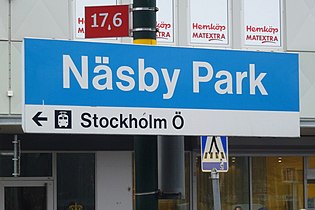 Näsby Park is one of the four systems termini.
 -
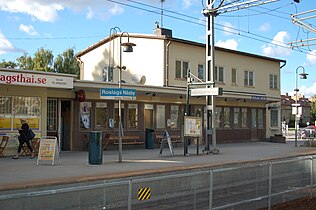 Roslags Näsby is, together with Stockholm East Station and Djursholms Ösby one of the three junctions of the system.


Historical[edit]
-
 Old bridge of Stocksund, dismantled in 1997
 -
 Old station of Stocksund, now replaced with a station some hundred metres to the north-west, where the rails go straighter allowing for higher speed
 -
 Old signal box at Djursholms Ösby
.jpg)
.jpg)

See also[edit]


References[edit]
- ^ a b "Fakta om SL och regionen 2019" (PDF) (in Swedish). Storstockholms Lokaltrafik. p. 34. Archived (PDF) from the original on 27 December 2020. Retrieved 3 April 2021.
- ^ SL annual report for the fiscal year 2007: Page 34 (PDF) (Report). Storstockholms Lokaltrafik. 2008-06-27. Archived from the original (PDF) on 2009-02-26. Retrieved 2009-02-01.
- ^ a b "Historia". sl.se (in Swedish). SL. 2006-06-01. Archived from the original on 2007-10-13. Retrieved 2009-02-01.
- ^ "Tekniska fakta - Roslagsbanan". sl.se (in Swedish). Storstockholms Lokaltrafik. 2006-06-01. Archived from the original on 2007-10-13. Retrieved 2009-02-01.
- ^ "Arninge resecentrum". taby.se (in Swedish). Täby Municipality. Retrieved 2019-08-12. opens 2021
- ^ BANVAKT.se Bandel [Timetables] (317, 318, 319, 321, 323 & 325)
- ^ Historiskt om Svenska Järnvägar Bandelar i Nummerordning [Swedish Railways historic timetables in numeric order] (317, 318, 319, 321, 323 & 325)
- ^ jarnvag.net: Roslagsbanan [https://web.archive.org/web/20140115033544/http://www.jarnvag.net/index.php/banguide/banor-svealand/stockholm-karsta Archived 2014-01-15 at the Wayback Machine]
- ^ "SSÄ Banbok för Roslagsbanan" (PDF) (in Swedish). Stockholm Regional Council. 11 February 2019. Retrieved 28 July 2020.
- ^ "Official Map" (PDF).
- ^ Toll, Michael; Andreas, Jennische (2017-03-30). "Beskedet: Här får Storstockholm ny tunnelbana och spårvagn". Stockholm Direkt. Retrieved 2017-03-30.
- ^ "DHJ, Dannemora - Hargs Järnväg, Innehållsförteckning. Table of content".
- ^ "Banguide - Roslagsbanan Stockholm-Kårsta m fl". järnväg.net. Retrieved 2022-09-13.
- ^ "98,9 procent punktlighet första helgen då Transdev började köra Roslagsbanan". Mynewsdesk. Transdev Sverige AB. Retrieved 2022-09-13.
- ^ "Stockholm/Roslagsbanan | Arriva". www.arriva.se. Archived from the original on 2012-05-05.
- ^ "H27-29" (PDF). Tidtabeller - SL. Retrieved 2022-09-13.
- ^ "Så ska Roslagsbanan till city byggas snabbare". mitti.se (in Swedish). 6 February 2019.[permanent dead link]
- ^ "Stockholm to invest SEK30.2 billion in public transport infrastructure by 2035". Global Mass Transit. 31 March 2017. Archived from the original on 21 February 2022. Retrieved 21 February 2021.
- ^ "Tvärförbindelse Roslagsbanan–Arlanda". Stockholm County Council. Archived from the original on 2016-01-25. Retrieved 2017-03-30.
- ^ "Roslagstag.se – Sida 4".
- ^ Upprustade och nya tåg på Roslagsbanan
- ^ Stadler to supply new trains for Stockholm’s Roslagsbanan
- ^ "Roslagsbanans depå i Vallentuna".
- ^ "Narrow gauge commuter trains enter service in Stockholm". Railway Gazette International. 6 November 2023.
External links[edit]

- 2021 Simplified map of Roslagsbanan lines Archived 2021-05-24 at the Wayback Machine (pdf)
- Storstockholms Lokaltrafik (Stockholm Transport) - Official site (English)
- Storstockholms Lokaltrafik (Stockholm Transport) - Official site (Swedish)
- Järnväg.net - Roslagsbanan Archived 2005-10-13 at the Wayback Machine (Swedish)
| Commuter rail and regional rail |
|   | ||||||||||
|---|---|---|---|---|---|---|---|---|---|---|---|---|
| Rapid transit | ||||||||||||
| Trams and light rail |
| |||||||||||
| Trolleybuses |
| |||||||||||
| Ferries | ||||||||||||

| International | |
|---|---|
| National | |
