


Passiflora foetida
| Passiflora foetida | |
|---|---|

| |
| Flowers | |

| |
| Fruits | |
Scientific classification 
| |
| Kingdom: | Plantae |
| Clade: | Tracheophytes |
| Clade: | Angiosperms |
| Clade: | Eudicots |
| Clade: | Rosids |
| Order: | Malpighiales |
| Family: | Passifloraceae |
| Genus: | Passiflora |
| Species: | P. foetida
|
| Binomial name | |
| Passiflora foetida | |
Passiflora foetida (common names: stinking passionflower, wild maracuja, bush passion fruit, wild water lemon,[1] stoneflower,[1] love-in-a-mist, or running pop[1]) is a species of passion flower that is native to the southwestern United States (southern Texas and Arizona), Mexico,[2] the Caribbean, Central America, and much of South America. It has been introduced to tropical regions around the world,[1] such as Southeast Asia, South Asia, Hawaii, Africa, and The Maldives.[3] It is a creeping vine like other members of the genus, and yields an edible fruit.[4] The specific epithet, foetida, means "stinking" in Latin and refers to the strong aroma emitted by damaged foliage.[5]
This passion flower tolerates arid ground, but favours moist areas. It is known to be an invasive species in some areas.[4] This plant is also a widely grown perennial climber, and has been used in traditional medicine.[6]
Description[edit]
The stems are thin and wiry, and are covered with minute sticky yellow hairs. Older stems become woody. The leaves are three- to five-lobed and viscid-hairy. When crushed, these leaves give off a pungent odor that some people consider unpleasant. The flowers are white to pale cream coloured, or pink to pale purple, about 5–6 cm diameter. The ripe fruit is globose, 2–3 cm diameter, yellow from the white-flowered form, and red from the pink form, although there are more than 50 variants (Vanderplank), and has numerous black seeds embedded in the pulp; the fruit are eaten and the seeds dispersed by birds.
Passiflora foetida is able to trap insects on its bracts, which exude a sticky substance that also contains digestive enzymes. This minimizes predation on young flowers and fruits.[7] Whether or not it gains nourishment from its prey is uncertain, and it is considered a protocarnivorous plant.[8]
-
 Leaves
 -
 Flower close-up
 -
 Pollen grains
 -
 Fruits
 -
 Fruiting plant
 -
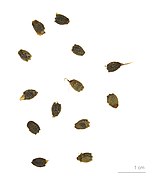 Seeds
Seeds

_(cropped).jpg)


Animal interactions[edit]
Passiflora foetida is a larval host and nectar source for the Gulf fritillary (Agraulis vanillae).[9]
Passiflora foetida has been mentioned as a toxic plant by farmers from northeastern Brazil. An experiment done with goats led to the discovery that high levels of cyanide in P. foetida cause poisoning after the ingestion of fresh leaves, mostly during the dry season.[10]
Uses[edit]
The fruits are roughly the size of a ping pong ball or kumquat and contain a bluish-white pulp that is mildly sweet and delicately flavored. In the Philippines, the fruit of Passiflora foetida are known colloquially as marya-marya ('Little Mary'), kurombot, utot-utot, and santo papa (due to its resemblance to the Pope's mitre). Young leaves and plant tips are also edible. Dry leaves are used in tea in Vietnamese folk medicine to relieve sleeping problems, as well as treatment for itching and coughs.[11]
References[edit]
- ^ a b c d "Passiflora foetida". Germplasm Resources Information Network. Agricultural Research Service, United States Department of Agriculture. Retrieved 2010-01-06.
- ^ Passion flower native from Mexico. (2022, February 6). abcFlora. Retrieved February 6, 2023, from https://abcflora.com/pages/flowers-mexico
- ^ Food Standards: Passiflora foetida Archived 2011-03-30 at the Wayback Machine
- ^ a b "Passiflora foetida (vine, climber)". Global Invasive Species Database. Invasive Species Specialist Group. 2006-03-23. Retrieved 2010-01-07.
- ^ Nellis, David W. (1997). Poisonous Plants and Animals of Florida and the Caribbean. Pineapple Press Inc. p. 224. ISBN 978-1-56164-111-6.
- ^ Sathish, R.; Sahu, Alok; Natarajan, K. (May–June 2011). "Antiulcer and antioxidant activity of ethanolic extract of Passiflora foetida L." Indian Journal of Pharmacology. 43 (3): 336–339. doi:10.4103/0253-7613.81501. PMC 3113390. PMID 21713043.
- ^ Radhamani, T R; L Sudarshana; Rani Krishnan (December 1995). "Defense and carnivory: Dual role of bracts in Passiflora foetida" (PDF). Journal of Biosciences. 20 (5): 657–664. doi:10.1007/BF02703305. S2CID 43357745.
- ^ "Carnivorous Plants / Insectivorous Plants". Botanical Society of America. Retrieved 2010-01-07.
- ^ "Lady Bird Johnson Wildflower Center - the University of Texas at Austin".
- ^ Carvalho, Fabricio K. de L.; de Medeiros, Rosane M. T.; de Araujo, Jose A. S.; Riet-Correa, Franklin (June 2011). "Experimental poisoning by Passiflora foetida (Passifloraceae) in goats". Pesquisa Veterinária Brasileira. 31 (6): 477–481. doi:10.1590/s0100-736x2011000600003.
- ^ Tanaka, Yoshitaka; Van Ke, Nguyen (2007). Edible Wild Plants of Vietnam: The Bountiful Garden. Thailand: Orchid Press. p. 109. ISBN 978-9745240896.
Further reading[edit]
Rosa, Yara Brito Chain Jardim; Dornelas, Marcelo Carnier (9 August 2011). "In vitro plant regeneration and de novo differentiation of secretory trichomes in Passiflora foetida L. (Passifloraceae)". Plant Cell, Tissue and Organ Culture. 108 (1): 91–99. doi:10.1007/s11240-011-0016-6. S2CID 17653122.