


Sahagún
 | You can help expand this article with text translated from the corresponding article in Spanish. (December 2009) Click [show] for important translation instructions.
|
Sahagún | |
|---|---|
 | |
 Flag  Coat of arms | |
  Sahagún Location in Spain | |
| Coordinates: 42°22′19″N 5°1′49″W / 42.37194°N 5.03028°W | |
| Country | Spain |
| Autonomous community | Castile and León |
| Province | León |
| Government | |
| • Alcalde | Paula Conde Huerta (2019) (PP) |
| Area | |
• Total | 123.64 km2 (47.74 sq mi) |
| Elevation | 822 m (2,697 ft) |
| Population (2018)[1] | |
• Total | 2,517 |
| • Density | 20/km2 (53/sq mi) |
| Demonym(s) | facundino/na, sahagunense |
| Time zone | UTC+1 (CET) |
| • Summer (DST) | UTC+2 (CEST) |
| Postal code | 24320 |
| Dialing code | 987 |
| Official language(s) | Spanish |
| Website | Official website |
Sahagún (Spanish pronunciation: [sa(a)ˈɣun]) is a town and municipality of Spain, part of the autonomous community of Castile and León and the province of León. It is the main centre of population in the Leonese part of the Tierra de Campos natural region.
Sahagún contains some of the earliest examples of the mudéjar architecture. It lies on the Way of St. James and is often considered the half-way point between St. Jean Pied de Port and Santiago de Compostela. The Battle of Sahagún was a notable victory by the British light cavalry against their more numerous French adversaries in 1808.
The first settlement on the site grew up around the nearby Benedictine monastery consecrated to the saints Facundus and Primitivus. The name Sahagún is thought to derive from an abbreviation and variation on the name San Fagun ("Saint Facundus").
Villages
[edit]Arenillas de Valderaduey, Celada de Cea, Galleguillos de Campos, Joara, Riosequillo, Sahagún, San Martín de la Cueza, San Pedro de las Dueñas, Sotillo de Cea, Villalebrín and Villalmán.
Monastery
[edit]The monastery acquired importance during the reign of Alfonso III de Asturias, and reached its greatest splendour during the reign of Alfonso VI of Castile. On November 25, 1085, this latter king promulgated the edicts known as the Fuero de Sahagún, which gave a number of privileges to the Monastery and town, fomenting its growth. The king favoured the Cluniac order and the monastery was known as the "Spanish Cluny".
Friction often erupted into disputes between the townsfolk and the monastery in the mid-12th century, as recorded in the Crónicas anónimas de Sahagún. The monastery was very important on the pilgrimage route to Santiago de Compostela, and in the 14th century housed a University (see also List of early modern universities in Europe). In the 19th century, the monastery was disbanded and the structure nearly completely razed.
Notable residents
[edit]See also
[edit]External links
[edit]
- IX Centenary of Leon-Castilla's King Alfonso VI
- Sahagun's History webpage
- Sahagun's townhall webpage
Gallery
[edit]-
 Roman bridge
 -
 Arch of San Benito
 -
 Chapel of San Mancio
 -
 Monastery of Santa Cruz
 -
 Torre del Reloj
 -
 Church of San Lorenzo
 -
 Church of the Virgen Peregrina
 -
 Hermitage of La Virgen del Puente
 -
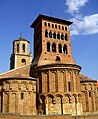 Church of San Tirso
 -
 Church of La Trinidad
 -
 Monastery of San Benito
 -
 Street in Sahagún


.jpg)


2.jpg)


References
[edit]- ^ Municipal Register of Spain 2018. National Statistics Institute.

| International | |
|---|---|
| National | |

 | This article about a location in the province of León, Spain is a stub. You can help Wikipedia by expanding it. |