


Squid giant axon
.jpg)
The squid giant axon is the very large (up to 1.5 mm in diameter; typically around 0.5 mm) axon that controls part of the water jet propulsion system in squid. It was first described by L. W. Williams[1] in 1909,[2] but this discovery was forgotten until English zoologist and neurophysiologist J. Z. Young demonstrated the axon's function in the 1930s while working in the Stazione Zoologica in Naples, the Marine Biological Association in Plymouth and the Marine Biological Laboratory in Woods Hole.[3][4] Squids use this system primarily for making brief but very fast movements through the water.
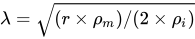
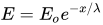
On the underside of the squid's body, between the head and the mantle, is a siphon through which water can be rapidly expelled by the fast contractions of the body wall muscles of the animal. This contraction is initiated by action potentials in the giant axon. Action potentials travel faster in a larger axon than a smaller one,[5] and squid have evolved the giant axon to improve the speed of their escape response. The increased radius of the squid axon decreases the internal resistance of the axon, as resistance is inversely proportional to the cross sectional area of the object. This increases the space constant (), leading to faster local depolarization and a faster action potential conduction ().[6]
In their Nobel Prize-winning work uncovering ionic mechanism of action potentials, Alan Hodgkin and Andrew Huxley performed experiments on the squid giant axon, using the longfin inshore squid as the model organism.[7] The prize was shared with John Eccles. The large diameter of the axon provided a great experimental advantage for Hodgkin and Huxley as it allowed them to insert voltage clamp electrodes inside the lumen of the axon.
While the squid axon is very large in diameter it is unmyelinated which decreases the conduction velocity substantially. The conduction velocity of a typical 0.5 mm squid axon is about 25 m/s. During a typical action potential in the cuttlefish Sepia giant axon, an influx of 3.7 pmol/cm2 (picomoles per centimeter2) of sodium is offset by a subsequent efflux of 4.3 pmol/cm2 of potassium.[8]
See also[edit]
References[edit]
- ^ Kingsley, J. S. (1913). "Obituary. Leonard Worcester Williams" (PDF). The Anatomical Record. 7: 33–38. doi:10.1002/ar.1090070202.
- ^ Williams, Leonard Worcester (1909). Anatomy of the Common Squid: Loligo pealii, Lesueur. Leiden, Holland: Library and Printing-office late E.J. Brill. p. 74. OCLC 697639284 – via Internet Archive.
- ^ Young, J.Z. (April 1938). "The Functioning of the Giant Nerve Fibres of the Squid". Journal of Experimental Biology. 15 (2): 170–185. doi:10.1242/jeb.15.2.170 – via The Company of Biologists Ltd.
- ^ Young, J.Z. (June 1985). "Cephalopods and Neuroscience". Biological Bulletin. 168 (3S): 153–158. doi:10.2307/1541328. JSTOR 1541328.
- ^ Purves, Dale; Augustine, George J.; Fitzpatrick, David; Katz, Lawrence C.; LaMantia, Anthony-Samuel; McNamara, James O.; Williams, S. Mark (2001). "Increased Conduction Velocity as a Result of Myelination". Neuroscience. 2nd edition. Sunderland, MA.
{{cite book}}: CS1 maint: location missing publisher (link) - ^ Holmes, William (2014). "Cable Equation". In Jaeger, Dieter; Jung, Ranu (eds.). Encyclopedia of Computational Neuroscience. New York, NY: Springer. doi:10.1007/978-1-4614-7320-6. ISBN 978-1-4614-7320-6. S2CID 29482994. Retrieved August 30, 2020.
- ^ Hodgkin AL, Huxley AF (August 1952). "A quantitative description of membrane current and its application to conduction and excitation in nerve". The Journal of Physiology. 117 (4): 500–44. doi:10.1113/jphysiol.1952.sp004764. PMC 1392413. PMID 12991237.
- ^ Plonsey, Robert; Barr, Roger C. (2007). Bioelectricity: A Quantitative Approach (3rd ed.). New York, NY: Springer. p. 109. ISBN 978-0-387-48864-6.
Cephalopod anatomy | ||||||||||||||
|---|---|---|---|---|---|---|---|---|---|---|---|---|---|---|
| Shell |
|    | ||||||||||||
| Mantle & funnel |
| |||||||||||||
| Head & limbs |
| |||||||||||||
| General |
| |||||||||||||
Developmental stages: Spawn → Paralarva (Doratopsis stage) → Juvenile → Subadult → Adult • Egg fossils • Protoconch (embryonic shell) | ||||||||||||||