


Tensor–vector–scalar gravity
Tensor–vector–scalar gravity (TeVeS),[1] developed by Jacob Bekenstein in 2004, is a relativistic generalization of Mordehai Milgrom's Modified Newtonian dynamics (MOND) paradigm.[2][3]
The main features of TeVeS can be summarized as follows:
- As it is derived from the action principle, TeVeS respects conservation laws;
- In the weak-field approximation of the spherically symmetric, static solution, TeVeS reproduces the MOND acceleration formula;
- TeVeS avoids the problems of earlier attempts to generalize MOND, such as superluminal propagation;
- As it is a relativistic theory it can accommodate gravitational lensing.
The theory is based on the following ingredients:
- A unit vector field;
- A dynamical scalar field;
- A nondynamical scalar field;
- A matter Lagrangian constructed using an alternate metric;
- An arbitrary dimensionless function.
These components are combined into a relativistic Lagrangian density, which forms the basis of TeVeS theory.
Details
[edit]MOND[2] is a phenomenological modification of the Newtonian acceleration law. In Newtonian gravity theory, the gravitational acceleration in the spherically symmetric, static field of a point mass at distance from the source can be written as


where is Newton's constant of gravitation. The corresponding force acting on a test mass is


To account for the anomalous rotation curves of spiral galaxies, Milgrom proposed a modification of this force law in the form
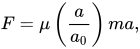
where is an arbitrary function subject to the following conditions:

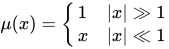
In this form, MOND is not a complete theory: for instance, it violates the law of momentum conservation.
However, such conservation laws are automatically satisfied for physical theories that are derived using an action principle. This led Bekenstein[1] to a first, nonrelativistic generalization of MOND. This theory, called AQUAL (for A QUAdratic Lagrangian) is based on the Lagrangian
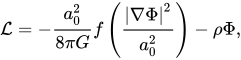
where is the Newtonian gravitational potential, is the mass density, and is a dimensionless function.


In the case of a spherically symmetric, static gravitational field, this Lagrangian reproduces the MOND acceleration law after the substitutions and are made.


Bekenstein further found that AQUAL can be obtained as the nonrelativistic limit of a relativistic field theory. This theory is written in terms of a Lagrangian that contains, in addition to the Einstein–Hilbert action for the metric field , terms pertaining to a unit vector field and two scalar fields and , of which only is dynamical. The TeVeS action, therefore, can be written as



The terms in this action include the Einstein–Hilbert Lagrangian (using a metric signature and setting the speed of light, ):
![{\displaystyle [+,-,-,-]}](https://wikimedia.org/api/rest_v1/media/math/render/svg/aac20348c9806cad564d1e470a20a3b51d3c513f)

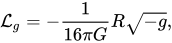
where is the Ricci scalar and is the determinant of the metric tensor.


The scalar field Lagrangian is
![{\displaystyle {\mathcal {L}}_{s}=-{\frac {1}{2}}\left[\sigma ^{2}h^{\alpha \beta }\partial _{\alpha }\phi \partial _{\beta }\phi +{\frac {1}{2}}{\frac {G}{l^{2}}}\sigma ^{4}F\left(kG\sigma ^{2}\right)\right]{\sqrt {-g}},}](https://wikimedia.org/api/rest_v1/media/math/render/svg/c910261c12afb49cc5747695ffa0526b8a9d78fd)
where is a constant length, is the dimensionless parameter and an unspecified dimensionless function; while the vector field Lagrangian is



![{\displaystyle {\mathcal {L}}_{v}=-{\frac {K}{32\pi G}}\left[g^{\alpha \beta }g^{\mu \nu }\left(B_{\alpha \mu }B_{\beta \nu }\right)+2{\frac {\lambda }{K}}\left(g^{\mu \nu }u_{\mu }u_{\nu }-1\right)\right]{\sqrt {-g}}}](https://wikimedia.org/api/rest_v1/media/math/render/svg/30fd6acf4b68ec3cb54a8332f9f97fe71213c2b5)
where while is a dimensionless parameter. and are respectively called the scalar and vector coupling constants of the theory. The consistency between the Gravitoelectromagnetism of the TeVeS theory and that predicted and measured by the Gravity Probe B leads to ,[4] and requiring consistency between the near horizon geometry of a black hole in TeVeS and that of the Einstein theory, as observed by the Event Horizon Telescope leads to [5] So the coupling constants read:



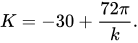

The function in TeVeS is unspecified.
TeVeS also introduces a "physical metric" in the form

The action of ordinary matter is defined using the physical metric:

where covariant derivatives with respect to are denoted by


TeVeS solves problems associated with earlier attempts to generalize MOND, such as superluminal propagation. In his paper, Bekenstein also investigated the consequences of TeVeS in relation to gravitational lensing and cosmology.
Problems and criticisms
[edit]In addition to its ability to account for the flat rotation curves of galaxies (which is what MOND was originally designed to address), TeVeS is claimed to be consistent with a range of other phenomena, such as gravitational lensing and cosmological observations. However, Seifert[6] shows that with Bekenstein's proposed parameters, a TeVeS star is highly unstable, on the scale of approximately 106 seconds (two weeks). The ability of the theory to simultaneously account for galactic dynamics and lensing is also challenged.[7] A possible resolution may be in the form of massive (around 2eV) neutrinos.[8]
A study in August 2006 reported an observation of a pair of colliding galaxy clusters, the Bullet Cluster, whose behavior, it was reported, was not compatible with any current modified gravity theory.[9]
A quantity [10] probing general relativity (GR) on large scales (a hundred billion times the size of the solar system) for the first time has been measured with data from the Sloan Digital Sky Survey to be[11] (~16%) consistent with GR, GR plus Lambda CDM and the extended form of GR known as theory, but ruling out a particular TeVeS model predicting . This estimate should improve to ~1% with the next generation of sky surveys and may put tighter constraints on the parameter space of all modified gravity theories.


TeVeS appears inconsistent with recent measurements made by LIGO of gravitational waves.[12]
See also
[edit]- Gauge vector–tensor gravity
- Modified Newtonian dynamics
- Nonsymmetric gravitational theory
- Scalar–tensor–vector gravity
References
[edit]- ^ a b Bekenstein, J. D. (2004), "Relativistic gravitation theory for the modified Newtonian dynamics paradigm", Physical Review D, 70 (8): 083509, arXiv:astro-ph/0403694, Bibcode:2004PhRvD..70h3509B, doi:10.1103/PhysRevD.70.083509
- ^ a b Milgrom, M. (1983), "A modification of the Newtonian dynamics as a possible alternative to the hidden mass hypothesis", The Astrophysical Journal, 270: 365–370, Bibcode:1983ApJ...270..365M, doi:10.1086/161130
- ^ Famaey, B.; McGaugh, S. S. (2012), "Modified Newtonian Dynamics (MOND): Observational Phenomenology and Relativistic Extensions", Living Rev. Relativ., 15 (10): 10, arXiv:1112.3960, Bibcode:2012LRR....15...10F, doi:10.12942/lrr-2012-10, ISSN 1433-8351, PMC 5255531, PMID 28163623
- ^ Exirifard, Q. (2013), "GravitoMagnetic Field in Tensor-Vector-Scalar Theory", Journal of Cosmology and Astroparticle Physics, JCAP04 (4): 034, arXiv:1111.5210, Bibcode:2013JCAP...04..034E, doi:10.1088/1475-7516/2013/04/034, S2CID 250745786
- ^ Exirifard, Q. (2019), "Addendum: GravitoMagnetic field in tensor-vector-scalar theory", Journal of Cosmology and Astroparticle Physics, JCAP05 (5): A01, arXiv:1111.5210, doi:10.1088/1475-7516/2019/05/A01, S2CID 182361144
- ^ Seifert, M. D. (2007), "Stability of spherically symmetric solutions in modified theories of gravity", Physical Review D, 76 (6): 064002, arXiv:gr-qc/0703060, Bibcode:2007PhRvD..76f4002S, doi:10.1103/PhysRevD.76.064002, S2CID 29014948
- ^ Mavromatos, Nick E.; Sakellariadou, Mairi; Yusaf, Muhammad Furqaan (2009), "Can TeVeS avoid Dark Matter on galactic scales?", Physical Review D, 79 (8): 081301, arXiv:0901.3932, Bibcode:2009PhRvD..79h1301M, doi:10.1103/PhysRevD.79.081301, S2CID 119249051
- ^ Angus, G. W.; Shan, H. Y.; Zhao, H. S.; Famaey, B. (2007), "On the Proof of Dark Matter, the Law of Gravity, and the Mass of Neutrinos", The Astrophysical Journal Letters, 654 (1): L13–L16, arXiv:astro-ph/0609125, Bibcode:2007ApJ...654L..13A, doi:10.1086/510738, S2CID 17977472
- ^ Clowe, D.; Bradač, M.; Gonzalez, A. H.; Markevitch, M.; Randall, S. W.; Jones, C.; Zaritsky, D. (2006), "A Direct Empirical Proof of the Existence of Dark Matter", The Astrophysical Journal Letters, 648 (2): L109, arXiv:astro-ph/0608407, Bibcode:2006ApJ...648L.109C, doi:10.1086/508162, S2CID 2897407
- ^ Zhang, P.; Liguori, M.; Bean, R.; Dodelson, S. (2007), "Probing Gravity at Cosmological Scales by Measurements which Test the Relationship between Gravitational Lensing and Matter Overdensity", Physical Review Letters, 99 (14): 141302, arXiv:0704.1932, Bibcode:2007PhRvL..99n1302Z, doi:10.1103/PhysRevLett.99.141302, PMID 17930657, S2CID 119672184
- ^ Reyes, R.; Mandelbaum, R.; Seljak, U.; Baldauf, T.; Gunn, J. E.; Lombriser, L.; Smith, R. E. (2010), "Confirmation of general relativity on large scales from weak lensing and galaxy velocities", Nature, 464 (7286): 256–258, arXiv:1003.2185, Bibcode:2010Natur.464..256R, doi:10.1038/nature08857, PMID 20220843, S2CID 205219902
- ^ Boran, Sibel; Desai, Shantanu; Kahya, Emre; Woodard, Richard (2018), "GW170817 Falsifies Dark Matter Emulators", Physical Review D, 97 (4): 041501, arXiv:1710.06168, Bibcode:2018PhRvD..97d1501B, doi:10.1103/PhysRevD.97.041501, S2CID 119468128
Further reading
[edit]- Bekenstein, J. D.; Sanders, R. H. (2006), "A Primer to Relativistic MOND Theory", EAS Publications Series, 20: 225–230, arXiv:astro-ph/0509519, Bibcode:2006EAS....20..225B, doi:10.1051/eas:2006075, S2CID 6539084
- Zhao, H. S.; Famaey, B. (2006), "Refining the MOND Interpolating Function and TeVeS Lagrangian", The Astrophysical Journal, 638 (1): L9–L12, arXiv:astro-ph/0512425, Bibcode:2006ApJ...638L...9Z, doi:10.1086/500805, S2CID 14867245
- Dark Matter Observed (SLAC Today)
- Einstein's Theory 'Improved'? (PPARC)
- Einstein Was Right: General Relativity Confirmed ' TeVeS, however, made predictions that fell outside the observational error limits', (Space.com)