Three-wheeler
 | This article needs additional citations for verification. (January 2012) |


A three-wheeler is a vehicle with three wheels. Some are motorized tricycles, which may be legally classed as motorcycles, while others are tricycles without a motor, some of which are human-powered vehicles and animal-powered vehicles.
Overview[edit]
Many three-wheelers which exist in the form of motorcycle-based machines are often called trikes and often have the front single wheel and mechanics similar to that of a motorcycle and the rear axle similar to that of a car. Often such vehicles are owner-constructed using a portion of a rear-engine, rear-drive Volkswagen Beetle in combination with a motorcycle front end. Other trikes include All-terrain vehicles that are specially constructed for off-road use.
Three-wheelers can have either one wheel at the back and two at the front (2F1R), (for example: Morgan Motor Company) or one wheel at the front and two at the back (1F2R) (such as the Reliant Robin). Due to better safety when braking, an increasingly popular form is the front-steering "tadpole" or "reverse trike" sometimes with front drive but usually with rear drive. A variant on the 'one at the front' layout was the Scott Sociable, which resembled a four-wheeler with a front wheel missing.[1]
Three-wheelers, including some cyclecars, bubble cars and microcars, are built for economic and legal reasons: in the UK for tax advantages, or in the US to take advantage of lower safety regulations, being classed as motorcycles. As a result of their light construction and potential better streamlining, three-wheeled cars are usually less expensive to operate.[citation needed]
Some inexpensive three-wheelers have been designed specifically to improve mobility for disabled people.[2]
Three-wheeler transport vehicles known as auto rickshaws are a common means of public transportation in many countries in the world, and are an essential form of urban transport in many developing countries such as India and the Philippines.
History[edit]
Early automotive pioneer Karl Benz developed a number of three-wheeled models.[3] One of these, the Benz Patent Motorwagen,[4] is regarded as the first purpose-built automobile. It was made in 1885.
In 1896, John Henry Knight showed a tri-car at The Great Exhibition.[3]
In 1897, Edward Butler made the Butler Petrol Cycle, another three-wheeled car.
A Conti 6 hp Tri-car competed in (but did not complete) a 1907 Peking to Paris race sponsored by a French newspaper, Le Matin.[5]
-

-
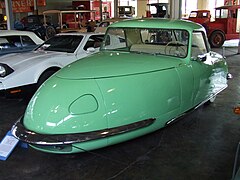
 Goliath pickup truck at a meeting for vintage cars in the 1990s
 -
-
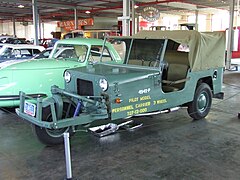 Davis 494, at the National Automotive and Truck Museum, Auburn, Indiana, USA
 -
 Velorex was a manufacturing cooperative in Solnice, Czechoslovakia, formed in 1936 to satisfy demand for small, inexpensive city cars.
 -
-
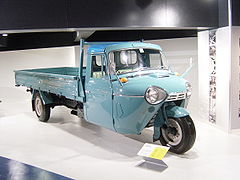
 An early Daihatsu Midget, which would serve as the basis for auto rickshaws that proliferate across South and Southeast Asia
 -
 Reliant Robin 3-wheeler car.
 -


Configurations[edit]

Two front[edit]
A configuration of two wheels in the front and one wheel at the back presents two advantages: it has improved aerodynamics, and that it readily enables the use of a small lightweight motorcycle powerplant and rear wheel. This approach was used by the Messerschmitt KR200 and BMW Isetta. Alternatively, a more conventional front-engine, front wheel drive layout as is common in four-wheeled cars can be used, with subsequent advantages for transversal stability (the center of mass is further to the front) and traction (two driven wheels instead of one). Some vehicles have a front engine driving the single rear wheel, similar to the rear engine driving the rear wheel. The wheel must support acceleration loads as well as lateral forces when in a turn, and loss of traction can be a challenge.
A new tadpole configuration has been proposed with a rear engine driving the front wheels. This concept (Dragonfly Three Wheeler[6]) claims both stability and traction (two driven wheels), as well as a unique driving experience.
With two wheels in the front (the "tadpole" form or "reverse trike") the vehicle is far more stable in braking turns, but remains more prone to overturning in normal turns compared to an equivalent four-wheeled vehicle, unless the center of mass is lower and/or further forward. Motorcycle-derived designs suffer from most of the weight being toward the rear of the vehicle.[citation needed]
For lower wind resistance (which increases fuel efficiency), a teardrop shape is often used.[citation needed] A teardrop is wide and round at the front, tapering at the back. The three-wheel configuration allows the two front wheels to create the wide round surface of the vehicle. The single rear wheel allows the vehicle to taper at the back. Examples include the Aptera (solar electric vehicle) and Myers Motors NmG.
Two rear[edit]
Having one wheel in front and two in the rear for power reduces the cost of the steering mechanism but greatly decreases lateral stability when cornering while braking.
When the single wheel is in the front (the "delta" form, as in a child's pedal tricycle), the vehicle is inherently unstable in a braking turn, as the combined tipping forces at the center of mass from turning and braking can rapidly extend beyond the triangle formed by the contact patches of the wheels. This type, if not tipped, also has a greater tendency to spin out ("swap ends") when handled roughly.[citation needed]
Lateral stability[7][edit]
The disadvantage of a three-wheel configuration is that lateral stability is lower than with a four-wheeled vehicle.
With any vehicle, an imaginary line can be projected from the vehicles centre of mass to the ground, representing the force exerted on the vehicle by its mass. With the vehicle stationary, the line will be vertical. As the vehicle accelerates, that imaginary line tilts backward, remaining anchored to the centre of mass the point at which the line intersects the ground moves backward. As you brake it moves forward, with cornering it moves sideward. Should the point at which this line intersects the ground move outside of the boundary formed by connecting the tyre contact patches together (a rectangle for a four-wheeled car, or a triangle for a trike) then the vehicle will tip and eventually fall over. This is true for any vehicle.
With all vehicles it is critical that the vehicle should be engineered to slide before this point of instability is reached.
This can be achieved in several ways:
- by placing the center of mass closer to the ground
- by placing the center of mass closer to the axle with two wheels (for three wheelers)
- by increasing the track width
- by limiting the grip provided by the tyres, such that the vehicle loses adhesion before it starts to tip.
- By tilting some or all of the vehicle as it corners.
In the case of a three-wheeled ATV, tipping may be avoided by the rider leaning into turns.
Tilting option[edit]


To improve stability some three-wheelers are designed to tilt while cornering like a motorcyclist would do. The tilt may be controlled manually, mechanically or by computer.
A tilting three-wheeler's body or wheels, or both, tilt in the direction of the turn. Such vehicles can corner safely even with a narrow track.
Some tilting three-wheelers could be considered to be forms of feet forward motorcycles or cabin motorcycles or both.
Electric three wheelers[edit]
Battery-powered three wheelers[edit]

Three-wheeled battery powered designs include:
- Aptera (solar electric vehicle)
- Arcimoto
- CityEl
- Commuter Cars Tango
- Cree SAM
- ElectraMeccanica SOLO
- Myers Motors NmG (formerly Corbin Sparrow)
- Nobe GT100
- Toyota i-Road
- Triac
- Vanderhall Edison 2
- ZAP Xebra
- EWheels EW 36(mobility scooter)
Solar-powered three wheelers[edit]
Here are three notable examples of solar-powered three wheelers; two race cars, the Infinium and the Sky Ace TIGA, and a vehicle planned for production, the Aptera.

The Infinium, built by the University of Michigan Solar Car Team, came in 3rd place in the 2009 World Solar Challenge held in Australia, and won the 2010 American Solar Challenge.
Ashiya University's Sky Ace TIGA achieved 91.332 kilometres per hour (56.751 mph) at Shimojishima Airport, in Miyakojima, Okinawa, Japan, to win the Guinness World Record, on 20 August 2014.[8] It took the record from another three-wheeler, Sunswift IV, designed and built at the University of New South Wales in Australia,[9] by a margin of almost 3 km/h.

The Aptera solar electric vehicle[10] uses a tadpole layout and is being designed to have a top speed of over 100 mph. The Aptera uses 42 KW in-wheel electric motors[11] and can be ordered with two (front-wheel drive) or three (all-wheel drive) motors. The Aptera's roof and dashboard, and optionally its hood and hatch, are fitted with solar panels, with the full compliment being designed to add a range of up to 40 miles per day and 11,000 miles per year in the sunniest climates. First customer availability is planned for before the end of 2024.[12]
Steam-powered three wheelers[edit]

The world's first full-size self-propelled land vehicle was a three-wheeler. French Army Captain Nicolas-Joseph Cugnot's 1770 fardier à vapeur (steam dray), a steam tricycle with a top speed of around 3 km/h (2 mph), was intended for hauling artillery.[13]
Another of the earliest preserved examples is the Long steam tricycle, built by George A. Long around 1880 and patented in 1883,[14][15] now on display at the Smithsonian Institution.
Wind-powered three wheelers[edit]
The Whike is a recumbent tricycle with a sail, made in the Netherlands.
All-terrain vehicles[edit]

Due to the incidence of injuries and deaths related to their use, a 10-year ban, entirely voluntary for manufacturers, was placed on the sale of new three-wheeled all-terrain vehicles in the United States in January 1988.[citation needed] More injuries were sustained by riders by not applying a proper riding technique, and lack of wearing proper safety gear such as helmets and riding boots. In a search conducted by the Consumer Product Safety Commission, it was determined that "no inherent flaw was found in the three wheel design".[citation needed]
Registration[edit]

 | The examples and perspective in this section may not represent a worldwide view of the subject. (October 2015) |
In the U.S, the National Highway Traffic Safety Administration defines and regulates three-wheeled vehicles as motorcycles.[16] However, in 2015 a bill was introduced in Congress that would prevent some three wheeled vehicles from being classified as motorcycles in the United States, instead creating a new classification for "autocycles".[17][18]
Driver's license and registration requirements vary on a state-by-state basis. Some states require drivers of three wheeled vehicles to have a motorcycle license and register the vehicle as a motorcycle. Some states, including Virginia, Kansas, and Indiana, classify some three wheeled vehicles as autocycles. Virginia defines an autocycle as "a three-wheeled motor vehicle that has a steering wheel and seating that does not require the operator to straddle or sit astride and is manufactured to comply with federal safety requirements for motorcycles."[19] Indiana defines it as "a three (3) wheeled motor vehicle in which the operator and passenger ride in a completely or partially enclosed seating area that is equipped with:(1) a rollcage or roll hoops; (2) safety belts for each occupant; and (3) antilock brakes;and is designed to be controlled with a steering wheel and pedals."[20] In other jurisdictions, such as British Columbia, Canada, and Connecticut, a three-wheeled vehicle with an enclosed passenger compartment or partially enclosed seat is considered an automobile.[citation needed]
Examples[edit]
Two front wheels[edit]
| Name | Country | Years manufactured | Comments |
|---|---|---|---|
| Léon Bollée Voiturette | France | 1895–? | |
| TriPodCars[21] Tripod 1 | Australia | 2012–? | 400 kg Reverse Trike, Bandit 1250, ZX14R (200+ hp) and EV |
| Berkeley Cars Berkeley T60 | England | 1959 | |
| Egg | Switzerland | 1896–99 | |
| Advance 6 hp air-cooled Tri Car and 9 hp water-cooled Tri Car[22] | England | 1902–12 | |
| Humber Tricar[23][24] | England | 1904 | |
| Riley Olympia Tricar[25] | England | 1904 | [26] |
| Mars Carette[27] | England | 1904–05 | Mars Motors Co existed in Finchley, London, White and Poppe water-cooled engine, Single-cylinder, 3.3 kW |
| Lagonda Tricar[28] | England | 1904–07 | total production: 69 cars |
| Anglian | England | 1905–07 | |
| Armadale | England | 1906–07 | |
| Ranger Cub | England | 1970–1980 | Reverse Trike/Tadpole, A-Series engine 848-1275cc |
| Morgan V-Twin and F-Series | England | 1911–39, 1932–52 | Morgan Super Sports 2-Seater 1937 |
| American Tri-Car | United States | 1912 | |
| Birmingham Small Arms Company Three Wheeler | England | 1929–36 | 1100cc engine[29] |
| Zaschka | Germany | 1929 | Folding three-wheeler: Zaschka Three-wheeler 1929 |
| Dymaxion car | United States | 1933 | Concept car designed by Buckminster Fuller |
| Mathis VEL 333 | France | 1946 | 3 seats, flat-twin front engine, aluminium body, production less than 10 units |
| Fend Flitzer | Germany | 1948 - 1951 | 1 seat, Messerschmitt kabinenroller precursor, production about 250 units |
| 1951 Hoffmann | Germany | 1951 | 2 seats, aluminium body, engine mounted on the rear wheel steering pivot |
| Velorex Oskar and other models | Czechoslovakia | 1951–71 | Originally with leather bodies |
| Isetta | UK | 1957–62 | Three-wheeled version of the Isetta built in the UK to take advantage of tax and licensing regulations |
| Scootacar | UK | 1957–64 | |
| Messerschmitt KR175 | Germany | 1953–55 | |
| Messerschmitt KR200 | Germany | 1955–64 | |
| Peel P50 | Isle of Man | 1963–64 | Smallest production car ever built |
| HM Vehicles Free-way | United States | 1979–82 | |
| Campagna T-Rex | Canada | 1996–present | |
| Malone Car Company F1000|Skunk SS|TAZR | United Kingdom | 1999–present | High-power internal combustion and pure electric versions released November 2010 |
| Cree SAM | Switzerland | 2001 | Electric, only 80 produced |
| Myers Motors NmG ("No more Gas") | United States | 2006–present | Single-occupant all-electric plug-in |
| BRP Can-Am Spyder RoadsterCan-Am Spyder Roadster | Canada | 2007–present | The Can-Am Spyder is a three-wheeled motorcycle manufactured by Bombardier Recreational Products. |
| Brudeli 645L | Norway | 2008– | |
| Moonbeam | United States | 2008–present | 100 mpg DIY, fabric-covered car based on parts from two Honda 150cc motorscooters[30] |
| Triac | United States | 2009–2011 | Electric, never entered production |
| XR-3 Hybrid | United States | Plans–2008, Kit–2009 | Front 3-cylinder diesel (125 mpg), rear electric 40 mile range (220 mpg when used as a hybrid)[31] |
| Aptera (solar electric vehicle) | United States | 2022 planned | Solar-powered Electric |
| Triton Trike | United States | 2000–present | Gas-powered, 42+ mpg, front-wheel drive, custom builds and kits available |
| Nobe GT100 | Estonia & United States | 2021 planned | Electric, powered at all 3 wheels |
| Polaris Slingshot | United States | 2015–present | |
| Vanderhall Laguna Roadster | United States | 2016–2018 | Exotic Auto-cycle, mono-aluminum chassis, carbon fiber body, 200 HP, 1550 pounds dry weight, side-by-side seating, fwd. 1.4 liter turbo GM power plant. 6 speed Automatic with paddle shift option. Manufactured by Vanderhall Motor Works in Provo, Utah U.S.A |
| Vanderhall Venice | United States | 2017–present | The mainstay of the Vanderhall line up, the Venice brings the soul of roadster motoring while extending effortless performance in kind.[32] |
| Vanderhall Carmel | United States | 2020–present | The Vanderhall Carmel brings more luxury and convenience to the Carmel lineup. With provisions to accommodate a removable capshade, the Carmel promises additional class and comfort for your journey.[33] |
| Vanderhall Edison | United States | 2020–present | The Edison2: A fully electric roadster that combines refined and eye-catching design while maintaining classic, elegant lines. Unplug and play has been redefined [34] |
| Elio Motors | Shreveport, LA, United States | Awaiting funding | Two passenger fully enclosed cockpit with car controls |
| Girfalco Azkarra | Canada | 2017 | All-electric two-passenger three-wheeled vehicle, possibly the quickest three-wheeler |
| Go3Wheeler | United States | 2014 | single person three wheeler |
| Corbin Sparrow | |||
| Piaggio MP3 | |||
| Tri-Magnum | United States | Tilting 3-wheeler capable of seating two people.[35] | |
| Volkswagen GX3 | |||
| Morgan 3-Wheeler | England | 2012–present | The power train is a 1983cc ‘V-twin’ fuel injected engine mated to a Mazda 5 speed (and reverse) gearbox |
| Fuel Vapours Alé | Canada | 2005–present | Prototype. Gets 92 mpg. |
| Arcimoto FUV | United States | 2019–present | Two passenger all-electric, 102 mile range City |
| Fiberfab Scarab STM | United States | 1976 | Kit car with canopy door manufactured by Fiberfab |
| Bricklin 3EV | United States | Planned | Two passenger electric vehicle from Malcolm Bricklin.[36] |

Two rear wheels[edit]
| Name | Country | Years manufactured | Comments |
|---|---|---|---|
| Apino | Brazil | unknown | Mini Truck |
| Benz Patent Motorwagen | Germany | 1886–93 | |
| Eco-Fueler | USA | 2009–2011 | 2 seater built in Oregon.[37] |
| La Va Bon Train | France | 1904–10 | 50–100 believed built |
| Davis D-2 Divan | United States | 1947–48 | about 13–17 built, including the 494, a Jeep-like military vehicle[38] |
| Scammell Scarab | England | 1948–67 | |
| Autoette | United States | 1948–70 | |
| Daihatsu Bee | Japan | 1951–1952 | |
| Daihatsu Midget | Japan | 1957–72 | |
| Mazda T-2000 | Japan | 1957–74 | |
| Mazda K360 | Japan | 1959–69 | |
| Mazda T600 | Japan | 1959–71 | |
| Kia K-360 | South Korea | 1962–1973 | Kia's first truck (OEM Mazda K-360) |
| Kia T-1500 | South Korea | 1963–? | 1484 cc, 60 hp, four cylinder and a maximum load of 1.5 tons. (OEM Mazda T-1500) |
| Kia T-600 | South Korea | 1969–1974 | 577cc, 20 HP and 500 kg load. Top speed of 75 km/h. 7726 produced (OEM Mazda T-600) |
| Kia T-2000 | South Korea | 1967–1981 | 1985 cc, 81 hp, four cylinder and a maximum load of 2 tons. 15952 produced (OEM Mazda T-2000) |
| Piaggio Ape | Italy | 1948–present | |
| Electra-King | United States | 1964?–1980s? | Two-seater electric car[39] |
| Bond 875 | England | 1965–70 | |
| Bond Bug | England | 1970–74 | |
| Reliant Robin | England | 1973–81, 1989–2002 | |
| Reliant Regal | England | 1953–1973 | An example of this vehicle is the iconic van belonging to Del Boy and Rodney Trotter in the long-running BBC sitcom Only Fools and Horses, though it is often incorrectly referred to as a Reliant Robin. |
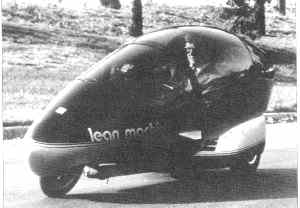
| GM Lean Machine[40][41] | United States | 1980s | Tilt, concept car[42] |
| TriVette | United States | 1974–1976 | |
| Twike | Germany | 1995–present | Electric-human-power hybrid, developed in Switzerland |
| ZAP Xebra | United States | 2006–2009 | electric power |
| eTuk | United States | 2014– | re-designed tuk tuk for the US Market, including an all-electric motor[43] |
| Snyder ST600-c | United States | 2011–2012 | Imported by Snyder Technologies / Wildfire Motors, this is a rebrand of the Fulu Motors 富路金骏马, Fulu Jinjunma in English. Referred to as the 09 golden horse internally. |
| Carver | Netherlands | 2007–2009 | Tilt |
| CityEl | Denmark | Mini-El, City-El | |
| CLEVER | |||
| Harley-Davidson Servi-Car |
United States | 1932-1973[44] | |
| Harley-Davidson Tri Glide |
United States | since 2009 |
See also[edit]
References[edit]
- ^ "Scott Sociable". Retrieved 2015-10-05.
- ^ Stańko-Pająk, K; Bursa, B; Seńko, J; Detka, T; Korczak, S; Nowak, R; Popiołek, K; Lisiecki, J; Paczkowski, A (2022-07-01). "A three-wheeled vehicle for the disabled people". IOP Conference Series: Materials Science and Engineering. 1247 (1): 012039. Bibcode:2022MS&E.1247a2039S. doi:10.1088/1757-899X/1247/1/012039. ISSN 1757-8981. S2CID 250504234.
- ^ a b Elvis Payne (2012). "The History of the 3-Wheeled Vehicle". 3-wheelers.com. Retrieved 2012-01-03.
- ^ Chris Chong (July 2, 2006). "History in its magnificence". star-motoring.com. Archived from the original on 2007-10-24. Retrieved 2008-01-20.
- ^ "History". pekingparisraid.co.uk. Archived from the original on 2007-08-26. Retrieved 2008-01-20.
- ^ Design. "Dragonfly three wheeler". www.dragonflythreewheeler.com. Retrieved 2021-06-09.
- ^ Riley, Robert Q. "The Dynamic Stability of Three-Wheeled Vehicles in Automotive-Type Applications". Robert Q. Riley Enterprises. Archived from the original on 2020-09-22.
- ^ "Fastest solar-powered vehicle". Guinness World Records.
- ^ "Aussie car breaks a world speed record". AAP. 7 January 2011. Retrieved 2011-01-07.
- ^ Voelcker, John (2019-08-28). "Exclusive: 3-Wheeled Aptera Reboots as World's Most Efficient Electric Car". IEEE Spectrum. IEEE. Retrieved 2020-01-20.
- ^ "Aptera solar EV Launch Edition: 400-mile range, no Supercharging yet". Green Car Reports. 2023-01-22. Retrieved 2023-03-18.
- ^ Chris (2023-01-27). "Aptera Announces Accelerator Program to Kick Off Production Plan". Aptera. Retrieved 2023-02-24.
- ^ "Fardier de Cugnot". Archived from the original on July 16, 2013.
- ^ "1880 Long Steam Tricycle - Pictures". Remarkablecars.com. 2009-06-17. Retrieved 2010-07-29.[dead link]
- ^ "America on the Move | Long steam tricycle". Americanhistory.si.edu. 2008-10-24. Retrieved 2014-06-17.
- ^ "Highway Safety - Title 23, United States Code, Chapter 4 and Related Highway Safety Provisions" (PDF). December 2008. Retrieved 2015-10-05.
- ^ "Newly Introduced Federal Legislation Would Ensure That Three-Wheeled Automobiles Are Not Classified As Motorcycles". Motorcycle Law Group. Retrieved 26 April 2017.
- ^ "S.685 - Autocycle Safety Act". Congress. 10 March 2015. Retrieved 26 April 2017.
- ^ Va. Code Ann. § 46.2-100 (West)
- ^ Ind. Code Ann. § 9-13-2-6.1 (West)
- ^ "Tri Pod Cars".
- ^ "Advance Fore-Cars and Tri-Cars". oakingtonplane.co.uk. Archived from the original on 2008-01-12. Retrieved 2008-01-23.
- ^ "British Motor Manufacturers (1894-1960) Humber". britishmm.co.uk. Archived from the original on February 21, 2009. Retrieved 2008-01-20.
- ^ "Humber History". histomobile.com. Archived from the original on June 8, 2007. Retrieved 2008-01-20.
- ^ "Rileys 1896 - 1939 The Pre-Nuffield Years". Rob's Riley Pages (ukonline.co.uk/rileyrob). Archived from the original on March 21, 2005. Retrieved 2008-01-20.
- ^ illustration Archived December 29, 2010, at the Wayback Machine
- ^ "1904 Mars Carette - Franschhoek Motor Museum". 20 October 2017. Retrieved 2020-11-24.
- ^ "The History of Classic Cars: 1905 Lagonda Tricar". autoclassic.com. Retrieved 2008-01-20.
- ^ Peter Bowler, president The BSAFWD Club. "image and description". Bsafwdc.co.uk. Archived from the original on 2012-02-05. Retrieved 2012-04-09.
- ^ Wilson, Mark (2006-09-24). "Moonbeam: 100mpg Homemade Car". Gizmodo.com. Retrieved 2015-10-05.
- ^ "XR3 Hybrid Personal Transit Vehicle: A 125 mpg Plug-In Hybrid Three Wheeler You Build From Plans". Rqriley.com. Retrieved 2012-04-09.
- ^ "Venice". Vanderhall Motor Works. Retrieved 2020-09-18.
- ^ "Carmel". Vanderhall Motor Works. Retrieved 2020-09-18.
- ^ "Edison 2". Vanderhall Motor Works. Retrieved 2020-09-18.
- ^ "Project 32: A High-Performance Tilting Three-Wheel Vehicle". www.rqriley.com. Archived from the original on 15 January 2006. Retrieved 19 April 2022.
- ^ "Meet The Bricklin 3EV". www.vvcars.com.
- ^ "Eco-Fueler". www.eco-fueler.com. Archived from the original on 7 February 2011. Retrieved 19 April 2022.
- ^ Patton, Phil (September 24, 2009). "A Dreamer's Machine, More Promise Than Reality". The New York Times – via NYTimes.com.
- ^ Rob & Sharon McLellan. "advertising brochure". Mclellansautomotive.com. Retrieved 2012-04-09.
- ^ "General Motors Three Wheeled Cars". GM's Lean Machine (3-wheelers.com/gmlean). Retrieved 2008-04-08.
- ^ "Lean Machines: Preliminary Investigation" (PDF). Institute of Transportation Studies, University of California at Berkeley (commutercars.com/downloads/studies/). Retrieved 2008-04-08.
- ^ "illustration". Retrieved 2012-04-09.
- ^ "eTuk USA". Retrieved 2014-07-01.
- ^ "Remembering the 1937 Harley-Davidson Servi-Car GE". March 2022.