


Zaslavskii map
 | This article includes a list of references, related reading, or external links, but its sources remain unclear because it lacks inline citations. (June 2013) |


The Zaslavskii map is a discrete-time dynamical system introduced by George M. Zaslavsky. It is an example of a dynamical system that exhibits chaotic behavior. The Zaslavskii map takes a point () in the plane and maps it to a new point:

![{\displaystyle x_{n+1}=[x_{n}+\nu (1+\mu y_{n})+\epsilon \nu \mu \cos(2\pi x_{n})]\,({\textrm {mod}}\,1)}](https://wikimedia.org/api/rest_v1/media/math/render/svg/adfd5ccf515d6ae89e6340eb9ec4775d8ef23e40)

and
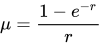
where mod is the modulo operator with real arguments. The map depends on four constants ν, μ, ε and r. Russel (1980) gives a Hausdorff dimension of 1.39 but Grassberger (1983) questions this value based on their difficulties measuring the correlation dimension.
See also[edit]
References[edit]
- G.M. Zaslavskii (1978). "The Simplest case of a strange attractor". Phys. Lett. A. 69 (3): 145–147. Bibcode:1978PhLA...69..145Z. doi:10.1016/0375-9601(78)90195-0. (LINK)
- D.A. Russel; J.D. Hanson & E. Ott (1980). "Dimension of strange attractors". Phys. Rev. 45 (14): 1175. Bibcode:1980PhRvL..45.1175R. doi:10.1103/PhysRevLett.45.1175. (LINK)
- P. Grassberger and I. Procaccia (1983). "Measuring the strangeness of strange attractors". Physica. 9D (1–2): 189–208. Bibcode:1983PhyD....9..189G. doi:10.1016/0167-2789(83)90298-1. (LINK)

