


Band cell
| Band cell | |
|---|---|
| Details | |
| Precursor | metamyelocyte |
| Gives rise to | Granulocyte |
| Identifiers | |
| TH | H2.00.04.3.04011 |
| FMA | 86471 |
| Anatomical terms of microanatomy | |


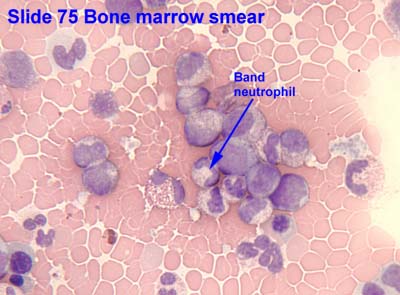
A band cell (also called band neutrophil, band form or stab cell) is a cell undergoing granulopoiesis, derived from a metamyelocyte, and leading to a mature granulocyte.
It is characterized by having a curved but not lobular nucleus.[1]
The term "band cell" implies a granulocytic lineage (e.g., neutrophils).[2]
Clinical significance[edit]
Band neutrophils are an intermediary step prior to the complete maturation of segmented neutrophils. Polymorphonuclear neutrophils are initially released from the bone marrow as band cells. As the immature neutrophils become activated or exposed to pathogens, their nucleus will take on a segmented appearance. An increase in the number of these immature neutrophils in circulation can be indicative of a infection for which they are being called to fight against, or some inflammatory process. The increase of band cells in the circulation is called bandemia and is a "left shift" process.
Blood reference ranges for neutrophilic band cells in adults are 3 to 5% of white blood cells,[3] or up to 0.7 × 10⁹/L.[4]
An excess may sometimes be referred to as bandemia.
See also[edit]
Additional images[edit]
-
 Band neutrophil in peripheral blood film
 -
 Hematopoiesis

_diagram_en.svg)
References[edit]
- ^ "band cell" at Dorland's Medical Dictionary
- ^ "Eosinophilic band". Archived from the original on 2008-08-29. Retrieved 2009-03-01.
- ^ Last page of Deepak A. Rao; Le, Tao; Bhushan, Vikas (2007). First Aid for the USMLE Step 1 2008 (First Aid for the Usmle Step 1). McGraw-Hill Medical. ISBN 978-0-07-149868-5.
- ^ Clinical Laboratory Medicine. By Kenneth D. McClatchey. Page 807.
External links[edit]
- Histology image: 01807loa – Histology Learning System at Boston University - "Bone Marrow and Hemopoiesis: bone marrow smear, neutrophil series"
- Histology at KUMC blood-blood11
- Histology image: 75_07 at the University of Oklahoma Health Sciences Center
- Histology at okstate.edu
- Slide at hematologyatlas.com - "Neutrophil band" visible in second row
- Interactive diagram at lycos.es

 | This developmental biology article is a stub. You can help Wikipedia by expanding it. |