


Baranavichy
 | This article has multiple issues. Please help improve it or discuss these issues on the talk page. (Learn how and when to remove these template messages)
|


Baranavichy
| |
|---|---|
.jpg) | |
 Flag  Coat of arms | |
  Baranavichy Location in Belarus | |
| Coordinates: 53°08′N 26°01′E / 53.133°N 26.017°E | |
| Country | Belarus |
| Region | Brest Region |
| First mentioned | 1706 |
| Founded | 1871 |
| City status since | 1919 |
| Area | |
| • Total | 53.64 km2 (20.71 sq mi) |
| Elevation | 193 m (633 ft) |
| Population (2023)[1] | |
| • Total | 172,150 |
| • Density | 3,200/km2 (8,300/sq mi) |
| Time zone | UTC+3 (MSK) |
| Postal code | 225320 |
| Area code | +375 (0)163 |
| Vehicle registration | 1 |
| Website | www |
Baranavichy (/bəˈrɑːnəvɪtʃi/ bə-RAH-nə-vitch-ee; Belarusian: Баранавічы, IPA: [baˈranavʲitʂɨ] ⓘ; Russian: Барановичи, romanized: Baranovichi [bɐˈranəvʲɪtɕɪ]; Yiddish: באַראַנאָוויטש; Polish: Baranowicze; Lithuanian: Baranovičiai) is a city in Brest Region, western Belarus.[2] It serves as the administrative center of Baranavichy District, though it is administratively separated from the district.[1][2] As of 2023, it has a population of 172,150.[1] It is notable for an important railway junction and is home to Baranavichy State University.
General information[edit]
The city of Baranavichy is located on the Baranavichy Plain in the interfluve of Shchara and its tributary Myshanka. Baranavichy is located virtually on a straight line, connecting the regional center Brest (206 km) and Minsk (149 km). Nearby cities: Lyakhavichy (17 km), Slonim (42 km), Nyasvizh (51 km), Navahrudak (52 km), and Hantsavichy (72 km). Baranavichy is located on flat terrain where the height difference does not exceed 20 m (from 180 to 200 m above sea level). The altitude of the city is 193 m above sea level. The total length of the city is 10 km from west to east and 7 km from south to north. The city is somewhat extended (by 8 km) in the southwest (from Brestskaya Street) to the northeast (to Fabrichnaya Street) and compressed (6.3 km) in the north (Sovetskaya Street) to the southeast (Frolenkov street). The total area occupied by the city is 80.66 sq. km. (8066 ha as of 12 August 2012). The population density is more than 2,000 people per sq. km.
The northernmost point of the city is Korolik Street, located to the north of the plant Baranovichsky automatic lines at 53°10' north latitude, and the southernmost is the village of Uznogi located at 53°06' north latitude. The extreme western point is located in the vicinity of Badaka Street at 25°57' east longitude, and the extreme eastern point is located in the vicinity of the intersection of Egorov Street and Kashtanovaya Street at 26°04' east longitude. The geometric center of the city is Lenin Square. In total, the city has about five hundred streets and lanes with an overall length of 252.8 km, 129.8 km of which are landscaped and of which 240 km are lit.
The city of Baranavichy is characterized by a favourable geographical position and is a major junction of the most important railways and highways. There is a close location to the main gas pipeline, a developed system of energy and water supply, and a favourable climate. A number of large industrial enterprises are located in the city.
As of 1 January 2019, 81,829 passenger cars are registered in Baranavichy. 146,678 adult residents live in the city. Thus, almost every second citizen of the city owns a passenger car.
The city of Baranavichy is not only one of the largest cities of Belarus in terms of population (eighth largest in the country) but also one of the most important industrial, cultural, and educational centers of Belarus.
At the beginning of 2010, Baranavichy had 21 sister cities, including Russian Mytishchi (Moscow Oblast), Vasileostrovsky district of St. Petersburg, Finnish Heinola, Austrian Stockerau, Polish Biala Podlaska, Gdynia, Sulentsin povet, Chinese Chibi, Italian Ferrara, Latvian Jelgava, Ukrainian Poltava, Novovolynsk and others.
History[edit]
Early history[edit]
In the second half of the 17th century, Baranavichy housed the Jesuit mission. In the second half of the 18th century, Baranavichy was the property of Massalski and Niesiołowski families. The village was administratively part of the Nowogródek Voivodeship until the Third Partition of Poland (1795) when it was annexed by Imperial Russia. In the 19th century, it belonged to the Countess E.A. Rozwadowski. It was part of the Novogrodek (now Navahrudak) okrug, which was part of Slonim Governorate, the Lithuania Governorate, the Grodno Governorate and then the Minsk Governorate.
Growth[edit]
.jpg)
The town's history began on 17 (29) November 1871, the beginning of construction of a movement to the new section of the Smolensk-Brest. The name of the station arose during the construction of the nearby village, Baranavichy, whose first mention was in the testament of A.E Sinyavskaya in 1627. Then, in 1871, not far from the station, the locomotive depot was built.
In 1874 came the appearance of the railway junction. In the wooden station buildings lived the railway workers of Baranavichy. The new railway linked Moscow with the western outskirts of Imperial Russia.
The impetus for more intensive settlement of the areas adjacent to the station from the south was the May 27, 1884 decision by the governor of Minsk to build a town, Rozvadovo, on the lands of the landlord, Rozwadowski. The town was built according to the governor's approved plan. In the village were 120 houses and 500 people.
The plans approved by Emperor Alexander III assumed that there would also be one railway linking Vilnius, Luninets, Pinsk, and Rovno. Therefore, 2.5 km from the station, the Moscow-Brest railway crossed the track Vilnius-Rovno from Polesie railways. At the junction was another station, Baranavichy (according to Polesie Railways), which became the second centre of the city.
As before, workers and traders settled near the station. The new settlement was called New Baranavichy, unlike Rozvadovo, which became informally called Old Baranavichy. It was developed on the land owned by peasants of the villages near the new station (Svetilovichi, Gierow and Uznogi). More convenient than the landlords' land, its lease terms and proximity to administrative agencies contributed to the rapid growth of this settlement.
20th century[edit]
At the beginning of World War I, Baranavichy was the location for the Stavka, the headquarters of the Russian General Staff, until the Great Retreat.[3]
.jpg)
After the settlement was left by the Germans, it was captured on January 5, 1919 by the Soviets. In the early stages of the Polish–Soviet War, it was briefly captured by the Poles on 18 March 1919[4] and again captured, for longer, in April 1919,[5] five months after Poland regained independence. The Russians retook it on 17 July 1920, but the Poles took it again on 30 September 1920.
.JPG)
On 1 August 1919, it received city rights and became a powiat centre in the Polish Nowogródek Voivodeship. In 1921, Baranowicze had over 11,000 inhabitants (67% Jews, the rest being mostly Belarusians, Poles and Russians). Soon, the city started to grow and became an important centre of trade and commerce for the area. The city's Orthodox cathedral was built in the Neoclassical style in 1924 to 1931 and was decorated with mosaics that had survived the demolition of the Alexander Nevsky Cathedral, Warsaw. In 1930, a monument to Hungarian Lieutenant colonel Artur Buol, a hero of Polish fights in the Polish–Soviet War, was unveiled in Baranowicze.[6] In the interbellum, the grandparents and the father of Polish politicians Lech Kaczyński and Jarosław Kaczyński lived in Baranowicze.[7]
The city was also an important military garrison, with a KOP Cavalry Brigade, the 20th Infantry Division and the Nowogródzka Cavalry Brigade stationed there. Because of the fast growth of local industry, a local branch of the Polish Radio was opened in 1938. In 1939 Baranavichy had almost 30,000 inhabitants and was the biggest and the most important city in the Nowogródek Voivodeship.[citation needed]
After the invasion of Poland, the Soviet Union took the city on 17 September 1939 and annexed it to the Byelorussian Soviet Socialist Republic. The local Jewish population of 9,000 was joined by approximately 3,000 Jewish refugees from the Polish areas occupied by Germany. After the start of Operation Barbarossa, the city was seized by the Wehrmacht on June 27, 1941. It was part of Generalbezirk Weißruthenien in Reichskommissariat Ostland during the German occupation. In August 1941, a ghetto (the Baranavichy Ghetto) was created in the city, with more than 12,000 Jews kept in terrible conditions in six buildings on the outskirts. From March 4 to December 14, 1942, the entire Jewish population of the ghetto was sent to various extermination camps and killed in gas chambers. Only about 250 survived the war.[8] Hugo Armann, head of a unit that arranged travel for soldiers and security police, saved six people from a murder squad and another 35 to 40 people who worked for him.[9]
The city was liberated by the Red Army on 8 July 1944.[10] It was also the seat of the Baranavichy Voblast from 1939 to 1941 and again from 1944 to 1954. Meanwhile, intensive industrialization took place. In 1991, the city became part of independent Belarus.[citation needed]
Climate[edit]
| Climate data for Baranavichy (1991–2020, extremes 1940–present) | |||||||||||||
|---|---|---|---|---|---|---|---|---|---|---|---|---|---|
| Month | Jan | Feb | Mar | Apr | May | Jun | Jul | Aug | Sep | Oct | Nov | Dec | Year |
| Record high °C (°F) | 13.0 (55.4) |
15.1 (59.2) |
25.5 (77.9) |
29.0 (84.2) |
31.5 (88.7) |
34.3 (93.7) |
34.7 (94.5) |
35.7 (96.3) |
33.5 (92.3) |
25.5 (77.9) |
17.8 (64.0) |
11.4 (52.5) |
35.7 (96.3) |
| Mean daily maximum °C (°F) | −1.5 (29.3) |
−0.2 (31.6) |
5.2 (41.4) |
13.3 (55.9) |
19.1 (66.4) |
22.5 (72.5) |
24.4 (75.9) |
24.1 (75.4) |
18.2 (64.8) |
11.2 (52.2) |
4.3 (39.7) |
−0.1 (31.8) |
11.7 (53.1) |
| Daily mean °C (°F) | −3.8 (25.2) |
−3 (27) |
1.2 (34.2) |
8.1 (46.6) |
13.6 (56.5) |
17.0 (62.6) |
18.9 (66.0) |
18.3 (64.9) |
13.0 (55.4) |
7.2 (45.0) |
2.0 (35.6) |
−2.2 (28.0) |
7.5 (45.5) |
| Mean daily minimum °C (°F) | −6.0 (21.2) |
−5.6 (21.9) |
−2.1 (28.2) |
3.3 (37.9) |
8.2 (46.8) |
11.8 (53.2) |
13.6 (56.5) |
12.9 (55.2) |
8.5 (47.3) |
3.9 (39.0) |
0.0 (32.0) |
−4.2 (24.4) |
3.7 (38.7) |
| Record low °C (°F) | −34.5 (−30.1) |
−35.4 (−31.7) |
−28.8 (−19.8) |
−9.6 (14.7) |
−4.1 (24.6) |
0.9 (33.6) |
3.9 (39.0) |
−0.5 (31.1) |
−3.4 (25.9) |
−11.2 (11.8) |
−19.5 (−3.1) |
−29.9 (−21.8) |
−35.4 (−31.7) |
| Average precipitation mm (inches) | 41 (1.6) |
36 (1.4) |
37 (1.5) |
38 (1.5) |
68 (2.7) |
77 (3.0) |
96 (3.8) |
53 (2.1) |
55 (2.2) |
47 (1.9) |
43 (1.7) |
45 (1.8) |
636 (25.0) |
| Average extreme snow depth cm (inches) | 6 (2.4) |
8 (3.1) |
4 (1.6) |
0 (0) |
0 (0) |
0 (0) |
0 (0) |
0 (0) |
0 (0) |
0 (0) |
1 (0.4) |
4 (1.6) |
8 (3.1) |
| Average rainy days | 9 | 7 | 8 | 11 | 15 | 15 | 15 | 12 | 13 | 14 | 13 | 10 | 142 |
| Average snowy days | 16 | 16 | 11 | 3 | 0.1 | 0 | 0 | 0 | 0 | 2 | 8 | 15 | 71 |
| Average relative humidity (%) | 87 | 84 | 79 | 69 | 68 | 73 | 74 | 73 | 79 | 83 | 88 | 89 | 79 |
| Source: Pogoda.ru.net[11] | |||||||||||||
Sights[edit]
As a fairly young city, Baranavichy does not have many cultural heritage monuments. Most are buildings erected in the interwar period, including the Catholic Church of the Exaltation of the Holy Cross, the former Bank of Poland building, the building of the Polish Radio Baranowicze station, the fire station and the Orthodox Church of the Protection of the Holy Virgin. A few old houses from the early 20th century are preserved. There is a railway museum in the city.
-
 Church of the Exaltation of the Holy Cross
 -
 Former Bank of Poland building
 -
 Polish Radio Baranowicze station
 -
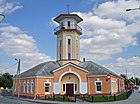 Pre-war fire station
 -
 Church of the Protection of the Holy Virgin
 -
 One of the preserved old townhouses
.jpg)


Transport[edit]


The city is on the main east-west highway in Belarus, the M1, which forms a part of European route E30.
The first rail line through the city opened in around 1870. Additional railways built helped the city become an important rail junction.
The large airbase, south of the city, is used by the Belarusian Air Force.
Notable people[edit]
- Mirosław Araszewski, Polish photographer and cinematographer
- Maja Berezowska, Polish painter
- Abraham Foxman, former CEO of Anti-Defamation League
- Alina Kabata-Pendias (1929-2019), scientist
- Lidia Korsakówna, Polish theatre and film actress
- Ihar Losik (1992), Belarusian blogger and activist recognised by Amnesty International as a political prisoner[12]
- Kazimierz Świątek, Roman Catholic Cardinal and archbishop
- Elchonon Wasserman, rabbi and Rosh Yeshiva
- Valeriya Novodvorskaya, Soviet dissident, writer and liberal politician
- Valanсin Taŭlaj (be:Валянцін Таўлай), Belarusian Soviet poet
Twin towns – sister cities[edit]
Baranavichy is twinned with:[13]
 Biała Podlaska, Poland
 Chibi, China
 Kaliningrad, Russia
 Karlovo, Bulgaria
- Kineshma, Russia
 Konyaaltı, Turkey
- Magadan, Russia
- Mytishchi, Russia
 Nacka, Sweden
 Poltava, Ukraine
- Solntsevo (Moscow), Russia
 Stockerau, Austria
- Sulęcin County, Poland
- Vasileostrovsky (Saint Petersburg), Russia
- Yeysky District, Russia


In 2022 Jelgava, Latvia (2006) suspended the cooperation agreements with Baranavichy due to Russian invasion of Ukraine.[14]
Significant depictions in popular culture[edit]
- Baranavichy is one of the starting towns of Lithuania in the turn-based strategy game Medieval II: Total War: Kingdoms.[15]
See also[edit]
References[edit]
- ^ a b c "Численность населения на 1 января 2023 г. и среднегодовая численность населения за 2022 год по Республике Беларусь в разрезе областей, районов, городов, поселков городского типа". belsat.gov.by. Archived from the original on 17 April 2023. Retrieved 10 August 2023.
- ^ a b Gaponenko, Irina Olegovna (2010). Назвы населеных пунктаў Рэспублікі Беларусь: Брэсцкая вобласць. Minsk: Тэхналогія. p. 60. ISBN 978-985-458-198-9.
- ^ Massie, Robert (1967). Nicholas and Alexandria. New York: Ballantine Books. p. 300. ISBN 9780345438317.
- ^ Lech Wyszczelski, Wojna polsko-rosyjska 1919–1920, Bellona, Warsaw, 2010, p. 70 (in Polish)
- ^ Paweł Wlezień. "Baranowicze – Nowogródek kwiecień 1919". Historia Wojskowa (in Polish). Retrieved 22 October 2019.
- ^ Sławek Zagórski. "Artur Buol - węgierski bohater Wojska Polskiego". Menway w Interia.pl (in Polish). Retrieved 22 October 2019.
- ^ "Kim był ojciec Jarosława i Lecha Kaczyńskich?". Fakt24.pl (in Polish). 17 April 2015. Retrieved 22 October 2019.
- ^ "Jewish Heritage Research Group in Belarus". jhrgbelarus.org. Archived from the original on 2011-08-18. Retrieved 2022-04-21.
- ^ "Armann Hugo". Yad Vashem. Retrieved 2023-04-18.
- ^ Soviet General Staff, Operation Bagration, ed. & trans. R. W. Harrison, Helion & Co., Ltd., Solihull, UK, 2016, Kindle ed., vol. 2, ch. 10
- ^ "Weather and Climate-The Climate of Baranavichy" (in Russian). Weather and Climate. Retrieved 8 November 2021.
- ^ Belarus: Scathing sentence for opposition leader following politically motivated case
- ^ "Города-побратимы". baranovichy.by (in Russian). Baranovichy. Archived from the original on 2018-12-17. Retrieved 2020-01-12.
- ^ Jelgava suspends cooperation agreement with twin cities Magadan (Russia) and Baranovichi (Belarus)
- ^ "Lithuania (M2TW-K-TC faction)". wiki.totalwar.com. Retrieved 27 November 2019.
External links[edit]

- Baranavichy city portal
- Modern views of Baranavichy
- INTEX-PRESS online - latest news of Baranavichy region
- Public Transport in Baranavichy
- Baranavichy University Photos
Sports-related links:
- Football in Baranavichy Archived 2010-01-23 at the Wayback Machine
History-related links:
- Photos on Radzima.org
- Baranowicze Radio Station Archived 2008-10-26 at the Wayback Machine
- Pre-war photos of Baranavichy
- Baranavichy in history
- Baranavichy. Synagogues Archived 2011-08-19 at the Wayback Machine
- British 1:25,000 map from 1943
| Districts (raiony) |  | |
|---|---|---|
| Cities and towns | ||

| International | |
|---|---|
| National | |
| Other | |

