


Birthstone

A birthstone is a gemstone that represents a person's period of birth, which is usually the month or zodiac sign. Birthstones are often worn as jewelry or as a pendant necklace.
History of birthstones[edit]
Western custom[edit]
The first-century historian Josephus believed there was a connection between the twelve stones in Aaron's breastplate (signifying the tribes of Israel, as described in the Book of Exodus), the twelve months of the year, and the twelve signs of the zodiac.[1]: 275–306 Translations and interpretations of the passage in Exodus regarding the breastplate have varied widely, with Josephus himself giving two different lists for the twelve stones.[2]: 130–131 George Frederick Kunz argues that Josephus saw the breastplate of the Second Temple, not the one described in Exodus. St. Jerome, referencing Josephus, said the Foundation Stones of the New Jerusalem (Revelation 21:19–20) would be appropriate for Christians.[3]: 294
In the eighth and ninth centuries, religious treatises associating a particular stone with an apostle were written so that "their name would be inscribed on the Foundation Stones, and his virtue."[3]: 299 Practice became to keep twelve stones and wear one a month.[3]: 298 The custom of wearing a single birthstone is only a few centuries old, though modern authorities differ on dates. Kunz places the custom in eighteenth-century Poland, while the Gemological Institute of America starts it in Germany in the 1560s.[3]: 293

Modern lists of birthstones have little to do with either the breastplate or the Foundation Stones of Christianity. Tastes, customs and confusing translations have distanced them from their historical origins,[3]: 310 with one author calling the 1912 Kansas list (see below) "nothing but a piece of unfounded salesmanship."[2]: 132
Some poems match each month of the Gregorian calendar with a birthstone. These are traditional stones of English-speaking societies. Tiffany & Co. published these poems "of unknown author" for the first time in a pamphlet in 1870.[4]
Modern birthstones[edit]
In 1912, in an effort to standardize birthstones, the (American) National Association of Jewelers (now called Jewelers of America) met in Kansas and officially adopted a list.[1]: 317 The Jewelry Industry Council of America updated the list in 1952[3]: 311 by adding Alexandrite for June, citrine for November and pink tourmaline for October. They also replaced December's lapis with zircon and switched the primary/alternative gems for March. The American Gem Trade Association added tanzanite as a December birthstone in 2002.[5] In 2016, the American Gem Trade Association and Jewelers of America added spinel as an additional birthstone for August.[6] Britain's National Association of Goldsmiths created its own standardized list of birthstones in 1937.[7] In 2021, Japanese industry associations added ten new types of birthstones.[8]
Eastern tradition[edit]
Eastern culture recognizes a similar range of gemstones associated with birth, though rather than associating a gem with a birth month, gemstones are associated with celestial bodies. Astrology is employed to determine the gemstones most closely associated with and beneficial to a particular individual. For example, in Hinduism, there are nine gemstones associated with the Navagraha (celestial forces including the planets, the Sun, and the Moon), known in Sanskrit as Navaratna (nine gems). At birth, an astrological chart is calculated. Certain stones are recommended to be worn on the body to supposedly ward off potential problems based on the place of these forces in the sky at the exact place and time of birth.[9]
Birthstones by time frame[edit]
| Month | 15th–20th century[1]: 315 | U.S. (1912)[1]: 319–320 | UK (2013)[10] | U.S. (2019)[11] |
|---|---|---|---|---|
| January | Garnet | Garnet | Garnet | Garnet |
| February | Amethyst, hyacinth, pearl | Amethyst | Amethyst | Amethyst |
| March | Bloodstone, jasper | Bloodstone, aquamarine | Aquamarine, bloodstone | Aquamarine, bloodstone |
| April | Diamond, sapphire | Diamond | Diamond, rock crystal | Diamond |
| May | Emerald, agate | Emerald | Emerald, chrysoprase | Emerald |
| June | Cat's eye, turquoise, agate | Pearl, moonstone | Pearl, moonstone | Pearl, moonstone, alexandrite |
| July | Turquoise, onyx | Ruby | Ruby, carnelian | Ruby |
| August | Sardonyx, carnelian, moonstone, topaz | Sardonyx, peridot | Peridot, sardonyx | Peridot, spinel, sardonyx |
| September | Chrysolite | Sapphire | Sapphire, lapis lazuli | Sapphire |
| October | Opal, aquamarine | Opal, tourmaline | Opal | Opal, tourmaline |
| November | Topaz, pearl | Topaz | Topaz, citrine | Topaz, citrine |
| December | Bloodstone, ruby | Turquoise, lapis lazuli | Tanzanite, turquoise | Turquoise, zircon, tanzanite |
Zodiacal[edit]
Tropical zodiac[edit]
| Sign | Dates[3]: 318 | Stone[1]: 345–347 |
|---|---|---|
| Aries | 21 March – 19 April | Bloodstone |
| Taurus | 20 April – 20 May | Sapphire |
| Gemini | 21 May – 20 June | Agate |
| Cancer | 21 June – 22 July | Emerald |
| Leo | 23 July – 22 August | Onyx |
| Virgo | 23 August – 22 September | Carnelian |
| Libra | 23 September – 22 October | Chrysolite |
| Scorpio | 23 October – 21 November | Beryl |
| Sagittarius | 22 November – 21 December | Topaz |
| Capricorn | 22 December – 19 January | Ruby |
| Aquarius | 20 January – 18 February | Garnet |
| Pisces | 19 February – 20 March | Amethyst |
Birthday (day of the week) stones[edit]
While the term "birthday stone" is sometimes used as a synonym for a birthstone, each day of the week is also assigned a unique gemstone, and these assignments are distinct from the monthly assignments.[1]
| Day of the Week | Stone(s) |
|---|---|
| Sunday | Topaz, diamond |
| Monday | Pearl, crystal |
| Tuesday | Ruby, emerald |
| Wednesday | Amethyst, lodestone |
| Thursday | Sapphire, carnelian |
| Friday | Emerald, cat's eye |
| Saturday | Turquoise, diamond |
Gallery[edit]
-
 Garnet, the birthstone for January
 -
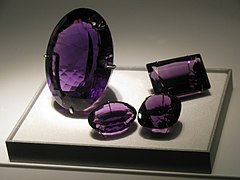 Amethyst, the birthstone for February
 -
 Aquamarine, the birthstone for March
 -
 Diamond, the birthstone for April
 -
 Emerald, the birthstone for May
 -
 Pearl, one of three June birthstones
 -
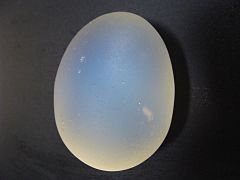 Moonstone, one of three June birthstones
 -
 Alexandrite, one of three June birthstones
 -
 Ruby, the birthstone for July
 -
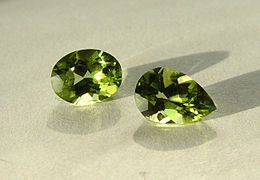 Peridot, the modern birthstone for August
 -
 Sardonyx, the traditional birthstone for August
 -
 Spinel, a more recent (2019) alternative birthstone for August
 -
 Sapphire, the birthstone for September
 -
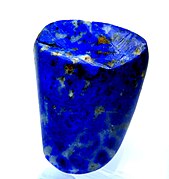 Lapis lazuli, the traditional birthstone for September
 -
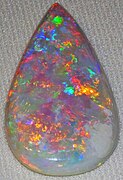 Opal, one of two October birthstones
 -
 Tourmaline, one of two October birthstones
 -
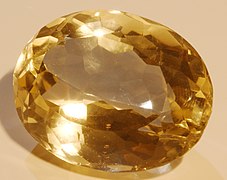 Citrine, one of two November birthstones
 -
 Topaz, one of two November birthstones
 -
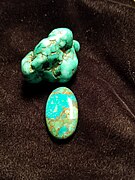 Turquoise, one of three December birthstones
 -
 Tanzanite, one of three December birthstones
 -
 Zircon, one of three December birthstones


.jpg)


.jpg)

See also[edit]
References[edit]
- ^ a b c d e f Kunz, George F. (1913). The curious lore of precious stones. Lippincott.
- ^ a b Gleadow, Rupert (2001). The Origin of the Zodiac. Dover Publications. Retrieved 26 September 2023.
- ^ a b c d e f g Knuth, Bruce G. (2007). Gems in Myth, Legend and Lore (Revised ed.). Parachute: Jewelers Press.
- ^ Farrington, Oliver Cummins (1903). Gems and Gem Minerals. Mumford. pp. 63–64.
- ^ Grande, Lance; Augustyn, Allison (2009). Gems and Gemstones: Timeless Natural Beauty of the Mineral World. University of Chicago Press. p. 335. ISBN 978-0-226-30511-0.
- ^ National Jeweler Magazine, "JA, AGTA Add Spinel as August Birthstone"
- ^ Osborne, Harold, ed. (1985). The Oxford Companion to the Decorative Arts. Oxford University Press. p. 513. ISBN 978-0-19-281863-8.
- ^ 日本放送協会. 誕生石が新たに10種類増えます 63年ぶりに改定 加わったのは?. NHK (in Japanese). Retrieved 24 February 2023.
- ^ Johari, Harish (1986). The Healing Power of Gemstones: In Tantra, Ayurveda, and Astrology. Destiny Books. pp. 15–34.
- ^ "Tips & Tools: Birthstones". The National Association of Goldsmiths. Archived from the original on 28 May 2007. Retrieved 16 June 2014.
- ^ "Birthstones For Each Month". Gemological Institute of America. Retrieved 5 September 2023.
External links[edit]
- The Curious Lore of Precious Stones, G.F. Kunz – full text online version
- Gems and Gem Minerals, Oliver Cummings Farrington – full text online version