


Aries (astrology)
| Aries | |
|---|---|
.svg) | |
 | |
| Zodiac symbol | Ram |
| Duration (tropical, western) | March 20 – April 19 (2024, UT1)[1] |
| Constellation | Aries |
| Zodiac element | Fire |
| Zodiac quality | Cardinal |
| Sign ruler | Mars |
| Detriment | Venus |
| Exaltation | Sun |
| Fall | Saturn |
            | |
| Astrology |
|---|
 |
| Background |
| Traditions |
| Branches |
| Astrological signs |
| Symbols |
Aries (♈︎) (Greek: Κριός, romanized: Kriós, Latin: Ariēs, lit. 'ram') is the first astrological sign in the zodiac, spanning the first 30 degrees of celestial longitude (0°≤ λ <30°), and originates from the Aries constellation. Under the tropical zodiac, the Sun transits this sign from approximately March 21 to April 19 each year.[2] This time-duration is exactly the first month of the Solar Hijri calendar (Arabic Hamal/Persian Farvardin/Pashto Wray).[3]
According to the tropical system of astrology, the Sun enters the sign of Aries when it reaches the March equinox, typically on March 21. Because the Earth takes approximately 365.24 days to go around the Sun, the precise time of the equinox is not the same each year, and generally will occur about six hours later from one year to the next until reset by a leap year. The leap day February 29 causes that year's March equinox to fall about eighteen hours earlier compared with the previous year.
Background[edit]
Aries is one of the six positive signs of the zodiac and its one of the four modality cardinal of the zodiac. Aries is one of the three fire signs in the zodiac, along with Leo and Sagittarius. The ruling planet is Mars.[4] Individuals born while the Sun is in this sign may be called Ariens[2] The color for Aries is red.[5] The opposite zodiac sign to Aries is Libra.[6]
The equivalent in the Hindu solar calendar is Meṣa.[7]
Mythology[edit]
In Greek Mythology, the symbol of the ram is based on the Chrysomallus, the flying ram that rescued Phrixus and Helle, the children of the Boeotian king Athamas and provided the Golden Fleece. There is no link between Aries and Ares, the god of war, often pictured with a vulture and whose origin stems from ἀρή (arē), the Ionic form of the Doric ἀρά (ara), "bane, ruin, curse, imprecation".[8][9]
Gallery[edit]
-
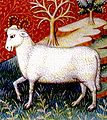
-
 Mosaic in Maltezana near Analipsi, Astypalaia, 5th century CE
 -
 Aries zodiac sign, Jantar Mantar, Jaipur, India, 18th century CE
 -
 Aries, or al-ħamal, depicted in the 14th/15th century Arabic astrology text Book of Wonders


See also[edit]
References[edit]
Citations[edit]
- ^ Astronomical Applications Department 2011.
- ^ a b dictionary n.d., s.v. Aries.
- ^ Atsma 2015.
- ^ Sakoian, Frances (2001). The astrologer's handbook. HarperResource. OCLC 49659919.
- ^ Orion 2011, p. 1.
- ^ 321horoscope.com (February 15, 2024). "Arries - Opposite Zodiac Sign". Horoscope. Retrieved April 15, 2024.
{{cite web}}: CS1 maint: numeric names: authors list (link) - ^ Raman 2003, pp. 10–19.
- ^ "The Myths of the Constellations".
- ^ "The Mythology of Aries". www.gods-and-monsters.com.
Sources[edit]
- "Aries". dictionary.com. n.d. Retrieved October 14, 2022.
- Astronomical Applications Department (2011). Multiyear Computer Interactive Almanac. 2.2.2. Washington DC: US Naval Observatory. For time of Sun's entry or exit from a sign, calculate Longitude of Sun, apparent geocentric ecliptic of date, interpolated to find time of crossing 0°, 30°..... For list of vernal equinox dates calculate phenomena: solstices/equinoxes, choosing UT1 and years 1800 through 2050.
- Atsma, Aaron J. (2015). "Chrysomallus". The Theoi Project: Greek mythology.
- Orion, Rae (2011). Astrology for Dummies. Hoboken, NJ: John Wiley & Sons. ISBN 9780470098400.
- Raman, Bangalore V. (2003). Studies in Jaimini Astrology. Motilal Banarsidass. ISBN 978-81-208-1397-7.
External links[edit]


| Authority control databases: National |
|---|
