


Brigadeführer
| Brigadeführer | |
|---|---|
 Post April 1942 gorget patch | |
  Shoulder and camo insignia | |
| Country |  Nazi Germany Nazi Germany |
| Service branch |  Schutzstaffel Schutzstaffel Sturmabteilung Sturmabteilung National Socialist Motor Corps National Socialist Motor Corps National Socialist Flyers Corps National Socialist Flyers Corps |
| Abbreviation | Brif |
| Rank | One-star |
| NATO rank code | OF-6 |
| Non-NATO rank | O-7 |
| Formation | 1933 |
| Abolished | 1945 |
| Next higher rank | Gruppenführer |
| Next lower rank | Oberführer |
| Equivalent ranks | Generalmajor |
Brigadeführer (German: [bʁiˈɡaːdəfyːʁɐ], lit. 'brigade leader') was a paramilitary rank of the Nazi Party (NSDAP) that was used between 1932 and 1945.[1] It was mainly known for its use as an SS rank. As an SA rank,[2] it was used after briefly being known as Untergruppenführer in late 1929 and 1930.
History[edit]
The rank was first created due to an expansion of the SS and assigned to those officers in command of SS-Brigaden. In 1933, the SS-Brigaden were changed in name to SS-Abschnitte; however, the rank of Brigadeführer remained the same.
Originally, Brigadeführer was considered the second general officer rank of the SS and ranked between Oberführer and Gruppenführer.[3] This changed with the rise of the Waffen-SS and the Ordnungspolizei. In both of those organizations, Brigadeführer was the equivalent to a Generalmajor and ranked above an Oberst in the German Army or police. The rank of Generalmajor was the equivalent of brigadier general, a one-star general in the US Army.[4]The insignia for Brigadeführer was at first two oak leaves and a silver pip; however, the design was changed to three oak leaves in April 1942 after the creation of the rank SS-Oberst-Gruppenführer. Brigadeführer in the Waffen-SS or police also wore the shoulder insignia of a Generalmajor and were referred to as such after their SS rank (e.g. SS-Brigadeführer und Generalmajor der Waffen-SS und Polizei).[5]
-
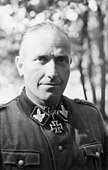 Hermann Prieß as SS-Brigadeführer and Generalmajor of the Waffen-SS

Insignia[edit]
-

-
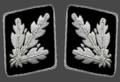 Gorget patches
1942–1945
(Allgemeine SS and Waffen-SS) -
 Shoulder board
(Waffen-SS) -
 NSFK gorget patch
 -
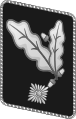 NSKK gorget patch


| Junior Rank Oberführer |
SS rank and SA rank Brigadeführer |
Senior Rank Gruppenführer |
See also[edit]
Notes[edit]
- ^ McNab 2009, pp. 29, 30.
- ^ McNab 2009b, p. 15.
- ^ McNab 2009, p. 29.
- ^ Flaherty 2004, p. 148.
- ^ Stein 2002, pp. 297, 298 chart, 300 chart.
Bibliography[edit]
- Flaherty, T. H. (2004) [1988]. The Third Reich: The SS. Time-Life Books, Inc. ISBN 1-84447-073-3.
- McNab, Chris (2009). The SS: 1923–1945. Amber Books Ltd. ISBN 978-1-906626-49-5.
- McNab, Chris (2009b). The Third Reich. Amber Books Ltd. ISBN 978-1-906626-51-8.
- Stein, George (2002) [1966]. The Waffen-SS: Hitler's Elite Guard at War 1939–1945. Cerberus Publishing Ltd. ISBN 978-1841451008.