Kind of matrix
In mathematics and multivariate statistics, the centering matrix[1] is a symmetric and idempotent matrix, which when multiplied with a vector has the same effect as subtracting the mean of the components of the vector from every component of that vector.
Definition[edit]
The centering matrix of size n is defined as the n-by-n matrix
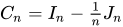
where  is the identity matrix of size n and
  is an n-by-n matrix of all 1's.
For example
 ,
,
![{\displaystyle C_{2}=\left[{\begin{array}{rrr}1&0\\0&1\end{array}}\right]-{\frac {1}{2}}\left[{\begin{array}{rrr}1&1\\1&1\end{array}}\right]=\left[{\begin{array}{rrr}{\frac {1}{2}}&-{\frac {1}{2}}\\-{\frac {1}{2}}&{\frac {1}{2}}\end{array}}\right]}](https://wikimedia.org/api/rest_v1/media/math/render/svg/a7852e24334b421119dccfb674a1f7957298645c) ,
,
![{\displaystyle C_{3}=\left[{\begin{array}{rrr}1&0&0\\0&1&0\\0&0&1\end{array}}\right]-{\frac {1}{3}}\left[{\begin{array}{rrr}1&1&1\\1&1&1\\1&1&1\end{array}}\right]=\left[{\begin{array}{rrr}{\frac {2}{3}}&-{\frac {1}{3}}&-{\frac {1}{3}}\\-{\frac {1}{3}}&{\frac {2}{3}}&-{\frac {1}{3}}\\-{\frac {1}{3}}&-{\frac {1}{3}}&{\frac {2}{3}}\end{array}}\right]}](https://wikimedia.org/api/rest_v1/media/math/render/svg/a280df1cf0b14b46e0f24b487f0c0f0dc22269a3)
Properties[edit]
Given a column-vector,  of size n, the centering property of
  can be expressed as

where  is a column vector of ones and
  is the mean of the components of .
is symmetric positive semi-definite.
is idempotent, so that  , for
, for  . Once the mean has been removed, it is zero and removing it again has no effect.
is singular. The effects of applying the transformation  cannot be reversed.
has the eigenvalue 1 of multiplicity n − 1 and eigenvalue 0 of multiplicity 1.
has a nullspace of dimension 1, along the vector .
is an orthogonal projection matrix. That is,  is a projection of onto the (n − 1)-dimensional subspace that is orthogonal to the nullspace . (This is the subspace of all n-vectors whose components sum to zero.)
The trace of  is
is  .
.
Application[edit]
Although multiplication by the centering matrix is not a computationally efficient way of removing the mean from a vector, it is a convenient analytical tool. It can be used not only to remove the mean of a single vector, but also of multiple vectors stored in the rows or columns of an m-by-n matrix  .
.
The left multiplication by  subtracts a corresponding mean value from each of the n columns, so that each column of the product
  has a zero mean. Similarly, the multiplication by on the right subtracts a corresponding mean value from each of the m rows, and each row of the product
  has a zero mean.
The multiplication on both sides creates a doubly centred matrix
has a zero mean.
The multiplication on both sides creates a doubly centred matrix  , whose row and column means are equal to zero.
The centering matrix provides in particular a succinct way to express the scatter matrix,  of a data sample
  , where
  is the sample mean. The centering matrix allows us to express the scatter matrix more compactly as

is the covariance matrix of the multinomial distribution, in the special case where the parameters of that distribution are  , and
, and 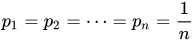 .
.
References[edit]
- ^ John I. Marden, Analyzing and Modeling Rank Data, Chapman & Hall, 1995, ISBN 0-412-99521-2, page 59.



