


Cent (music)


The cent is a logarithmic unit of measure used for musical intervals. Twelve-tone equal temperament divides the octave into 12 semitones of 100 cents each. Typically, cents are used to express small intervals, to check intonation, or to compare the sizes of comparable intervals in different tuning systems. For humans, a single cent is too small to be perceived between successive notes.
Cents, as described by Alexander John Ellis, follow a tradition of measuring intervals by logarithms that began with Juan Caramuel y Lobkowitz in the 17th century.[a] Ellis chose to base his measures on the hundredth part of a semitone, 1200√2, at Robert Holford Macdowell Bosanquet's suggestion. Making extensive measurements of musical instruments from around the world, Ellis used cents to report and compare the scales employed,[1] and further described and utilized the system in his 1875 edition of Hermann von Helmholtz's On the Sensations of Tone. It has become the standard method of representing and comparing musical pitches and intervals.[2][3]
History[edit]
Alexander John Ellis' paper On the Musical Scales of Various Nations,[1] published by the Journal of the Society of Arts in 1885, officially introduced the cent system to be used in exploring, by comparing and contrasting, musical scales of various nations. The cent system had already been defined in his History of Musical Pitch, where Ellis writes: "If we supposed that, between each pair of adjacent notes, forming an equal semitone [...], 99 other notes were interposed, making exactly equal intervals with each other, we should divide the octave into 1200 equal hundrecths [sic] of an equal semitone, or cents as they may be briefly called."[4]
Ellis defined the pitch of a musical note in his 1880 work History of Musical Pitch[5] to be "the number of double or complete vibrations, backwards and forwards, made in each second by a particle of air while the note is heard".[6] He later defined musical pitch to be "the pitch, or V [for "double vibrations"] of any named musical note which determines the pitch of all the other notes in a particular system of tunings."[7] He notes that these notes, when sounded in succession, form the scale of the instrument, and an interval between any two notes is measured by "the ratio of the smaller pitch number to the larger, or by the fraction formed by dividing the larger by the smaller".[8] Absolute and relative pitches were also defined based on these ratios.[8]
Ellis noted that "the object of the tuner is to make the interval [...] between any two notes answering to any two adjacent finger keys throughout the instrument precisely the same. The result is called equal temperament or tuning, and is the system at present used throughout Europe.[9] He further gives calculations to approximate the measure of a ratio in cents, adding that "it is, as a general rule, unnecessary to go beyond the nearest whole number of cents."[10]
Ellis presents applications of the cent system in this paper on musical scales of various nations, which include: (I. Heptatonic scales) Ancient Greece and Modern Europe,[11] Persia, Arabia, Syria and Scottish Highlands,[12] India,[13] Singapore,[14] Burmah[15] and Siam,;[16] (II. Pentatonic scales) South Pacific, [17] Western Africa,[18] Java,[19] China[20] and Japan.[21] And he reaches the conclusion that "the Musical Scale is not one, not 'natural,' nor even founded necessarily on the laws of the constitution of musical sound, so beautifully worked out by Helmholtz, but very diverse, very artificial, and very capricious".[22]
Use[edit]

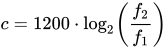
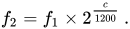
A cent is a unit of measure for the ratio between two frequencies. An equally tempered semitone (the interval between two adjacent piano keys) spans 100 cents by definition. An octave—two notes that have a frequency ratio of 2:1—spans twelve semitones and therefore 1200 cents. The ratio of frequencies one cent apart is precisely equal to 21⁄1200 = 1200√2, the 1200th root of 2, which is approximately 1.0005777895. Thus, raising a frequency by one cent corresponds to multiplying the original frequency by this constant value. Raising a frequency by 1200 cents doubles the frequency, resulting in its octave.
If one knows the frequencies and of two notes, the number of cents measuring the interval from to is:


Likewise, if one knows and the number of cents in the interval from to , then equals:
Comparison of major third in just and equal temperament[edit]
The major third in just intonation has a frequency ratio 5:4 or ~386 cents, but in equal temperament is 400 cents. This 14 cent difference is about a seventh of a half step and large enough to be audible.
Piecewise linear approximation[edit]
As x increases from 0 to 1⁄12, the function 2x increases almost linearly from 1.00000 to 1.05946, allowing for a piecewise linear approximation. Thus, although cents represent a logarithmic scale, small intervals (under 100 cents) can be loosely approximated with the linear relation 1 + 0.0005946 instead of the true exponential relation 2c⁄1200. The rounded error is zero when is 0 or 100, and is only about 0.72 cents high at =50 (whose correct value of 21⁄24 ≅ 1.02930 is approximated by 1 + 0.0005946 × 50 ≅ 1.02973). This error is well below anything humanly audible, making this piecewise linear approximation adequate for most practical purposes.
Human perception[edit]

It is difficult to establish how many cents are perceptible to humans; this precision varies greatly from person to person. One author stated that humans can distinguish a difference in pitch of about 5–6 cents.[23] The threshold of what is perceptible, technically known as the just noticeable difference (JND), also varies as a function of the frequency, the amplitude and the timbre. In one study, changes in tone quality reduced student musicians' ability to recognize, as out-of-tune, pitches that deviated from their appropriate values by ±12 cents.[24] It has also been established that increased tonal context enables listeners to judge pitch more accurately.[25] "While intervals of less than a few cents are imperceptible to the human ear in a melodic context, in harmony very small changes can cause large changes in beats and roughness of chords."[26]
When listening to pitches with vibrato, there is evidence that humans perceive the mean frequency as the center of the pitch.[27] One study of modern performances of Schubert's Ave Maria found that vibrato span typically ranged between ±34 cents and ±123 cents with a mean of ±71 cents and noted higher variation in Verdi's opera arias.[28]
Normal adults are able to recognize pitch differences of as small as 25 cents very reliably. Adults with amusia, however, have trouble recognizing differences of less than 100 cents and sometimes have trouble with these or larger intervals.[29]
Other representations of intervals by logarithms[edit]
Octave[edit]
The representation of musical intervals by logarithms is almost as old as logarithms themselves. Logarithms had been invented by Lord Napier in 1614.[30] As early as 1647, Juan Caramuel y Lobkowitz (1606-1682) in a letter to Athanasius Kircher described the usage of base-2 logarithms in music.[31] In this base, the octave is represented by 1, the semitone by 1/12, etc.
Heptamerides[edit]
Joseph Sauveur, in his Principes d'acoustique et de musique of 1701, proposed the usage of base-10 logarithms, probably because tables were available. He made use of logarithms computed with three decimals. The base-10 logarithm of 2 is equal to approximately 0.301, which Sauveur multiplies by 1000 to obtain 301 units in the octave. In order to work on more manageable units, he suggests to take 7/301 to obtain units of 1/43 octave.[b] The octave therefore is divided in 43 parts, named "merides", themselves divided in 7 parts, the "heptamerides". Sauveur also imagined the possibility to further divide each heptameride in 10, but does not really make use of such microscopic units.[32]
Savart[edit]
Félix Savart (1791-1841) took over Sauveur's system, without limiting the number of decimals of the logarithm of 2, so that the value of his unit varies according to sources. With five decimals, the base-10 logarithm of 2 is 0.30103, giving 301.03 savarts in the octave.[33] This value often is rounded to 1/301 or to 1/300 octave.[34][35]
Prony[edit]
Early in the 19th century, Gaspard de Prony proposed a logarithmic unit of base , where the unit corresponds to a semitone in equal temperament.[36] Alexander John Ellis in 1880 describes a large number of pitch standards that he noted or calculated, indicating in pronys with two decimals, i.e. with a precision to the 1/100 of a semitone,[37] the interval that separated them from a theoretical pitch of 370 Hz, taken as point of reference.[38]
![{\displaystyle {\sqrt[{12}]{2}}}](https://wikimedia.org/api/rest_v1/media/math/render/svg/bc835f27425fb3140e1f75a5faa35b1e8b9efc35)
Centitones[edit]
A centitone (also Iring) is a musical interval (21⁄600, ) equal to two cents (22⁄1200)[39][40] proposed as a unit of measurement (ⓘ) by Widogast Iring in Die reine Stimmung in der Musik (1898) as 600 steps per octave and later by Joseph Yasser in A Theory of Evolving Tonality (1932) as 100 steps per equal tempered whole tone.
![{\displaystyle {\sqrt[{600}]{2}}}](https://wikimedia.org/api/rest_v1/media/math/render/svg/ea43c0bc8f62081f2f0b830dd7da893a9d97a9a9)
Iring noticed that the Grad/Werckmeister (1.96 cents, 12 per Pythagorean comma) and the schisma (1.95 cents) are nearly the same (≈ 614 steps per octave) and both may be approximated by 600 steps per octave (2 cents).[41] Yasser promoted the decitone, centitone, and millitone (10, 100, and 1000 steps per whole tone = 60, 600, and 6000 steps per octave = 20, 2, and 0.2 cents).[42][43]
For example: Equal tempered perfect fifth = 700 cents = 175.6 savarts = 583.3 millioctaves = 350 centitones.[44]
| Centitones | Cents |
|---|---|
| 1 centitone | 2 cents |
| 0.5 centitone | 1 cent |
| 21⁄600 | 22⁄1200 |
| 50 per semitone | 100 per semitone |
| 100 per whole tone | 200 per whole tone |
Sound files[edit]
The following audio files play various intervals. In each case the first note played is middle C. The next note is sharper than C by the assigned value in cents. Finally, the two notes are played simultaneously.
Note that the JND for pitch difference is 5–6 cents. Played separately, the notes may not show an audible difference, but when they are played together, beating may be heard (for example if middle C and a note 10 cents higher are played). At any particular instant, the two waveforms reinforce or cancel each other more or less, depending on their instantaneous phase relationship. A piano tuner may verify tuning accuracy by timing the beats when two strings are sounded at once.
ⓘ, beat frequency = 0.16 Hz
ⓘ, beat frequency = 1.53 Hz
ⓘ, beat frequency = 3.81 Hz

See also[edit]

References[edit]
Footnotes[edit]
- ^ Caramuel mentioned the possible use of binary logarithms for music in a letter to Athanasius Kircher in 1647; this usage often is attributed to Leonhard Euler in 1739 (see Binary logarithm). Isaac Newton described musical logarithms using the semitone (12√2) as base in 1665; Gaspard de Prony did the same in 1832. Joseph Sauveur in 1701, and Félix Savart in the first half of the 19th century, divided the octave in 301 or 301,03 units. See Barbieri 1987, pp. 145–168 and also Stigler's law of eponymy.
- ^ 301 can be divided only by 7 or by 43.
Citations[edit]
- ^ a b Ellis 1885, p. 485-527.
- ^ Benson 2007, p. 166:The system most often employed in the modern literature.
- ^ Renold 2004, p. 138.
- ^ Ellis 1880, p. 295.
- ^ Ellis 1880, p. 293-336.
- ^ Ellis 1880, p. 293-294.
- ^ Ellis 1880, p. 294.
- ^ a b Ellis 1885, p. 487.
- ^ Ellis 1885, p. 491-.
- ^ Ellis 1885, p. 488.
- ^ Ellis 1885, p. 491-492.
- ^ Ellis 1885, p. 492-500.
- ^ Ellis 1885, p. 500-505.
- ^ Ellis 1885, p. 505-506.
- ^ Ellis 1885, p. 506.
- ^ Ellis 1885, p. 506-507.
- ^ Ellis 1885, p. 507.
- ^ Ellis 1885, p. 507-508.
- ^ Ellis 1885, p. 508-514.
- ^ Ellis 1885, p. 514-520.
- ^ Ellis 1885, p. 520-525.
- ^ Ellis 1885, p. 526.
- ^ Loeffler 2006.
- ^ Geringer & Worthy 1999, pp. 135–149.
- ^ Warrier & Zatorre 2002, pp. 198–207.
- ^ Benson 2007, p. 368.
- ^ Brown & Vaughn 1996, pp. 1728–1735.
- ^ Prame 1997, pp. 616–621.
- ^ Peretz & Hyde 2003, pp. 362–367.
- ^ Ernest William Hobson (1914), John Napier and the invention of logarithms, 1614, Cambridge, The University Press
- ^ Ramon Ceñal, "Juan Caramuel, su epistolario con Athanasio Kircher, S.J.", Revista de Filosofia XII/44, Madrid 1954, p. 134 ss.
- ^ Joseph Sauveur, Principes d'acoustique et de musique ou Système général des intervalles des sons, Minkoff Reprint, Geneva, 1973; see online Mémoires de l'Académie royale des sciences, 1700, Acoustique; 1701 Acoustique.
- ^ Émile Leipp, Acoustique et musique : Données physiques et technologiques, problèmes de l'audition des sons musicaux, principes de fonctionnement et signification acoustique des principaux archétypes d'instruments de musique, les musiques expérimentales, l'acoustique des salles, Masson, 1989, 4th edition, p. 16.
- ^ "Ordinary savart", 1/301 octave, and "modified savart", 1/300 octave. Herbert Arthur Klein, The Science of Measurement. A Historical Survey, New York, 1974, p. 605
- ^ Alexander Wood, The Physics of Music, London, 1944, ²2007, p. 53-54.
- ^ Gaspard de Prony, Instruction élémentaire sur les moyens de calculer les intervalles musicaux, Paris, 1832. Online: [1].
- ^ The precision is the same as with cents, but Ellis had not yet devised this unit.
- ^ Alexander John Ellis, "On the History of Musical Pitch," Journal of the Society of Arts, 1880, reprinted in Studies in the History of Musical Pitch, Frits Knuf, Amsterdam, 1968, p. 11-62.
- ^ Randel 1999, p. 123.
- ^ Randel 2003, pp. 154, 416.
- ^ "Logarithmic Interval Measures". Huygens-Fokker.org. Retrieved 2021-06-25.
- ^ Yasser 1932, p. 14.
- ^ Farnsworth 1969, p. 24.
- ^ Apel 1970, p. 363.
Sources[edit]
- Apel, Willi (1970). Harvard Dictionary of Music. Taylor & Francis.
- Barbieri, Patrizio (1987). "Juan Caramuel Lobkowitz (1606–1682): über die musikalischen Logarithmen und das Problem der musikalischen Temperatur". Musiktheorie. 2 (2): 145–168.
- Benson, Dave (2007). Music: A Mathematical Offering. Cambridge. ISBN 9780521853873.
{{cite book}}: CS1 maint: location missing publisher (link) - Brown, J.C.; Vaughn, K.V. (September 1996). "Pitch Center of Stringed Instrument Vibrato Tones" (PDF). Journal of the Acoustical Society of America. 100 (3): 1728–1735. Bibcode:1996ASAJ..100.1728B. doi:10.1121/1.416070. PMID 8817899. Retrieved 2008-09-28.
- Ellis, Alexander J.; Hipkins, Alfred J. (1884), "Tonometrical Observations on Some Existing Non-Harmonic Musical Scales", Proceedings of the Royal Society of London, 37 (232–234): 368–385, doi:10.1098/rspl.1884.0041, JSTOR 114325, Zenodo: 1432077.
- Ellis, Alexander J. (1880), "History of Musical Pitch", Journal of the Society of Arts, 21 (545): 293–337, Bibcode:1880Natur..21..550E, doi:10.1038/021550a0, S2CID 4107831
- Ellis, Alexander J. (1885), "On the Musical Scales of Various Nations", Journal of the Society of Arts: 485–527, retrieved 1 January 2020
- Farnsworth, Paul Randolph (1969). The Social Psychology of Music. Iowa State University Press. ISBN 9780813815473.
- Geringer, J. M.; Worthy, M.D. (1999). "Effects of Tone-Quality Changes on Intonation and Tone-Quality Ratings of High School and College Instrumentalists". Journal of Research in Music Education. 47 (2): 135–149. doi:10.2307/3345719. JSTOR 3345719. S2CID 144918272.
- Loeffler, D.B. (April 2006). Instrument Timbres and Pitch Estimation in Polyphonic Music (Master's). Department of Electrical and Computer Engineering, Georgia Tech. Archived from the original on 2007-12-18.
- Peretz, I.; Hyde, K.L. (August 2003). "What is specific to music processing? Insights from congenital amusia". Trends in Cognitive Sciences. 7 (8): 362–367. CiteSeerX 10.1.1.585.2171. doi:10.1016/S1364-6613(03)00150-5. PMID 12907232. S2CID 3224978.
- Prame, E. (July 1997). "Vibrato extent and intonation in professional Western lyric singing". The Journal of the Acoustical Society of America. 102 (1): 616–621. Bibcode:1997ASAJ..102..616P. doi:10.1121/1.419735.
- Randel, Don Michael (1999). The Harvard Concise Dictionary of Music and Musicians. Harvard University Press. ISBN 978-0-674-00084-1.
- Randel, Don Michael (2003). The Harvard Dictionary of Music (4th ed.). Harvard University Press. ISBN 978-0-674-01163-2.
- Renold, Maria (2004) [1998], Anna Meuss (ed.), Intervals, Scales, Tones and the Concert Pitch C = 128 Hz, translated by Bevis Stevens, Temple Lodge, ISBN 9781902636467,
Interval proportions can be converted to the cent values which are in common use today
{{citation}}: CS1 maint: location missing publisher (link) - Warrier, C.M.; Zatorre, R.J. (February 2002). "Influence of tonal context and timbral variation on perception of pitch". Perception & Psychophysics. 64 (2): 198–207. doi:10.3758/BF03195786. PMID 12013375. S2CID 15094971.
- Yasser, Joseph (1932). A Theory of Evolving Tonality. American Library of Musicology.
External links[edit]
- Cent conversion: Whole number ratio to cent Archived 2017-04-22 at the Wayback Machine [rounded to whole number]
- Cent conversion: Online utility with several functions
| Twelve- semitone (post-Bach Western) |
| ||||||||||||||
|---|---|---|---|---|---|---|---|---|---|---|---|---|---|---|---|
| Other tuning systems |
| ||||||||||||||
| Other intervals |
| ||||||||||||||
