


Civilian Space eXploration Team
 | This article has multiple issues. Please help improve it or discuss these issues on the talk page. (Learn how and when to remove these template messages)
|


The Civilian Space eXploration Team, also known as the CSXT, is a team of around 30 civilians interested in private spaceflight. The team was created by Ky Michaelson. Having conducted multiple rocket launches in an attempt to establish altitude records, CSXT became the first entity to officially launch an amateur rocket into space on May 17, 2004, with the successful launch of its GoFast rocket to an altitude of 116 km (72 miles) above the surface, which was verified by FAA analysis of the team's flight data.[1]
Prior privately funded space launches were achieved by the Orbital Sciences Pegasus, and many other amateur teams havemade unverified claims of rocket flights exceeding the boundary of space.[1]
Team composition[edit]
Currently, Ky Michaelson is the CSXT program director. The CSXT's program is subdivided into three teams:[1]
- Rocket Design and Ground Support Equipment
- Avionics and Ground System Design
- Wind Weighting System Development
History[edit]
The team was established in 1995 by a group of model rocket hobbyists interested in spaceflight. The team is supported by corporate sponsorship.[1]
D.R. Hero[edit]
The D.R. Hero rocket was launched in August 1995. It was dedicated to stuntman Dar Robinson, a late friend of Ky Michaelson. The rocket was 18 feet (5 m) tall and 6 inches in diameter. It was anticipated to reach 100,000 feet (30,000 m). This rocket failed in a large CATO (catastrophe at take off) motor failure just above the ground.[1]
Joe Boxer launches[edit]
Launched on August 18, 1996, [2] this rocket was also 18 feet (5 m) tall and 6 inches in diameter. The name is attributed to the largest contributing sponsor, Joe Boxer. It was anticipated to reach 70,000 feet (21,000 m); however, the actual height obtained was only 66,000 feet (20,100 m). The entire rocket was recovered after what was considered a successful flight. All of the rocket's systems functioned as intended and this flight was claimed to be the first amateur rocket to be recovered intact after reaching more than 50,000 feet (15,000 m).[3]
Space shots[edit]
1997[edit]
Launched on July 21, 1997, [4] this slightly smaller rocket was 17 feet (5 m) tall and 6 inches in diameter, with an upper stage dart, which was only 3 or 4 inches across. It was the first two-stage rocket launched by CSXT and was expected to reach 400,000 feet (120,000 m). During the launch, an electronics failure prevented the ignition of the second stage, though the first stage successfully detached and was recovered with a parachute.[1]
2000[edit]
This rocket was launched on September 29, 2000, and was 15 feet (5 m) tall and 8.625 inches in diameter. It was expected to reach 60 nautical miles (110 km) with a maximum speed of 3,205 mph (5,158 km/h). After launch, the rocket encountered problems at 45,000 feet (13,700 m), where the wind sheared off the fin, causing the rocket to break apart. Although the launch was fairly unsuccessful, it did set a record for amateur rocket speed of 3,205 mph (5,158 km/h).[1]
2002[edit]
This rocket was launched on September 19, 2002.[5] It was launched at the Black Rock Desert in Nevada.[1] The rocket was equipped with a solid propellant motor. The motor was to accelerate the rocket to Mach 5. The rocket was equipped with GPS receivers and antennas, video recording devices, and a series of flight monitoring devices.[1] Three seconds after the rocket launched the motor burned through the casing, causing the rocket to fail.[1]
2004 "GoFast"[edit]
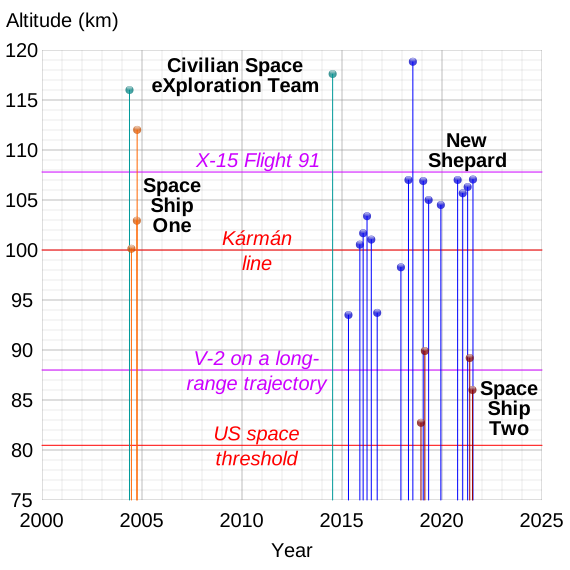
The rocket was launched on Monday, May 17, 2004.[1][6] This rocket was the first amateur rocket to exceed 100 kilometres (62 mi), the official boundary of outer space.[6] It was launched at the Black Rock Desert.[7] The rocket reached top speed of 3,420 mph (5,500 km/h) in 10 seconds, and reached an estimated altitude of 72 miles (116 km).[6] The avionics were recovered by deployment of a parachute.[6][8] The final verified altitude of the rocket was released as 72 miles (116 km).[6][9][10][11]
The rocket was 21 feet (6 m) tall and 10 inches (25 cm) in diameter, and used an ammonium perchlorate-based solid propellant.[11]
2014 "GoFast"[edit]
On July 14, 2014, the team repeated their accomplishment with a second successful space launch, which set new records for the highest and fastest amateur rocket ever launched. Analysis of the data from the recovered military-grade Inertial Measurement Unit (IMU) that flew onboard shows that the GoFast rocket reached an altitude of 385,800 feet (73.07 mi; 117.6 km) above mean sea level and hit a top speed of 3,580 mph (5,800 km/h).[12]
See also[edit]
References[edit]
- ^ a b c d e f g h i j k Rocketman Enterprises (2005). CSXT: Civilian Space eXploration Team. Retrieved on 2007-01-27. http://www.the-rocketman.com/CSXT/default2.asp%7C[permanent dead link] http://www.the-rocketman.com/CSXT/about/teamlist.htm#%7C Archived 2012-04-15 at the Wayback Machine http://www.the-rocketman.com/go-fast.html Archived 2015-12-09 at the Wayback Machine
- ^ Joe Boxer Corp (1996). Joe Boxer and World Class Rocketeer Ky Michaelson Make History. Retrieved on 2014-10-27. http://www.thefreelibrary.com/Joe+Boxer+and+World+Class+Rocketeer+Ky+Michaelson+Make+History-a018592805 Archived 2014-10-27 at the Wayback Machine
- ^ Michaelson, Ky (2004). The ROCKETMAN and Joe Boxer Team Up. Retrieved on 2007-01-28. http://www.the-rocketman.com/boxerstory.html Archived 2007-03-15 at the Wayback Machine
- ^ Michaelson, Ky (1997). Launch At Balls 007. Retrieved on 2014-10-27. http://www.the-rocketman.com/CSXT_info.html Archived 2014-02-06 at the Wayback Machine
- ^ CSXT (2002). Disappointed but looking to the future. Motor failure prevents civilian rocket from reaching space. Retrieved on 2014-10-27. http://www.the-rocketman.com/CSXT/news/n9_21_02_disappointed.htm Archived 2011-07-01 at the Wayback Machine
- ^ a b c d e Knight, Eric (2010). The New Race to Space. ISBN 978-0-615-43015-7. Retrieved 2013-04-27.
- ^ Space Frontier Foundation (2007). Go "GoFast"! Space Frontier Foundation Congratulates First Amateur Team to Enter Space. Retrieved on 2007-01-27. http://www.space-frontier.org/PressReleases/2004/20040519gofastflight.html Archived 2007-03-01 at the Wayback Machine
- ^ ARRL Web: Ham Radio-Carrying Rocket Exceeds Goal; Avionics Recovered Intact (2004-05-20). Retrieved on 2007-01-28. http://www.arrl.org/news/stories/2004/05/19/1/?nc=1
- ^ Civilian Space eXploration Team (2005). GoFast Rocket Maximum Altitude Verification. http://www.ddeville.com/GoFast%20Maximum%20Altitude%20Press%20Release1.pdf Archived 2008-10-30 at the Wayback Machine
- ^ Lindsey, Clark, HobbySpace.com - Advanced Rocketry: Records, Achievements & Competitions, retrieved 2008-01-06
- ^ a b Wade, Mark, Astronautix - GoFast, archived from the original on 2009-01-05, retrieved 2008-10-22
- ^ "CSXT GO FAST! Rocket Confirms Multiple World Records". Colorado Space News. 4 September 2014. Archived from the original on 4 March 2016. Retrieved 12 May 2015.
External links[edit]
- High Altitude Amateur Rocket Records, HobbySpace.com (2004)
- Mystery Solved: Stratofox Recovers CSXT Booster, Stratofox Aerospace Tracking Team (2004)
- CSXT SpaceShot 2004 - First Amateur Launch to Space, Stratofox Aerospace Tracking Team (2004)
- Recollections of the CSXT Space Shot 2004 (5th anniversary page), Stratofox Aerospace Tracking Team (2009)
- First amateur rocket into space on YouTube, posted by Ky Michaelson
- Rocket Launch - CSXT First civilian rocket to reach space on YouTube, posted by Wayne Vaughan
- CSXT First Civilian Rocket Launch to Space on YouTube, posted by Derek Deville
- Stratofox recovery of CSXT Space Booster, Nov 26, 2004, Granite Range, NV on YouTube, posted by Ian Kluft
- The Rocketman, Ky Michaelson's website.
- GoFast 2014 HD OnBoard Cameras on YouTube, posted by Ky Michaelson

