


Cloister

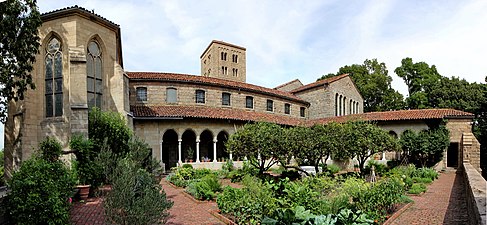
A cloister (from Latin claustrum, "enclosure") is a covered walk, open gallery, or open arcade running along the walls of buildings and forming a quadrangle or garth. The attachment of a cloister to a cathedral or church, commonly against a warm southern flank,[1] usually indicates that it is (or once was) part of a monastic foundation, "forming a continuous and solid architectural barrier... that effectively separates the world of the monks from that of the serfs and workmen, whose lives and works went forward outside and around the cloister."[1]
Cloistered (or claustral) life is also another name for the monastic life of a monk or nun. The English term enclosure is used in contemporary Catholic church law translations[2] to mean cloistered, and some form of the Latin parent word "claustrum" is frequently used as a metonymic name for monastery in languages such as German.[3] Cloistered clergy refers to monastic orders that strictly separate themselves from the affairs of the external world.
History of the cloister[edit]

Historically, the early medieval cloister had several antecedents: the peristyle court of the Greco-Roman domus, the atrium and its expanded version that served as forecourt to early Christian basilicas, and certain semi-galleried courts attached to the flanks of early Syrian churches.[4] Walter Horn suggests that the earliest coenobitic communities, which were established in Egypt by Saint Pachomius c. AD 320, did not result in cloister construction, as there were no lay serfs attached to the community of monks, and thus no need for separation within the walled community.[5]
Horn finds the earliest prototypical cloisters in some exceptional[6] late fifth-century monastic churches in southern Syria, such as the Convent of Saints Sergius and Bacchus, at Umm-is-Surab (AD 489), and the colonnaded forecourt of the convent of Id-Dêr,[7] but nothing similar appeared in the semi-eremitic Irish monasteries' clustered roundhouses nor in the earliest Benedictine collective communities of the West.[5]
In the time of Charlemagne (r. 768–814) the requirements of a separate monastic community within an extended and scattered manorial estate led to the development of a "monastery within a monastery" in the form of the locked cloister, an architectural solution allowing the monks to perform their sacred tasks apart from the distractions of laymen and servants.[8] Horn offers as early examples Abbot Gundeland's "Altenmünster" of Lorsch abbey (765–74), as revealed in the excavations by Frederich Behn.[9] Lorsch was adapted without substantial alteration from a Frankish nobleman's villa rustica, in a tradition unbroken from late Roman times.[10]
Another early cloister, in the abbey of Saint-Riquier (790–99), took a triangular shape, with chapels at the corners, in conscious representation of the Trinity.[11] A square cloister sited against the flank of the abbey church was built at Inden (816) and the abbey of St. Wandrille at Fontenelle (823–33). At Fulda, a new cloister (819) was sited to the liturgical west of the church "in the Roman manner"[12] familiar from the forecourt of Old St. Peter's Basilica because it would be closer to the relics. More recently, John D. Rockefeller Jr. commissioned the construction of The Cloisters museum and gardens in medieval style in Manhattan in 1930-1938.
Gallery[edit]
-
-
 The Romanesque cloister of Santo Domingo de Silos, Spain
 -
 Cloister of Saint-Michel de Grandmont Priory (Languedoc-Roussillon, France)
 -
 Chiostro del Paradiso, Amalfi Cathedral, Italy
 -
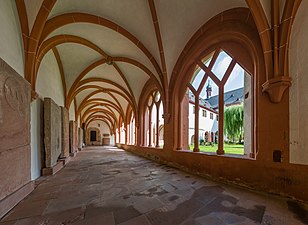 Cloister of the former Cistercian Eberbach Abbey, Germany


See also[edit]
Notes[edit]
- ^ a b Horn 1973, p. 13.
- ^ "The Code of Canon Law, Canon 667 ff. English translation copyright 1983 The Canon Law Society Trust". Archived from the original on 19 June 2006. Retrieved 17 June 2006.
- ^ Cf. German Kloster.
- ^ Horn 1973 gives these sources.
- ^ a b Horn 1973, pp. 39–40.
- ^ The normal Syrian monastery plan was an open one, Horn observes.
- ^ Horn 1973, plans, figs 9 and 10
- ^ Horn pp 40ff.
- ^ When Lorsch was rebuilt on a neighboring site by Abbot Richbold (784–804) the cloister was made a perfect square, against the south flank of the new church, precisely as in the plan of the 8th-century Abbey of Saint Gall (Horn 1973:44, figs 43ab, 45).
- ^ When Lorsch was rebuilt on a neighboring site by Abbot Richbold (784–804) the cloister was made a perfect square, against the south flank of the new church, precisely as in the plan of the 8th-century Abbey of Saint Gall (Horn 1973:44, figs 43ab, 45).
- ^ Horn 1973:43 and fig 42ab.
- ^ Vita Eigili, the life of Abbot Eigil.
References[edit]
- Coomans, Thomas (2018). Life Inside the Cloister. Understanding Monastic Architecture: Tradition, Reformation, Adaptive Reuse. Leuven University Press. ISBN 9789462701434.
- Horn, Walter (1973). "On the Origins of the Medieval Cloister". Gesta. 2 (1/2): 13–52. doi:10.2307/766633. JSTOR 766633. S2CID 192563869.
External links[edit]

 Media related to Cloisters at Wikimedia Commons
- The Code of Canon Law, cf canons 667 ff.
- New Advent Encyclopaedia III ff. on "Nuns, properly so called"
- "Cloister" in the New Advent encyclopaedia
- New Advent Encyclopaedia on "Religious Life"
- Photos and information on cloisters in France, Italy and Spain
- . Encyclopædia Britannica. Vol. VI (9th ed.). 1878. pp. 35–36.


