


Dioscorea alata
| Dioscorea alata | |
|---|---|

| |
| Sliced purple yam | |
Scientific classification 
| |
| Kingdom: | Plantae |
| Clade: | Tracheophytes |
| Clade: | Angiosperms |
| Clade: | Monocots |
| Order: | Dioscoreales |
| Family: | Dioscoreaceae |
| Genus: | Dioscorea |
| Species: | D. alata
|
| Binomial name | |
| Dioscorea alata | |
| Synonyms[2] | |
|
List
| |
Dioscorea alata – also called ube (/ˈuːbɛ, -beɪ/), ubi, purple yam, or greater yam, among many other names – is a species of yam (a tuber). The tubers are usually a vivid violet-purple to bright lavender in color (hence the common name), but some range in color from cream to plain white. It is sometimes confused with taro and the Okinawa sweet potato beniimo (紅芋) (Ipomoea batatas cv. Ayamurasaki), however D. alata is also grown in Okinawa. With its origins in the Asian tropics, D. alata has been known to humans since ancient times.[3]
Names
[edit]Because it has become naturalized following its origins in Asia, specifically the Philippines, through tropical South America, and the southeastern U.S., D. alata is referred to by many different names in these regions. In English alone, aside from purple yam, other common names include ten-months yam, water yam, white yam, winged yam, violet yam, Guyana arrowroot, or simply yam.[3]
 | This article is missing information about wild relatives (D. nummularia, D. transverse, and D. hastifolia; progenitor unknown) [doi:10.1111/boj.12374]). (October 2021) |
History of cultivation
[edit]
Dioscorea alata is one of the most important staple crops in Austronesian cultures. It is one of various species of yams that were domesticated and cultivated independently within Island Southeast Asia and New Guinea for their starchy tubers, including the round yam (Dioscorea bulbifera), ubi gadong (Dioscorea hispida), lesser yam (Dioscorea esculenta), Pacific yam (Dioscorea nummularia), fiveleaf yam (Dioscorea pentaphylla), and pencil yam (Dioscorea transversa).[4] Among these, D. alata and D. esculenta were the only ones regularly cultivated and eaten, while the rest were usually considered as famine food due to their higher levels of the toxin dioscorine which requires that they be prepared correctly before consumption.[5] D. alata is also cultivated more than D. esculenta, largely because of its much larger tubers.[6]
D. alata and D. esculenta were the most suitable for long transport in Austronesian ships and were carried through all or most of the range of the Austronesian expansion. D. alata in particular were introduced into the Pacific Islands and New Zealand. They were also carried by Austronesian voyagers into Madagascar and the Comoros.[7][8][9]

The center of origin of purple yam is in the Philippines, but archaeological evidence suggests that it was exploited in Island Southeast Asia and New Guinea before the Austronesian expansion. Purple yam is believed to be a true cultigen, only known from its cultivated forms. The vast majority of cultivars are sterile, which restricts its introduction into islands purely by human agency, making them a good indicator of human movement. Some authors have proposed, without evidence, an origin in Mainland Southeast Asia, but it shows the greatest phenotypic variability in the Philippines and New Guinea.[10][11][12]
Based on archaeological evidence of early farming plots and plant remains in the Kuk Swamp site, authors have suggested that it was first domesticated in the highlands of New Guinea from around 10,000 BP and spread into Island Southeast Asia via the Lapita culture at around c. 4,000 BP, along with D. nummularia and D. bulbifera. In turn, D. esculenta is believed to have been introduced by the Lapita culture into New Guinea. There is also evidence of an agricultural revolution during this period brought by innovations from contact with Austronesians, including the development of wet cultivation.[13][14]
However, much older remains identified as being probably D. alata have also been recovered from the Niah Caves of Borneo (Late Pleistocene, <40,000 BP) and the Ille Cave of Palawan (c. 11,000 BP), along with remains of the toxic ubi gadong (D. hispida) which requires processing before it can be edible. Although it doesn't prove cultivation, it does show that humans already had the knowledge to exploit starchy plants and that D. alata were native to Island Southeast Asia. Furthermore, it opens the question on whether D. alata is a true species or cultivated much older than believed.[4][15][16][17][18][19]
Purple yam remains an important crop in Southeast Asia, particularly in the Philippines where the vividly purple variety is widely used in various traditional and modern desserts. It also remains important in Melanesia, where it is also grown for ceremonial purposes tied to the size of the tubers at harvest time. Its importance in eastern Polynesia and New Zealand, however, has waned after the introduction of other crops, most notably the sweet potato.[6]
Uses
[edit]Culinary
[edit]Purple yams have edible tubers which have a mildly sweet, earthy and nutty taste, reminiscent of sweet potatoes or taro. The violet cultivars, in particular, turn dishes distinctively vivid violet because of the high amount of anthocyanins.[20] Purple yams are also valued for the starch that can be processed from them.[3] Purple yam is most common in Philippine cuisine (where it is known as ube or ubi). It is widely applied for many Philippine desserts, such as ube cake, ube cheesecake and ube crinkles, as well as an ingredient or flavor for ice cream, milk, donuts, tarts, jam and other types of pastries. It is often eaten boiled, baked, or as a sweetened dessert called ube halayá; the latter being a popular ingredient in the iced dessert called halo-halo.[21][22][23] Purple yam desserts have more recently entered the United States through Philippine cuisine, under the Filipino name "ube". It is particularly popular due to the striking violet-purple color it gives to desserts.[20][21][24]
Purple yam is commonly confused with purple/violet varieties of sweet potatoes because of their similarities in color, taste, and culinary uses. However, like other yams, purple yam tends to have a moister texture than sweet potatoes. Purple yams also have higher anthocyanin content than sweet potatoes. They can otherwise be used interchangeably in most recipes.[25][26]
-
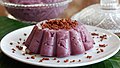 Ube halaya (mashed purple yam) from the Philippines
 -
 Ube champorado from the Philippines
 -
 Ube and muscovado piayas from the Philippines
 -

-
 Okinawan sweet potato pancakes with coconut ube sauce
 -
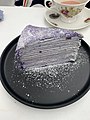 A slice of ube crepe cake
 -
 Purple yam cupcakes with flan top layers
 -
 Filipino ube donut
 -
 Ube Mamón
 -
 Halo-halo with ube halaya


_01.jpg)


Supplements, folk medicine and adverse effects
[edit]Although available as a dietary supplement and used in folk medicine, there is no clinical evidence that D. alata has any therapeutic properties.[27] Use of D. alata supplements may have adverse effects in people taking estrogens, anticoagulant drugs or during pregnancy and breast-feeding.[27] Some people may have allergic reactions to use of D. alata supplements.[27]
D. alata has relatively high levels of oxalates (486–781 mg/100 g dry matter),[28] which are associated with antinutritional effects and kidney stone formation.[29]
Other uses
[edit]The color of purple varieties is due to various anthocyanin pigments.[30] The pigments are water-soluble, and have been proposed as possible food coloring agents.[31] D. alata is sometimes grown in gardens for its ornamental value.[3]
As an invasive species
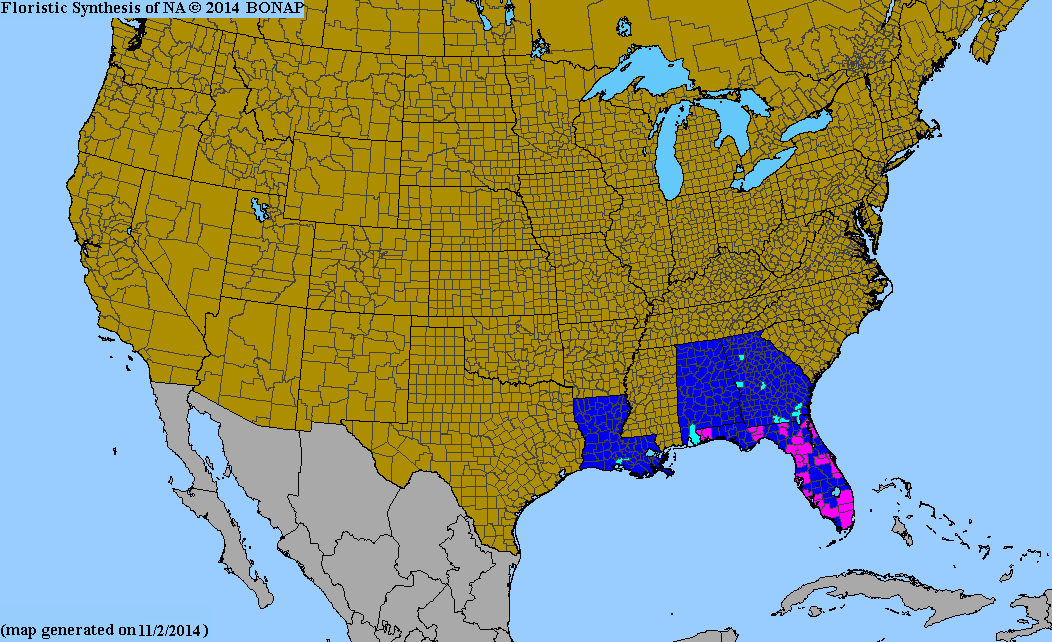
[edit]Dioscorea alata is native to the Philippines, as well as surrounding areas (Taiwan and the Ryukyu Islands of Japan). It has escaped from its native growth area and into the wild in many other places, becoming naturalized in parts of southern and east-central China, Africa and Madagascar, the Western Hemisphere, and various islands in the Indian and Pacific oceans.[32][33] It persists in the wild in Haiti, as well as the United States, in Louisiana, Georgia, Alabama, Puerto Rico, the U.S. Virgin Islands, and in Florida where it is considered an invasive species.[34][35]
Gallery
[edit]-
 Purple yam leaves
 -
 Purple yam flowers

.jpg)
See also
[edit]- Domesticated plants and animals of Austronesia
- Colocasia esculenta
- Alocasia macrorrhizos
- Amorphophallus paeoniifolius
- Cyrtosperma merkusii
- Ipomoea batatas
References
[edit]- ^ Dioscorea alata was first described and published in Species Plantarum 2: 1033. 1753. "Name - Dioscorea alata L." Tropicos. Saint Louis, Missouri: Missouri Botanical Garden. Retrieved May 26, 2011.
- ^ "The Plant List: A Working List of All Plant Species".
- ^ a b c d "Dioscorea alata". Germplasm Resources Information Network. Agricultural Research Service, United States Department of Agriculture. Retrieved May 26, 2011.
- ^ a b Barker G, Hunt C, Barton H, et al. (August 2017). "The 'cultured rainforests' of Borneo" (PDF). Quaternary International. 448: 44–61. Bibcode:2017QuInt.448...44B. doi:10.1016/j.quaint.2016.08.018.
- ^ Bevacqua RF (1994). "Origin of Horticulture in Southeast Asia and the Dispersal of Domesticated Plants to the Pacific Islands by Polynesian Voyagers: The Hawaiian Islands Case Study" (PDF). HortScience. 29 (11): 1226–1229. doi:10.21273/HORTSCI.29.11.1226.
- ^ a b "*Qufi ~ Uwhi, uhi". Te Mära Reo: The Language Garden. Benton Family Trust. Retrieved January 21, 2019.
- ^ Crowther A, Lucas L, Helm R, et al. (June 14, 2016). "Ancient crops provide first archaeological signature of the westward Austronesian expansion". Proceedings of the National Academy of Sciences. 113 (24): 6635–6640. Bibcode:2016PNAS..113.6635C. doi:10.1073/pnas.1522714113. PMC 4914162. PMID 27247383.
- ^ Beaujard P (August 2011). "The first migrants to Madagascar and their introduction of plants: linguistic and ethnological evidence" (PDF). Azania: Archaeological Research in Africa. 46 (2): 169–189. doi:10.1080/0067270X.2011.580142. S2CID 55763047.
- ^ Walter A, Lebot V (2007). Gardens of Oceania. IRD Éditions-CIRAD. ISBN 9781863204705.
- ^ Malapa R, Arnau G, Noyer J, et al. (November 2005). "Genetic Diversity of the Greater Yam (Dioscorea alata L.) and Relatedness to D. nummularia Lam. and D. transversa Br. as Revealed with AFLP Markers". Genetic Resources and Crop Evolution. 52 (7): 919–929. doi:10.1007/s10722-003-6122-5. S2CID 35381460.
- ^ Cruz V, Altoveros N, Mendioro M, et al. (1999). "Geographical patterns of diversity in the Philippine edible yam collection". Plant Genetic Resources Newsletter. 119: 7–11.
- ^ Paz VJ (1999). "Neolithic Human Movement to Island Southeast Asia: The Search for Archaeobotanical Evidence". Indo-Pacific Prehistory Association Bulletin. 18 (Melaka Papers Vol. 2): 151–158. doi:10.7152/bippa.v18i0.11710 (inactive September 6, 2024).
{{cite journal}}: CS1 maint: DOI inactive as of September 2024 (link) - ^ Chaïr H, Traore RE, Duval MF, et al. (June 17, 2016). "Genetic Diversification and Dispersal of Taro (Colocasia esculenta (L.) Schott)". PLOS ONE. 11 (6): e0157712. Bibcode:2016PLoSO..1157712C. doi:10.1371/journal.pone.0157712. PMC 4912093. PMID 27314588.
- ^ Bayliss-Smith T, Golson J, Hughes P (2017). "Phase 4: Major Disposal Channels, Slot-Like Ditches and Grid-Patterned Fields". In Golson J, Denham T, Hughes P, Swadling P, Muke J (eds.). Ten Thousand Years of Cultivation at Kuk Swamp in the Highlands of Papua New Guinea. terra australis. Vol. 46. ANU Press. pp. 239–268. ISBN 9781760461164.
- ^ Barker G, Lloyd-Smith L, Barton H, et al. (2011). "Foraging-farming transitions at the Niah Caves, Sarawak, Borneo". Antiquity. 85 (328): 492–509. doi:10.1017/S0003598X00067909. S2CID 131187696.
- ^ Balbaligo Y (November 15, 2007). "A Brief Note on the 2007 Excavation at Ille Cave, Palawan, the Philippines". Papers from the Institute of Archaeology. 18 (2007): 161. doi:10.5334/pia.308.
- ^ Barton H (2005). "The Case for Rainforest Foragers: The Starch Record at Niah Cave, Sarawak" (PDF). Asian Perspectives. 44 (1): 56–72. doi:10.1353/asi.2005.0005. hdl:10125/17222. S2CID 11596542.
- ^ Barton H, Denham T (2011). "Prehistoric vegeculture and social life in Island Southeast Asia and Melanesia" (PDF). In Barker G, Janowski M (eds.). Why cultivate? Anthropological and Archaeological Approaches to Foraging–Farming Transitions in Southeast Asia. McDonald Institute for Archaeological Research. pp. 61–74. ISBN 9781902937588. Archived from the original (PDF) on March 28, 2019. Retrieved January 21, 2019.
- ^ Reynolds T, Barker G, Barton H, et al. (2013). "The First Modern Humans at Niah, c. 50,000–35,000 Years Ago" (PDF). In Barker G (ed.). Rainforest Foraging and Farming in Island Southeast Asia. McDonald Institute for Archaeological Research. pp. 133–170. ISBN 9781902937540.
- ^ a b Sutherlin M. "Everything You Need to Know About Ube, The Purple Yam". Chowhound. Retrieved May 18, 2019.
- ^ a b Kearns L. "Ube Is The Natural Ingredient That Turns Food Perfectly Purple". The Huffington Post. Retrieved May 18, 2019.
- ^ Bueno A. "All hail ube, the culinary gem we took for granted". CNN Philippines. Archived from the original on November 1, 2019. Retrieved May 18, 2019.
- ^ Valdeavilla R (June 6, 2018). "Ube: The Philippine Purple Yam (More Popular Than Vanilla!)". culture trip. Retrieved May 18, 2019.
- ^ "Donut Shop in Gurnee Cranks Out Unique Freshly Made Donuts". ABC7 Chicago. November 11, 2016.
- ^ "Ube or Not Ube, That Is the Question…and Frieda's Is Answering". Frieda's. April 17, 2017. Retrieved May 18, 2019.
- ^ "Ingredient Spotlight: Ube, the Purple Yams That Make Dessert". OneGreenPlanet. March 24, 2017. Retrieved May 18, 2019.
- ^ a b c "Wild yam". Drugs.com. July 24, 2020. Retrieved March 15, 2021.
- ^ Wanasundera JP, Ravindran G (1994). "Nutritional assessment of yam (Dioscorea alata) tubers". Plant Foods Hum Nutr. 46 (1): 33–9. doi:10.1007/BF01088459. PMID 7971785. S2CID 36080604.
- ^ Otegbayo BO, Oguniyan DJ, Olunlade BA, et al. (November 1, 2017). "Characterizing genotypic variation in biochemical composition, anti-nutritional and mineral bioavailability of some Nigerian yam (Dioscorea spp.) land races". Journal of Food Science and Technology. 55 (1): 205–216. doi:10.1007/s13197-017-2913-0. ISSN 0022-1155. PMC 5756202. PMID 29358812.
- ^ Moriya C, Hosoya T, Agawa S, et al. (2015). "New acylated anthocyanins from purple yam and their antioxidant activity". Biosci Biotechnol Biochem. 79 (9): 1484–92. doi:10.1080/09168451.2015.1027652. PMID 25848974. S2CID 11221328.
- ^ Li J, Zhang L, Liu Y (2013). "Optimization of Extraction of Natural Pigment from Purple Sweet Potato by Response Surface Methodology and Its Stability". Journal of Chemistry. 2013: 1–5. doi:10.1155/2013/590512.
- ^ Kew World Checklist of Selected Plant Families
- ^ Flora of China, Vol. 24 Page 296, shen shu, Dioscorea alata Linnaeus, Sp. Pl. 2: 1033. 1753.
- ^ "Profile for Dioscorea alata (water yam)". PLANTS Database. USDA, NRCS. Retrieved May 26, 2011.
- ^ Biota of North America Program, 2013 county distribution map
External links
[edit]

- "Dioscorea alata". Integrated Taxonomic Information System. Retrieved February 18, 2006.
- Images from Forestry Images (webpages from the University of Georgia's Center for Invasive Species and Ecosystem Health)