This article is about calculating the area of a triangle. For calculating a square root, see Heron's method.
A triangle with sides a, b, and c
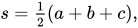
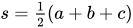
In geometry, Heron's formula (or Hero's formula) gives the area of a triangle in terms of the three side lengths Letting be the semiperimeter of the triangle, the area is[1]
It is named after first-century engineer Heron of Alexandria (or Hero) who proved it in his work Metrica, though it was probably known centuries earlier.
Let be the triangle with sides , , and .
This triangle's semiperimeter is therefore , , , and the area is
In this example, the triangle's side lengths and area are integers, making it a Heronian triangle. However, Heron's formula works equally well when the side lengths are arbitrary real numbers.
The formula is credited to Heron (or Hero) of Alexandria (fl. 60 AD),[3] and a proof can be found in his book Metrica. Mathematical historian Thomas Heath suggested that Archimedes knew the formula over two centuries earlier,[4] and since Metrica is a collection of the mathematical knowledge available in the ancient world, it is possible that the formula predates the reference given in that work.[5]
A formula equivalent to Heron's was discovered by the Chinese:
There are many ways to prove Heron's formula, for example using trigonometry as below, or the incenter and one excircle of the triangle,[7] or as a special case of De Gua's theorem (for the particular case of acute triangles),[8] or as a special case of Brahmagupta's formula (for the case of a degenerate cyclic quadrilateral).
A modern proof, which uses algebra and is quite different from the one provided by Heron, follows.[9]
Let be the sides of the triangle and the angles opposite those sides.
Applying the law of cosines we get
A triangle with sides a, b and c
From this proof, we get the algebraic statement that
The altitude of the triangle on base has length , and it follows
Triangle with altitude h cutting base c into d + (c − d)
The following proof is very similar to one given by Raifaizen.[10]
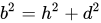
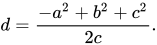
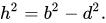
By the Pythagorean theorem we have and according to the figure at the right. Subtracting these yields This equation allows us to express in terms of the sides of the triangle:
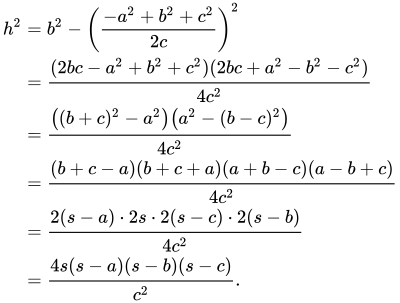
For the height of the triangle we have that By replacing with the formula given above and applying the difference of squares identity we get
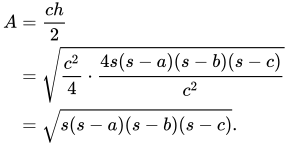
We now apply this result to the formula that calculates the area of a triangle from its height:
Geometrical significance of s − a, s − b, and s − c. See the law of cotangents for the reasoning behind this.
If is the radius of the incircle of the triangle, then the triangle can be broken into three triangles of equal altitude and bases and Their combined area is
where is the semiperimeter.
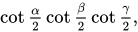
The triangle can alternately be broken into six triangles (in congruent pairs) of altitude and bases and of combined area (see law of cotangents)
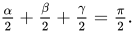
The middle step above is the triple cotangent identity, which applies because the sum of half-angles is
Combining the two, we get
from which the result follows.
Heron's formula as given above is numerically unstable for triangles with a very small angle when using floating-point arithmetic. A stable alternative involves arranging the lengths of the sides so that and computing[11][12]
The extra brackets indicate the order of operations required to achieve numerical stability in the evaluation.
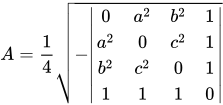
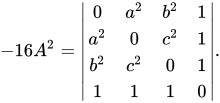
Heron's formula is a special case of Brahmagupta's formula for the area of a cyclic quadrilateral. Heron's formula and Brahmagupta's formula are both special cases of Bretschneider's formula for the area of a quadrilateral. Heron's formula can be obtained from Brahmagupta's formula or Bretschneider's formula by setting one of the sides of the quadrilateral to zero.
Brahmagupta's formula gives the area of a cyclic quadrilateral whose sides have lengths as
Heron's formula is also a special case of the formula for the area of a trapezoid or trapezium based only on its sides. Heron's formula is obtained by setting the smaller parallel side to zero.
There are also formulas for the area of a triangle in terms of its side lengths for triangles in the sphere or the hyperbolic plane. [19]
For a triangle in the sphere with side lengths and the semiperimeter and area , such a formula is
while for the hyperbolic plane we have
^Raifaizen, Claude H. (1971). "A Simpler Proof of Heron's Formula". Mathematics Magazine. 44 (1): 27–28. doi:10.1080/0025570X.1971.11976093.
^Sterbenz, Pat H. (1974-05-01). Floating-Point Computation. Prentice-Hall Series in Automatic Computation (1st ed.). Englewood Cliffs, New Jersey, USA: Prentice Hall. ISBN0-13-322495-3.
^Bényi, Árpád (July 2003). "A Heron-type formula for the triangle". Mathematical Gazette. 87: 324–326. doi:10.1017/S0025557200172882.
^Mitchell, Douglas W. (November 2005). "A Heron-type formula for the reciprocal area of a triangle". Mathematical Gazette. 89: 494. doi:10.1017/S0025557200178532.
^Alekseevskij, D. V.; Vinberg, E. B.; Solodovnikov, A. S. (1993). "Geometry of spaces of constant curvature". In Gamkrelidze, R. V.; Vinberg, E. B. (eds.). Geometry. II: Spaces of constant curvature. Encyclopaedia of Mathematical Sciences. Vol. 29. Springer-Verlag. p. 66. ISBN1-56085-072-8.











![{\displaystyle {\begin{aligned}A&={\textstyle {\sqrt {s(s-a)(s-b)(s-c)}}}\\[3mu]&={\textstyle {\sqrt {16\cdot 12\cdot 3\cdot 1{\vphantom {)}}}}}\\[3mu]&=24.\end{aligned}}}](https://wikimedia.org/api/rest_v1/media/math/render/svg/78ab0c134413a06e8879b8018426a92787a8db29)
![{\displaystyle {\begin{aligned}A&={\tfrac {1}{4}}{\sqrt {(a+b+c)(-a+b+c)(a-b+c)(a+b-c)}}\\[6mu]&={\tfrac {1}{4}}{\sqrt {2(a^{2}b^{2}+a^{2}c^{2}+b^{2}c^{2})-(a^{4}+b^{4}+c^{4})}}\\[6mu]&={\tfrac {1}{4}}{\sqrt {(a^{2}+b^{2}+c^{2})^{2}-2(a^{4}+b^{4}+c^{4})}}\\[6mu]&={\tfrac {1}{4}}{\sqrt {4(a^{2}b^{2}+a^{2}c^{2}+b^{2}c^{2})-(a^{2}+b^{2}+c^{2})^{2}}}\\[6mu]&={\tfrac {1}{4}}{\sqrt {4a^{2}b^{2}-(a^{2}+b^{2}-c^{2})^{2}}}.\end{aligned}}}](https://wikimedia.org/api/rest_v1/media/math/render/svg/aef917f26003ff72dea9d89da7cb56775c079724)







![{\displaystyle {\begin{aligned}A&={\tfrac {1}{2}}({\mbox{base}})({\mbox{altitude}})\\[6mu]&={\tfrac {1}{2}}ab\sin \gamma \\[6mu]&={\frac {ab}{4ab}}{\sqrt {4a^{2}b^{2}-(a^{2}+b^{2}-c^{2})^{2}}}\\[6mu]&={\tfrac {1}{4}}{\sqrt {-a^{4}-b^{4}-c^{4}+2a^{2}b^{2}+2a^{2}c^{2}+2b^{2}c^{2}}}\\[6mu]&={\tfrac {1}{4}}{\sqrt {(a+b+c)(-a+b+c)(a-b+c)(a+b-c)}}\\[6mu]&={\sqrt {\left({\frac {a+b+c}{2}}\right)\left({\frac {-a+b+c}{2}}\right)\left({\frac {a-b+c}{2}}\right)\left({\frac {a+b-c}{2}}\right)}}\\[6mu]&={\sqrt {s(s-a)(s-b)(s-c)}}.\end{aligned}}}](https://wikimedia.org/api/rest_v1/media/math/render/svg/b8c5a8858de9d2a045e2a6bcd363a7f86e93365f)









![{\displaystyle {\begin{aligned}A&=r(s-a)+r(s-b)+r(s-c)\\[2mu]&=r^{2}\left({\frac {s-a}{r}}+{\frac {s-b}{r}}+{\frac {s-c}{r}}\right)\\[2mu]&=r^{2}\left(\cot {\frac {\alpha }{2}}+\cot {\frac {\beta }{2}}+\cot {\frac {\gamma }{2}}\right)\\[3mu]&=r^{2}\left(\cot {\frac {\alpha }{2}}\cot {\frac {\beta }{2}}\cot {\frac {\gamma }{2}}\right)\\[3mu]&=r^{2}\left({\frac {s-a}{r}}\cdot {\frac {s-b}{r}}\cdot {\frac {s-c}{r}}\right)\\[3mu]&={\frac {(s-a)(s-b)(s-c)}{r}}.\end{aligned}}}](https://wikimedia.org/api/rest_v1/media/math/render/svg/0c8fda08d86253fc84256b8229ec47df29418689)













![{\displaystyle {\begin{aligned}A&=D^{2}{\sqrt {S(S-\sin \alpha )(S-\sin \beta )(S-\sin \gamma )}}\\[5mu]&={\tfrac {1}{2}}D^{2}\sin \alpha \,\sin \beta \,\sin \gamma ,\end{aligned}}}](https://wikimedia.org/api/rest_v1/media/math/render/svg/dd202793a39af6fd48df60bf7174e51e70a99710)