


Intercept theorem
The intercept theorem, also known as Thales's theorem, basic proportionality theorem or side splitter theorem, is an important theorem in elementary geometry about the ratios of various line segments that are created if two rays with a common starting point are intercepted by a pair of parallels. It is equivalent to the theorem about ratios in similar triangles. It is traditionally attributed to Greek mathematician Thales. It was known to the ancient Babylonians and Egyptians, although its first known proof appears in Euclid's Elements.
Formulation of the theorem
[edit]

Suppose S is the common starting point of two rays, and two parallel lines are intersecting those two rays (see figure). Let A, B be the intersections of the first ray with the two parallels, such that B is further away from S than A, and similarly C, D are the intersections of the second ray with the two parallels such that D is further away from S than C. In this configuration the following statements hold:[1][2]
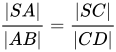
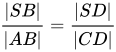
- The ratio of any two segments on the first ray equals the ratio of the according segments on the second ray:
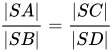
, , - The ratio of the two segments on the same ray starting at S equals the ratio of the segments on the parallels:
- The converse of the first statement is true as well, i.e. if the two rays are intercepted by two arbitrary lines and holds then the two intercepting lines are parallel. However, the converse of the second statement is not true (see graphic for a counterexample).
Extensions and conclusions
[edit]

The first two statements remain true if the two rays get replaced by two lines intersecting in . In this case there are two scenarios with regard to , either it lies between the 2 parallels (X figure) or it does not (V figure). If is not located between the two parallels, the original theorem applies directly. If lies between the two parallels, then a reflection of and at yields V figure with identical measures for which the original theorem now applies.[2] The third statement (converse) however does not remain true for lines.[3][4][5]


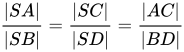
If there are more than two rays starting at or more than two lines intersecting at , then each parallel contains more than one line segment and the ratio of two line segments on one parallel equals the ratio of the according line segments on the other parallel. For instance if there's a third ray starting at and intersecting the parallels in and , such that is further away from than , then the following equalities holds:[4]


- ,

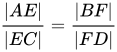
For the second equation the converse is true as well, that is if the 3 rays are intercepted by two lines and the ratios of the according line segments on each line are equal, then those 2 lines must be parallel.[4]
Related concepts
[edit]Similarity and similar triangles
[edit]
The intercept theorem is closely related to similarity. It is equivalent to the concept of similar triangles, i.e. it can be used to prove the properties of similar triangles and similar triangles can be used to prove the intercept theorem. By matching identical angles you can always place two similar triangles in one another so that you get the configuration in which the intercept theorem applies; and conversely the intercept theorem configuration always contains two similar triangles.
Scalar multiplication in vector spaces
[edit]In a normed vector space, the axioms concerning the scalar multiplication (in particular and ) ensure that the intercept theorem holds. One has




Applications
[edit]Algebraic formulation of compass and ruler constructions
[edit]There are three famous problems in elementary geometry which were posed by the Greeks in terms of compass and straightedge constructions:[6][7]
It took more than 2000 years until all three of them were finally shown to be impossible. This was achieved in the 19th century with the help of algebraic methods, that had become available by then. In order to reformulate the three problems in algebraic terms using field extensions, one needs to match field operations with compass and straightedge constructions (see constructible number). In particular it is important to assure that for two given line segments, a new line segment can be constructed, such that its length equals the product of lengths of the other two. Similarly one needs to be able to construct, for a line segment of length , a new line segment of length . The intercept theorem can be used to show that for both cases, that such a construction is possible.


|
Construction of a product
|
Construction of an inverse
|


Dividing a line segment in a given ratio
[edit]To divide an arbitrary line segment in a ratio, draw an arbitrary angle in A with as one leg. On the other leg construct equidistant points, then draw the line through the last point and B and parallel line through the mth point. This parallel line divides in the desired ratio. The graphic to the right shows the partition of a line segment in a ratio.[8]


Measuring and survey
[edit]Height of the Cheops pyramid
[edit]

According to some historical sources the Greek mathematician Thales applied the intercept theorem to determine the height of the Cheops' pyramid. The following description illustrates the use of the intercept theorem to compute the height of the pyramid. It does not, however, recount Thales' original work, which was lost.[9][10]
Thales measured the length of the pyramid's base and the height of his pole. Then at the same time of the day he measured the length of the pyramid's shadow and the length of the pole's shadow. This yielded the following data:
- height of the pole (A): 1.63 m
- shadow of the pole (B): 2 m
- length of the pyramid base: 230 m
- shadow of the pyramid: 65 m
From this he computed

Knowing A, B and C he was now able to apply the intercept theorem to compute

Measuring the width of a river
[edit]The intercept theorem can be used to determine a distance that cannot be measured directly, such as the width of a river or a lake, the height of tall buildings or similar. The graphic to the right illustrates measuring the width of a river. The segments ,, are measured and used to compute the wanted distance .


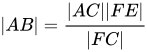
Parallel lines in triangles and trapezoids
[edit]The intercept theorem can be used to prove that a certain construction yields parallel line (segment)s.
|
If the midpoints of two triangle sides are connected then the resulting line segment is parallel to the third triangle side (Midpoint theorem of triangles).  |
If the midpoints of the two non-parallel sides of a trapezoid are connected, then the resulting line segment is parallel to the other two sides of the trapezoid.  |
Historical aspects
[edit]The theorem is traditionally attributed to the Greek mathematician Thales of Miletus, who may have used some form of the theorem to determine heights of pyramids in Egypt and to compute the distance of ship from the shore.[11][12][13][14]
Proof
[edit]An elementary proof of the theorem uses triangles of equal area to derive the basic statements about the ratios (claim 1). The other claims then follow by applying the first claim and contradiction.[1]
Claim 1
[edit]
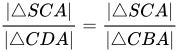
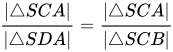
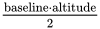
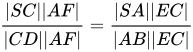
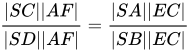
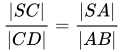
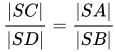
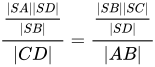
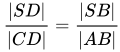
 Notation: For a triangle the vertical bars () denote its area and for a line segment its length. Proof: Since , the altitudes of and are of equal length. As those triangles share the same baseline, their areas are identical. So we have and therefore as well. This yields and Plugging in the formula for triangle areas () transforms that into and Canceling the common factors results in: (a) and (b) Now use (b) to replace and in (a): Using (b) again this simplifies to: (c) |







Claim 2
[edit]
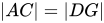
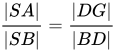
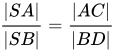
 Draw an additional parallel to through A. This parallel intersects in G. Then one has and due to claim 1 and therefore
|



Claim 3
[edit]
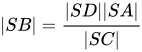
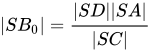
 Assume and are not parallel. Then the parallel line to through intersects in . Since is true, we have |





Notes
[edit]- ^ a b Schupp, H. (1977). Elementargeometrie (in German). UTB Schöningh. pp. 124–126. ISBN 3-506-99189-2.
- ^ a b Strahlensätze. In: Schülerduden: Mathematik I. Dudenverlag, 8. edition, Mannheim 2008, pp. 431–433 (German)
- ^ Agricola, Ilka; Friedrich, Thomas (2008). Elementary Geometry. AMS. pp. 10–13, 16–18. ISBN 0-8218-4347-8. (online copy, p. 10, at Google Books)
- ^ a b c Lorenz Halbeisen, Norbert Hungerbühler, Juan Läuchli: Mit harmonischen Verhältnissen zu Kegelschnitten: Perlen der klassischen Geometrie. Springer 2016, ISBN 9783662530344, pp. 191–208 (German)
- ^ See Agricola/Thomas or the following figure:

|SA| / |SB| = |SC| / |SD| does not necessarily imply AC is parallel to BD. - ^ Kazarinoff, Nicholas D. (2003) [1970], Ruler and the Round, Dover, p. 3, ISBN 0-486-42515-0
- ^ Kunz, Ernst (1991). Algebra (in German). Vieweg. pp. 5–7. ISBN 3-528-07243-1.
- ^ Ostermann, Alexander; Wanner, Gerhard (2012). Geometry by Its History. Springer. pp. 7. ISBN 978-3-642-29163-0. (online copy, p. 7, at Google Books)
- ^ No original work of Thales has survived. All historical sources that attribute the intercept theorem or related knowledge to him were written centuries after his death. Diogenes Laertius and Pliny give a description that strictly speaking does not require the intercept theorem, but can rely on a simple observation only, namely that at a certain point of the day the length of an object's shadow will match its height. Laertius quotes a statement of the philosopher Hieronymus (3rd century BC) about Thales: "Hieronymus says that [Thales] measured the height of the pyramids by the shadow they cast, taking the observation at the hour when our shadow is of the same length as ourselves (i.e. as our own height).". Pliny writes: "Thales discovered how to obtain the height of pyramids and all other similar objects, namely, by measuring the shadow of the object at the time when a body and its shadow are equal in length.". However, Plutarch gives an account that may suggest Thales knowing the intercept theorem or at least a special case of it:".. without trouble or the assistance of any instrument [he] merely set up a stick at the extremity of the shadow cast by the pyramid and, having thus made two triangles by the intercept of the sun's rays, ... showed that the pyramid has to the stick the same ratio which the shadow [of the pyramid] has to the shadow [of the stick]". (Source: Thales biography of the MacTutor, the (translated) original works of Plutarch and Laertius are: Moralia, The Dinner of the Seven Wise Men, 147A and Lives of Eminent Philosophers, Chapter 1. Thales, para.27)
- ^ Herbert Bruderer: Milestones in Analog and Digital Computing. Springer, 2021, ISBN 9783030409746, pp. 214–217
- ^ Dietmar Herrmann: Ancient Mathematics. History of Mathematics in Ancient Greece and Hellenism, Springer 2022, ISBN 978-3-662-66493-3, pp. 27-36
- ^ Francis Borceux: An Axiomatic Approach to Geometry. Springer, 2013, pp. 10–13
- ^ Gilles Dowek: Computation, Proof, Machine. Cambridge University Press, 2015, ISBN 9780521118019, pp. 17-18
- ^ Lothar Redlin, Ngo Viet, Saleem Watson: "Thales' Shadow", Mathematics Magazine, Vol. 73, No. 5 (Dec., 2000), pp. 347-353 (JSTOR

References
[edit]- French, Doug (2004). Teaching and Learning Geometry. BLoomsbury. pp. 84–87. ISBN 9780826473622. (online copy, p. 84, at Google Books)
- Agricola, Ilka; Friedrich, Thomas (2008). Elementary Geometry. AMS. pp. 10–13, 16–18. ISBN 0-8218-4347-8. (online copy, p. 10, at Google Books)
- Stillwell, John (2005). The Four Pillars of Geometry. Springer. p. 34. ISBN 978-0-387-25530-9. (online copy, p. 34, at Google Books)
- Ostermann, Alexander; Wanner, Gerhard (2012). Geometry by Its History. Springer. pp. 3–7. ISBN 978-3-642-29163-0. (online copy, p. 3, at Google Books)
- Lorenz Halbeisen, Norbert Hungerbühler, Juan Läuchli: Mit harmonischen Verhältnissen zu Kegelschnitten: Perlen der klassischen Geometrie. Springer 2016, ISBN 9783662530344, pp. 191–208 (German)
External links
[edit]
- Intercept Theorem at PlanetMath
- Alexander Bogomolny: Thales' Theorems and in particular Thales' Theorem at Cut-the-Knot
- intercept theorem interactive

