


Integral theory (Ken Wilber)
Integral theory, developed by Ken Wilber, is a synthetic metatheory aiming to unify a broad spectrum of theories and models within a singular conceptual framework. The basis is the concept of a 'spectrum of consciousness' that ranges from archaic consciousness to the highest form of spirit, depicting it as an evolutionary developmental model. This model incorporates stages of development as described in structural developmental stage theories, encompassing a variety of psychic and supernatural experiences, as well as models of spiritual growth.
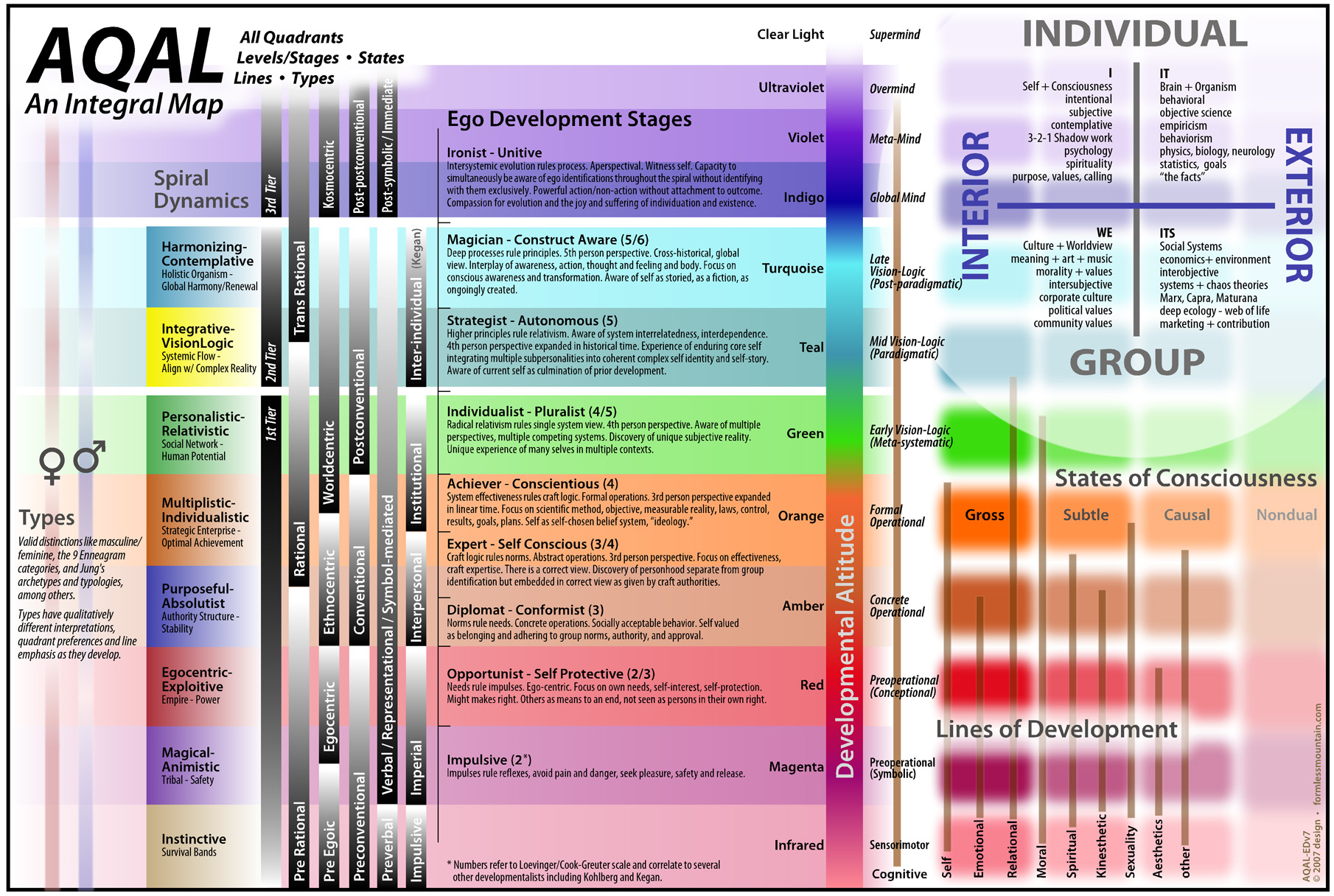
In the advancement of his framework, Wilber introduced the AQAL (All Quadrants All Levels) model, which further expands the theory through a four-quadrant grid (interior-exterior and individual-collective). This grid integrates theories and models detailing the individual's psychological and spiritual development, collective shifts in consciousness, and levels or holons in neurological functioning and societal organisation. Integral theory aims to be a universal metatheory in which all academic disciplines, forms of knowledge, and experiences cohesively align.[1]
Integral theory has found its primary audience within certain subcultures, with limited engagement from the broader academic community.[web 1][2] The Integral Institute publishes the peer-reviewed Journal of Integral Theory and Practice,[web 2] and SUNY Press has released a twelve books under the "SUNY series in Integral Theory."[web 3]
Origins and background[edit]
Origins[edit]
Ken Wilber's Integral theory is a synthetic metatheory, a theory whose subject matter is theory itself,[3] aiming to describe existing theory in a systematic way.[4] A synthetic metatheory "classifies whole theories according to some overarching typology."[4] Wilber's metatheory started in the early 1970s, with the publication of The Spectrum of Consciousness (1977), synthesizing eastern religious traditions with western developmental psychology.[5] In The Atman Project (1980), this spectrum was presented as a developmental model, akin to western structural stage theory, models of psychology development that describe human development as following a set course of stages of development.[6]
According to these early presentations, which rely strongly on perceived analogies between disparate theories (Sri Aurobindo's Integral Yoga, stage theories of psychological development, and Gebser's theory of collective mutations of consciousness), human development follows a set course, from pre-personal infant development, to personal adult development, culminating in trans-personal spiritual development. In Wilber's model, development starts with the separation of individual consciousness from a transcendental reality. The whole course of human development aims at restoring the primordial unity of human and transcendental consciousness. The pre-personal and personal stages are taken from western structural stage theories, which are correlated with other theories. The trans-personal stages consist of psychic and supernatural experiences (psychic and subtle stage), and of models of spiritual development from a variety of eastern religious traditions as interpreted by Wilber (subtle and causal stage). These are placed in a value hierarchy above the structural stages, akin to the Great Chain of Being and Aurobindo's elaboration of the five koshas, and presented as further structural stages.[7][8][9]
Wilber's ideas have grown more and more inclusive over the years, incorporating ontology, epistemology, and methodology,[10] creating that place as a framework which he calls AQAL, "All Quadrants All Levels." In this, Wilber's older frameworks are extended with a grid with four quadrants (interior-exterior, individual-collective), to comprehend individual development, collective mutations of consciousness, and levels or holons of neurological functioning and societal organisation, in a metatheory, in which all academic disciplines and every form of knowledge and experience are supposed to fit together.[1]
Main influences[edit]
Sri Aurobindo[edit]
| Aurobindo's model of Being and Evolution[11][12] | |||||
|---|---|---|---|---|---|
| Levels of Being | Development | ||||
| Overall | Outer Being | Inner Being | Psychic Being | ||
| Supermind | Supermind | Gnostic Man | |||
| Supra-mentalisation | |||||
| Mind | Overmind | Psychisation and Spiritualisation | |||
| Intuition | |||||
| Illuminated Mind | |||||
| Higher Mind | |||||
| Subconscient mind |
Mind proper | Subliminal (inner) mind |
Evolution | ||
| Vital | Subconsc. Vital |
Vital | Subl. (inner) Vital | ||
| Physical | Subconsc. Physical |
Physical | Subl. (inner) Physical | ||
| Inconscient | Inconscient | ||||
The integral yoga of Sri Aurobindo describes five levels of being (physical; vital; mind or mental being; the higher reaches of mind or psychic being; Supermind), akin to the five koshas or sheaths, and three types of being (outer being, inner being, psychic being). The psychic being refers to the higher reaches of mind (higher mind, illuminated mind, intuition, overmind). It correlates with buddhi, the connecting element between purusha and prakriti in Samkhya, and correlated by Wilber with his transpersonal stages. Aurobindo focuses on spiritual development and the process of unifying of all parts of one's being with the Divine. As described by Sri Aurobindo and his co-worker The Mother (1878–1973), this spiritual teaching involves an integral divine transformation of the entire being, rather than the liberation of only a single faculty such as the intellect or the emotions or the body.[13]
Structural stage theory[edit]
Structural stage theories are based on the observation that humans develop through a pattern of distinct stages over time, and that these stages can be described based on their distinguishing characteristics. In Piaget's theory of cognitive development, and related models like those of Jane Loevinger and James W. Fowler, stages have a constant order of succession, later stages integrate the achievements of earlier stages, and each is characterized by a particular type of structure of mental processes which is specific to it. The time of appearance may vary to a certain extent depending upon environmental conditions.[14]
Jean Gebser - Mutations of consciousness[edit]
The word integral was independently suggested by Jean Gebser (1905–1973), a Swiss phenomenologist and interdisciplinary scholar, in 1939 to describe his own intuition regarding the next structure of human consciousness. Gebser was the author of The Ever-Present Origin, which describes human history as a series of mutations in consciousness. He only afterwards discovered the similarity between his own ideas and those of Sri Aurobindo and Teilhard de Chardin.[15] In his book The Ever-Present Origin, Gebser distinguished between five mutations of consciousness: archaic, magic, mythical, mental, and integral. Gebser wrote that he was unaware of Sri Aurobindo's prior usage of the term "integral", which coincides to some extent with his own.[citation needed] He collaborated with the German indologist Georg Feuerstein, who popularized his work.
Spiral Dynamics and collaboration with Don Beck[edit]
| Spiral Dynamics vs AQAL altitudes[16][note 1] | |||||||
| SD / SDi | AQAL altitudes (Numbers correspond to Loevinger's model[17] | ||||||
|---|---|---|---|---|---|---|---|
| source | tier | level | level | tier | source | ||
| Inspired by Graves |
2nd | Coral (unrelated and not corresponding to Wilber's 3rd tier) |
Clear Light | 3rd | Spiritual development (Aurobindo, Buddhism) | ||
| Ultraviolet | |||||||
| Violet | |||||||
| Indigo | |||||||
| Turquoise | Turquoise (5/6 Post-autonomous)) | 2nd | Structural Stage Theory | ||||
| Yellow | Teal (5 Autonomous) | ||||||
| 1st | Green | Green (4/5 Individualistic) | 1st | ||||
| Orange | Orange (4 Consciountious) | ||||||
| - | - | Orange-Amber (3/4 self-consciousness) | |||||
| Blue | Amber (3 Conformist) | ||||||
| Red | Red (2/3 Self-protective) | ||||||
| Purple | Magenta (2 Impulsive) | ||||||
| Beige | Infrared | ||||||
After completing Sex, Ecology, Spirituality (1995), Ken Wilber started to collaborate with Don Beck, whose Spiral Dynamics is based on the work of Clare W. Graves, and shows strong correlates with Wilber's model.[18][note 3] The collaboration with Wilber led to a split between Beck and Cowan.[note 4] After the collaboration with Christopher Cowan ended, Beck announced his own version of Spiral Dynamics, namely "Spiral Dynamics integral" (SDi) at the very end of 2001,[20] while Cowan and his business partner Natasha Todorovic stayed closer to Graves'original model.
In his 2006 book Integral Spirituality, Wilber created the AQAL "altitudes," the first eight of which parallel Spiral Dynamics, as a more comprehensive, integrated system.[23][note 5] By 2006, Wilber and Beck had diverged in their interpretations of the Spiral Dynamics model, with Beck positioning the spiral of levels at the center of the quadrants, while Wilber placed it solely in the lower left quadrant. Beck saw Wilber's modifications as distortions of the model, and expressed frustration with what he saw as Wilber's exclusive focus on spirituality, while Wilber declared Spiral Dynamics to be incomplete as those who study only Spiral Dynamics "will never have a satori." Beck continued to use the SDi name along with the 4Q/8L (four quadrants/eight levels) system from A Theory of Everything, while Wilber went on to criticize both Beck and Cowan.[20]
Wilber's metatheory[edit]
In Sex, Ecology, Spirituality (1995), Wilbur introduced his AQAL (All Quadrants All Levels) metatheory, a framework which consists of four fundamental concepts and a rest-category: four quadrants (interior-exterior, individual-collective), several levels and lines of development, several states of consciousness, and "types", topics which don't fit into these four concepts.[28] According to Wilber, it is one of the most comprehensive approaches to reality, a metatheory in which all academic disciplines and every form of knowledge and experience fit together coherently.[1]
"Levels" are the stages of development, from pre-personal through personal to transpersonal. "Lines" are lines of development, the several domains of development, which may process uneven, with several stages of development in place at the various domains.[note 6] "States" are states of consciousness; according to Wilber persons may have a terminal experience of a higher developmental stage.[note 7] "Types" is a rest-category, for phenomena which don't fit in the other four concepts.[29] The individual building blocks of Wilber's model are holons, which means that every entity and concept is both an entity on its own, and a hierarchical part of a larger whole.[note 8] Holons form natural "holarchies", like Russian dolls, where a whole is a part of another whole, in turn part of another whole, and so on.[30]
In order for an account of the Kosmos to be complete, Wilber believes that it must include each of these five categories. For Wilber, only such an account can be accurately called "integral," describing AQAL as "one suggested architecture of the Kosmos."[31]
Four quadrants[edit]
| Upper-Left (UL) "I" e.g. Jane Loevinger and Sigmund Freud |
Upper-Right (UR) "It" e.g. Skinner |
| Lower-Left (LL) "We" e.g. Jean Gebser and Jurgen Habermas |
Lower-Right (LR) "Its" e.g. Marx |
The AQAL-framework has a four-quadrant grid with two axes, namely "interior-exterior," akin to the subjective-objective distinction, and "individual-collective." The left side (interior) mirrors the individual development from structural stage theory, and the collective mutations of consciousness from Gebser. The right side describes levels of neurological functioning and societal organisation. Wilber uses this grid to categorize the perspectives of various theories and scholars:
- Interior individual perspective (upper-left quadrant) describes individual psychological development, as described in structural stage theory, focusing on "I";
- Interior plural perspective (lower-left) describes collective mutations in consciousness, as in Gebser's theory, focusing on "We";
- Exterior individual perspective (upper-right) describes the physical (neurological) correlates of consciousness, from atoms through the nerve-system to the neo-cortex, focusing on observable behaviour, "It";
- Exterior plural perspective (lower-right) describes the organisational levels of society (i.e. a plurality of people) as functional entities seen from outside, e.g. "They."
Each of the four approaches has a valid perspective to offer. The subjective emotional pain of a person who suffers a tragedy is one perspective; the social statistics about such tragedies are different perspectives on the same matter. According to Wilber all are needed for real appreciation of a matter.
According to Wilber, all four perspectives offer complementary, rather than contradictory, perspectives. It is possible for all to be correct, and all are necessary for a complete account of human existence. According to Wilber, each by itself offers only a partial view of reality. According to Wilber modern western society has a pathological focus on the exterior or objective perspective. Such perspectives value that which can be externally measured and tested in a laboratory, but tend to deny or marginalize the left sides (subjectivity, individual experience, feelings, values) as unproven or having no meaning. Wilber identifies this as a fundamental cause of society's malaise, and names the situation resulting from such perspectives, "flatland".
The model is topped with formless awareness, "the simple feeling of being," which is equated with a range of "ultimates" from a variety of eastern traditions. This formless awareness transcends the phenomenal world, which is ultimately only an appearance of some transcendental reality. According to Wilber, the AQAL categories—quadrants, lines, levels, states, and types—describe the relative truth of the two truths doctrine of Buddhism.[note 9]
Levels or stages[edit]
| Developmental stages | ||||||||||||
| Wilber | Wilber[32] | Wilber (AQAL)[web 4][web 5] (Numbers correspond to Loevinger's model[17] |
Aurobindo[11][12][note 10] | Gebser | Piaget/Koplowitz | Fowler | Age | |||||
|---|---|---|---|---|---|---|---|---|---|---|---|---|
| Levels of Being | Development | |||||||||||
| Overall | Outer Being | Inner Being | Psychic Being | |||||||||
| Transpersonal | Nondual | Clear Light (non-dual self) |
Supermind | Supermind | Gnostic Man | |||||||
| Supra-mentalisation | ||||||||||||
| Causal | Ultraviolet (causal self) |
Mind | Overmind | Psychisation and Spiritualisation | ||||||||
| Subtle | Violet (subtle self) |
Intuition | ||||||||||
| Psychic | Indigo (psychic self) |
Illuminated Mind | ||||||||||
| Personal | Centaur (Vision-logic) | Turquoise (Integral self)(5/6) |
Higher Mind | Integral | Unitary | 6. Universalizing | 45+? | |||||
| Teal (Integral self)(5) |
System | 5. Conjunctive | 35+? | |||||||||
| Formal-reflexive | Green (4/5) | Subconscient mind |
Mind proper | Subliminal (inner) mind |
Evolution | Rational | 4. Individual-reflexive | 21+ years? | ||||
| Orange (4) | Formal-operational | |||||||||||
| Orange/Amber (3/4) | 3. Synthetic- Conventional |
12+ years | ||||||||||
| Amber (3) | ||||||||||||
| Rule/role mind | Red (2/3) | Mythic-rational | Concrete operational | 2. Mythic- literal |
7–12 years | |||||||
| Pre-personal | Rep-mind | Magenta (2) | Mythic | Pre-operational | 1. Intuitive- projective |
2–7 years | ||||||
| Phantasmic-emotional | Infrared (1 & 2/D) | Vital | Subconsc. Vital |
Vital | Subl. (inner) Vital |
Magical | Sensoric-motorical | 0. Undifferentiated Faith |
0–2 years | |||
| Sensori-physical | Physical | Subconsc. Physical |
Physical | Subl. (inner) Physical |
Archaic | |||||||
| undifferentiated or primary matrix | Inconscient | Inconscient | ||||||||||
The basis of Wilber's theory is his developmental model. Wilber's model follows the discrete structural stages of development, as described in the structural stage theories of developmental psychology, most notably Loevinger's stages of ego development.[note 11] To these stages are added psychic and supernatural experiences and various models of spiritual development, presented as additional and higher stages of structural development. According to Wilber, these stages can be grouped in pre-personal (subconscious motivations), personal (conscious mental processes), and transpersonal (integrative and mystical structures) stages.[note 12]
All of these mental structures are considered to be complementary and legitimate, rather than mutual exclusive. Wilber's equates the levels in psychological and cultural development, with the hierarchical nature of matter itself.
Lines, streams, or intelligences[edit]
According to Wilber, various domains or lines of development, or intelligences can be discerned.[34] They include cognitive, ethical, aesthetic, spiritual, kinesthetic, affective, musical, spatial, logical-mathematical, karmic, etc. For example, one can be highly developed cognitively (cerebrally smart) without being highly developed morally (as in the case of Nazi doctors).
States[edit]
States are temporary states of consciousness, such as waking, dreaming and sleeping, bodily sensations, and drug-induced and meditation-induced states. Some states are interpreted as temporary intimations of higher stages of development.[35][36] Wilber's formulation is: "States are free but structures are earned." A person has to build or earn structure; it cannot be peak-experienced for free. What can be peak-experienced, however, are higher states of freedom from the stage a person is habituated to, so these deeper or higher states can be experienced at any level.[note 13]
Types[edit]
These are models and theories that don't fit into Wilber's other categorizations. Masculine/feminine, the nine Enneagram categories, and Jung's archetypes and typologies, among innumerable others, are all valid types in Wilber's schema. Wilber makes types part of his model in order to point out that these distinctions are different from the already mentioned distinctions: quadrants, lines, levels and states.[38]
Holons[edit]
Holons are the individual building blocks of Wilber's model. Wilber borrowed the concept of holons from Arthur Koestler's description of the great chain of being, a mediaeval description of levels of being. "Holon" means that every entity and concept is both an entity on its own, and a hierarchical part of a larger whole. For example, a cell in an organism is both a whole as a cell, and at the same time a part of another whole, the organism. Likewise a letter is a self-existing entity and simultaneously an integral part of a word, which then is part of a sentence, which is part of a paragraph, which is part of a page; and so on. Everything from quarks to matter to energy to ideas can be looked at in this way. The relation between individuals and society is not the same as between cells and organisms though, because individual holons can be members but not parts of social holons.[note 8]
In his book Sex, Ecology, Spirituality: The Spirit of Evolution, Wilber outlines twenty fundamental properties, called "tenets", that characterize all holons.[39] For example, they must be able to maintain their "wholeness" and also their "part-ness;" a holon that cannot maintain its wholeness will cease to exist and will break up into its constituent parts.
Holons form natural "holarchies", like Russian dolls, where a whole is a part of another whole, in turn part of another whole, and so on. Each holon can be seen from within (subjective, interior perspective) and from the outside (objective, exterior perspective), and from an individual or a collective perspective.[30]
Influence[edit]
Integral movement[edit]
Some individuals affiliated with Ken Wilber have claimed that there exists a loosely defined "Integral movement".[40] Others, however, have disagreed.[41] Whatever its status as a "movement", there are a variety of religious organizations, think tanks, conferences, workshops, and publications in the US and internationally that use the term integral.
According to John Bothwell and David Geier, among the top thinkers in the integral movement are Stanislav Grof, Fred Kofman, George Leonard, Michael Murphy, Jenny Wade, Roger Walsh, Ken Wilber, and Michael E. Zimmerman.[42] In 2007, Steve McIntosh pointed to Henri Bergson and Teilhard de Chardin as pre-figuring Wilber as integral thinkers.[43] While in the same year, the editors of What Is Enlightenment? listed as contemporary Integralists Don Edward Beck, Allan Combs, Robert Godwin, Sally Goerner, George Leonard, Michael Murphy, William Irwin Thompson, and Wilber.[44]
Gary Hampson suggested that there are six intertwined genealogical branches of Integral, based on those who first used the term: those aligned with Aurobindo, Gebser, Wilber, Gangadean, László and Steiner (noting that the Steiner branch is via the conduit of Gidley).[45]
Applications[edit]
Michael E. Zimmerman and Sean Esbjörn-Hargens have applied Wilber's integral theory in their environmental studies and ecological research, calling it "integral ecology".[46][47][48][49] Elza Maalouf had used the AQAL-model in her corporate consulting worm in the Middle East.[50] In his book MEMEnomics Said E. Dawlabani uses "Spiral Dynamics" to develop insights regarding the lead up and aftermath of the 2008 global financial crisis. "Integral leadership" is presented as a style of leadership that attempts to integrate major styles of leadership.[51] Don Beck, Lawrence Chickering, Jack Crittenden, David Sprecher, and Ken Wilber have applied the AQAL-model to issues in political philosophy and applications in government, calling it "integral politics".[52] Sen has called the Yoga psychology of Sri Aurobindo "Integral psychology."[53] For Wilber, "integral psychology" is psychology that is inclusive or holistic rather than exclusivist or reductive, and values and integrates multiple explanations and methodologies.[54][55] Marilyn Hamilton used the term "integral city", describing the city as a living human system, using an integral lens.[56] Integral Life Practice (ILP) applies Ken Wilber's Integral model through nine modules of personal practice. Examples of "integral practice" not associated with Ken Wilber, and derived from alternate approaches, are Integral Transformative Practice (ITP), Holistic Integration, and Integral Lifework.
Other approaches[edit]
Bonnitta Roy has introduced a "process model" of integral theory, combining Western process philosophy, Dzogchen ideas, and Wilberian theory. She distinguishes between Wilber's concept of perspective and the Dzogchen concept of view, arguing that Wilber's view is situated within a framework or structural enfoldment which constrains it, in contrast to the Dzogchen intention of being mindful of view.[57]
Wendelin Küpers, a German scholar specializing in phenomenological research, has proposed that an "integral pheno-practice" based on aspects of the work of Maurice Merleau-Ponty can provide the basis of an "adequate phenomenology" useful in integral research. His proposed approach claims to offer a more inclusive and coherent approach than classical phenomenology, including procedures and techniques called epoché, bracketing, reduction, and free variation.[58]
Sean Esbjörn-Hargens has proposed a new approach to climate change called "integral pluralism", which builds on Wilber's recent work but emphasizes elements such as ontological pluralism that are understated or absent in Wilber's own writings.[59]
Reception in mainstream academia[edit]
Integral Theory is irrelevant in, and widely ignored at, mainstream academic institutions, and has been sharply contested by critics.[6] The independent scholar Frank Visser says that there is a problematic relation between Wilber and academia for several reasons, including a "self-referential discourse" wherein Wilber tends to describe his work as being at the forefront of science.[60] Visser has compiled a bibliography of online criticism of Wilber's Integral Theory[web 6] and produced an overview of their objections.[web 7] Another Wilber critic, the independent scholar Andrew P. Smith, observes that most of Wilber's work has not been published by university presses, a fact that discourages some academics from taking his ideas seriously. Wilber's failure to respond to critics of Integral Theory is also said to contribute to the field's chilly reception in some quarters.[61]
Forman and Esbjörn-Hargens have countered criticisms regarding the academic standing of integral studies in part by claiming that the divide between Integral Theory and academia is exaggerated by critics who themselves lack academic credentials or standing. They also said that participants at the first Integral Theory Conference in 2008 had largely mainstream academic credentials and pointed to existing programs in alternative universities like John F. Kennedy University or Fielding Graduate University as an indication of the field's emergence.[62]
SUNY Press began publishing their "SUNY series in Integral Theory" in 2010; as of 2021 there were 12 books in the series.[63]
See also[edit]
- Metamodernism
- Multidisciplinary approach
- Post-postmodernism
- Scale (analytical tool)
- Systems science
- Transdisciplinarity
- Transmodernism
- Vedanta
Notes[edit]
- ^ Note that while Visser shows two Spiral Dynamics colors above Coral, these are not present in Beck or Cowan's publications, and Cowan explicitly states that "no colors have been assigned for nodal systems beyond Turquoise and Coral. Teal and Aubergine are candidates, but Azure and Plum also have a certain appeal." (Cowan, Christopher (2006). "FAQs > Questions About the Colors in Spiral Dynamics". Retrieved August 3, 2021.)
- ^ Nicholas Reitter notes that Wilber treated Graves "as a respected predecessor, though typically as only one among a group of recent, relevant developmental thinkers."[19]
- ^ Wilber referenced Graves's emergent cyclical levels of existence theory (ECLET) in SES, when he introduced his quadrant model.[note 2] Don Beck and Christopher Cowan published their application and extension of Graves's work in 1996 in Spiral Dynamics: Mastering Values, Leadership, and Change.[20] Wilber began to incorporate Spiral Dynamics in the "Integral Psychology" section of The Collected Works of Ken Wilber, Vol. 4 in 1999,[21] and gave it a prominent place in 2000's A Theory of Everything.[22]
- ^ Wilber and Beck put a strong emphasis on the distinctions between the 1st tier (Green and earlier) vs 2nd tier (Yellow and later) levels, associating integral thinking with the 2nd tier.[23] Wilber and Beck developed the concept of the "Mean Green Meme" (MGM) regarding the Green level of Spiral Dynamics, which they associated with postmodernism. Wilber further developed this idea into the "Boomeritis" concept, devoting a chapter to each in A Theory of Everything.[22] As Beck explained: "Ken and I asked: How do we uncap GREEN? How do we keep it moving? Because so much of it has become a stagnant pond, in our view. So we said, let's invent the Mean Green Meme. Let's shame it a bit. Let's hold up a mirror and show it what it's doing, with the hope that it will separate the Mean Green Meme from legitimate healthy GREEN. Let's expose enough people to the duplicity and artificiality and self-serving nature of their own belief systems around political correctness to finally get the word out that there's something beyond that.[24] Cowan and his business partner Natasha Todorovic disagreed with this view, leading Todorovic to publish a paper refuting it based on psychological trait mapping research.[25] Todorovic charged that when the Mean Green Meme concept is used to criticize a person making an argument, it "usurps arguments by undermining an individual before the debate has begun."[26]
- ^ The altitudes use a color system based on rainbow correlations with chakras, replacing the spiraling alternation of warm and cool colors that is a fundamental property in SDi with a linear progression.[27] In place of the six-levels-per-tier structure of SDi, Wilber truncates the 2nd tier after only two levels, adding a 3rd tier of his four levels of transpersonal development, derived from the work of Sri Aurobindo and other spiritual traditions. Wilber further elaborated on this expanded and recolored system in 2017's The Religion of Tomorrow.[23]
- ^ This interpretation is at odds with structural stage theory, which posits an overall follow-up of stages, instead of variations over several domains.
- ^ This too is at odds with structural stage theory, but in line with Wilber's philosophical idealism, which sees the phenomenal world as a concretisation, or immanation, of a "higher," transcendental reality, which can be "realized" in "religious experience."
- ^ a b See A Miracle Called "We" in Integral Spirituality and [https://web.archive.org/web/20120304183629/http://wilber.shambhala.com/html/books/kosmos/excerptA/notes-1.cfm/ Archived 2012-03-04 at the Wayback Machine.
- ^ The Madhyamaka Two Truths Doctrine discerns two epistemological truths, namely conventional and ultimate. Conventional truth is the truth of phenomenal appearances and causal relations, our daily common-sense world. Ultimate truth is the recognition that no-"thing" exists inherently; every"thing" is empty, sunyata of an unchanging "essence." It also means that there is no unchanging transcendental reality underlying phenomenal existence. "Formless awareness" belongs to another strand of Indian thinking, namely Advaita and Buddha-nature, which are ontological approaches, and do posit such a transcendental, unchanging reality, namely "awareness" or "consciousness." Wilber seems to be mixing, or confusing, these two different approaches freely, in his attempt to integrate "everything" into one conceptual scheme.
- ^ Note that Wilber presents Aurobindo's level of Being as developmental stages, whereas Aurobindo describes higher development as a Triple Transformation, which includes "psychicisation" (Wilber's psychic stage), the turn inward and the discovery of the psychic being; spiritualisation, the transformation of the lower being through the realisation of the psychic being, and involves the Higher Mind; and "supramentalisation," the realisation of Supermind, itself the intermediary between Spirit or Satcitananda and creation. A correct table would include Aurobindo's Triple Transformation and the Three Beings:

Comparison of the models of Wilber and Aurobindo; differentiating between Aurobindo's levels of being and Aurobindo's developmental stages. - ^ Other's are Piaget's theory of cognitive development,[33] Kohlberg's stages of moral development, Erikson's stages of psychosocial development, and Jane Loevinger's stages of ego development.
- ^ For example:
- ^ In his book Integral Spirituality, Wilber identifies a few varieties of states:
- The three daily cycling natural states: waking, dreaming, and sleeping.
- Phenomenal states such as bodily sensations, emotions, mental ideas, memories, or inspirations, or from exterior sources such as our sensorimotor inputs, seeing, hearing, touching, smelling, tasting.
- Altered states, is divided into two groups:
- Exogenous or induced states: psychedelic and other drug-induced states; hypnosis and hypnotherapy; psycho-therapeutic techniques; gestalt therapy; psychodrama; voice dialogue techniques; biofeedback states; forms of guided imagery;
- Endogenous or trained states: performance enhancement techniques in sports therapy; meditative training which work on calming, relaxation, equanimity states; and mental imaging and visualization such as tonglen meditation.
- Some techniques, such as Neuro-linguistic Programming, work with both endogenous and exogenous types.
- Spontaneous or peak states: unintentional or unexpected shifts of awareness from gross to subtle or causal states of consciousness.[37]

References[edit]
- ^ a b c Wilber, Ken. "AQAL Glossary," Archived 2011-10-12 at the Wayback Machine "Introduction to Integral Theory and Practice: IOS Basic and the AQAL Map," Vol. 1, No. 3. Retrieved on Jan. 7, 2010.
- ^ Visser, Frank. "Assessing Integral Theory: Opportunities and Impediments," Integral World. Retrieved via IntegralWorld.net on Jan. 7, 2010
- ^ Merriam-Webster, Definition of metatheory
- ^ a b Walter L. Wallace, Metatheory. In: Encyclopedia of Sociology, Encyclopedia.com
- ^ Grof, Stanislav. "A Brief History of Transpersonal Psychology" Archived 2011-07-16 at the Wayback Machine, StanislavGrof.com, p. 11. Retrieved via StanislavGrof.com on Jan. 13, 2010.
- ^ a b Zimmerman, Michael E. (2005). "Wilber, Ken (1949–)" (PDF). The Encyclopedia of Religion and Nature. London: Continuum. pp. 1734–1744. Archived from the original (PDF) on January 8, 2010. Retrieved March 21, 2021.
- ^ Wilber 1984, p. 76.
- ^ Wilber 1992.
- ^ Visser 2003.
- ^ Esbjörn-Hargens, Sean (2006). "Editor’s Inaugural Welcome,"[permanent dead link] AQAL: Journal of Integral Theory and Practice, p. v. Retrieved Jan. 7, 2010.
- ^ a b Wilber 1992, p. 263.
- ^ a b Sharma 1991.
- ^ Sri Aurobindo, The Synthesis of Yoga, p. 114
- ^ Piaget, J. (1970). Piaget's theory. In P. H. Mussen, (Ed.), Carmichael's handbook of child development (pp. 703-732). New York: Wiley.
- ^ Ever-Present Origin p.102 note 4
- ^ Visser 2017b, pp. 36–38.
- ^ a b Wilber's colours)
- ^ Christopher Cooke and Ben Levi Spiral Dynamics Integral
- ^ Reitter, Nicholas (June 2018). "Clare W. Graves and the Turn of Our Times". Journal of Conscious Evolution. 11 (11). California Institute of Integral Studies. Article 5, pages 42–43. Retrieved August 5, 2020.
- ^ a b c Butters, Albion (November 17, 2015). "A Brief History of Spiral Dynamics". Approaching Religion. 5 (2): 67–78. doi:10.30664/ar.67574.
- ^ Visser 2003, p. 229.
- ^ a b MacDonald, Copthorne. "Review Of: A Theory of Everything". Integralis: Journal of Integral Consciousness, Culture, and Science. 1. Retrieved August 12, 2020.
- ^ a b c Visser, Frank (May 2017). "A More Adequate Spectrum of Colors?". Integral World. Retrieved March 21, 2021.
- ^ Roemischer, Jessica (Fall–Winter 2002). "The Never-Ending Upward Quest: An Interview with Dr. Don Beck". What Is Enlightenment?. No. 22. pp. 105–126.
- ^ Hampson, Gary P. (June 2007). "Integral Re-views Postmodernism: The Way Out Is Through" (PDF). Integral Review (4): 131. Retrieved March 4, 2021.
- ^ Todorovic, Natasha (2002). "The Mean Green Hypothesis: Fact or Fiction?" (PDF). Spiral Dynamics Online. Retrieved August 24, 2020.
- ^ Hampson, Gary P. (June 2007). "Integral Re-views Postmodernism: The Way Out Is Through" (PDF). Integral Review (4): 122. Retrieved March 4, 2021. (footnote 39)
- ^ Fiandt, K.; Forman, J.; Erickson Megel, M.; et al. (2003). "Integral nursing: an emerging framework for engaging the evolution of the profession". Nursing Outlook. 51 (3): 130–137. doi:10.1016/s0029-6554(03)00080-0. PMID 12830106.
- ^ "Integral Psychology." In: Weiner, Irving B. & Craighead, W. Edward (ed.), The Corsini encyclopedia of psychology, Vol. 2, 4. ed., Wiley 2010, pp. 830 ff. ISBN 978-0-470-17026-7
- ^ a b Paulson 2008.
- ^ "Excerpt C: The Ways We Are In This Together". Ken Wilber Online. Archived from the original on December 23, 2005. Retrieved December 26, 2005.
- ^ Wilber, Ken (1996). A Brief History of Everything. Shambhala. p. 165. Retrieved March 21, 2021.
- ^ Marian de Souza (ed.), International Handbook of Education for Spirituality, Care and Wellbeing, Springer 2009, p. 427. ISBN 978-1-4020-9017-2
- ^ Wilber, Ken (2000). integral Psychology. Boston: Shambhala. pp. 197–217. ISBN 1-57062-554-9.
- ^ Wilber, Ken. (2006). Integral spirituality: A startling new role for religion in the modern and post-modern world. Boston, MA: Shambhala
- ^ Edwards, Mark (2008). "An Alternative View on States: Part One and Two. Retrieved in full 3/08 from http://www.integralworld.net/edwards14.html
- ^ Maslow, A. (1970). Religions, values, and peak experiences. New York: Penguin; McFetridge, Grant (2004). Peak states of consciousness: Theory and applications, vol. 1, Break-through techniques for exceptional quality of life. Hornsby Island, BC: Institute for the Study of Peak States Press; Bruce, R. (1999). Astral dynamics: A new approach to out-of-body experiences. Charlottesville, VA: Hampton Roads
- ^ Wilber, Ken (1996). A Brief History of Everything. Boston and London: Shambhala. pp. 209–218. ISBN 1-57062-187-X.
- ^ Wilber, Ken; Sex, Ecology, Spirituality, 1995, p. 35–78
- ^ Patten, Terry. "Integral Heart Newsletter #1: Exploring Big Questions in the Integral World," Integral Heart Newsletter. Retrieved via IntegralHeart.com on Jan. 13, 2010.
- ^ Kazlev, Alan. "Redefining Integral," Integral World. Retrieved via IntegralWorld.net on Jan. 13, 2010.
- ^ John Bothwell and David Geier, Score! Power Up Your Game, Business and Life by Harnessing the Power of Emotional Intelligence, p.144
- ^ Steve McIntosh, Integral Consciousness and the Future of Evolution, ch.7
- ^ The Real Evolution Debate, What Is Enlightenment?, no.35, January–March 2007, p.100
- ^ Gary Hampson, "Integral Re-views Postmodernism: The Way Out Is Through" Integral Review 4, 2007 pp.13-4, http://www.integral-review.org
- ^ Zimmerman, M. (2005). "Integral Ecology: A Perspectival, Developmental, and Coordinating Approach to Environmental Problems." World Futures: The Journal of General Evolution 61, nos. 1-2: 50-62.
- ^ Esbjörn-Hargens, S. (2008). "Integral Ecological Research: Using IMP to Examine Animals and Sustainability" in Journal of Integral Theory and Practice Vol 3, No. 1.
- ^ Esbjörn-Hargens, S. & Zimmerman, M. E. (2008). "Integral Ecology" Callicott, J. B. & Frodeman, R. (Eds.) Encyclopedia of Environmental Ethics and Philosophy. New York: Macmillan Library Reference.
- ^ Sean Esbjörn-Hargens and Michael E. Zimmerman, Integral Ecology: Uniting Multiple Perspectives on the Natural World, Integral Books (2009) ISBN 1-59030-466-7
- ^ Maalouf, E. 2014 "Emerge! The Rise of Functional Democracy and the Future of the Middle East" SelectBooks, Inc. 978-1-59079-286-5.
- ^ Kupers, W. & Volckmann, R. (2009). "A Dialogue on Integral Leadership"[permanent dead link]. Integral Leadership Review, Volume IX, No. 4 - August 2009. Retrieved on October 23, 2010.
- ^ Ken Wilber (2000). A Theory of Everything: An Integral Vision for Business, Politics, Science and Spirituality, p. 153. Boston: Shambhala Publications. ISBN 1-57062-855-6
- ^ Indra Sen, Integral Psychology: The Psychological System of Sri Aurobindo, Pondicherry, India: Sri Aurobindo Ashram Trust, 1986
- ^ Wilber, K., 1997, An integral theory of consciousness; Journal of Consciousness Studies, 4 (1), pp.71-92
- ^ Esbjörn-Hargens, S., & Wilber, K. (2008). "Integral Psychology" in The Corsini's Encyclopedia of Psychology. 4th Edition. New York: John Wiley and Sons.
- ^ Hamilton, M. (2008). Integral City: Evolutionary Intelligences for the Human Hive. Gabriola Island BC: New Society Publishers.
- ^ Roy, Bonnitta (2006). "A Process Model of Integral Theory," Integral Review, 3, 2006. Retrieved on Jan. 10, 2010.
- ^ Küpers, Wendelin "The Status and Relevance of Phenomenology for Integral Research: Or Why Phenomenology is More and Different than an 'Upper Left' or 'Zone #1' Affair," Integral Review, June 2009, Vol. 5, No. 1. Retrieved on Jan. 10, 2010.
- ^ Esbjörn-Hargens, S. (2010) An Ontology of Climate Change: Integral Pluralism and the Enactment of Multiple Objects. Journal of Integral Theory and Practice, V5.1, March 2010, pp.143-74
- ^ Visser, Frank. "Assessing Integral Theory: Opportunities and Impediments". Integral World. Retrieved July 1, 2010.
- ^ Smith, Andrew P. "Contextualizing Ken". Integral World. Retrieved January 7, 2010.
- ^ Forman, Mark D. and Esbjörn-Hargens, Sean. "The Academic Emergence of Integral Theory," Integral World. Retrieved via IntegralWorld.net on Jan. 7, 2010.
- ^ "Suny series in Integral Theory". SUNY Press. Retrieved May 12, 2021.
)
Sources[edit]
- Printed sources
- Esbjörn-Hargens, S. (2010). "Introduction". In Esbjörn-Hargens (ed.). Integral Theory in Action: Applied, Theoretical, and Constructive Perspectives on the AQAL Model. SUNY Series in Integral Theory. Albany, NY: SUNY Press. ISBN 978-1438433851.
- Paulson, Daryl S. (2008). "Wilber's Integral Philosophy: A Summary and Critique". Journal of Humanistic Psychology. 48 (3): 364–388. doi:10.1177/0022167807309748. S2CID 146586479.
- Sharma, Ram Nath (1991), Sri Aurobindo's Philosophy of Social Development, Atlantic Publishers
- Visser, Frank (September 1, 2003). Ken Wilber: Thought as Passion. SUNY series in Transpersonal and Humanistic Psychology. SUNY Press. p. 229. ISBN 978-0791458150.
- Visser, Frank (2017b). "Climbing the Stairway to Heaven: Reflections on Ken Wilber's "The Religion of Tomorrow"" (PDF). Integral World. Retrieved May 19, 2021.
- Wilber, Ken (1992) [1977], The Atman Project, Servire
- Wilber, Ken (1984), "The developmental spectrum and psychopathology: Part I, stages and types of pathology" (PDF), Journal of Transpersonal Psychology
- Web-sources
- ^ Forman, Mark D. and Esbjörn-Hargens, Sean. "The Academic Emergence of Integral Theory," Integral World. Retrieved via IntegralWorld.net on Jan. 7, 2010.
- ^ "Integral Institute"..
- ^ "SUNY Press".
- ^ Integral Life
- ^ Integral European Conference 2022
- ^ Visser, Frank. "Critics on Ken Wilber". Integral World. Retrieved January 10, 2010.
- ^ Visser, Frank. "A Spectrum of Wilber Critics". Integral World. Retrieved October 1, 2010.

External links[edit]
- IntegralLife (former Integral Institute)
- Homepage of Ken Wilber, the founder of the Integral theory