


Kawasaki Heavy Industries & Nippon Sharyo C751B
 | This article needs additional citations for verification. (April 2019) |
Kawasaki Heavy Industries & Nippon Sharyo (KNS) C751B
| |
|---|---|
 A C751B trainset at Eunos. | |
 Interior of a C751B motor compartment. | |
| Stock type | Electric multiple unit |
| In service | 8 May 2000 – 30 September 2024 (24 years, 145 days) |
| Manufacturer | Kawasaki Heavy Industries and Nippon Sharyo |
| Designer | GK Industrial Design[1] |
| Built at | Kobe, Hyogo (Kawasaki) and Toyokawa, Aichi (Nippon Sharyo), Japan |
| Constructed | 1999 – 2001 |
| Entered service | 8 May 2000 |
| Retired | 7 December 2024[2] |
| Scrapped | March 2021 – December 2024 |
| Number built | 126 Vehicles (21 Sets) |
| Number preserved | 10 Vehicles |
| Number scrapped | 116 Vehicles |
| Successor | Alstom Movia R151 |
| Formation | 6 per trainset DT–M1–M2+M2–M1–DT |
| Fleet numbers | 311/312 – 351/352 |
| Capacity | 1920 passengers (276/288 seats) |
| Operators | SMRT Trains (SMRT Corporation) |
| Depots | |
| Lines served | |
| Specifications | |
| Car body construction | Aluminium-alloy double-skinned construction |
| Train length | 138.86 m (455 ft 6+7⁄8 in) |
| Car length |
|
| Width | 3.2 m (10 ft 6 in) |
| Height | 3.7 m (12 ft 1+5⁄8 in) |
| Doors | 1,450 mm (57+1⁄8 in), 8 per car, 4 per side |
| Maximum speed |
|
| Weight |
|
| Traction system | Fuji Electric IGBT–VVVF (output 415 kVA) |
| Traction motors | 16 × Fuji Electric MLR109 140 kW (188 hp) self-ventilated 3-phase AC induction motor 550V 193A 1760 r/min |
| Power output | 2.24 MW (3,004 hp) |
| Transmission | Westinghouse-Natal (WN) Drive |
| Acceleration | 1 m/s2 (3.3 ft/s2) |
| Deceleration | 1.3 m/s2 (4.3 ft/s2) (service) |
| Auxiliaries | Fuji Electric auxiliary inverter with battery charger 80 kVA + 16 kW |
| Electric system(s) | 750 V DC third rail |
| Current collector(s) | Collector shoe |
| UIC classification | 2′2′+Bo′Bo′+Bo′Bo′+Bo′Bo′+Bo′Bo′+2′2′ |
| Bogies | bolsterless air-spring monolink axlebox type |
| Braking system(s) | Regenerative and electro-pneumatic |
| Safety system(s) | |
| Coupling system | Scharfenberg coupler |
| Track gauge | 1,435 mm (4 ft 8+1⁄2 in) standard gauge |
The Kawasaki Heavy Industries & Nippon Sharyo (KNS) C751B was the third generation electric multiple unit rolling stock that operated on the North–South and East–West lines of Singapore's Mass Rapid Transit (MRT) system from 2000 to 2024, manufactured by Kawasaki Heavy Industries & Nippon Sharyo (KNS) under Contract 751B.[6] 21 trainsets of 6 cars each were purchased at S$231 million, and it was the first rolling stock to feature VVVF insulated-gate bipolar transistor traction control system. Kawasaki manufactured 66 cars and Nippon Sharyo manufactured 60 cars respectively with no comparable differences, having been built to agreed specifications.
Exterior design
[edit]The front of the train spotted a more slanted and streamlined look, with the run number display in Orange LED Displays supplied by Mobitec MobiLED. The C751B train was the first Singapore's MRT train to be painted in SMRT's "Blackbird" livery.
The C751B was also the first MRT train type to feature anti-climbers, which help prevent overriding of the train cab in the event of a collision that could cause a catastrophic failure. They also featured rubber guards to prevent people from falling between cars: this feature was also used on the C151A. However, the rubber guards are now redundant with the introduction of half height platform screen doors (HHPSDs) on elevated stations. The C151A, C151B and C151C sets manufactured by Kawasaki Heavy Industries & CRRC Qingdao Sifang are also developed from the Kawasaki–Nippon Sharyo C751B.
Interior design
[edit]All cars were retrofitted with 6 LCD Displays per car and all except trainset 347/348 which featured Visual Passenger Information System displays from July 2001 to September 2009. These used to show rail travel information, commercials and movie trailers. The C751B was also the first train to have wheelchair spaces, with the retrofitting of the elevators in the MRT stations, which also began in 2000. The interior design was also improved; the seats were now 48 cm wide - about 5 cm wider than on previous train types. The STARIS version 2.0 was piloted on train car 3322 in 2010, but it was uninstalled in 2016 as it was not compatible with the updated STARIS displays.
The LCD Displays were deactivated since July 2007 and LED Displays was not used since January 2008 with the change of voice announcer. All VPIS were removed to make way for the STARIS by 2010. In 2013, support bars are added to the seats with hand grips, and the middle handrails with hand grips are configured to join across nearly one car, as such all triplicates stanchion poles are replaced by regular single grabpoles.
The colour of the seats on each car of these trains were also different from their earlier counterparts - cobalt blue for M1, turquoise for M2 and magenta for DT. A teal green colour flooring was also installed, and all door panels and walls were cream coloured, which is a standard appearance of all SMRT trains. Energy efficient lighting was installed on cars 1328 and 3328 in 2017, however this train have scrapped on 12 March 2024.
-
 Builder's plate of a Nippon Sharyo-built C751B train

Equipment
[edit]
Main propulsion controller/motor
[edit]The C751B was the second commuter type Electric Multiple Unit (EMU) after the Sanyo 5030 series to feature electric systems fully manufactured by Fuji Electric. Propulsion was controlled by VVVF Inverter with 2-level IGBT semiconductor controller, rated at 415 kVA. Each inverter unit controlled two motors on one bogie (1C2M), and one motor car featured two of such units. Motors were three-phrase AC induction type, model MLR109, with a maximum output of 140 kW.
Bogies
[edit]The C751B used the monolink axlebox type bolsterless air spring bogie. There are no major technical difference between a trailer and motor car bogie other than additional electrical components for the latter.
Auxiliary systems
[edit]A break from tradition, the C751B featured auxiliary inverters for its electrical systems on all six cars of the train. Previously, auxiliary inverters are mounted only on motor cars. The VVVF Inverter was controlled by IGBT semiconductors and rated at 80 kVA. A battery charger was built with the inverter and provides 16 kW output.
Derivatives
[edit]The Kawasaki Heavy Industries & Nippon Sharyo C751B formed the basis for the next three rolling stock generations for the North–South and East–West lines, consisting of the C151A, C151B and C151C sets manufactured by Kawasaki Heavy Industries & CRRC Qingdao Sifang.
-
 A Kawasaki Heavy Industries & CSR Qingdao Sifang C151A approaching Khatib MRT station in 2020.
 -
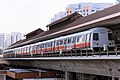 A Kawasaki Heavy Industries & CSR Qingdao Sifang C151B at Boon Lay MRT station in 2022.
 -
 A Kawasaki Heavy Industries & CRRC Qingdao Sifang C151C approaching Bukit Batok MRT station in 2022.


Operational history
[edit]The tender of the C751B trains was called on 12 April 1997 together with the opening of Changi Airport extension and to continuously expand the fleet. The contract was awarded to Japanese firms Kawasaki and Nippon Sharyo on 18 January 1998.[7] The first C751B was delivered in August 1999 to Singapore, before entering revenue service in April 2000. The formal launch ceremony was held on 8 May 2000 at Ang Mo Kio MRT Station.
It was the first train to be painted in the Blackbird SMRT livery since 1998, which was mandated for new and refurbished trains until 2016. These trains were capable of running on both the North–South and East–West Lines at all times. However, they were mostly deployed from 2012 on the North–South Line until 2018 when most trains were moved to East–West Line.
With the opening of the Changi Airport Line, several trains were delivered with luggage racks and were installed in every carriage of the train, taking up the space of two seats next to the door at the end of each carriage. Passengers preferred not to use them in favour of theft and were underutilised as people preferred to hold on to their bags in the train. Luggage racks were eventually removed when the through train service to Changi Airport was converted into a shuttle service, and the luggage rack spaces were replaced by extra standing spaces.
On 13 April 2002, a fault was detected in a C751B train and it was subsequently withdrawn to Changi Depot for investigations. As the train was under warranty, the engineers from the manufacturers of the train and gearbox were flown in on 21 April. They subsequently detected metal fragments in the gearboxes, and those of another 20 trains. On 23 April 2002, SMRT immediately withdrew all 21 C751B trains and suspended the Boon Lay – Changi Airport train through service, replacing it with the Tanah Merah – Changi Airport shuttle service.[8] Train frequencies were also adjusted until 6 May 2002, when 8 trains returned to service. Service resumed on 16 May 2002, with 7 more trains back on service.[9] By end of May 2002, all C751B trains had been returned to service.
Retirement
[edit]In December 2019, Toyotron Pte Ltd was awarded the contract for disposal of old SMRT trains. On 28 September 2020, the LTA announced that all C751B trains would be replaced by new Alstom Movia R151 trains, along with the 19 C651 trainsets and the 66 C151 trainsets from 2024 onwards.[10] On 14 March 2021, the first C751B train (set 339/340) was sent for scrap. On 30 September 2024, the last C751B train (set 337/338) made its final run on the North-South Line; it was sent to Tuas Depot to await scrapping on 4 October 2024. As of 11 December 2024, all C751B trains have been scrapped or preserved.[2]
These are the trains that are preserved:[additional citation(s) needed]
| Trainset | Car number(s) | Notes | Rules |
|---|---|---|---|
| 317/318 | 2317 | Preserved outside City Square Mall since September 2024 and repurposed to become the CDL Eco Train near Farrer Park MRT station. EMU 318 together with cars 3317 and 1317 were sent for scrap in September 2024. | |
| 319/320 | 3320 | Preserved at ITE College West since May 2023. Cars 2320, 1320 and EMU 319 were sent for scrap in March 2023. | |
| 321/322 | 3321, 1322, 3322 | Preserved at SAFTI City since November 2023. Strictly no unauthorised entry, photography and/or filming allowed. Deadly force may be used against trespassers. Cars 1321, 2321 and 2322 were sent for scrap in November 2023. | 
|
| 325/326 | 3326 | Preserved at JTC LaunchPad @one-north since June 2024 and repurposed to become Train Pod hotel. Cars 1326, 2326 along with EMU 325 were sent for scrap in early June 2024. | |
| 337/338 | 3337, 3338 | Currently stored in Tuas Depot, awaiting preservation. Cars 1337, 2337, 1338 and 2338 were sent for scrap in December 2024. | |
| 345/346 | 3345, 1345 | Preserved at SAFTI City since November 2023. Strictly no unauthorised entry, photography and/or filming allowed. Deadly force may be used against trespassers. Car 2345 together with EMU 346 were sent for scrap in November 2023. |
|
Train Formation
[edit]The configuration of a C751B in revenue service is DT–M1–M2+M2–M1–DT.
| Cars of C751B | ||||||
|---|---|---|---|---|---|---|
| Car Type | Driver Cab | Motor | Collector Shoe | Car Length | Wheelchair Space | |
| mm | ft in | |||||
| DT | ✓ | ✗ | ✓ | 23,830 | 78 ft 2.2 in | ✗ |
| M1 | ✗ | ✓ | ✓ | 22,800 | 74 ft 9.6 in | ✗ |
| M2 | ✗ | ✓ | ✓ | 22,800 | 74 ft 9.6 in | ✓ |
The car numbers of the trains range from x311 to x352, where x depends on the carriage type. Individual cars are assigned a 4 digit serial number by the rail operator SMRT Trains. A complete six-car trainset consists of an identical twin set of one driving trailer (DT) and two motor (M) cars permanently coupled together.
For example, set 349/350 consists of carriages 3349, 1349, 2349, 2350, 1350 and 3350 in this order.
- The first digit identifies the car number, where the trailer cars has a 3, the second and fifth cars has a 1 & the middle cars has a 2.
- The second digit is always a 3, part of the identification numbers
- The third digit and fourth digit are the train identification numbers. A full-length train of 6 cars have 2 different identification numbers. For example, 329/330 (normal coupling) or 332/338 (cross coupling).
- Kawasaki built sets 311/312, 315/316, 319/320, 323/324, 327/328 – 333/334, 343/344, 347/348 and 351/352.
- Nippon Sharyo co-built sets 313/314, 317/318, 321/322, 325/326, 335/336 – 341/342, 345/346 and 349/350.
As fleet number 301/302 was already being used by a money train (which was a Kawasaki Heavy Industries C151), the C751B trains were numbered starting from 311/312.
References
[edit]- ^ "GKID MRT Singapore Subway". GK Industrial Design Incorporated. Archived from the original on 9 August 2022. Retrieved 17 March 2020.
- ^ a b "Kawasaki Heavy Industries & Nippon Sharyo C751B (KNS)". SGTrains.com. Archived from the original on 8 December 2024. Retrieved 8 December 2024.
- ^ Woodland, Daniel (August 2004). "Optimisation of Automatic Train Protection Systemstion Systems" (PDF). p. Appendix C Page 32 to Page 33. Archived (PDF) from the original on 15 June 2020. Retrieved 15 June 2020.
- ^ "THALES Urban Rail Signalling Singapore – North-South / East-West Lines" (PDF). Archived (PDF) from the original on 15 June 2020. Retrieved 16 June 2020.
- ^ Fang, Joy (2 February 2012). "Coming: $600m upgrade for MRT system/New train measures a 'catch-up'". My Paper. pp. A2, A6. Archived from the original on 18 May 2015. Retrieved 13 May 2015.
- ^ "EMU Trains for the Singapore Land Transport Authority". Kawasaki Heavy Industries. Archived from the original on 3 December 2013. Retrieved 5 November 2012.
- ^ "MRT CONTRACTS". The Straits Times. 18 January 1998. p. 39. Retrieved 27 June 2024.
- ^ "SMRT Website - Release Preview". Archived from the original on 29 April 2007. Retrieved 22 January 2008.
- ^ "Train service back on track". Today. 16 May 2002. Archived from the original on 25 May 2021. Retrieved 6 October 2019.
- ^ "LTA Buys 40 New Trains for the North-South and East-West Lines". lta.gov.sg. Archived from the original on 22 October 2021. Retrieved 22 October 2021.
External links
[edit]
- Manufacturer's information on C751B, Kawasaki Heavy Industries
- Manufacturer's information on C751B, Nippon Sharyo
Italicized entries are planned or under construction | |||||||||
| Overview | |||||||||
| MRT |
| ||||||||
| LRT | |||||||||
| Others |
| ||||||||
| Cross-border | |||||||||
| Rolling stock |
| ||||||||
| Depots |
| ||||||||
| Companies | |||||||||
| Major incidents | |||||||||
