An illustration of Stokes' theorem, with surface Σ, its boundary ∂Σ and the normal vector n.
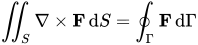
Stokes' theorem,[1] also known as the Kelvin–Stokes theorem[2][3] after Lord Kelvin and George Stokes, the fundamental theorem for curls or simply the curl theorem,[4] is a theorem in vector calculus on . Given a vector field, the theorem relates the integral of the curl of the vector field over some surface, to the line integral of the vector field around the boundary of the surface. The classical theorem of Stokes can be stated in one sentence: The line integral of a vector field over a loop is equal to the surface integral of its curl over the enclosed surface. It is illustrated in the figure, where the direction of positive circulation of the bounding contour ∂Σ, and the direction n of positive flux through the surface Σ, are related by a right-hand-rule. For the right hand the fingers circulate along ∂Σ and the thumb is directed along n.
Let be a smooth oriented surface in with boundary . If a vector field is defined and has continuous first order partial derivatives in a region containing , then
More explicitly, the equality says that
The main challenge in a precise statement of Stokes' theorem is in defining the notion of a boundary. Surfaces such as the Koch snowflake, for example, are well-known not to exhibit a Riemann-integrable boundary, and the notion of surface measure in Lebesgue theory cannot be defined for a non-Lipschitz surface. One (advanced) technique is to pass to a weak formulation and then apply the machinery of geometric measure theory; for that approach see the coarea formula. In this article, we instead use a more elementary definition, based on the fact that a boundary can be discerned for full-dimensional subsets of .
A more detailed statement will be given for subsequent discussions.
Let be a piecewise smooth Jordan plane curve. The Jordan curve theorem implies that divides into two components, a compact one and another that is non-compact. Let denote the compact part; then is bounded by . It now suffices to transfer this notion of boundary along a continuous map to our surface in . But we already have such a map: the parametrization of .
The proof of the theorem consists of 4 steps. We assume Green's theorem, so what is of concern is how to boil down the three-dimensional complicated problem (Stokes' theorem) to a two-dimensional rudimentary problem (Green's theorem).[9] When proving this theorem, mathematicians normally deduce it as a special case of a more general result, which is stated in terms of differential forms, and proved using more sophisticated machinery. While powerful, these techniques require substantial background, so the proof below avoids them, and does not presuppose any knowledge beyond a familiarity with basic vector calculus and linear algebra.[8] At the end of this section, a short alternative proof of Stokes' theorem is given, as a corollary of the generalized Stokes' theorem.
First step of the elementary proof (parametrization of integral)[edit]
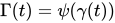
As in § Theorem, we reduce the dimension by using the natural parametrization of the surface. Let ψ and γ be as in that section, and note that by change of variables
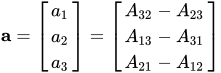
But now consider the matrix in that quadratic form—that is, . We claim this matrix in fact describes a cross product.
Here the superscript "" represents the transposition of matrices.
To be precise, let be an arbitrary 3 × 3 matrix and let
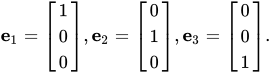
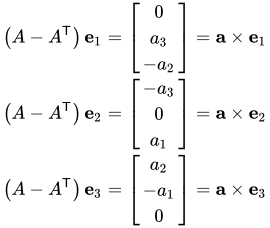
Note that x ↦ a × x is linear, so it is determined by its action on basis elements. But by direct calculation
Here, {e1, e2, e3} represents an orthonormal basis in the coordinate directions of .[note 5]
On the other hand, the definition of a surface integral also includes a triple product—the very same one!
So, we obtain
Fourth step of the elementary proof (reduction to Green's theorem)[edit]
Combining the second and third steps, and then applying Green's theorem completes the proof.
Green's theorem asserts the following: for any region D bounded by the Jordans closed curve γ and two scalar-valued smooth functions defined on D;
We can substitute the conclusion of STEP2 into the left-hand side of Green's theorem above, and substitute the conclusion of STEP3 into the right-hand side.
Q.E.D.
In this section, we will discuss the irrotational field (lamellar vector field) based on Stokes' theorem.
Definition 2-1 (irrotational field). A smooth vector field F on an open is irrotational (lamellar vector field) if ∇ × F = 0.
This concept is very fundamental in mechanics; as we'll prove later, if F is irrotational and the domain of F is simply connected, then F is a conservative vector field.
In this section, we will introduce a theorem that is derived from Stokes' theorem and characterizes vortex-free vector fields. In fluid dynamics it is called Helmholtz's theorems.
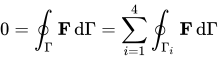
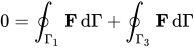
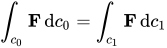
Theorem 2-1 (Helmholtz's theorem in fluid dynamics).[5][3]: 142 Let be an opensubset with a lamellar vector field F and let c0, c1: [0, 1] → U be piecewise smooth loops. If there is a function H: [0, 1] × [0, 1] → U such that
[TLH0]H is piecewise smooth,
[TLH1]H(t, 0) = c0(t) for all t ∈ [0, 1],
[TLH2]H(t, 1) = c1(t) for all t ∈ [0, 1],
[TLH3]H(0, s) = H(1, s) for all s ∈ [0, 1].
Then,
Some textbooks such as Lawrence[5] call the relationship between c0 and c1 stated in theorem 2-1 as "homotopic" and the function H: [0, 1] × [0, 1] → U as "homotopy between c0 and c1". However, "homotopic" or "homotopy" in above-mentioned sense are different (stronger than) typical definitions of "homotopic" or "homotopy"; the latter omit condition [TLH3]. So from now on we refer to homotopy (homotope) in the sense of theorem 2-1 as a tubular homotopy (resp. tubular-homotopic).[note 6]
Above Helmholtz's theorem gives an explanation as to why the work done by a conservative force in changing an object's position is path independent. First, we introduce the Lemma 2-2, which is a corollary of and a special case of Helmholtz's theorem.
Lemma 2-2.[5][6] Let be an opensubset, with a Lamellar vector field F and a piecewise smooth loop c0: [0, 1] → U. Fix a point p ∈ U, if there is a homotopy H: [0, 1] × [0, 1] → U such that
[SC0]H is piecewise smooth,
[SC1]H(t, 0) = c0(t) for all t ∈ [0, 1],
[SC2]H(t, 1) = p for all t ∈ [0, 1],
[SC3]H(0, s) = H(1, s) = p for all s ∈ [0, 1].
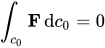
Then,
Above Lemma 2-2 follows from theorem 2–1. In Lemma 2-2, the existence of H satisfying [SC0] to [SC3] is crucial;the question is whether such a homotopy can be taken for arbitrary loops. If U is simply connected, such H exists. The definition of simply connected space follows:
Definition 2-2 (simply connected space).[5][6] Let be non-empty and path-connected. M is called simply connected if and only if for any continuous loop, c: [0, 1] → M there exists a continuous tubular homotopy H: [0, 1] × [0, 1] → M from c to a fixed point p ∈ c; that is,
[SC0']H is continuous,
[SC1]H(t, 0) = c(t) for all t ∈ [0, 1],
[SC2]H(t, 1) = p for all t ∈ [0, 1],
[SC3]H(0, s) = H(1, s) = p for all s ∈ [0, 1].
The claim that "for a conservative force, the work done in changing an object's position is path independent" might seem to follow immediately if the M is simply connected. However, recall that simple-connection only guarantees the existence of a continuous homotopy satisfying [SC1-3]; we seek a piecewise smooth homotopy satisfying those conditions instead.
Fortunately, the gap in regularity is resolved by the Whitney's approximation theorem.[6]: 136, 421 [11] In other words, the possibility of finding a continuous homotopy, but not being able to integrate over it, is actually eliminated with the benefit of higher mathematics. We thus obtain the following theorem.
Theorem 2-2.[5][6] Let be open and simply connected with an irrotational vector field F. For all piecewise smooth loops c: [0, 1] → U
In the physics of electromagnetism, Stokes' theorem provides the justification for the equivalence of the differential form of the Maxwell–Faraday equation and the Maxwell–Ampère equation and the integral form of these equations. For Faraday's law, Stokes' theorem is applied to the electric field, :
For Ampère's law, Stokes' theorem is applied to the magnetic field, :
^ may not be a Jordan curve if the loop interacts poorly with . Nonetheless, is always a loop, and topologically a connected sum of countably many Jordan curves, so that the integrals are well-defined.
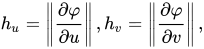
Note that, in some textbooks on vector analysis, these are assigned to different things.
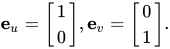
For example, in some text book's notation, {eu, ev} can mean the following {tu, tv} respectively.
In this article, however, these are two completely different things.
Note that, in some textbooks on vector analysis, these are assigned to different things.
^There do exist textbooks that use the terms "homotopy" and "homotopic" in the sense of Theorem 2-1.[5] Indeed, this is very convenient for the specific problem of conservative forces. However, both uses of homotopy appear sufficiently frequently that some sort of terminology is necessary to disambiguate, and the term "tubular homotopy" adopted here serves well enough for that end.
^Colley, Susan Jane (2002). Vector Calculus (4th ed.). Boston: Pearson. pp. 500–3.
^Edwards, Harold M. (1994). Advanced Calculus: A Differential Forms Approach. Birkhäuser. ISBN0-8176-3707-9.
^L. S. Pontryagin, Smooth manifolds and their applications in homotopy theory, American Mathematical Society Translations, Ser. 2, Vol. 11, American Mathematical Society, Providence, R.I., 1959, pp. 1–114. MR0115178 (22 #5980 [4]). See theorems 7 & 8.









![{\displaystyle \gamma :[a,b]\to \mathbb {R} ^{2}}](https://wikimedia.org/api/rest_v1/media/math/render/svg/f1d326a550ef41246054e0311de07e1375d535f3)















![{\displaystyle {\begin{aligned}{\frac {\partial P_{u}}{\partial v}}&={\frac {\partial (\mathbf {F} \circ {\boldsymbol {\psi }})}{\partial v}}\cdot {\frac {\partial {\boldsymbol {\psi }}}{\partial u}}+(\mathbf {F} \circ {\boldsymbol {\psi }})\cdot {\frac {\partial ^{2}{\boldsymbol {\psi }}}{\partial v\,\partial u}}\\[5pt]{\frac {\partial P_{v}}{\partial u}}&={\frac {\partial (\mathbf {F} \circ {\boldsymbol {\psi }})}{\partial u}}\cdot {\frac {\partial {\boldsymbol {\psi }}}{\partial v}}+(\mathbf {F} \circ {\boldsymbol {\psi }})\cdot {\frac {\partial ^{2}{\boldsymbol {\psi }}}{\partial u\,\partial v}}\end{aligned}}}](https://wikimedia.org/api/rest_v1/media/math/render/svg/f51dcdb39953b46773127bb038799e610b8672eb)
![{\displaystyle {\begin{aligned}{\frac {\partial P_{v}}{\partial u}}-{\frac {\partial P_{u}}{\partial v}}&={\frac {\partial (\mathbf {F} \circ {\boldsymbol {\psi }})}{\partial u}}\cdot {\frac {\partial {\boldsymbol {\psi }}}{\partial v}}-{\frac {\partial (\mathbf {F} \circ {\boldsymbol {\psi }})}{\partial v}}\cdot {\frac {\partial {\boldsymbol {\psi }}}{\partial u}}\\[5pt]&={\frac {\partial {\boldsymbol {\psi }}}{\partial v}}\cdot (J_{{\boldsymbol {\psi }}(u,v)}\mathbf {F} ){\frac {\partial {\boldsymbol {\psi }}}{\partial u}}-{\frac {\partial {\boldsymbol {\psi }}}{\partial u}}\cdot (J_{{\boldsymbol {\psi }}(u,v)}\mathbf {F} ){\frac {\partial {\boldsymbol {\psi }}}{\partial v}}&&{\text{(chain rule)}}\\[5pt]&={\frac {\partial {\boldsymbol {\psi }}}{\partial v}}\cdot \left(J_{{\boldsymbol {\psi }}(u,v)}\mathbf {F} -{(J_{{\boldsymbol {\psi }}(u,v)}\mathbf {F} )}^{\mathsf {T}}\right){\frac {\partial {\boldsymbol {\psi }}}{\partial u}}\end{aligned}}}](https://wikimedia.org/api/rest_v1/media/math/render/svg/5aaaa6a4a22c19ada2efe9544e29878feaa55378)


















![{\displaystyle {\begin{aligned}\gamma _{1}:[0,1]\to D;\quad &\gamma _{1}(t)=(t,0)\\\gamma _{2}:[0,1]\to D;\quad &\gamma _{2}(s)=(1,s)\\\gamma _{3}:[0,1]\to D;\quad &\gamma _{3}(t)=(1-t,1)\\\gamma _{4}:[0,1]\to D;\quad &\gamma _{4}(s)=(0,1-s)\end{aligned}}}](https://wikimedia.org/api/rest_v1/media/math/render/svg/b440cc87d1805ebd2adafff5286e09cd7aae8677)