


Marlin
| Marlin Temporal range:
| |
|---|---|

| |
| Atlantic blue marlin (Makaira nigricans) | |
Scientific classification 
| |
| Domain: | Eukaryota |
| Kingdom: | Animalia |
| Phylum: | Chordata |
| Class: | Actinopterygii |
| Order: | Carangiformes |
| Suborder: | Menoidei |
| Family: | Istiophoridae Rafinesque, 1810 |
| Type genus | |
| Istiophorus Lacépède, 1801
| |
| Genera | |
Marlins are fish from the family Istiophoridae, which includes 11 species.
Name
[edit]The family's common name is thought to derive from their resemblance to a sailor's marlinspike.[1]
Taxonomy
[edit]The family name Istiophoridae comes from the genus Istiophorus which first placed the species Istiophorus platypterus by George Kearsley Shaw in 1792 from the Greek word ἱστίον istion meaning "sail" that describes the shape of the species's dorsal fins.[2]: 6
Family description
[edit]Marlins have elongated bodies, a spear-like snout or bill, and a long, rigid dorsal fin which extends forward to form a crest.
Marlins are among the fastest marine swimmers. However, greatly exaggerated speeds are often claimed in popular literature, based on unreliable or outdated reports.[3]
The larger species include the Atlantic blue marlin, Makaira nigricans, which can reach 5 m (16 ft) in length and 820 kg (1,810 lb) in weight[4] and the black marlin, Istiompax indica, which can reach in excess of 5 m (16 ft) in length and 670 kg (1,480 lb) in weight. They are popular sporting fish in tropical areas. The Atlantic blue marlin and the white marlin are endangered due to overfishing.[5]
Marlins can change colour, lighting up their stripes just before attacking prey.[6]
Classification
[edit]The marlins are Istiophoriform fish, most closely related to the swordfish (which itself is the sole member of the family Xiphiidae). The carangiformes are believed to be the second-closest clade to marlins. Although previously thought to be closely related to Scombridae, genetic analysis only shows a slight relationship.
Extant genera
[edit]Istiophoriform genera and species Image Genus Living species Common name 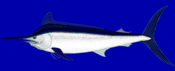 black marlin
Istiompax
(Whitley, 1931)Istiompax indica black marlin 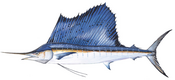 Atlantic sailfish
Istiophorus
(Lacépède, 1801)I. albicans Atlantic sailfish I. platypterus Indo-Pacific sailfish 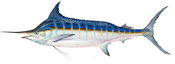 Atlantic blue
Makaira
(Lacépède, 1802)Makaira nigricans
(Lacepède, 1802)Atlantic blue marlin Makaira mazara
(Jordan & Snyder, 1901)Indo-Pacific blue marlin  white marlin
Kajikia
(Hirasaka & H. Nakamura, 1947)Kajikia albida
(Poey, 1860)white marlin Kajikia audax
(Philippi (Krumweide), 1887)striped marlin 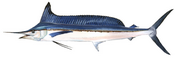 longbill
Tetrapturus
(Rafinesque, 1810)Tetrapturus angustirostris
(S. Tanaka (I), 1915)shortbill spearfish Tetrapturus belone
(Rafinesque, 1810)Mediterranean spearfish Tetrapturus georgii
(R.T. Lowe, 1841)roundscale spearfish Tetrapturus pfluegeri
(C. R. Robins & de Sylva, 1963)longbill spearfish

.png)
.png)
.png)
.png)
Fossil genera
[edit]Marlins have a continuous fossil record from the Miocene onwards, with the oldest uncontroversial fossil dated to 22 million years ago.[7] It is thought that they probably evolved in the Paratethys Sea.[8]
The following fossil genera are known:[9][10]
- †Morgula Gracia et al., 2022
- †Pizzikoskerma Gracia, Villalobos-Segura, Ballen, Carnevale & Kriwet, 2024
- †Prototetrapturus Gracia et al., 2022
- †Sicophasma Gracia, Villalobos-Segura, Ballen, Carnevale & Kriwet, 2024
- †Spathochoira Gracia et al., 2022

Popular culture
[edit]
In the Nobel Prize-winning author Ernest Hemingway's 1952 novel The Old Man and the Sea, the central character of the work is an aged Cuban fisherman who, after 84 days without success on the water, heads out to sea to break his run of bad luck. On the 85th day, Santiago, the old fisherman, hooks a resolute marlin; what follows is a great struggle between man, sea creature, and the elements.
Frederick Forsyth's story "The Emperor", in the collection No Comebacks, tells of a bank manager named Murgatroyd, who catches a marlin and is acknowledged by the islanders of Mauritius as a master fisherman.
A marlin features prominently in the last chapter and climactic scenes of Christina Stead's The Man Who Loved Children. Sam's friend Saul gives Sam a marlin, and Sam makes his children help him render the fish's fat.
The Miami Marlins, a professional baseball team based in Miami, Florida, is named after the fish.
There is a character in the film, Finding Nemo, called Marlin.
See also
[edit]
References
[edit]- ^ Harper, Douglas (November 2001). "marlin". Online Etymological Dictionary.
- ^ Scharpf, Christopher (13 September 2023). "Order CARANGIFORMES". The ETYFish Project. p. 1–19. Retrieved 18 December 2023.
- ^ Svendsen, Morten B.S.; Domenici, Paolo; Marras, Stefano; Krause, Jens; Boswell, Kevin M.; Rodriguez-Pinto, Ivan; et al. (2016-10-15). "Maximum swimming speeds of sailfish and three other large marine predatory fish species based on muscle contraction time and stride length: a myth revisited". Biology Open. 5 (10): 1415–1419. doi:10.1242/bio.019919. ISSN 2046-6390. PMC 5087677. PMID 27543056.
- ^ "Makaira nigricans, blue marlin". fisheries, gamefish. FishBase.
- ^ "Tunas and marlins officially classified as threatened". Smithsonian Ocean. Smithsonian Institution – via ocean.si.edu.
- ^ Pinkstone, Joe (26 February 2024). "Marlin use their surprising superpower to attack other fish". The Telegraph. Retrieved 9 March 2024.
- ^ De Gracia, C.; Berning, B.; Kriwet, J. (March 2023). "The origin of modern marlins (Teleostei: Istiophoridae): new fossil evidence from the Lower Miocene of Austria". Journal of Vertebrate Paleontology. 43 (2): e2281490. doi:10.1080/02724634.2023.2281490.
- ^ Fierstine, H.L. (2006). "Fossil history of billfishes (Xiphioidei)". Bulletin of Marine Science. 79 (3): 433–453. Retrieved 30 April 2024.
- ^ De Gracia, Carlos; Correa-Metrio, Alex; Carvalho, Mónica; Velez-Juarbe, Jorge; Přikryl, Tomáš; Jaramillo, Carlos; Kriwet, Jürgen (2022-12-31). "Towards a unifying systematic scheme of fossil and living billfishes (Teleostei, Istiophoridae)". Journal of Systematic Palaeontology. 20 (1): 1–36. Bibcode:2022JSPal..20....1D. doi:10.1080/14772019.2022.2091959. ISSN 1477-2019.
- ^ De Gracia, Carlos; Villalobos-Segura, Eduardo; Ballen, Gustavo A.; Carnevale, Giorgio; Kriwet, Jürgen (2024). "Phylogenetic patterns in fossil and living billfishes (Istiophoriformes, Istiophoridae): evidence from the Central Mediterranean". Papers in Palaeontology. 10 (4). Bibcode:2024PPal...10E1559D. doi:10.1002/spp2.1559. ISSN 2056-2799.
Further reading
[edit]- Sepkoski, Jack (2002). "A compendium of fossil marine animal genera". Bulletins of American Paleontology. 364: 560. Archived from the original on 2011-07-23. Retrieved 2011-05-19.
- Froese, Rainer; Pauly, Daniel (eds.). "Family Istiophoridae". FishBase. November 2005 version.
External links
[edit]
- "Marlin fishing". FishingBooker (blog). 3 December 2015.
- Melissa Block & John Nielson (radio hosts), Jason Schratwieser (marlin sport fishing expert), Mahmoud Sivji (fish research biologist involved in discovery) (2 March 2007). 'Ghost fish' revelation may alter marlin's status. NPR.org (radio news recording & transcript). All Things Considered. National Public Radio. Retrieved 2023-10-29. — news clip discussing discovery that a look-alike fish has been widely mis-identified as white marlin
| Swordfish (1 species) |  | ||||||||||
|---|---|---|---|---|---|---|---|---|---|---|---|
| Marlin |
| ||||||||||
| Related topics | |||||||||||
| International | |
|---|---|
| National | |
