


Cultural references to Ophelia
(Redirected from References to Ophelia)

Ophelia, a character in William Shakespeare's drama Hamlet, is often referred to in literature and the arts,[1] often in connection to suicide, love, and/or mental instability.
Literature[edit]

.jpg)
Novels[edit]
- Russian novelist Fyodor Dostoevsky, in the first chapter of his 1880 novel The Brothers Karamazov, described a capricious young woman who committed suicide by throwing herself off a steep cliff into a river, simply to imitate Shakespeare's Ophelia. Dostoevsky concludes that "Even then, if the cliff, chosen and cherished from long ago, had not been so picturesque, if it had been merely a flat, prosaic bank, the suicide might not have taken place at all." Dostoevsky also depicts the heroine Grushenka as Ophelia, binding the two through the words "Woe is me!" in the chapter titled "The First Torment".[2]
- Dating Hamlet (2002), by Lisa Fiedler, tells a version of Ophelia's story.[3]
- Agatha Christie's characters refer to Ophelia in the novels After the Funeral (1953), Third Girl (1966) and Nemesis (1971).[4][5]
- In Jasper Fforde's novel Something Rotten (2004) Ophelia tries to take over the play during Hamlet's excursion to the real world.[6]
- Ophelia by Lisa Klein tells the story of Hamlet from Ophelia's point of view.[7]
- In Paul Griffiths' novel let me tell you (2008) Ophelia tells a narrative using only her words from Hamlet, rearranged. The novel has been adapted as music by Hans Abrahamsen.[8][9]
Poetry[edit]
- French poet Arthur Rimbaud wrote a poem called Ophélie in 1870, inspired by Hamlet.[10]
- In T. S. Eliot's poem The Waste Land, several allusions are made to Ophelia's death: for example, one section is titled "Death by Water".[11]
Non-fiction[edit]
- Mary Pipher alluded to Ophelia in the title of her nonfiction book Reviving Ophelia: Saving the Selves of Adolescent Girls. The book puts forth the thesis that modern American teenage girls are victimized, lost, and unsure of themselves, like Ophelia.[12][13]
Drama[edit]
- In 2011 the Department of Theatre and Performance at the Victoria and Albert Museum invited director Katie Mitchell and Leo Warner of 59 Productions to conceive and produce a video installation exploring the nature of 'truth in performance'.[14] Taking as its inspiration 5 of the most influential European theatre directors of the last century, the project examines how each of the practitioners would direct the actress playing Ophelia in the famous 'mad' scenes in the play. This multiscreen video installation, launched at the Chantiers Europe festival at the Theatre de la Ville in Paris on 4 June, and opened at the museum on 12 July 2011.[15][16]
Film and television[edit]
- Sons of Anarchy included several parallels to Hamlet, including Ophelia influencing the characters Tara Knowles and Opie Winston.[17][18]
- In the Simpsons episode "Tales from the Public Domain", the story of Hamlet is retold using Simpsons characters. The role of Ophelia is taken by Lisa Simpson who, upon seeing Hamlet (Bart Simpson) talking to a picture of his deceased father (Homer Simpson), claims "Nobody out-crazies Ophelia!" She then backs up her claim by jumping on a table, stepping in people's food and kicking over flowers, before finally cartwheeling out a nearby window and into the moat, presumably to her death.[19]
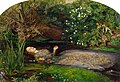
- In the opening montage of the 2011 film Melancholia, Kirsten Dunst's character is shown in her wedding dress, floating face up in a stream, similar to John Everett Millais' painting of Ophelia.[20][21]
- In the 2005 film The Libertine, Samantha Morton portrays aspirant actress Elizabeth Barry, who portrays Ophelia, and brings the house down.[22]
- In the 1964 The Addams Family, Morticia's sister is named Ophelia: both sisters are played by Carolyn Jones. Ophelia is depicted with flowers in her hair, and often carrying flowers, alluding to the play.[23]
- In the second episode of the television series Desperate Romantics, Elizabeth Siddal poses for John Everett Millais' Ophelia painting.[24]
- In the 1986 film Fire with Fire, Virginia Madsen plays a Catholic schoolgirl enthralled with John Everett Millais' depiction of Ophelia which she saw in school. She later recreated the scene for a photography project and took pictures of herself immersed in a pond.[25]
- In the 2012 film Savages it is mentioned that the character "O" goes by "O" because she is named after Ophelia, "the bipolar chick who killed herself in Hamlet."[26]
- In the 2006 film Pan's Labyrinth, Ofelia, the main character, alludes to the play.[27]
- The 2013 anime Blast of Tempest has many Shakespearean elements, including references to Ophelia.[28]
- In Queen and Country (2014) the protagonist nick-names his mentally unstable girl-friend Ophelia.[29]
- In Agents of S.H.I.E.L.D.'s fourth season (2017), during its final arc – Agents of Hydra – the android Aida assumes the name "Ophelia" when inside the Framework, a reference to her unrequited infatuation with Agent Leo Fitz.[30]
Music[edit]
Classical works[edit]
- Hector Berlioz made Hamlet the subject of his composition: Tristia, and titled one movement "The Death of Ophelia".[31]
- Frank Bridge wrote a symphonic poem for orchestra titled There is a willow grows aslant a brook, taken from the first line of Gertrude's monologue recounting Ophelia's death.[32]
- Dmitri Shostakovich's Incidental Music to Hamlet features a movement titled "Ophelia's Song", which depicts her descent into madness.[33]
- Hans Abrahamsen's Let me tell you, a song cycle for soprano and orchestra.
Contemporary[edit]
- Debra Gail White, an Electronic musician and singer-songwriter known as her stage name Ophelia.[34]
- In The Grateful Dead song "Althea" lyricist Robert Hunter references Hamlet in a near-quote from the famous soliloquy: "To be or not to be...To sleep, perchance to dream," The line in the song reads, "Yours may be the fate of Ophelia, sleeping and perchance to dream."[35][36]
- Natalie Merchant recorded a song and an album called Ophelia, inspired by the play.[37]
- Emilie Autumn has a song and album titled Opheliac in which the singer compares herself to Ophelia, connecting to her own experiences with bipolar disorder.[38]
- Jewel has a song titled "Innocence Maintained" from her album Spirit (1998) with the lyrics "Ophelia drowned in the water, crushed by her own weight".[39]
- Indigo Girls recorded an album called Swamp Ophelia, placing Ophelia in the Deep South.[40]

The Play Scene in Hamlet (1897) by Edwin Austin Abbey. - British pop singer Toyah Willcox released an album and song titled Ophelia's Shadow, focussing on Ophelia's isolation.[41]
- Melora Creager of Rasputina recorded a song titled "Dig Ophelia" for the album Thanks for the Ether. The song "speaks for and with her".[42]
- Tori Amos recorded a song titled "Ophelia" for the album Abnormally Attracted to Sin, perhaps inspired by Shakespeare's Ophelia.[43]
- British band Wild Beasts' song "Bed of Nails", the second track of Smother, combine Ophelia and Hamlet with the work of Mary Shelley.[44]
- Italian singer-songwriter Francesco Guccini recorded a song titled "Ophelia" for the album Due anni dopo.[45]
- American singer-songwriter Bob Dylan includes Ophelia as one of the characters residing on Desolation Row in the song of the same title from the album Highway 61, recorded in 1965.[46]
- The steampunk band Abney Park recorded a song called "Dear Ophelia" that is sung from the point of Hamlet, writing letters to Ophelia expressing that he does, in fact, love her.[47]
- The Band recorded a song titled "Ophelia" for the album Northern Lights – Southern Cross, in which some have interpreted Ophelia as a metaphor for race-mixing.[48]
- French singer-songwriter Nolwenn Leroy recorded a song titled "Ophélia" for her 2012 album Ô Filles de l'eau.[49]
- American singer-songwriter Zella Day recorded a song titled "Sweet Ophelia" for her 2014 album Zella Day – EP.[50]
- The single titled "Ophelia" was released by The Lumineers on February 4, 2016, ahead of the release of their second album Cleopatra which was released on April 8, 2016.[51]
- The video to the song "Where the Wild Roses Grow" by Kylie Minogue and Nick Cave is based on Ophelia by John Everett Millais.[52]
- Gudrun Gut vocalizes the role of Ophelia on Die Hamletmaschine (1990), an album by Einstürzende Neubauten, based on the 1977 play by East German author and theatre director Heiner Müller.


Science[edit]
- Uranus's secondmost inner moon was named after Ophelia after being discovered by Voyager 2 in 1986, and is one of the smallest moons in the Solar System (with a diameter of only 16 km).[53]
- 171 Ophelia is an asteroid in the asteroid belt.[54]
Video games[edit]
- The Sims 2, one of the three neighborhoods, Strangetown, is inhabited by a character named Ophelia Nigmos. An interesting fact is that another neighborhood called Veronaville is entirely based on and dedicated to the plays of William Shakespeare.
- Brütal Legend features a supporting character named Ophelia, voiced by Jennifer Hale.[55] Her name and story are references to the plot of Hamlet.
- Elsinore retells Hamlet from the point of view of Ophelia, who is caught in a time loop that always results in her death and seeks to escape it while investigating mysteries in the castle.
Art[edit]
Arthur Hughes[edit]
-
 1851
1851 -
 1863
1863
.JPG)
.JPG)
John William Waterhouse[edit]
-
 1889
1889 -
 1894
1894 -
 1910
1910


Other artists[edit]
-
-
 Eugène Delacroix
1853 -

-

-

-
 Marcus Stone
1888 -
-
 Henrietta Rae
1890


.jpg)


References[edit]
- ^ Harris, Jonathan Gil (2010). Shakespeare and Literary Theory. Oxford University Press. p. 118. ISBN 9780199573387. Retrieved 12 July 2019.
- ^ Jackson, Robert Louis; Allen, Elizabeth Cheresh; Morson, Gary Saul (1995). Freedom and Responsibility in Russian Literature: Essays in Honor of Robert Louis Jackson. Northwestern University Press. pp. 105–109. ISBN 9780810111462. Retrieved 12 June 2019.
- ^ Shaughnessy, Robert (2007). The Cambridge Companion to Shakespeare and Popular Culture. Cambridge University Press. p. 125. ISBN 9780521844291.
- ^ Bunson, Matthew (2000). The Complete Christie: An Agatha Christie Encyclopedia. Simon and Schuster. p. 185. ISBN 9780671028312. Retrieved 12 June 2019.
- ^ Hopkins, Lisa (2016). Shakespearean Allusion in Crime Fiction: DCI Shakespeare. Springer. p. 44. ISBN 9781137538758. Retrieved 12 June 2019.
- ^ Funk, Wolfgang (2015). The Literature of Reconstruction: Authentic Fiction in the New Millennium. Bloomsbury Publishing USA. p. 157. ISBN 9781501306181. Retrieved 12 June 2019.
- ^ Loftis, Sonya Freeman; Kellar, Allison; Ulevich, Lisa (2017). SHAKESPEARE'S HAMLET IN AN ERA OF TEXTUAL EXHAUSTION. Routledge. ISBN 9781351967457. Retrieved 12 June 2019.
- ^ Shakespeare in Our Time: A Shakespeare Association of America Collection. Bloomsbury Publishing. 2016. ISBN 9781472520432.
- ^ Tommasini, Anthony (18 January 2016). "Review: 'Let Me Tell You' Has Its New York Premiere". The New York Times. Retrieved 16 July 2019.
- ^ Bailey, Helen Phelps (1964). Hamlet in France: From Voltaire to Laforgue ; (with an Epilogue). Librairie Droz. p. 150. ISBN 9782600034708.
- ^ Bloom, Harold (2007). T.S. Eliot's The Waste Land. Infobase Publishing. p. 186. ISBN 9780791093078. Retrieved 13 June 2019.
- ^ Code, Lorraine (2002). Encyclopedia of Feminist Theories. Routledge. p. 3. ISBN 9781134787265. Retrieved 12 June 2019.
- ^ "Why 'Women Rowing North' May Be the Next Boomer Bible". Next Avenue. 14 March 2019. Retrieved 12 June 2019.
- ^ "Five Truths - 59 Productions".
- ^ "Five Truths - Victoria and Albert Museum". Archived from the original on 1 August 2011.
- ^ Purcell, Stephen (2013). Shakespeare and Audience in Practice. Macmillan International Higher Education. ISBN 9781137194244. Retrieved 12 June 2019.
- ^ Dunn, George A.; Eberl, Jason T. (2013). Sons of Anarchy and Philosophy: Brains Before Bullets. John Wiley & Sons. ISBN 9781118641668. Retrieved 16 July 2019.
- ^ Fanetti, Susan (2018). Bonds of Brotherhood in Sons of Anarchy: Essays on Masculinity in the FX Series. McFarland. p. 67. ISBN 9781476632353. Retrieved 16 July 2019.
- ^ Hulbert, J.; Wetmore, K. J. Jr.; York, R. (2009). Shakespeare and Youth Culture. Springer. p. 31. ISBN 9780230105249. Retrieved 12 June 2019.
- ^ Jeong, Seung-hoon; Szaniawski, Jeremi (2016). The Global Auteur: The Politics of Authorship in 21st Century Cinema. Bloomsbury Publishing USA. p. 104. ISBN 9781501312649.
- ^ Honig, Bonnie; Marso, Lori J. (2016). Politics, Theory, and Film: Critical Encounters with Lars von Trier. Oxford University Press. ISBN 9780190600204.
- ^ "The Libertine **". The Globe and Mail. Retrieved 12 June 2019.
- ^ "Ophelia Through the Kaleidoscope • Pre-Raphaelite Sisterhood". Pre-Raphaelite Sisterhood. 5 June 2018. Archived from the original on 14 June 2019. Retrieved 12 June 2019.
- ^ Grant, Olly (15 July 2009). "Rafe Spall and Sam Barnett on Desperate Romantics: interview". Retrieved 12 June 2019.
- ^ Steinmetz, Johanna. "TEEN LOVE BURNS IN 'FIRE' WITH AID OF SHAKESPEARE". chicagotribune.com. Retrieved 12 June 2019.
- ^ Robey, Tim (20 September 2012). "Savages, review". Retrieved 13 June 2019.
- ^ Desmet, Christy; Loper, Natalie; Casey, Jim (2017). Shakespeare / Not Shakespeare. Springer. p. 280. ISBN 9783319633008.
- ^ "Blast of Tempest". Anime News Network. Retrieved 13 June 2019.
- ^ Bell, Nicholas (24 February 2015). "Queen and Country | Review". IONCINEMA.com. Retrieved 13 June 2019.
- ^ McLevy, Alex (11 April 2017). "A frantic Agents Of S.H.I.E.L.D. can't quite catch its breath". The A.V. Club. Retrieved 1 July 2021.
- ^ Cairns, David (2003). Berlioz: Servitude and Greatness, 1832-1869. University of California Press. p. 711. ISBN 9780520240582.
- ^ Huss, Fabian (2015). The Music of Frank Bridge. Boydell & Brewer. pp. 166–167. ISBN 9781783270590.
- ^ Moore, Robin (1968). Fiedler, the colorful Mr. Pops: the man and his music. Little, Brown. pp. 353.
Incidental Music to Hamlet Ophelia's Song Shostakovich.
- ^ "Ophelia and Her New Track Vehement". 16 April 2021.
- ^ Barnes, Barry; Trudeau, Bob (2018). The Grateful Dead's 100 Essential Songs: The Music Never Stops. Rowman & Littlefield. p. 13. ISBN 9781538110584.
- ^ Bosch, Lindsay J.; Mancoff, Debra N. (2009). Icons of Beauty: Art, Culture, and the Image of Women [2 volumes]. ABC-CLIO. p. 473. ISBN 9780313081569.
- ^ Shaughnessy, Robert (2007). The Cambridge Companion to Shakespeare and Popular Culture. Cambridge University Press. p. 169. ISBN 9780521844291.
- ^ Loftis, Sonya Freeman; Kellar, Allison; Ulevich, Lisa (2017). SHAKESPEARE'S HAMLET IN AN ERA OF TEXTUAL EXHAUSTION. Routledge. ISBN 9781351967457.
- ^ Sanders, Julie (2007). Shakespeare and Music: Afterlives and Borrowings. Polity. p. 188. ISBN 9780745632971. Retrieved 12 July 2019.
- ^ Hansen, Adam (2010). Shakespeare and Popular Music. Bloomsbury Publishing. p. 37. ISBN 9781441134257. Retrieved 12 July 2019.
- ^ Shaughnessy, Robert (2007). The Cambridge Companion to Shakespeare and Popular Culture. Cambridge University Press. p. 169. ISBN 9780521844291. Retrieved 12 July 2019.
- ^ Shaughnessy, Robert (2007). The Cambridge Companion to Shakespeare and Popular Culture. Cambridge University Press. p. 168. ISBN 9781107495029. Retrieved 12 July 2019.
- ^ Trier-Bieniek, Adrienne (2013). Sing Us a Song, Piano Woman: Female Fans and the Music of Tori Amos. Scarecrow Press. p. 109. ISBN 9780810885516. Retrieved 12 July 2019.
- ^ Barker, Emily (5 August 2014). "From Lana Del Rey To Led Zeppelin, 30 Awesome Songs Inspired By Books". NME. Retrieved 12 July 2019.
- ^ Sidonio, Daniele (2016). Mi si scusi il paragone: Canzone d'autore e letteratura da Guccini a Caparezza (in Italian). musicaos:ed. p. 67. ISBN 9788899315566. Retrieved 12 July 2019.
- ^ West, Summar; Wagner, Patricia (2016). A Midsummer Night's Dream. Cavendish Square Publishing, LLC. p. 76. ISBN 9781502623355.
- ^ Bosch, Lindsay J.; Mancoff, Debra N. (2009). Icons of Beauty: Art, Culture, and the Image of Women [2 volumes]. ABC-CLIO. p. 473. ISBN 9780313081569. Retrieved 12 July 2019.
- ^ Shaughnessy, Robert (2007). The Cambridge Companion to Shakespeare and Popular Culture. Cambridge University Press. p. 171. ISBN 9780521844291. Retrieved 16 July 2019.
- ^ "Nolwenn Leroy. Chanson par chanson, elle commente son nouvel album". Le Telegramme (in French). 12 November 2012. Retrieved 16 July 2019.
- ^ Triola, Carmen. "Zella Day: Kicker | The Aquarian". www.theaquarian.com. Retrieved 16 July 2019.
- ^ "Ophelia by The Lumineers - Songfacts". www.songfacts.com. Retrieved 16 July 2019.
- ^ O'Neill, Stephen (2014). Shakespeare and YouTube: New Media Forms of the Bard. Bloomsbury Publishing. p. 263. ISBN 9781441153982. Retrieved 16 July 2019.
- ^ "Uranus Moons". NASA Solar System Exploration. Retrieved 16 July 2019.
- ^ Schmadel, Lutz (2003). Dictionary of Minor Planet Names. Springer Science & Business Media. p. 30. ISBN 9783540002383. Retrieved 17 July 2019.
- ^ "Brütal Legend Extras". Brütal Legend Extras. Retrieved 5 July 2021.