


Terra (satellite)
 Artistic rendering of the satellite | |
| Mission type | Climate research |
|---|---|
| Operator | NASA |
| COSPAR ID | 1999-068A |
| SATCAT no. | 25994 |
| Website | terra |
| Mission duration | Elapsed: 24 years, 4 months, 9 days |
| Spacecraft properties | |
| Manufacturer | NASA |
| Launch mass | 4,864 kilograms (10,723 lb) |
| Start of mission | |
| Launch date | December 18, 1999, 18:57:39 UTC |
| Rocket | Atlas IIAS AC-141 |
| Launch site | Vandenberg SLC-3E |
| Contractor | ILS |
| End of mission | |
| Disposal | Deorbited |
| Last contact | 2025-2026 (planned) |
| Orbital parameters | |
| Reference system | Geocentric |
| Regime | Low Earth |
| Semi-major axis | 7,080.0 kilometers (4,399.3 mi) |
| Eccentricity | 0.0001392 |
| Perigee altitude | 708.7 kilometers (440.4 mi) |
| Apogee altitude | 710.6 kilometers (441.5 mi) |
| Inclination | 98.2098° |
| Period | 98.8 minutes |
| RAAN | 251.3130 degrees |
| Argument of perigee | 83.7699 degrees |
| Mean anomaly | 276.3654 degrees |
| Mean motion | 14.57110250 |
| Epoch | 25 June 2016, 02:58:27 UTC |
| Revolution no. | 87867 |

| |

Terra (EOS AM-1) is a multi-national scientific research satellite operated by NASA in a Sun-synchronous orbit around the Earth. It takes simultaneous measurements of Earth's atmosphere, land, and water to understand how Earth is changing and to identify the consequences for life on Earth.[1] It is the flagship of the Earth Observing System (EOS) and the first satellite of the system which was followed by Aqua (launched in 2002) and Aura (launched in 2004). Terra was launched in 1999.
The name "Terra" comes from the Latin word for Earth. A naming contest was held by NASA among U.S. high school students. The winning essay was submitted by Sasha Jones of Brentwood, Missouri. The identifier "AM-1" refers to its orbit, passing over the equator in the morning.
Launch[edit]
The satellite was launched from Vandenberg Air Force Base on December 18th, 1999, aboard an Atlas IIAS vehicle and began collecting data on February 24th, 2000. It was placed into a near-polar, sun-synchronous orbit at an altitude of 705 km (438 mi), with a 10:30am descending node.
Mission[edit]

Terra carries a payload of five remote sensors designed to monitor the state of Earth's environment and ongoing changes in its climate system:[2]
- ASTER (Advanced Spaceborne Thermal Emission and Reflection Radiometer)[3] ASTER creates high-resolution images of clouds, ice, water and the land surface using 3 different sensor subsystems. They are the Shortwave Infrared (SWIR); Thermal Infrared (TIR); and Visible and Near Infrared (VNIR). They cover 14 multi-spectral bands from visible to the thermal infrared. The SWIR stopped working in 2008. ASTER was provided by Japan's Ministry of Economy, Trade, and Industry.[4]
- CERES (Clouds and the Earth's Radiant Energy System)
- MISR (Multi-angle Imaging SpectroRadiometer)
- MODIS (Moderate-resolution Imaging Spectroradiometer)[5]
- MOPITT (Measurements of Pollution in the Troposphere)[6]
Data from the satellite helps scientists better understand the spread of pollution around the globe. Studies have used instruments on Terra to examine trends in global carbon monoxide and aerosol pollution.[7] The data collected by Terra will ultimately become a new, 15-year global data set.
After launch, operators observed that high energy protons like those found over the South Atlantic Anomaly or the poles could induce single-event upsets that would cause the Motor Drive Assembly (MDA) Built-In Test Equipment (BITE) to turn off the MDA. These false shut-downs occur 12–14 times a month and eventually the operations team automated the recovery to reduce the impact of these shut-downs.[8]
Starting in 2007, increased thermal resistance in the SWIR cryocooler of the ASTER instrument caused the temperature to gradually increase. By 2008, despite frequent attempts to recycle the cryocooler the data began to significantly degrade and on January 12, 2009, ASTER managers declared the SWIR no longer functional due to anomalously high SWIR detector temperatures. Data gathered after April 2008 was declared not usable.[9]
On October 13, 2009, Terra suffered a single battery cell failure anomaly and a battery heater control anomaly likely the result of a Micrometeoroid or Orbital Debris (MMOD) strike.[8]
On February 27, 2020, the Terra flight operations team conducted Terra's last inclination adjust maneuver due to the satellite's limited remaining fuel. With no more such maneuvers, Terra's mean local time has begun to drift starting in April 2021 and with it, its data quality. In October 2022, Terra is expected to reach and exceed a 10:15 AM MLT crossing which is expected to lead operators to initiate a constellation exit to a lower orbit altitude (694 km). Decommissioning would occur around 2025-26 followed by an un-controlled reentry several years later.[10]
Malicious cyber activities[edit]
In June and October 2008 the spacecraft was targeted by hackers who gained unauthorized access to its command and control systems, but did not issue any commands.[11]
Gallery of images by Terra[edit]
-
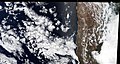 The first image taken by Terra.
 -
 The Solar eclipse of August 1, 2008, over Russia, Norway, and the Arctic Ocean as seen from NASA's Terra satellite.
 -
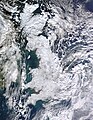 The effects of the European winter storms of 2009–2010 on Great Britain, seen from Terra.
 -
 The Deepwater Horizon oil spill oil slick as seen from space by NASA's Terra satellite on May 1, 2010.
 -
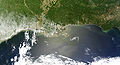 The Deepwater Horizon oil slick just off the Louisiana coast on April 30, 2010, visible from space.
 -
 Hurricane Karl, the most destructive hurricane of the 2010 Atlantic Hurricane Season, approaches Mexico on September 16.
 -
 Satellite image of Sweden in March 2002.
 -
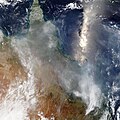 Satellite image of the Ash distribution over Australia from the 2022 Hunga Tonga–Hunga Ha'apai eruption.
 -
 Animation of Terra's orbit around the Earth. Earth is not shown.


See also[edit]
References[edit]
- ^ "NASA: TERRA (EOS AM-1)". nasa.gov. Retrieved 2011-01-07.
- ^ Maurer, John (November 2001). "Overview of NASA's Terra satellite". hawaii.edu (University of Hawai'i). Retrieved 2011-01-07.
- ^ Stevens, Nicki F.; Garbeil, Harold; Mouginis-Mark, Peter J. (2004-01-22). "NASA EOS Terra ASTER: Volcanic topographic mapping and capability" (PDF). Hawai'i Institute of Geophysics and Planetology. Retrieved 2011-01-07.
- ^ Wigglesworth, Alex (2019-11-06). "Satellite image shows Kincade fire burn scar". Los Angeles Times. Retrieved 2019-11-07.
- ^ "MODIS Terra Satellite Images". ucar.edu(National Center for Atmospheric Research: Earth Observatory Laboratory). Retrieved 2011-01-07.
- ^ "Measurements of Pollution in the Troposhere (MOPITT)". acd.ucar.edu (NESL's Atmospheric Chemistry Division). Archived from the original on 2011-01-28. Retrieved 2011-01-07.
- ^ "NASA's Terra Satellite Tracks Global Pollution". gsfc.nasa.gov (Goddard Space Flight Center). 2004-05-18. Archived from the original on 2010-11-24. Retrieved 2011-01-07.
- ^ a b Kelley, Angelita (17 August 2014). "Terra mission operations: Launch to the present (and beyond)" (PDF). Retrieved 5 April 2018.
- ^ "ASTER SWIR Alert". Retrieved 5 April 2018.
- ^ Owen, Tassia. "Terra Begins to Drift in Time". Retrieved 15 July 2021.
- ^ "2011 Report to Congress of the U.S.–China Economic and Security Review Commission" (PDF). uscc.gov. p. 216. Archived from the original (PDF) on 2013-02-15. Retrieved 2012-10-09.
External links[edit]


