


Three Views of Japan

The Three Views of Japan (日本三景, Nihon Sankei) is the canonical list of Japan's three most celebrated scenic sights, attributed to 1643 and scholar Hayashi Gahō.[1] In 1915, modeled on the old Three Views of Japan, Jitsugyo no Nihon Sha (株式会社実業之日本社) held a national election to determine a list of New Three Views of Japan. The Three Major Night Views of Japan (日本三大夜景, Nihon Sandai Yakei) is the canonical list of Japan's three most celebrated scenic night views. In April 2003, the New Three Major Night Views of Japan and the 100 Night Views of Japan Club (新日本三大夜景・夜景100選事務局), a nonprofit organization, formed a selection committee and, together with its members, selected by vote the New Three Major Night Views of Japan (新日本三大夜景), modeled on the traditional list of Three Major Night Views of Japan. In August 2004, they also announced the 100 Night Views of Japan (夜景百選).
Three Views of Japan[edit]




- Classic
- New
- Night
- New Night
The views are of the eponymous pine-clad islands of Matsushima in Miyagi Prefecture; the pine-clad sandbar of Amanohashidate in Kyoto Prefecture; and Itsukushima Shrine in Hiroshima Prefecture. All three are designated Special Places of Scenic Beauty, while Itsukushima is also a Special Historic Site and a UNESCO World Heritage Site.
Coordinates[edit]
These are the coordinates of the Three Views of Japan.
- Matsushima Bay, Miyagi Prefecture 38°21′59.1″N 141°4′26.6″E / 38.366417°N 141.074056°E
- Amanohashidate, Kyoto Prefecture 35°34′12.4″N 135°11′31.1″E / 35.570111°N 135.191972°E
- Itsukushima (Miyajima), Hiroshima Prefecture 34°17′45.6″N 132°19′11.4″E / 34.296000°N 132.319833°E
Gallery[edit]
- Three Views of Japan
-
 Pine-clad islands of Matsushima
 -
 Sandbar of Amanohashidate
 -


.jpg)
New Three Views of Japan[edit]
The New Three Views of Japan are:
- Ōnuma (大沼), a big pond in Ōnuma Quasi-National Park, which is at the town Nanae and the east side of Oshima Peninsula in southwest Hokkaidō
- Miho no Matsubara (三保の松原), a pine grove in the Miho Peninsula, in the Shimizu-ku area of Shizuoka
- Yabakei (耶馬渓), a section of river and valley at the upstream and midstream of Yamakuni River (山国川), in Nakatsu, Ōita, Kyūshū
Gallery[edit]
- New Three Views of Japan
-

-
 Hagoromo no Matsu at Miho no Matsubara
 -


Three Major Night Views of Japan[edit]
The Three Major Night Views of Japan are:
- Hakodate seen from Mount Hakodate in Hokkaido
- Kobe and Osaka Bay seen from Maya Mountains in Hyōgo Prefecture
- Nagasaki seen from Mount Inasa in Nagasaki Prefecture.
All three are called ten million dollar night views, while Michelin Green Guide: Japan gave the Mount Hakodate experience 3/3 stars in a review, placing it as equal to mountain views of Naples and Hong Kong.[2]
Gallery[edit]
- Three Major Night Views of Japan
-
 Night view from Mount Hakodate
 -
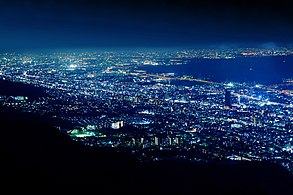 Ten Million Dollar Night View, Kobe
 -
 Night view of Nagasaki city


New Three Major Night Views of Japan[edit]
 |
The New Three Major Night Views of Japan are:
- Views of Kitakyushu from Mount Sarakura (皿倉山), a mountain in Kitakyūshū Quasi-National Park, which is at the city of Kitakyushu in Fukuoka Prefecture, Kyūshū.
- Views of Nara from Mount Wakakusa (若草山), a mountain located in the east of Nara Park.
- Views of Kōfu Basin from Yamanashi Fuefukigawa Fruit Park (山梨県笛吹川フルーツ公園), a city park in Yamanashi, Yamanashi Prefecture.
Gallery[edit]
- New Three Major Night Views of Japan
-
 Night view from Mount Sarakura.
 -
 Burning the dead grass at Mount Wakakusa.
 -
 Kōfu Basin from Yamanashi Prefecture Fuefukigawa Fruit Park.


See also[edit]
- List of Special Places of Scenic Beauty, Special Historic Sites and Special Natural Monuments
- 100 Landscapes of Japan (Heisei era)
- 100 Landscapes of Japan (Shōwa era)
- 100 Soundscapes of Japan
- Three Great Gardens of Japan
- Tourism in Japan
- UNESCO World Heritage Sites in Japan
- Thirty-six Views of Mount Fuji (disambiguation)
References[edit]
- ^ "Amanohashidate - History" (in Japanese). Amanohashidate kankokyokai. Archived from the original on 17 July 2011. Retrieved 14 May 2011.
- ^ "The Night View from Mt. Hakodate". Archived from the original on 19 October 2014. Retrieved 21 July 2014.
External links[edit]

- Official website of Nihon-Sankei, the three most scenic spots of Japan (in Japanese)
- Yakei official site (in Japanese)
- Fruit Park Fujiya Hotel official website (in Japanese)
| Three Views of Japan | |
| Amanohashidate – Matsushima – Itsukushima | |
 – –  – – 
| |
- Tourism in Japan
- Tourist attractions in Miyagi Prefecture
- Tourist attractions in Kyoto Prefecture
- Tourist attractions in Hiroshima Prefecture
- Tourist attractions in Hokkaido
- Tourist attractions in Hyōgo Prefecture
- Tourist attractions in Nagasaki Prefecture
- Tourist attractions in Yamanashi Prefecture
- Tourist attractions in Nara Prefecture
- Tourist attractions in Fukuoka Prefecture
- 1643 in Japan
- 1915 in Japan
- 2003 in Japan
- 2004 in Japan
- Places of Scenic Beauty