


Viburnum tinus
| Viburnum tinus | |
|---|---|

| |
| By L. By Jacob van Huysum | |
Scientific classification 
| |
| Kingdom: | Plantae |
| Clade: | Tracheophytes |
| Clade: | Angiosperms |
| Clade: | Eudicots |
| Clade: | Asterids |
| Order: | Dipsacales |
| Family: | Adoxaceae |
| Genus: | Viburnum |
| Species: | V. tinus
|
| Binomial name | |
| Viburnum tinus | |
| Synonyms | |
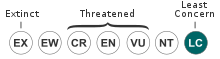
Viburnum tinus, the laurustinus, laurustine or laurestine, is a species of flowering plant in the family Adoxaceae, native to the Mediterranean area of Europe and North Africa. Laurus signifies the leaves' similarities to bay laurel.
Description[edit]

It is a shrub (rarely a small tree) reaching 2–7 m (7–23 ft) tall and 3 m (10 ft) broad,[1] with a dense, rounded crown. The leaves are evergreen, persisting 2–3 years, ovate to elliptic, borne in opposite pairs, 4–10 cm long and 2–4 cm broad, fine hairs persisting on the underside, with an entire margin.
The flowers are small, white or light pink, produced from reddish-pink buds in dense cymes 5–10 cm diameter in the winter. The fragrant flowers (some consider the fragrance offensive, especially after rain when it is very strong) are bisexual (monoecious — having both male and female parts on one plant) and pentamerous. The flowering period is in winter, or from October to June in the northern hemisphere. The five petals are tubular, with rounded, corolla lobes, pink in the bud but later white. There is only one whorl with five stamens. Pollination is by insects. The fruit is a dark blue-black drupe 5–7 mm long. A 2020 study of the fruit's metallic blue hue revealed microscopic globules of fat to be the cause, an example of structural color,[2] which is unusual in plants.
The leaves have domatia where predatory and microbivorous mites can be housed.[3]
Distribution and habitat[edit]
Native to the Mediterranean region, Viburnum tinus prefers shady, moist areas. It is most commonly found in the western Mediterranean due to a shorter drought season and is one of the dominant species of Mediterranean sclerophyllous shrubland.[4] It has also been introduced to Australia, Pakistan, California, Oregon and Tajikistan.[5]
Cultivation[edit]
Viburnum tinus is widely cultivated for its winter blooms and metallic blue berries. It is hardy down to −10 °C (14 °F). The cultivars 'Eve Price',[6] 'French White'[7] and 'Gwenllian'[8] have gained the Royal Horticultural Society's Award of Garden Merit.[9]
Other uses[edit]
V. tinus has been used for its traditional medicinal properties, for example in Pakistan.[citation needed] The active ingredients are viburnin (a substance or more probably a mixture of compounds) and tannins. Tannins can cause stomach upset. The leaves when infused are said to have antipyretic properties. The fruits have been used as purgatives against constipation. The tincture has been used lately in herbal medicine as a remedy for depression. The plant also contains iridoid glucosides.[10]
Pests[edit]
In south-east Britain Viburnum tinus is the principal host of the viburnum beetle (Pyrrhalta viburni), the country's "number one pest species" according to the Royal Horticultural Society.[11]
Etymology[edit]
The generic name of the plant derives from Latin viburnum, referring to Viburnum lantana.[12] The specific name derives from Latin tinus referring to the plant itself, Viburnum tinus.[13]
References[edit]
- ^ RHS A-Z encyclopedia of garden plants. United Kingdom: Dorling Kindersley. 2008. p. 1136. ISBN 978-1405332965.
- ^ Hartley, Charlotte (2020-08-06). "The secret to this fruit's mysterious blue color". Science | AAAS. Retrieved 2020-08-07.
- ^ Plants, mites and mutualism: leaf domatia and the abundance and reproduction of mites on Viburnum tinus (Caprifoliaceae). Raul Grostal and Dennis J. O'Dowd, Oecologia, April 1994, Volume 97, Issue 3, pages 308-315, doi:10.1007/BF00317319
- ^ "Laurestine". IUCN. November 2017. Retrieved 8 December 2020.
- ^ "Viburnum tinus L." Catalogue of Life. Retrieved 8 December 2020.
- ^ "RHS Plantfinder - Viburnum tinus 'Eve Price'". Retrieved 18 February 2019.
- ^ "RHS Plantfinder - Viburnum tinus 'French White'". Retrieved 18 February 2019.
- ^ "RHS Plantfinder - Viburnum tinus 'Gwenllian'". Retrieved 18 February 2019.
- ^ "AGM Plants - Ornamental" (PDF). Royal Horticultural Society. July 2017. p. 107. Retrieved 18 February 2019.
- ^ Iridoid glucosides from Viburnum tinus. Lamberto Tomassini, M. Francesca Cometa, Sebastiano Foddai and Marcello Nicoletti, Phytochemistry, January 1995, Volume 38, Issue 2, Pages 423–425, doi:10.1016/0031-9422(94)00618-4
- ^ "Top 10 pests". Wisley, England: Royal Horticultural Society. 19 January 2011. Archived from the original on October 9, 2013. Retrieved 10 May 2011.
- ^ viburnum. Charlton T. Lewis and Charles Short. A Latin Dictionary on Perseus Project.
- ^ tinus. Charlton T. Lewis and Charles Short. A Latin Dictionary on Perseus Project.
External links[edit]

- Flora Europaea: Viburnum tinus
- Eriksson, O., et al. 1979. Flora of Macaronesia: checklist of vascular plants
- Pignatti S. - Flora d'Italia – Edagricole – 1982, Vol. II, pag. 639
- Biolib
- Viburnum tinus
Gallery[edit]
-
 Plant
Plant -
 Inflorescence
 -
 Close-up on flowers
 -
 Unripe fruits
 -
 Ripe fruits
 -
 Close-up on fruits
 -
 Leaf
Leaf


.JPG)

.JPG)