Vicarius Filii Dei
Vicarius Filii Dei (Latin: Vicar or Representative of the Son of God) is a phrase first used in the forged medieval Donation of Constantine to refer to Saint Peter, who is regarded as the first Pope by the Catholic Church.[1]
Origins and uses of the phrase
[edit]The earliest known instance of the phrase Vicarius Filii Dei is in the Donation of Constantine, now dated between the eighth and the ninth centuries AD.
It et cuncto populo Romanae gloriae imperij subiacenti, ut sicut in terris vicarius filii Dei esse videtur constitutus etiam et pontifices[2][3]
Johann Peter Kirsch states that "many of the recent critical students of the document [i.e. Donation of Constantine] locate its composition at Rome and attribute the forgery to an ecclesiastic, their chief argument being an intrinsic one: this false document was composed in favour of the popes and of the Holy Catholic Roman Church, therefore the Christ Church itself must have had the chief interest in a forgery executed for a purpose so clearly expressed".[4]
However, it goes on to state, "Grauert, for whom the forger is a Frankish subject, shares the view of Hergenröther, i.e. the forger had in mind a defence of the new Western Empire from the attacks of the Eastern Romans. Therefore it was highly important for him to establish the legitimacy of the newly founded empire, and this purpose was especially aided by all that the document alleges concerning the elevation of the pope."[4]
Despite the Donation later being recognized as a forgery, initially the whistleblower Laurentius Valla who discovered the forgery had his work suppressed by the Index Librorum Prohibitorum[5]
Gratian included the phrase in his "Decretum" in Distinctio 96 chapter 14.[6] The title was also included in some collections of Greek canons. Though it was derived from a forgery (The Donation of Constantine) and some[4] have said it carried no dogmatic or canonical authority, protestants pointed to the weight and authority proscribed within Gratian's Decretal Distinctio 19 Chapter 6 which stated that the decretal epistles were reckoned part of the canonical scriptures.[7][8] It was previously also used as such for hundreds of years in the past.
Documented Usage
[edit]Several popes used the phrase and quoted it throughout their documents including the following:
- Pope Leo IX in his In Terra Pax Hominibus, 1054[9]
- Pope Nicholaus IV in his letter to Caydonius the Tartar, 1289[10]
- Pope John XXII in his Licet juxta doctrinam, 1327[11][12][13][14]
- Pope John XXII in his Bulla Sabbatina, 1322[15][16]
- Pope Paul VI in his Rivi Muniensis, 1965[17] and in his Bafianae, 1968 [18]
Lawyers
[edit]Catholic documents used the phrase as well including those from Canon Lawyer Augustinus Triumphus in his Summa de potestate ecclesiastica.[19][20][21] Others such as Venetian lawyer Alphonsus Alvarez Guerrero, a Spanish civil and canon lawyer (1559) used the phrase in his Thesaurus Christianae Religiones.[22][23] Venetian jureconsult and author (16th century) Giovanni Battista Ziletti (1577) also used the phrase in his work Consiliorum Seu Responsorum, Ad Causas Criminales, Recens Editorum[24]
Cardinals and Bishops
[edit]In 1561 Dominican and Spanish theologian Juan de Torquemada used the phrase in his monumental Summa de Ecclesia.[25] In 1581, Antonino (Archbishop of Florence) in Volume 3 of his Summa Theologicae quotes the phrase and applies it to the pope.[26] The acclaimed Cardinal Henry Edward Manning used an english equivalent "Vicar of the Son of God" to refer to the pope.[27] In his "Vindication of the Popes against opponents of all kinds" Vindiciae Summorum Pontificum adversus omnis generis adversarios, Wilibald Heiss (1755) also used the title.[28] Jesuit Vincent Houdry also used the title in his work Bibliotheca Concionatoria Complectens Panegyricas Orationes Sanctorum where he described the win of Innocent II over antipope Anaclectus II[29][30]
Ecclesiastical Anthology
[edit]In his Polyanthea Sacrorum, Giovanni Paolo Paravicini and also Laurentius Brancati in his Epitome Canonum Omnium, enumerated papal names or claims to authority and stated that the "Papa Est Vicarius Filii Dei Sicut Petris" "The Pope is Vicarius Filii Dei like Peter".[31][32][33][34] Wolfgang Frölich in his 1790 work (Who is Peter) Quis est Petrus seu qualis Petri Primatus?: Liber theologico-canonico catholicus described Peter's successor with the phrase "Christi Filii Dei Vicarius".[35] The French catechism Catéchisme de persévérance, also used the french version of the title "vicaire du Fils de Dieu".[36] Italian Franciscan canonist Lucius Ferraris also used the title in his Prompta Bibliotheca Canonica, Juridica, Moralis. [37] Theologian D'Utrecht in his work Défense de L'Eglise Romaine et des Souverains Pontifes also used the title.[38]
Papal title?
[edit]

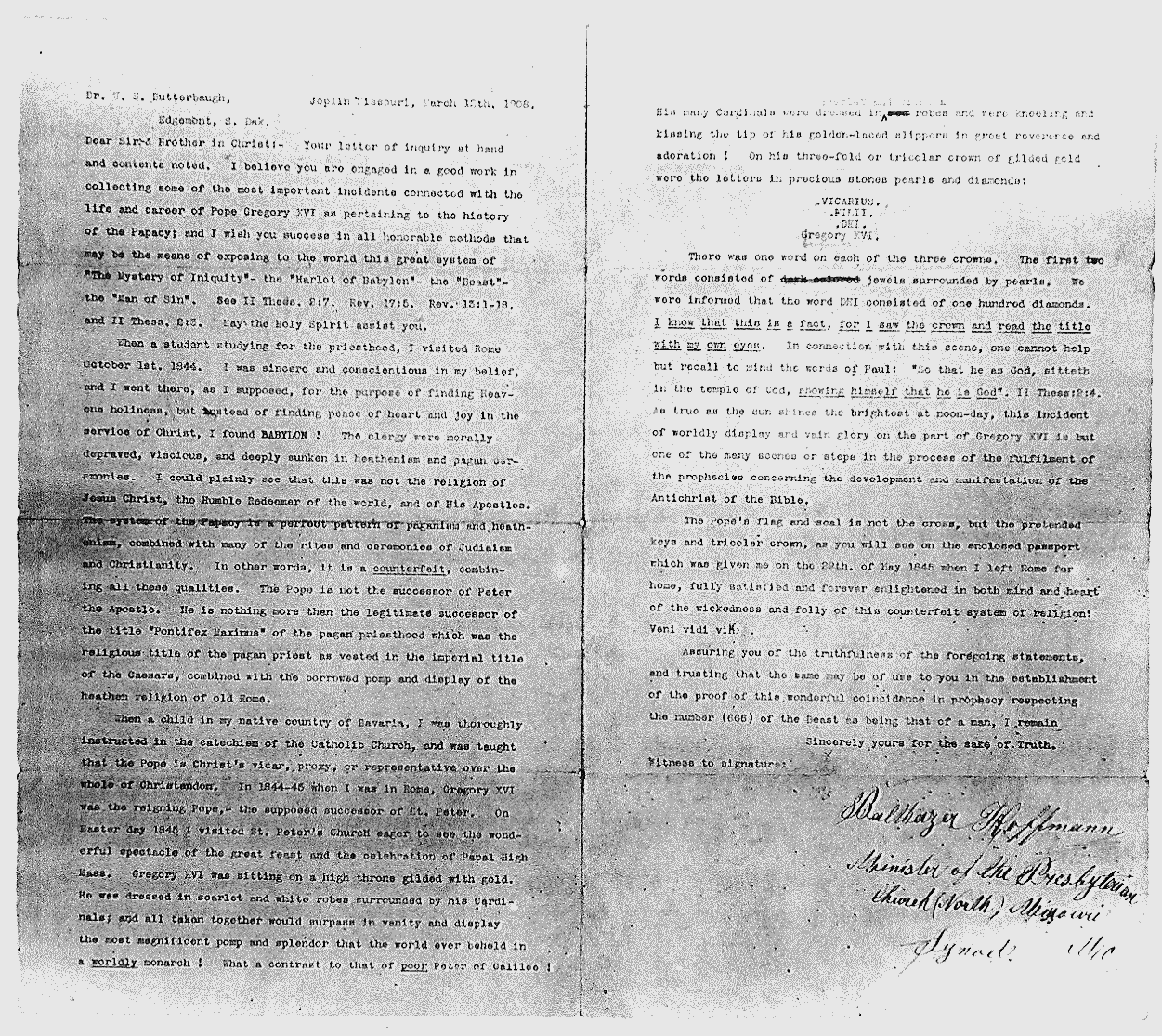
The Protestant writer Andreas Helwig suggested that Vicarius Filii Dei was an expansion of the historical title Vicarius Christi, rather than an official title used by the Popes themselves. His interpretation did not become common until about the time of the French Revolution.[39] Some later Protestant figures asserted that Vicarius Filii Dei was an official title of the Pope, with some saying that this title appeared on the papal tiara and/or a mitre. Some Catholic converts to protestantism such as Balthasar Hoffman[40] also testified to witnessing the title engraved with 100 diamonds on the 1845 tiara of Gregory XVI[41]
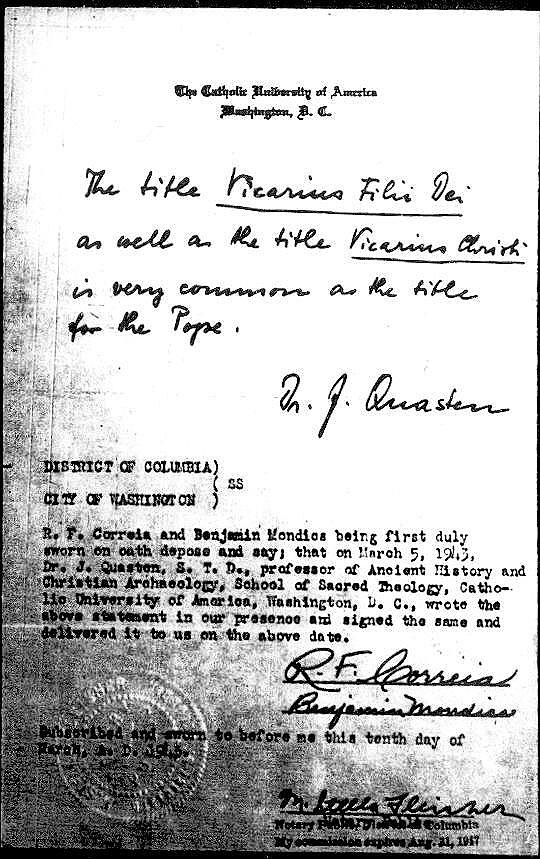
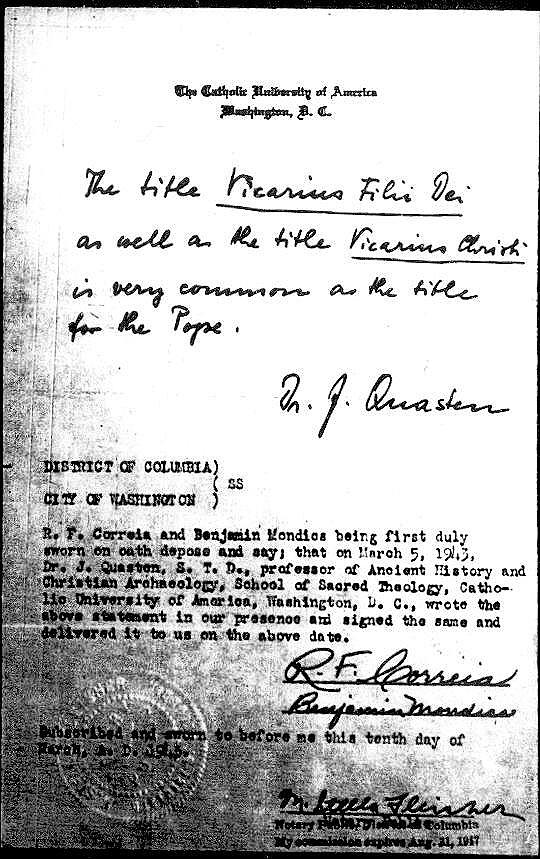
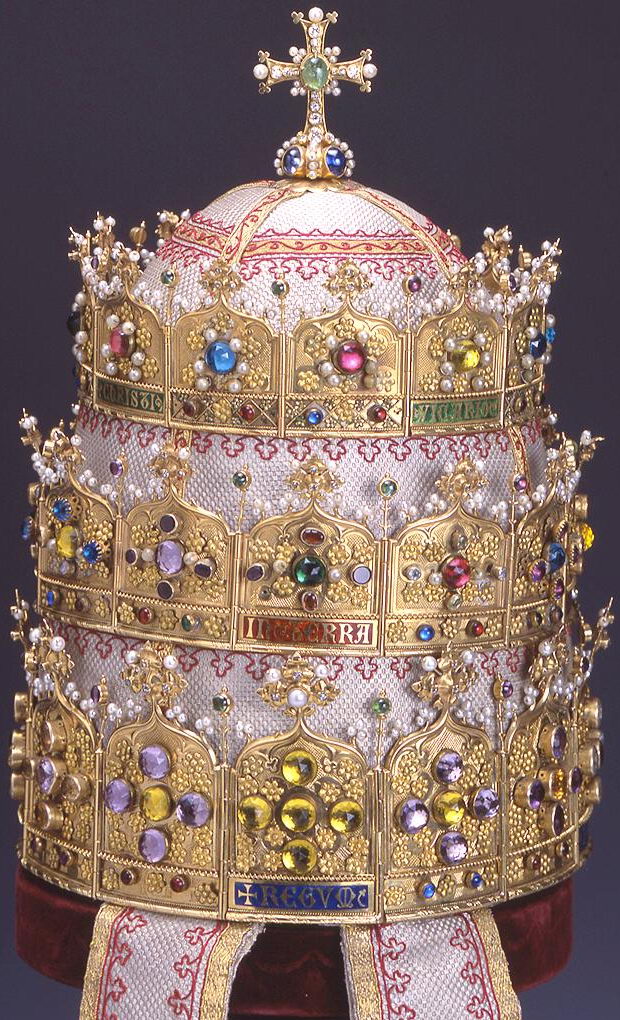
Catholic apologist Patrick Madrid answers the Protestant assertions by claiming that Vicarius Filii Dei has never been an official Papal title. Catholics answer the claims that "Vicarius Filii Dei" is written on the Papal Tiara by stating that a simple inspection of the more than 20 papal tiaras still in existence—including those in use in 1866 during the reign of Pope Pius IX when Uriah Smith made his claim—shows that none have this inscription, nor is there any evidence that any of the earlier papal tiaras destroyed by invading French troops in 1798 had it.[42] However, a Catholic publication, Our Sunday Visitor, did admit to the title being inscribed on a tiara.[43] Catholic scholar, Professor Emeritus at the Catholic University of America, Dr Johannes Quasten (1900-1987), stated that "The title Vicarius Filii Dei as well as the title vicarius christi is very common as the title of the pope".[44]
Protestant view
[edit]Some fundamentalist Protestants have the view that Vicarius Filii Dei can be applied to the Bishop of Rome.
Origins of a controversy
[edit]The earliest extant record of a Protestant writer on this subject is that of Professor Andreas Helwig in 1612. In his work Antichristus Romanus he took fifteen titles in Hebrew, Greek, and Latin and computed their numerical equivalents using the principle of Isopsephy in those languages, arriving at the number 666 mentioned in the Book of Revelation. Out of all these titles, he preferred to single out Vicarius Filii Dei, for the reason that it met "all the conditions which [Cardinal] Bellarmine[45] had thus far demanded."[46]
Helwig's criteria were as follows:[46]
- must yield the required number
- must agree with the papal order
- must not be a vile name applied by enemies, but acceptable to Antichrist himself
- must be one of which he can boast.[46]
Helwig suggested that the supposed title was an expansion of the historical title Vicarius Christi, rather than an official title used by the Popes themselves. Additionally, he said nothing about the title appearing on tiaras or mitres. Helwig's interpretation did not become a common one until about the time of the French Revolution.[47] Some later Protestant figures directly claimed that Vicarius Filii Dei was an official title of the Roman Catholic Pope, some claimed that this title appeared on the papal tiara and/or a mitre.
Some Protestants view the Pope as the Antichrist. This view was common at the time of Helwig and is still part of the confession of faith of some Protestant churches, such as those within Confessional Lutheranism[48] and the London Baptist confession of 1689.[49]
Historical Seventh-day Adventist views
[edit]In 1866, Uriah Smith was the first to propose the interpretation to the Seventh-day Adventist Church.[50][51] In The United States in the Light of Prophecy, he wrote: "The pope wears upon his pontifical crown in jeweled letters, this title: 'Vicarius Filii Dei', 'Viceregent of the Son of God'; the numerical value of which title is just six hundred and sixty-six. The most plausible supposition we have ever seen on this point is that here we find the number in question. It is the number of the beast, the papacy; it is the number of his name, for he adopts it as his distinctive title; it is the number of a man, for he who bears it is the 'man of sin'."[52]
Uriah Smith maintained his interpretation in the various editions of Thoughts on Daniel and the Revelation, which was influential in the church.[50]
In November 1948, Le Roy Froom, a Seventh-day Adventist ministerial leader, editor of the church's Ministry, and a church historian, wrote an article to correct the mistaken use of some of the denomination's evangelists who continued to claim that the Latin words "Vicarius Filii Dei" were written on a papal tiara.
Each pope, like any other sovereign, has his own tiara, which is the papal crown. There is, therefore, no one tiara that is worn by the full succession of papal pontiffs. Moreover, personal examination of these various tiaras, by different men back through the years, and a scrutiny of the pictures of many more, have failed to disclose one engraved with the inscription Vicarius Filii Dei ... As heralds of truth, we are to proclaim the truth truthfully. No fabrication should ever becloud our presentation of truth. The present truth of the threefold message [the Three Angels' Messages of Revelation 14] is so overwhelming in its logical appeal, and so inescapable in its claims, that it needs no dubious evidence or illustration to support it.[53]
Froom also stated in the 1948 article that at one point a prominent Adventist went to Rome to take some pictures of the papal tiaras, but "the photographs were without any wording of any sort on any one of the three crown, front or back." Later, an Adventist artist who wanted to illustrate a standard Adventist text on prophecies added the words "Vicarius", "Filii", and "Dei", one word on each of the three tiaras in the photograph taken. He submitted his image for publishing in a standard church text on Bible prophecy; the image was to serve as an illustration in the book, not as a visual proof. However, when an Adventist publishing house and the Adventist General Conference received it, they "emphatically rejected it as misleading and deceptive, and refused to allow its use. (All honor to them!)." Froom concluded his 1948 article with the following words: "Truth does not need fabrication to aid or support it. Its very nature precludes any manipulation or duplicity. We cannot afford to be party to any fraud. The reflex action upon our own souls should be a sufficient deterrent. We must never use a quotation or a picture merely because it sounds or looks impressive. We must honor the truth, and meticulously observe the principle of honesty in the handling of evidence under all circumstances."[53]
It is worth noting however that the equivalent title "Vicarius Christi" is indeed known to be inscribed upon the Belgium Tiara given to Pope Pius IX on 18 June 1871 by the Ladies of the Royal Court of the King of the Belgians and designed by Jean Baptist Bethune of Ghent.[54][55] Adventists have proposed that the alternate "Vicarius Christi" is no better than Vicarius Filii Dei, because of the correlation in Leviticus 24:18 between the substitute Vicarium in the Vulgate[56] and the substitute ἀντί "life for life" in the greek text.[57] They have proposed Vicarius Christi therefore means "Antichrist".[58]
Catholic response
[edit]Catholic apologist Patrick Madrid answers the Protestant claims by claiming that "Vicarius Filii Dei" has never been an official Papal title. He also argues that even if it were a Papal title, that would not be sufficient to associate the Pope with the number of the Beast, as, for example, the name of Ellen Gould White can also be similarly manipulated to get the same number (ELLen GoVLD VVhIte 50+50+5+50+500+5+5+1=666). He answers the claims that "Vicarius Filii Dei" is not written on Papal Tiara by stating that merely looking at any of the more than 20 papal tiaras still in existence—including those in use in 1866 during the reign of Pope Pius IX when Uriah Smith made his claim—plainly shows that not even one of them has any such inscription, nor is there any evidence that any of the earlier papal tiaras destroyed by invading French troops in 1798 had any such inscription either.[42]
Adventist Samuele Bacchiocchi responded to those claims, by pointing out that "interpreting 666 on the basis of the numerical values of the letters of names can give absurd results". He also notes the Donation of Constantine was considered as true to the point "this forged document was used by 10 popes over a period of six centuries to assert, not only their ecclesiastical supremacy over all the churches, but also their political sovereignty over what became known the Papal States, which included most of Italy." He also states the title "Vicarius Filii Dei" was considered as an official title of the pope.[59]
See also
[edit]References
[edit]- ^ "St. Peter". Saints and Angels. Catholic Online. Retrieved 4 August 2013.
- ^ "Donation of Constantine". www.thelatinlibrary.com.
- ^ "A COPY OF THE DONATION OF THE EMPEROR COSTANTINE I (306-337) TO POPE SYLVESTER I (314-335)". May 7, 2011. Archived from the original on 2011-05-07.
- ^ a b c Kirsch, Johann Peter. "Donation of Constantine". The Catholic Encyclopedia Vol. 5. New York: Robert Appleton Company, 1909. Retrieved 1 November 2017.
- ^ Index librorum prohibitorum. The Newberry Library. Romae : Ex Typographia Reuerendae Camerae Apostolicae. 1664. p. 195.
{{cite book}}: CS1 maint: others (link) - ^ Gratien (1582). Decretum Gratiani emendatum et notationibus illustratum, unà cum glossis , Gregorii XIII, pont. max. jussu editum (in Latin). in aedibus populi romani. p. 623.
- ^ Gratien (1582). Decretum Gratiani emendatum et notationibus illustratum, unà cum glossis , Gregorii XIII, pont. max. jussu editum (in Latin). in aedibus populi romani. p. 107.
- ^ Whitaker, William (1849). A Disputation on Holy Scripture: Against the Papists, Especially Bellarmine and Stapleton. Printed at the University Press. p. 109.
- ^ Contractus, Hermannus (1853). Patrologiae cursus completus, seu bibliotheca universalis, integra, uniformis, commoda, oeconomica, omnium SS. Patrum, doctorum scriptorumque ecclesiasticorum, sive latinorum, qui ab aevo apostolico ad tempora Innocentii 3. (anno 1216) pro Latinis et Concilii Florentini (ann. 1439) pro Graecis floruerunt: Recusio chronologica ...: Hermanni Contracti monachi Augià Divitis, Humberti S. R. E. cardinalis Silvà Candidà episcopi opera omnia ... accedunt S. Leonis 9., Victoris 2., Stephani 9., Nicolai 2., summorum pontificum opuscula, epistolà et privilegia (in Latin). Migne. p. 753.
- ^ Pontificiarum constitutionum in Bullariis Magno, et Romano contentarum, et aliunde desumptarum epitome, et secundum materias dispositio cum indicibus locupletissimis opera et studio Aloysii Guerra S.T.D. Tomus primus [-quartus] (in Latin). 1772. p. 456.
- ^ Historia di tutte l'heresie descritta da Domenico Bernino. Tomo primo [-quarto]. . (in Latin). 1707. p. 468.
- ^ Baronio, Cesare; Rinaldi, Odorico; Laderchi, Giacomo (1872). Caesaris S. R. E. Card. Baronii, Od. Raynaldi et Jac. Laderchii congregationis oratorii presbyterorum annales ecclesiastici: 1313 - 1333 (in Latin). Guerin. p. 323.
- ^ Martène (O.S.B.), Edmond (1717). Thesaurus novus anecdotorum: tomus secundus : in quo continentur urbani Papae IV epistolae LXIV, Clementis Papae IV epistolae DCCXI ... alia que plura de Schismate pontificium Avenionesium monumenta (in Latin). sumptibus Florentini Delaulne, Hilarii Foucault, Michaelis Clouzier, Joannis-Gaufridi Nyon, Stephani Ganeau, Nicolai Gosselin. p. 706.
- ^ Magnum Bullarium Romanum: A Beato Leone Magno Usque Ad S.D.N. Benedictum XIII.. Constitutiones Variorum Pontificum in praecedentibus Editionibus desideratas, summoque studio hinc inde conquistas complectens. 9 (in Latin). 1730. p. 168.
- ^ Josepho.), Raphael (a Sancto (1718). Signum Salutis, Salus in Periculis: hoc est, beneficia & admiranda Sac. Ordini Fratrum Gloriosissimae Dei Genitricis semperque Virginis Mariae de Monte Carmelo, nec non antiquissimae & celeberrimae archi-fraternitati sacri ac thaumaturgi Scapularis ... (in Latin). Leidenmayr. p. 34.
- ^ Josepho.), Raphael (a Sancto (1718). Signum Salutis, Salus in Periculis: hoc est, beneficia & admiranda Sac. Ordini Fratrum Gloriosissimae Dei Genitricis semperque Virginis Mariae de Monte Carmelo, nec non antiquissimae & celeberrimae archi-fraternitati sacri ac thaumaturgi Scapularis ... (in Latin). Leidenmayr.
- ^ "De Fernando Poo (Rivi Muniensis), Constitutio Apostolica, Nonnullis territoriis a vicariatu apostolico de Fernando Póo detractis, novus vicariatus apostolicus conditur, «Rivi Muniensis» nomine, d. 9 m. Augusti a. 1965, Paulus PP. VI | Paulus PP. VI". www.vatican.va. Retrieved 2022-12-04.
- ^ "Bafianae, Constitutio Apostolica, Quae erat praefectura apostolica Bafiensis in dioecesium ordinem redigitur, «Bafiana» nomine, d. 11 m. Ianuarii a. 1968, Paulus PP. VI | Paulus PP. VI". www.vatican.va. Retrieved 2022-12-04.
- ^ Triumphus, Augustinus. "'Incipit Summa augustini de Ancona de sum[m]a postestate ecclesiastica' - Viewer | MDZ". www.digitale-sammlungen.de. p. 391. Retrieved 2022-12-04.
- ^ texte, Augustin d'Ancône (127-1328) Auteur du (1476). Summa de potestate ecclesiastica ([Reprod.]) / Augustinus de Ancona. p. 245.
{{cite book}}: CS1 maint: numeric names: authors list (link) - ^ Trionfo, Agostino (1584). Augustini Triumphi Anconitani catholici doctoris Summa de potestate ecclesiastica edita anno Dni 1320 (in Latin). ex typographia Georgij Ferrarij. pp. 218, 239.
- ^ Guerrero, Alfonso Álvarez (1559). Thesaurus Christianae Religionis el Speculum, Sacrorum, Summorum, Romanarum, Pontificum, Imperatorum ac Regum, et Sanctissimarum Episcoparum (in Latin). Apud Cominum de Tridino Montisferrati. p. 305.
- ^ Guerrero, Alfonso Alvárez (1559). Thesaurus christianae religionis et speculum Sacrorum Summorum Romanorum Pontificum, Imperatorum, ac Regum et Sanctissimorum Episcopum (in Latin). Al segno della Fontana. p. 305.
- ^ Consiliorum Selectorum, In Criminalibus Causis: Consiliorum Seu Responsorum, Ad Causas Criminales ... Tomus Secundus. 2 (in Latin). 1577. p. 182.
- ^ Juan : de Torquemada (1561). Summa de ecclesia d. Ioan. De Turrecremata tituli sancti Sixti presbyteri cardinalis, una cum eiusdem apparatu, nunc primùm in lucem edito, super decreto papae Eugenij 4. in Concilio Florentino de unione Graecorum emanato, ... cum indice copiosissimo per ordinem alphabeticum ducto (in Latin). National Central Library of Rome. Michele Tramezzino!. p. 483.
- ^ Santo), Antonino (Arzobispo de Florencia (1581). Eximij doctoris B. Antonini Archiepiscopi Florentini ... Summae Sacrae Theologiae, iuris Pontificij [et] Caesarei prima [-quarta] pars ...: accedunt ... Indices copiosissimi (in Latin). apud Iuntas. p. 401.
- ^ Manning, Henry Edward (1885). The Glories of the Sacred Heart. D. & J. Sadlier & Company. p. 183.
- ^ Heiss, Wilibald (1756). Vindiciae Summorum Pontificum adversus omnis generis adversarios, ineffabilibus..., summam tiaram decussatim afficientes, methodo theologico-historica copiose adornatae per Wilibaldum Heissium, franciscanum,... (in Latin). sumptibus Andreae Stadler, & Christophori Barti. p. 90.
- ^ Houdry (S.I.), Vincent (1767). R.P. Vincentii Houdry ... Bibliotheca concionatoria complectens panegyricas orationes sanctorum: tomus primus [-secundus] (in Latin). ex Typographia Balleoniana. p. 102.
- ^ Houdry, Vincent (1779). Bibliotheca concionatoria complectens panegyricas orationes sanctorum (in Latin). Ex typographia HEredis Nicolai Pezzana. p. 96.
- ^ Brancati, Laurentius cardinalis (1659). Epitome canonum omnium, qui in concilijs generalibus, ac provincialibus, in dicreto Gratiani, in decretalibus ... continentur (in Latin). Mascardi. p. 630.
- ^ Brancati, Lorenzo (1684). ... D. Laurentii Brancati ... epitome canonum omnium, qui in conciliis generalibus ac provincialibus, in Decreto Gratiani, in Decretalibus, in epistolis et constitutionibus Rom. pontificum, usque ad nostra tempora, continentur (in Latin). Metternich. p. 447.
- ^ Paravicini, Giovanni. "'Polyanthea Sacrorum Canonum Coordinatorum : Qui In Conciliis Generalibus Ac Provincialibus, In Oriente ac Occidente celebratis, In Decreto Gratiani, in Decretalibus, in Epistolis ac Constitutionibus Romanorum Pontificium, Ad nostra usque tempora prodierunt ; Olim operâ Eminentissimi ... Domini, Dni Brancati De Laurea, Sac. Rom. Eccl. Cardinalis, ... In Epitomen Redacti, Nunc verò sic coordinati, & Serie Alphabeticâ dispositi, ... in oculos pariter ac animos Lectorum incurrat, Tribus Tomis Divisa ; Opus omnibus Praelatis Ecclesiasticis, ... utile, .... 3' - Viewer | MDZ". www.digitale-sammlungen.de. p. 211. Retrieved 2022-12-04.
- ^ Paravicini, Johannes Paulus (1728). Polyanthea sacrorum canonum coordinatorum qui in conciliis, in decreto, Gratiani in decretialibus ... ad nostra usque tempora prodierunt etc (in Latin). Vidua Joannes Schlebusch. p. 205.
- ^ Frölich, Wolfgang (1790). Quis est Petrus? seu Qualis Petri primatus? Liber theologico-canonico Catholicus [by W. Frölich] (in Latin). p. 438.
- ^ Gaume, Jean (1845). Catéchisme de persévérance, ou, Exposé historique, dogmatique, moral et liturgique de la religion depuis l'origine du monde jusqu'a nos jours (in French). Gaume frères. p. 25.
- ^ Ferraris, Lucius (1858). F. Lucii Ferraris Prompta bibliotheca canonica, juridica, moralis, theologica, nec non ascetica, polemica, rubricistica, historica (in Latin). J.-P. Migne. p. 1828.
- ^ D'Utrecht, Germain (1696). Defense de l'eglise romaine (in French). p. 629.
- ^ Le Roy Edwin Froom (1948). Prophetic Faith of Our Fathers, vol. 2 (PDF), pp. 605–608. Review and Herald. Compare Ibid., p. 649; vol. 3 (PDF), pp. 228, 242.
- ^ Robinson, Edgar Sutton (1898). The Ministerial Directory: Of the Ministers in the Presbyterian Church in the United States (Southern), and in the Presbyterian Church in the United States of America (Northern), Together with a Statement of the Work of the Executive Committees and Boards of the Two Churches... Ministerial Directory Company. p. 312.
- ^ Hoffman, Balthasar (1908). "Letter to Dr U.S. Butterbaugh". Archived from the original on December 4, 2022. Retrieved December 4, 2022.
- ^ a b Patrick Madrid. "Pope Fiction". Envoy magazine, March/April 1998
- ^ "Our Sunday Visitor" (PDF). Our Sunday Visitor. 3 (51). April 18, 1915. Archived from the original (PDF) on December 4, 2022.
- ^ Quasten, Johannes (March 10, 1943). "Quasten Document". Archived from the original on December 4, 2022. Retrieved December 4, 2022.
- ^ Bellarmino, Roberto Francesco Romolo (1615). Dispvtationvm Roberti Bellarmini Politiani ... de controversiis Christianæ fidei, adversvs hvivs temporis hæreticos, qvatvor tomis comprehensarvm, tomvs ... Accessere opuscula recenter nonnulla ... (in Latin). sumptibus Ioannis Gymnici & Antonij Hierat. p. 284.
- ^ a b c Helwig, Andreas (1512). Antichristus Romanus. VVttenbergae, Typis Laurentij Seuberlichs. pp. c2 (20).
- ^ See Leroy Edwin Froom, Prophetic Faith of Our Fathers, vol. 2, pp. 605-608. Compare Ibid., p. 649; vol. 3, pp. 228, 242.
- ^ A Treatise on the Power and Primacy of the Pope, a Lutheran Confession in the Book of Concord
- ^ A Confession of Faith: Put Forth by the Elders and Brethren of Many Congregations of Christians, (baptized Upon Profession of Their Faith), in London and the Country ... : First Printed in 1689. sold. 1809. p. 48.
- ^ a b Seventh-day Adventist Bible Commentary, 223
- ^ Smith, Uriah (1866). "The Two-Horned Beast - A Review of H. E. Carver" (PDF). Review and Herald.
- ^ Uriah Smith, The United States in the Light of Prophecy. Battle Creek, Michigan: Seventh-day Adventist Publishing Association (1884), 4th edition, p.224.
- ^ a b "The Query Column: Dubious Pictures of the Tiara". Ministry, vol. 10, no. 21. p.35. November, 1948
- ^ "Belgium Tiara". Archived from the original on December 6, 2022. Retrieved December 6, 2022.
- ^ Collins, Michael (2014). The Vatican. Internet Archive. London : Dorling Kindersley. p. 266. ISBN 978-1-4093-4975-4.
- ^ 1462 The Gutenberg Bible Latin Vulgate. p. 102.
- ^ Swete, Henry Barclay (1896–1905). The Old Testament in Greek according to the Septuagint. Robarts - University of Toronto. Cambridge : University Press. p. 272.
- ^ Bohr, Stephen (2016). "Reflections on Pope Francis, The UN, and the 2030 Agenda" (PDF). Secrets Unsealed Newsletter. Archived from the original (PDF) on December 6, 2022.
- ^ "THE MARK AND NUMBER OF THE BEAST", Samuele Bacchiocchi, Ph. D., ENDTIME ISSUES NEWSLETTER No. 139
 This article incorporates text from a publication now in the public domain: Herbermann, Charles, ed. (1913). "Donation of Constantine". Catholic Encyclopedia. New York: Robert Appleton Company.
Further reading
[edit]- Bruinsma, Reinder. (1994). Seventh-day Adventist Attitudes Toward Roman Catholicism 1844–1965, Berrien Springs, Michigan. ISBN 1-883925-04-5.
- Heim, Bruno (1978). Heraldry in the Catholic Church: Its Origins, Customs and Laws, Gerrards Cross, Eng.: Van Duren. ISBN 0-905715-05-5.
- Noonan, James-Charles. (1996). The Church Visible: The Ceremonial Life and Protocol of the Roman Catholic Church, New York: Viking. ISBN 0-670-86745-4.
- Smith, Uriah (1881). Thoughts, Critical and Practical on the Book of Revelation, Battle Creek, Mich.
- Froom, Le Roy (1948). "Dubious Pictures of the Tiara." The Ministry, vol.10, no.21. November, 1948.
- Smithe, Jefferson (1902). Roman Catholic Ritual, London.
| Jurisdiction |
| ||||
|---|---|---|---|---|---|
| Headquarters | |||||
| Major basilicas | |||||
| Titles Papal names | |||||
| Symbols | |||||
| Proclamations | |||||
| Activities | |||||
| Vestments | |||||
| Transportation | |||||
| Household | |||||
| Staff | |||||
| Related | |||||