


Mercedes-Benz 4G-Tronic transmission
 | This article relies largely or entirely on a single source. (January 2021) |
| Mercedes-Benz W4A 040 · W4A 028 · W4A 020 · W5A 030 | |
|---|---|
| Overview | |
| Manufacturer | Daimler AG |
| Production | 1979–1996 |
| Body and chassis | |
| Class | 4-speed longitudinal automatic transmission |
| Chronology | |
| Predecessor | Mercedes-Benz first series automatic transmission |
| Successor | 5G-Tronic (Type 722.6) |
Mercedes-Benz 4G-Tronic transmission is the unofficial name given to the transmission by car enthusiasts. It was produced from 1979 to 1996 in W4A 040, W4A 028 (both type 722.3), W4A 020 (type 722.4), and W5A 030 (type 722.5) variants.
Abstract
[edit]The 4G-Tronic transmission is a hydraulically operated four speed automatic without lock-up that replaced the similarly designed W3A 040, W3B 050, and W4B 025 family of automatic transmissions with the introduction of the W126 S-Class in 1979. In some models it is calibrated to move off in second gear to reduce "creeping" and provide a smoother ride, selecting 1st only if the selector is in "2" or in case of abrupt acceleration. Other calibrations have the transmission rest in 2nd gear and kick down to 1st as soon as the accelerator is touched but before the throttle is opened. In some V8 installations a small control unit activates the kick down solenoid when the brake pedal is released so that the car moves off in 1st gear. Other attributes of this transmission include a 2-3 shift delay when the engine is cold in order to speed up catalyst warm-up. 4th gear is a 1:1 ratio. Controls are all mechanical and pneumatic, except for the kickdown solenoid and 2-3 upshift delay solenoid on some models.
In some markets a W-S (Winter - Standard / Sport) switch was provided on the shifter. Activating S mode changes a linkage which effectively shortens the throttle pressure bowden cable. This causes later, higher RPM shifts and on some models a move off in 1st gear instead of 2nd. On V8 models a B (Brake) range is available on the shifter. This activates the kickdown solenoid, forcing the transmission to shift down to 1st sooner for increased engine braking. A hydraulically activated piston prevents shifting into Reverse when the car is moving forward.
Models from 1990 and earlier allow for push starting the engine. They are fitted with a secondary fluid pump, driven by the transmission output shaft. When the vehicle is rolling at 20 mph shifting from Neutral to the 2 range will couple power to the engine. The secondary pump and thus the push starting facility was eliminated for the 1991 model year.
The W4A 040 and the W4A 020 were used until mid-1996. The W4A 028 variant was used for off-road applications (RWD and 4X4). The W5A 030 is basically the same transmission with an additional electrically controlled 5th gear overdrive section attached to the main body in a separate housing; it was available as an extra charge option. All 4G-Tronics were succeeded by the more modern and economic 5G-Tronic (Type 722.6) transmission that features an integrated 5th gear overdrive ratio, torque converter lock-up and fully electronic control.
It is considered by enthusiasts to be one of the most reliable transmissions ever built by Mercedes-Benz with some examples exceeding 300,000 miles of service.
Specifications
[edit]Basic concept
[edit]For this W4A-models 4 forward gears[a] using 8 main components[b][1] show economic equivalence with the direct predecessor.[c] 5 forward gears[d] out of 11 main components[e][1] and the need of two housings[f] and two different controls[g] turn out the W5A 030 as the least economically designed automatic transmission ever manufactured for passenger cars. Obviously a transition solution: the direct successor, launched in 1996, requires 9 main components,[h] one housing and one control.[i]
Gear ratios
[edit]| Gear Teeth and Ratios[j] | Planetary Gearset: Teeth[k] | Count | Total | Avg. | ||||
|---|---|---|---|---|---|---|---|---|
| Ravigneaux | Simple | |||||||
| Model Type |
Version First Delivery |
S1[l] R1[m] |
S2[n] R2[o] |
S3[p] R3[q] |
S4[r] R4[s] |
Brakes Clutches |
Ratio Span |
Gear Step |
| Gear | R | 1 | 2 | 3 | 4 | 5 | ||
| Step |
–R1 : 1 | 1 : 2 | 2 : 3 | 3 : 4 | 4 : 5 | |||
| W4A 040 722.3 |
40 kp⋅m (289 lb⋅ft) 1979[1] | 34 50 |
50 78 |
34 78 |
3 2 |
3.6759 | 1.5433 | |
| Ratio |
−5.1388 |
3.6759 |
2.4123 |
1.4359 |
1.0000 |
|||
| Step | 1.3980 | 1.5238 | 1.6800 | 1.4359 | ||||
| W4A 020 722.4 |
20 kp⋅m (145 lb⋅ft) 1982[1] | 26 42 |
42 78 |
38 78 |
3 2 |
4.2491 | 1.6197 | |
| Ratio |
−5.6692 |
4.2491 |
2.4078 |
1.4872 |
1.0000 |
|||
| Step | 1.3342 | 1.7647 | 1.6190 | 1.4872 | ||||
| W4A 040 II 722.3 |
40 kp⋅m (289 lb⋅ft) 1985[1] | 26 46 |
46 78 |
34 78 |
3 2 |
3.8707 | 1.5701 | |
| Ratio | −5.5857 | 3.8707 | 2.2475 | 1.4359 | 1.0000 | |||
| W4A 028 722.3[2] |
28 kp⋅m (203 lb⋅ft) 1990 | 26 46 |
46 78 |
34 78 |
3 2 |
3.8707 | 1.5701 | |
| Ratio | −5.5857 | 3.8707 | 2.2475 | 1.4359 | 1.0000 | |||
| W5A 030 722.5 |
30 kp⋅m (217 lb⋅ft) 1990[1] | 26 46 |
46 78 |
34 78 |
26 78 |
4 3 |
5.1609 | 1.5072 |
| Ratio |
−5.5857 |
3.8707 |
2.2475 |
1.4359 |
1.0000 |
0.7500 | ||
| Step | 1.4430 | 1.7222 | 1.5652 | 1.4359 | 1.3333 | |||
| Ratio R & even |
||||||||
| Ratio odd |
||||||||


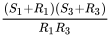
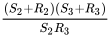


- ^ plus 1 reverse gear
- ^ 3 planetary gearsets (of which 2 gearsets are combined as a Ravigneaux compound gearset), 3 brakes, 2 clutches
- ^ 3 simple planetary gearsets, 3 brakes, 2 clutches
- ^ plus 1 reverse gear
- ^ 4 planetary gearsets (of which 2 gearsets are combined as a Ravigneaux compound gearset), 4 brakes, 3 clutches
- ^ regular bousing for gear 1 to 4 and reverse gear · supplemental housing for gear 5
- ^ hydraulic for gear 1 to 4 and reverse gear · electronic for gear 5
- ^ 3 simple planetary gearsets, 3 brakes, 3 clutches
- ^ electronic
- ^ Differences in gear ratios have a measurable, direct impact on vehicle dynamics, performance, waste emissions as well as fuel mileage
- ^ Layout
(1) Planetary gearset 1 (the inner Ravigneaux gearset) is on the input (turbine) side
(2) Output shaft is carrier 3 (planetary gear carrier of gearset 3)
(3) Output shaft for the W5A 030 is ring 4 (ring gear of gearset 4) - ^ Sun 1: sun gear of gearset 1: inner Ravigneaux gearset
- ^ Ring 1: ring gear of gearset 1: inner Ravigneaux gearset
- ^ Sun 2: sun gear of gearset 2: outer Ravigneaux gearset
- ^ Ring 2: ring gear of gearset 2: outer Ravigneaux gearset
- ^ Sun 3: sun gear of gearset 3
- ^ Ring 3: ring gear of gearset 3
- ^ Sun 4: sun gear of gearset 4
- ^ Ring 4: ring gear of gearset 4
Applications
[edit]The 4G-Tronic has been used in many Mercedes-Benz cars.
W4A 040 I+II (Type 722.3)
[edit]- 1981–1989 R107 and C107
- 1989–1996 R129
| Chassis code | Car model | Engine code |
Transmission code |
Notes |
|---|---|---|---|---|
| 123.026 | 250 | 123.920 123.921 |
722.308 | |
| 123.086 | 250 T | |||
| 123.028 | 250 Lang | |||
| 123.033 | 280 E | 110.984 110.988 |
722.300 722.309 | |
| 123.093 | 280 TE | 722.309 | ||
| 123.053 | 280 CE | 722.300 722.309 | ||
| 123.133 | 300 D Turbo | 617.952 | 722.315 | Only for USA 1982-1985 |
| 123.153 | 300 CD Turbo | |||
| 123.193 | 300 TD Turbo | 722.303 (81-85) 722.315 (82-85) |
Only for USA 1981-1985 |
W4A 028 (Type 722.3)
[edit]- 1990–1995 G-Class 463.
W4A 020 (Type 722.4)
[edit]| Chassis code | Car model | Engine code |
Transmission code |
Notes |
|---|---|---|---|---|
| 123.220 | 200 | 102.920 102.939 |
722.406 | |
| 123.280 | 200 T | |||
| 123.223 | 230 E | 102.980 | 722.401 | |
| 123.283 | 230 TE | |||
| 123.243 | 230 CE | |||
| 123.120 | 200 D | 615.940 | 722.407 | |
| 123.123 | 240 D | 616.912 | 722.404 | |
| 123.183 | 240 TD | |||
| 123.125 | 240 D Lang | |||
| 123.130 | 300 D | 617.912 | 722.405 | |
| 123.190 | 300 TD | |||
| 123.132 | 300 D Lang | |||
| 123.133 | 300 D Turbo | 617.952 | 722.416 | Only for California 1985 |
| 123.153 | 300 CD Turbo | |||
| 123.193 | 300 TD Turbo |
W5A 030 (Type 722.5)
[edit]See also
[edit]
References
[edit]- ^ a b c d e f Hans Joachim Foerster · Automatische Fahrzeuggetriebe · Page 171 and 192 · Berlin and Heidelberg 1991 · Print ISBN 978-3-642-84119-4 · Online ISBN 978-3-642-84118-7
- ^ https://up.picr.de/32855333vn.pdf [bare URL PDF]