


Bombardier ALP-46
| Bombardier ALP-46/ALP-46A | |||||||||||||||||||||||||||||||||||||||||||||
|---|---|---|---|---|---|---|---|---|---|---|---|---|---|---|---|---|---|---|---|---|---|---|---|---|---|---|---|---|---|---|---|---|---|---|---|---|---|---|---|---|---|---|---|---|---|
 NJT ALP-46 4615 pulling into Convent Station in New Jersey. | |||||||||||||||||||||||||||||||||||||||||||||
| |||||||||||||||||||||||||||||||||||||||||||||
| |||||||||||||||||||||||||||||||||||||||||||||
| |||||||||||||||||||||||||||||||||||||||||||||
| |||||||||||||||||||||||||||||||||||||||||||||
| Sources: * ALP-46.[6][7] † ALP46A.[8] except where noted | |||||||||||||||||||||||||||||||||||||||||||||
The Bombardier ALP-46 is an electric locomotive built in Germany by Bombardier between 2001 and 2002 (and 2009–2011 for the ALP-46A) for use in the United States. It is derived from the German Class 101. New Jersey Transit (NJT) is the only railroad to operate this locomotive model, which is used across the electrified NJT system, specifically on the Northeast Corridor, North Jersey Coast, Morris & Essex, and Montclair-Boonton lines. These locomotives replaced the ALP-44 locomotives, which were all retired by 2012.
Orders and delivery[edit]
NJT ordered 29 locomotives: the first 24 ALP-46 locomotives in December 1999[citation needed] and an additional five locomotives in September 2001.[citation needed]
They were built by Bombardier (formerly ADtranz) at their Kassel, Germany plant. The first two locomotives were built as preseries locomotives for testing—4600 was tested on the TTCI test plant in Pueblo, Colorado, 4601 was sent to Kearny for testing on the NJT network. All locomotives were transported via road to the port of Bremen and shipped on Roro-ships of Wallenius Wilhelmsen Logistics to Port Newark-Elizabeth Marine Terminal, New Jersey.
In February 2008, NJT ordered twenty-seven 125 mph (201 km/h) top speed ALP-46A locomotives from Bombardier, which were to haul Bombardier MultiLevel Coaches. The estimated value of the order was €155 million (approximately $230 million).[2] In June 2009, NJT took up an option for a further nine locomotives, and spare parts, at a cost of $72 million.[3]
On November 12, 2009, Bombardier ceremonially handed over the first two completed ALP-46As to New Jersey Transit over at their Kassel plant in Germany.[9]
They arrived on NJT property on December 13. Locomotive 4629 was shipped by rail to a testing facility in Pueblo, Colorado, while 4630 was placed on the rails at the Meadows Maintenance Complex in Kearny for testing on property and maintenance training.[citation needed]
All locomotives were delivered by April 5, 2011, and by of May 7, 2011, all locomotives have entered regular revenue service.[citation needed]
In October 2019, as part of New Jersey Transit's 40th Anniversary, locomotive No. 4636 was wrapped into a Pennsylvania Railroad scheme.[10] In September 2023, locomotive 4640 was wrapped in a heritage disco stripe scheme, in preparation for the 40th Anniversary of NJ Transit Rail Operations.
Variants and operations[edit]
Both the ALP-46 and ALP-46A have been used to haul NJ Transit's Comet IIM, IV, V, and Multilevel fleet.[11] The ALP-46 was also used to pull Amfleet consists on Amtrak's Clocker service in its final days of operation.[12]
ALP-46[edit]
The ALP-46 locomotives produce 7,100 hp (5,300 kW) and are powered by overhead catenary. They can reach a top speed of 100 mph (161 km/h).[1]
The ALP-46 is derived from the DBAG Class 101 locomotive, of which the operating speed is 200 km/h (124 mph).
The locomotives use Bombardier's MITRAC 3000 electric propulsion system. The system consists of a polyol-ester cooled transformer to reduce the catenary voltage which feeds two polyol-ester cooled GTO based traction converters (Bombardier MITRAC TC 3100 AC series). Each traction converter feeds the motors (Bombardier MITRAC DR 3700F series) of one truck.[citation needed]
ALP-46A[edit]
The ALP-46A locomotives use Bombardier's MITRAC 3000 electric propulsion system.[13] The traction converters (Bombardier MITRAC TC 3360 AC series) are from a newer generation based on IGBT technology. The converters are water cooled and have individual inverters for each traction motor (Bombardier MITRAC DR 3700F series).[citation needed] Power at rail is increased to 7,500 hp (5,600 kW) and top speed is increased to 125 miles per hour (201 km/h),[8] though NJ Transit limits them to 100.
Images[edit]
-
 ALP-46 entering South Orange, New Jersey
 -
 NJ Transit train with an ALP-46 leaving South Orange
 -
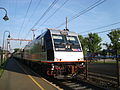 ALP-46A 4629 at Convent Station
 -
 ABB HEP transformer on ALP-46A 4637
 -
 ALP-46A 4636 wearing the PRR heritage scheme
 -
 NJ Transit ALP-46 No. 4653 pulls up to the high level platform at Gladstone Station


See also[edit]
References[edit]
- ^ a b c ALP-46 Electric Locomotive - USA, Bombardier, archived from the original on 2008-11-22, retrieved 2008-09-01
- ^ a b c Bombardier To Supply New Locomotives For NJ Transit, Bombardier, 22 February 2008
- ^ a b c NJ TRANSIT APPROVES PURCHASE OF NEW ELECTRIC LOCOMOTIVES, NJ Transit, 10 June 2009, archived from the original on 16 March 2018, retrieved 24 June 2009
- ^ APPENDIX 7 : Locomotives Comparison of Technical Data (PDF)
- ^ Eisenbahn-Revue (11): 562, 2009, ISSN 1421-2811
{{citation}}: CS1 maint: untitled periodical (link) - ^ NJ Transit ALP-46 Locomotives (4600 - 4628) Operating Instruction Manual [Edition C, September 15, 2003], Bombardier Transportation, 15 September 2003, retrieved 2023-07-13
- ^ † ALP-46A."New power and a new look for New jersey transit - Transit Update", Railway Age, December 2001
- ^ a b New Jersey - Passenger - Electric Locomotive Class ALP-46A (PDF), Bombardier Transportation, archived from the original (PDF) on 2009-03-19, retrieved 2009-03-07
- ^ "Bombardier hands over first ALP-46A", www.railwaygazette.com, 13 November 2009
- ^ "NJ Transit provides more details on heritage units | Trains Magazine". Archived from the original on 2019-12-11. Retrieved 2020-03-23.
- ^ "NJT HD: Four And A Half Windy Hours At Princeton Junction Station (New Jersey Transit + Amtrak)", www.youtube.com An assortment of ALP-46s and ALP-46As hauling Comet cars and Multilevels
- ^ "Last Amtrak Clockers October 28, 2005", www.youtube.comAn ALP-46 4610 Hauling one of the last Amtrak Clockers
- ^ MITRAC 3000 (references), Bombardier, archived from the original on 7 March 2011, retrieved 1 October 2017
Literature[edit]
- Schwendt, L. (2001). "New electric high speed locomotives with three phase drive systems for the US market". Proceedings of the 2001 IEEE/ASME Joint Railroad Conference (Cat. No.01CH37235). pp. 53–70. doi:10.1109/RRCON.2001.921751. ISBN 0-7803-7085-6. S2CID 108622866.
External links[edit]

- Bombardier ALP-46(A)
- New Jersey Transit
- Bombardier ALP-46 Electric Locomotive - USA
- NJ Transit ALP-46 Locomotives (4600–4628) Operating Instruction Manual
| Hoboken Division |  | |
|---|---|---|
| Newark Division | ||
| Connections | ||
| Current rolling stock | ||
| Bridges and tunnels |
| |
| Stations and yards | ||
| Proposed lines | ||
| Other topics | ||