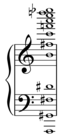
Added tone chord


An added tone chord, or added note chord, is a non-tertian chord composed of a triad and an extra "added" note. Any tone that is not a seventh factor is commonly categorized as an added tone. It can be outside the tertian sequence of ascending thirds from the root, such as the added sixth or fourth, or it can be in a chord that doesn't consist of a continuous stack of thirds, such as the added thirteenth (six thirds from the root, but the chord doesn't have the previous tertian notes – the seventh, ninth or eleventh). The concept of added tones is convenient in that all notes may be related to familiar chords.[3]
Inversions of added tone chords where the added tone is the bass note are usually simply notated as slash chords instead of added-tone chords. For example, instead of Cadd2/D, just C/D is used.
An added tone such as fourth voiced below the root may suggest polytonality.[4] The practice of adding tones may have led to superimposing chords and tonalities, though added tone chords have most often been used as more intense substitutes for traditional chords.[3] For instance a minor chord that includes a major second factor holds a great deal more dramatic tension due to the very close interval between the major second and minor third.[citation needed] Igor Stravinsky's polytonal Symphony of Psalms contains many added tone chords.[4]
Mixed third chords[edit]


ⓘ ⓘ
A mixed third chord, also split-third chord,[6] includes both the major and minor thirds (e.g. C–E♭–E♮–G), although the thirds are usually separated by an octave or more.[4] A minor chord above a major chord of the same root has a diminished octave (major seventh) separating the thirds and is more common, while a major chord above a minor chord of the same root has a very dissonant augmented octave (minor ninth) separating the thirds and is not as commonplace. Paul McCartney's "Maybe I'm Amazed" is an example of the use of a split-third chord,[5] as are many of William Schuman's symphonies.[4] It is also suggested by the final note and chord of "A Hard Day's Night".[5]
Mixed thirds caused by blue notes in blues, country music and rock music can be thought to form mixed third chords, such as in "Rock And Roll Music". The dominant seventh sharp ninth chord's major third and augmented ninth are enharmonically equivalent to a minor-over-major chord's thirds, and the two can be somewhat interchangeable. Songs with a 7♯9 chord include "Purple Haze" and "Boogie Nights".[5]
Other added tone chords[edit]
Examples of the added-second chord or added-ninth chord (notated "add2", "2" or "add9") in popular music include The Rolling Stones' "You Can't Always Get What You Want", Mr. Mister's "Broken Wings", Don Henley's "The End of the Innocence", The Police's "Every Breath You Take", Cheap Trick's "The Flame", Lionel Richie's "All Night Long (All Night)", Men at Work's "It's a Mistake", DeBarge's "Rhythm of the Night", Starship's "We Built This City", Deniece Williams' "Let's Hear It for the Boy",[2] and The Beatles' "A Hard Day's Night".[5] The jazz rock group Steely Dan popularized a particular voicing of the add2 chord they dubbed the mu chord.
The added-fourth chord (notated "add4") almost always occurs on the fifth scale degree where the added note is the key's tonic note. Examples in popular music include the second chord in the verse of "Runaway Train" and the introduction of The Who's "Baba O'Riley".[2]

The added-sixth chord (notated "6") is rarely inverted since it shares its notes with a seventh chord a minor third down (e.g. C6 has the same notes as an Am7), although a counterexample is The 5th Dimension's recorded version of "Stoned Soul Picnic" (on 5).[7] It's used only occasionally in rock and popular music,[2] but examples include the third measure of The Beatles' "A Hard Day's Night", the second chord of "You Keep Me Hangin' On", the third of "The Eagle And The Hawk", and The Beatles' "She Loves You".[2] When added at the suggestion of Harrison, producer George Martin described the chord as old-fashioned sounding.[2] An added-sixth chord ends songs including Hank Williams' "Hey Good Lookin'",[7] Chuck Berry's "Rock and Roll Music",[7] Sam Cooke's "You Send Me",[7] and The Beatles' "She Loves You".[7]
See also[edit]
References[edit]
- ^ Hawkins, Stan (Oct 1992). "Prince – Harmonic Analysis of 'Anna Stesia'". Popular Music. 11 (3): 325–335. doi:10.1017/s0261143000005171.
- ^ a b c d e f Stephenson, Ken (2002). What to Listen for in Rock: A Stylistic Analysis. p. 85. ISBN 978-0-300-09239-4.
- ^ a b Jones, George (1994). HarperCollins College Outline Music Theory, p.50. ISBN 0-06-467168-2.
- ^ a b c d Marquis, G. Welton (1964). Twentieth Century Music Idioms. Englewood Cliffs, New Jersey: Prentice-Hall, Inc. ISBN 0-313-22624-5.
- ^ a b c d e Stephenson (2002), p.84.
- ^ a b Kostka & Payne (1995). Tonal Harmony, p.494. Third Edition. ISBN 0-07-035874-5.
- ^ a b c d e Everett, Walter (2009). The Foundations of Rock. p. 195. ISBN 978-0-19-531023-8.