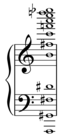
Borrowed chord

3 = F–A♭-B-D) in J.S. Bach's Prelude No. 1 in C major from The Well-Tempered Clavier
A borrowed chord (also called mode mixture,[1] modal mixture,[2] substituted chord,[3] modal interchange,[1] or mutation[4]) is a chord borrowed from the parallel key (minor or major scale with the same tonic). Borrowed chords are typically used as "color chords", providing harmonic variety through contrasting scale forms, which are major scales and the three forms of minor scales.[2] Chords may also be borrowed from other parallel modes besides the major and minor mode, for example D Dorian with D major.[1] The mixing of the major and minor modes developed in the Baroque period.[5]
Borrowed chords are distinguished from modulation by being brief enough that the tonic is not lost or displaced, and may be considered brief or transitory modulations[3] and may be distinguished from secondary chords[6] as well as altered chords.[1] According to Sheila Romeo, "[t]he borrowed chord suggests the sound of its own mode without actually switching to that mode."[1]
Common borrowed chords[edit]
![{
#(set-global-staff-size 14.2)
\set Score.proportionalNotationDuration = #(ly:make-moment 1/7)
<<
\new PianoStaff <<
\new Staff <<
\clef treble \key a \major \time 3/4
\set Score.currentBarNumber = #13
\bar ""
\new Voice \relative c'' {
\set Score.tempoHideNote = ##t \tempo 4 = 60
cis8.( d64 cis b cis) e8( d b gis)
a8.( cis32 a) g'2
eis32([ fis gis fis] e[ d cis b)] a16-.[ cis-. e8.] e,16( fis gis)
b4( a8)
}
>>
\new Staff <<
\clef treble \key a \major \time 3/4
\new Voice \relative c' {
<ais g'>4(_\markup { \concat { \translate #'(-7 . 0) { "A: vii" \raise #1 \small "o7" "/ii" \hspace #7 "ii" \hspace #1.8 "vii" \raise #1 \small "o" \combine \raise #1 \small 4 \lower #1 \small 3 \hspace #1.8 "I" \raise #1 \small "6" \hspace #4 "vii" \raise #1 \small "o" \combine \raise #1 \small 6 \lower #1 \small 5 "/ii" \hspace #7 "ii" \raise #1 \small "6" \hspace #13 "I" \raise #1 \small "6" \hspace #3.7 "V" \raise #1 \small "7" \hspace #5 "I" } } }
<b fis'> <d f>
<cis e>) r8 <cis ais'>8( <d b'> <e cis'>)
<d b'>8 r \clef bass <e, cis'> r <e d'> r
<a_~ d>4( <a cis>8)
}
>> >>
>> }](http://upload.wikimedia.org/score/9/i/9i3zteh33d4njo36ponsmouy31e2ea9/9i3zteh3.png)
Sheila Romeo explains that "[i]n theory, any chord from any mode of the scale of the piece is a potential modal interchange or borrowed chord. Some are used more frequently than others, while some almost never occur."[1]
In the minor mode, a common borrowed chord from the parallel major key is the Picardy third.
In the major mode, the most common examples of borrowed chords are those involving the ♭ , also known as the lowered sixth scale degree. These chords are shown below, in the key of C major.[8]
|
 |
The next most common involve the ♭ and ♭
and ♭ . These chords are shown below.[9]
|
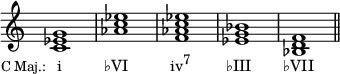 |


Chord progressions may be constructed with borrowed chords, including two progressions common in rock music, I–♭VII–♭VI–♭VII, common everywhere, and I–♭VI–IV (ⓘ), used by bands like Genesis, Yes, and Nirvana.[1] ♭VII is from Mixolydian and ♭VI is found in both Aeolian and Phrygian.[1] The ♭VII–I cadence with ♭VII substituting for V is common, as well as ♭II–I, ♭III–I, and ♭VI–I.[11] In popular music, the major triads on the lowered third (♭III), sixth (♭VI) and seventh (♭VII) scale degrees are common.
Borrowed chords have typical inversions or common positions, for example iio6 and iiø6
5, and progress in the same manner as the diatonic chords they replace except for ♭VI, which progresses to V(7).[2]
See also[edit]
- Aeolian harmony – Musical mode
- Diatonic function – Musical term
- Harmonic major – Musical scale
References[edit]
- ^ a b c d e f g h i Romeo, Sheila (1999). Complete Rock Keyboard Method: Mastering Rock Keyboard, p. 42. ISBN 0-88284-982-4. Bouchard, Joe and Romeo, Sheila (2007). The Total Rock Keyboardist, p. 120. Alfred Music. ISBN 9780739043127.
- ^ a b c Benward & Saker (2009), p. 71.
- ^ a b White, William Alfred (1911). Harmonic Part-writing, p. 42. Silver, Burdett, & Co. [ISBN unspecified].
- ^ Kostka, Stefan; Payne, Dorothy (2004). Tonal Harmony (5th ed.). Boston: McGraw-Hill. p. 343. ISBN 0072852607. OCLC 51613969.
- ^ Benward & Saker (2009), p. 74.
- ^ Sorce, Richard (1995). Music Theory for the Music Professional, p. 332. Scarecrow Press. ISBN 9781461664208.
- ^ Benward & Saker (2009). Music in Theory and Practice, Vol II, p. 75. 8th edition. McGraw Hill. ISBN 978-0-07-310188-0.
- ^ Kostka, p. 344.
- ^ Kostka, pp. 346–347.
- ^ Cooper, Paul (1975). Perspectives in Music Theory, p. 216. New York: Dodd, Mead, and Company. ISBN 0-396-06752-2. Original with Roman numeral analysis only.
- ^ Romeo (1999), p. 43.
External links[edit]
- "Modal Interchange in La Fille aux Cheveux de lin by Claude Debussy" on YouTube
- "Modal Interchange in Pop Songs" on YouTube
- "Mode Mixture", Robert J. Frank (2000), Theory on the Web.
- "Modal Interchange Examples in the Music of Stevie Wonder" part 2 on YouTube and part 1 on YouTube
- "Glossary: Terms Used in Writing Skills", Berklee.
- Mike Campese. Guest Column: "Modal Interchange", Guitar Nine Records.
- "Altered Chords in Jazz: Modal Interchange 0 –Altered Chords", Taming the Saxophone.