


Albanian Orthodox Church
 Orthodox Church of Albania | |
|---|---|
| Autocephalous Orthodox Church of Albania Kisha Ortodokse Autoqefale e Shqipërisë | |
 | |
| Primate | Archbishop Anastasios of Albania |
| Bishops | 6 |
| Priests | 135 |
| Parishes | 911 |
| Monasteries | 150 |
| Language | |
| Headquarters | Resurrection Cathedral, Tirana, Albania |
| Territory | Albania and Albanian diaspora |
| Founder | Theofan Stilian Noli |
| Independence | 17 September 1922[1] |
| Recognition | Autocephaly recognised in 1937 by the Ecumenical Patriarchate of Constantinople. |
| Separated from | Ecumenical Patriarchate of Constantinople |
| Members | 500,000[2]-700,000-800,000[3] (claimed), number much higher when diaspora is considered. |
| Official website | orthodoxalbania |
| Part of a series on the |
| Eastern Orthodox Church |
|---|
 |
| Overview |
The Autocephalous Orthodox Church of Albania (Albanian: Kisha Ortodokse Autoqefale e Shqipërisë), commonly known as the Albanian Orthodox Church or the Orthodox Church of Albania, is an autocephalous Eastern Orthodox church. It declared its autocephaly in 1922 through its Congress of 1922, and gained recognition from the Patriarch of Constantinople in 1937.
The church suffered during the Second World War, and in the communist period that followed, especially after 1967 when Albania was declared an atheist state, and no public or private expression of religion was allowed.
The church has, however, seen a revival since religious freedom was restored in 1991, with more than 250 churches restored or rebuilt, and more than 100 clergy being ordained. It has 909 parishes spread all around Albania, and around 500,000 to 550,000 faithful.[2] The number is claimed to be as high as 700,000 by some Orthodox sources – and higher when considering the Albanian diaspora.[4][5]
History
[edit]The Christian religious vocabulary of Albanian is mostly Latin, including even the basic terms such "to bless", "altar," and "to receive communion". It indicates that Albanians were Christianized under the Latin-based liturgy and ecclesiastical order which would be known as "Roman Catholic" in later centuries.[6] Ecclesiastically, Christians in Albania, as part of the province of Illyricum, were under the jurisdiction of the Bishop of Rome (2nd-8th century).[7] From 732 to 733 AD the ecclesiastical jurisdiction of Illyricum was transferred to the Ecumenical Patriarchate of Constantinople.[8][7] The Great Schism of 1054 formalized the split of Christianity into two branches, Catholicism and Orthodoxy, which was reflected in Albania through the emergence of a Catholic north and Orthodox south.[7]
Orthodox Church during the Ottoman Period
[edit]The official recognition of the Eastern Orthodox Church by the Porte resulted in the Orthodox population being tolerated until the late 18th century.[9][10][11] The Orthodox population of Albania was integrated into the Patriarchate of Constantinople, with the population of central and south-eastern Albania being under the ecclesiastical jurisdiction of the Orthodox Archbishopric of Ohrid, and the population of south-western Albania being under the ecclesiastical jurisdiction of the Metropolis of Ioannina.[12][13]
During the late eighteenth century, the poverty of the Orthodox Church, the illiterate clergy, a lack of clergy in some areas, liturgy in a language other than Albanian[9][14][15][16] and the reliance of the bishoprics of Durrës and southern Albania upon the declining Archbishopric of Ohrid, due in part to simony, weakened the faith among the church's adherents and reduced the ability for Orthodox Albanians to resist conversion to Islam.[14][15]
By the mid-19th century, due to the Tanzimat reforms which imposed mandatory military service on non-Muslims, the Orthodox Church lost adherents as the majority of Albanians became Muslim.
Movement for establishing an autocephalous Albanian Orthodox Church
[edit]
In the 19th century, Orthodox Albanians under the Patriarchate of Constantinople had liturgy and schooling in Greek, which was also the lingua franca in the South,[17] and in the late Ottoman period their political thinking was divided: although most Orthodox Christians wished for the end of Ottoman rule, some of them - especially the upper class - desired to be part of a Greek state, some sought Greek-Albanian cooperation and a Greek-Albanian federation state or dual monarchy, and some who sought Albanian statehood.[18][17][19] For Orthodox Albanians, Albanianism was closely associated with Hellenism, linked through the faith of Orthodoxy, however during the Eastern crisis this premise was rejected by some Albanian Orthodox because of the growing competition between the Albanian and Greek national movements over parts of Epirus.[20][21][22] These issues also generated a reaction against Greek nationalists that drove the Albanian desire to stress a separate cultural identity.[21][23]
The religious division among Albanians meant that Albanian nationalism could not be based on religion and instead Albanian nationalism as it developed tended to promote interreligious cooperation, from the point of its inception[24] in the writings of Naum Veqilharxhi.[25] Although the Orthodox were a minority among Albanians, the Albanian nationalist movement began among the Orthodox, and subsequently spread to other religious communities among Albanians.[26] Orthodox Albanians especially in the diaspora[27] and from Korçë and its nearby regions began to affiliate with the movement by working together with Muslim Albanians regarding shared socio-geopolitical Albanian interests and aims, causing concerns for Greece[28][29][30] because it threatened the aspirations to incorporate Epirus into Greece, and because those Greeks who sought an Albanian-Greek confederation took a negative view of other foreign influences among Albanians.[31] Although Greek schools were for a while the only way Orthodox children could become educated and at Greek schools children where they were exposed to Greek nationalism, Orthodox Albanians would instead come to play an active and often leading role in the Albanian national independence movement, often at great cost to themselves and their families.[32]
At the onset of the twentieth century, the idea to create an Albanian Orthodoxy or an Albanian expression of Orthodoxy emerged in the diaspora at a time when the Orthodox were increasingly being assimilated by the Patriarchate and Greece through the sphere of politics.[20] As Orthodoxy was associated with the Greek identity, the rise of the movement caused confusion for Orthodox Albanians as it interrupted the formation of a Greek national consciousness.[33] The Orthodox Albanian community had individuals such as Jani Vreto, Spiro Dine and Fan Noli involved in the national movement, of which some advocated for an Albanian Orthodoxy in order to curtail the Hellenisation process occurring amongst Orthodox Albanians.[34][35] In 1905, priest Kristo Negovani introduced Albanian liturgy for Orthodox worship in his native Negovan for the first time,[36][37][38] for which he was murdered by Greek andartes on behalf from Bishop Karavangelis of Kastoria, leading to the retaliatory murder of the Metropolitan of Korçë, Photios, who opposed the Albanian national movement.[39][37][36][38] In 1907, Orthodox Albanian immigrant Kristaq Dishnica was refused funeral services in the United States by a local Orthodox Greek priest for being an Albanian involved in nationalist activities.[40] Known as the Hudson incident, it galvanised the emigre Orthodox Albanian community to form the Albanian Orthodox Church under Fan Noli who hoped to counter Greek irredentism.[40][41][42][34]

On March 18, 1908, as a result of the Hudson incident, Fan Noli was ordained as a priest by Russian bishop Platon in the United States.[43][44][45][46] Noli conducted the Orthodox liturgy (March 1908) for the first time among the Albanian-American community in Albanian. Noli also devoted his efforts toward translating the liturgy into Albanian and emerging as a leader of the Orthodox Albanian community in the US. In 1911 he visited the Orthodox Albanian diasporas in Romania, Ukraine and Bulgaria.[43]
Autocephaly and statutes
[edit]
After Albanian independence in 1912, Fan Noli, who in 1924 would become an important political figure and prime minister of the nation, traveled to Albania, where he played an important role in establishing the Orthodox Albanian Church.[43] On September 17, 1922, the first Orthodox Congress convened at Berat formally laid the foundations of an Albanian Orthodox Church and declared its autocephaly.[40][47][48][1] Fan Noli was consecrated as Bishop of Korçë and primate of Albania, while the establishment of the Church was seen as an important development for maintaining Albanian national unity.[40][47][48] At the end of the congress the first statute of the church was approved.[49]
The church had a second statute that amended the First Statute in a second congress gathered in Korçë on June 29, 1929.[50] Also on September 6, 1929, the first Regulation of General Administration of the Church was approved.[51] The Patriarchate in Constantinople recognised the independence or autocephaly of the Orthodox Albanian Church in 1937.[40]
On November 26, 1950, the Parliament of Albania approved the Third Statute that abrogated the 1929 Statute. Such new statute required Albanian citizenship for the primate of the church in (article 4). With the exception of the amendments made in 1993, this statute is still in force for the church.[52]
On January 22 - June 1 - July 22, 1993, the 1950 statute was amended and in 1996 was approved by the then-president, Sali Berisha. In particular, article 4 of the 1950 statute, which required Albanian citizenship for primate of the church, was no longer so.
On November 3 and 4, 2006, at the new Monastery of St. Vlash in Durrës, there was a special Clergy-Laity Assembly of the Orthodox Autocephalous Church of Albania, attended by 257 representatives (including all clergy members). At this Assembly the New Constitution (Statute) of the Church was analyzed and accept unanimously. On November 6, 2006, the Holy Synod approved this Constitution (Statute). On November 24, 2008, the Orthodox Autocephalous Church of Albania and the Council of Ministers signed an agreement according to the 1998 Albanian Constitution, for the arrangement of their reciprocal relationship. The agreement was ratified by the Albanian Parliament, and became law (nr.10057) on January 22, 2009.[53]
Archbishops
[edit]The Primate of the Orthodox Autocephalous Church of Albania is also the Archbishop of Tirana and Durrës. The current archbishop of Tirana is Archbishop Anastasios of Albania.
| No. | Portrait | Name | Term in office | |
|---|---|---|---|---|
| Unrecognised Autocephaly (1929 – 1937) | ||||
| 1 | .jpg)
|
Vissarion (1890–1965) .svg)
|
20 February 1929 | 26 May 1936 |
| 7 years, 3 months and 6 days | ||||
| Recognised Autocephaly (1937 –) | ||||
| 2 | .jpg)
|
Kristofor (1881–1958) .svg)
|
12 April 1937 | 25 August 1949 |
| 12 years, 4 months and 13 days | ||||
| 3 | 
|
Paisi (1881–1966) .svg)
|
25 August 1949 | 4 March 1966 |
| 16 years, 6 months and 7 days | ||||
| 4 | 
|
Damian (1886–1973) .svg)
|
April 1966 | 13 November 1967 |
| 9 months and 16 days | ||||
| Vacant during Communist Era (1967 – 1992) | ||||
| 5 | .jpg)
|
Anastasi (1929) .svg)
|
11 July 1992 - 1 June 1993 - 22 July 1993 | Incumbent |
| 32 years, 3 months and 21 days | ||||
Persecution
[edit]The church greatly suffered during the dictatorship of Enver Hoxha as all churches were placed under government control, and land originally held by religious institutions were taken by the state. Religion in schools was banned. Similarly, Hoxha propagated that Albania was threatened by religion in general, since it served as the supposed "Trojan Horse" of the interests of the country's traditional enemies; in particular Orthodoxy (those of Greece and Serbia).[54] In 1952 Archbishop Kristofor was discovered dead; most believed he had been killed.
In 1967 Hoxha closed down all religious buildings in the country, and declared Albania the world's first atheist country. All expression of religion, public or private, was outlawed. Hundreds of clergy were killed or imprisoned. As a result of this policy, a total of 600 Orthodox churches were demolished (1,600 present in 1944). Other buildings of the Orthodox community forcibly seized their religious function.[55]
Revival of the church
[edit]At the end of the communist rule, when religious freedom was restored, only 22 Orthodox priests remained alive. To deal with this situation, the Ecumenical Patriarch appointed Anastasios to be the Patriarchal Exarch for the Albanian Church. As Bishop of Androusa, Anastasios was dividing his time between his teaching duties at the University of Athens and the Archbishopric of Irinoupolis in Kenya, which was then going through a difficult patch, before his appointment. He was elected on June 24, 1992, and enthroned on August 2, 1992.[56] Over time Anastasios has gained respect for his charity work and is now recognized as a spiritual leader of the Orthodox Church in Albania.
Orthodox parishes with active liturgical lives have been established in a majority of cities and villages. Liturgical, preaching, and catechism ministries have been expanded, increasing the participation of both clergy and laity. Several groups have been organized to assist the church with its ministries: the Orthodox Women, and Orthodox Intellectuals. The moral and spiritual strength offered through the cultivation of a sound religious life is contributing decisively to the general progress of the Albanian society.
Most parishes use the Albanian language in liturgy, while Greek is also partly used. In Greek minority areas the liturgy is accordingly celebrated in Greek.[57]
New clergy and ecclesiastical and theological education
[edit]The church has prepared a new generation of clergy. Anastasios started a seminary in 1992, initially in a disused hotel, which was relocated to its own buildings at Shën Vlash in 1996, 15 kilometres from the port of Durrës. As of February 2011, there were 145 clergy members, all of which were Albanian citizens who graduated from the Resurrection of Christ Theological Academy. This academy is also preparing new members (men and women) for catechism and for other services in different church activities.
Meanwhile, students are continuing their theological educations in well-known theological universities abroad.[58]
Two ecclesiastical high schools for boys were opened – the "Holy Cross" in Gjirokastër in 1998, and the "Holy Cross" in Sukth of Durrës in 2007.
New and reconstructed churches
[edit]
So far, 150 new churches have been built, 60 monasteries and more than 160 churches have been repaired.[59] Many buildings have been built, and others have been bought and reconstructed for various purposes (such buildings, numbering 70, include: preschools, schools, youth centers, health centers, metropolitan sees, hospitality homes, workshops, soup kitchens, etc.). In total there have been roughly 450 building projects. Through its construction projects and provision of jobs, the Orthodox Church is contributing to the economic development of the nation and is one of the most serious investors in the country, offering work for many local builders and dozens of workers. Since 1995, the church has put on an architecture course from time to time, each year giving more than 40 young people instruction in various aspects of ecclesiastical construction and architecture.
Media and publishing
[edit]The Orthodox Church of Albania has its own radio station, named "Ngjallja" (Resurrection) which 24 hours a day broadcasts spiritual, musical, informative and educational programmes and lectures, and has a special children's programme.[60]
A monthly newspaper with the same name, Ngjallja, is published, as well as a children's magazine Gëzohu ("Rejoice"), the magazine of the Orthodox Youth Kambanat ("Bells"), the student bulletin Fjala ("Word"), the news bulletin News from Orthodoxy in Albania (published in English), Tempulli ("Temple") and Kërkim ("Searching/Research"), which contain cultural, social and spiritual materials, Enoria Jonë ("Our Parish").
As of February 2008, more than 100 books with liturgical, spiritual, intellectual and academic topics have been published.[61]
Social activities
[edit]The Orthodox Church in Albania has taken various social initiatives. It started with health care, organising "The Annunciation" Orthodox Diagnostic Center in Tirana in 1999, with some of Albania's most renowned doctors and administers health care and most contemporary health services in 23 different specialties; four medical clinics, and one mobile dental clinic. The office "Service of Love" (Diakonia Agapes) contributes to the increasing of midwives' and nurses' roles, offering training projects and assistance.[62]
The Orthodox Autocephalous Church of Albania made extensive humanitarian contributions during the political and social crises (1992, 1994, 1997), collecting and distributing thousands of tons of food, clothing and medicine. In addition, it supported a wide range of social programs including: development projects in mountainous regions, especially in the areas of agriculture and farming; road construction; amelioration of water supplies; educational programs on health for children; construction of rural health centers and contributions for schools, orphanages, hospitals, institutes for the disabled, elderly homes, prisons (i.e. financed by the church, where would prisoners work and receive income accordingly), sports grounds, soup kitchens for the poor, and many more.[60]
During 1999, when Albania accepted waves of refugees from Kosovo, the Orthodox Autocephalous Church of Albania, in collaboration with donors and other international religious organizations (especially ACT and WCC), led an extensive humanitarian program of more than $12 million, hosting 33,000 Kosovars in its two camps, supplying them with food, clothes, medical care and other goods.
Apart from the two ecclesiastical high schools, it has established three elementary schools (1st – 9th grade), 17 day-care centers and two institutes for professional training (named "Spirit of Love", established in Tirana in 2000) which are said to be the first of their kind in Albania and provide education in the fields of Team Management, IT Accounting, Computer Science, Medical Laboratory, Restoration and Conservation of Artwork and Byzantine Iconography.[60] In Gjirokastër, 1 professional school, the orphanage "The Orthodox Home of Hope", a high school dormitory for girls, has also given technical and material support to many public schools.
An environmental programme was started in 2001.[60]
An Office of Cultural Heritage was established to look after the Orthodox structures considered to be national cultural monuments. A number of choirs have been organized in the churches. A Byzantine choir has also been formed and has produced cassettes and CDs. A workshop for the restoration and painting of icons was established with the aim to train a new generation of artists, to revive the rich tradition of iconography. The Church has also sponsored important academic publications, documentary films, academic symposiums and various exhibits of iconography, codex, children's projects and other culturally related themes.
The Orthodox Autocephalous Church of Albania actively participates as equals in the events of the Orthodox Church worldwide. It is a member of the Conference of the European Churches (of which the Archbishop Anastasios has served as vice-president since December 2003), the World Council of the Churches (of which Archbishop Anastasios was chosen as one of eight presidents in 2006), and the largest inter-faith organization in the world, "Religions for Peace" (of which Anastasios was chosen as Honorary President in 2006). It is also active in various ecumenical conferences and programs. The Orthodox Autocephalous Church of Albania contributes to the efforts for peaceful collaboration and solidarity in the region and beyond.
Administration and Holy Synod
[edit]
The Holy Synod of Bishops was established in 1997, and is currently composed of:[63]
- Archbishopric of Tirana-Durrës: Archbishop Anastasios of Albania (1992-), head of the Holy Synod
- Metropolis of Berat, Kaninë and Vlorë: vacant since the passing of His Grace Ignati of Berat (1997-2024)
- Metropolis of Korçë: Joan Pelushi (1999-)
- Metropolis of Gjirokastër, Sarandë and Himarë: Dhimitër of Gjirokastër (2004-)
- Metropolis of Elbasan, Shpat and Librazhd: Andon (2017-)
- Metropolis of Apollonia and Fier: Nikolla of Apollonia (2014-)
- Metropolis of Amantia: Nathanail (2017-)
- Titular Diocese of Byllis: Asti of Byllis (2012-)
- General Secretary Protopresbyter: Fr. Jani Trebicka
Gallery
[edit]-
 Church in Berat
 -
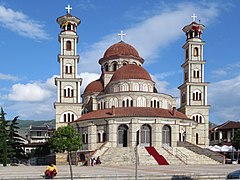 Church in Korçë. The Albanian Orthodox Flag Can be Seen Flown on the left Tower.
 -
 Orthodox church in Pogradec
 -
 Orthodox cathedral in Durrës
 -

-

-
-

-

-
 Church Synod

.jpg)


.jpg)
_korr2.jpg)


See also
[edit]References
[edit]Citations
[edit]- ^ a b "Archived copy" (PDF). Archived from the original (PDF) on 2011-07-16. Retrieved 2009-12-28.
{{cite web}}: CS1 maint: archived copy as title (link) - ^ a b John Anthony McGuckin (28 December 2010). The Orthodox Church: An Introduction to Its History, Doctrine, and Spiritual Culture. John Wiley & Sons. p. 72. ISBN 978-1-4443-3731-0. Retrieved 8 June 2012.
The Orthodox currently represent about half a million faithful, worshipping in 909 parishes.
- ^ CNEWA - Autocephalous Orthodox Church of Albania Archived 2008-01-26 at the Wayback Machine
- ^ "Kryesore". Archived from the original on 2016-04-07. Retrieved 2015-09-05.
- ^ "Albanian Orthodox".
- ^ De Vaan, Michiel (2018). "The phonology of Albanian". In Klein, Jared; Joseph, Brian; Fritz, Matthias (eds.). Handbook of Comparative and Historical Indo-European Linguistics. Walter de Gruyter GmbH & Co KG. pp. 1732–1749. ISBN 978-3-11-054243-1.
- ^ a b c Ramet 1998, p. 202.
- ^ Ekonomou Andrew J.. Byzantine Rome and the Greek Popes: Eastern Influences on Rome and the Papacy from Gregory the Great to Zacharias, A.D. 590-752. Roman Studies: Interdisciplinary Approaches. Lexington Books, 2007, ISBN 9780739133866, p. 275
- ^ a b Lederer 1994, pp. 333–334.
- ^ Ramet 1998, p. 203. "The Ottoman conquest between the end of the fourteenth century and the mid-fifteenth century introduced a third religion – Islam - but the Turks did not at first use force in its expansion, and it was only in the 1600s that large-scale conversion to Islam began – chiefly, at first, among Albanian Catholics."; p.204. "The Orthodox community enjoyed broad toleration at the hands of the Sublime Porte until the late eighteenth century."; p. 204. "In the late eighteenth century Russian agents began stirring up the Orthodox subjects of the Ottoman empire against the Sublime Porte. In the Russo-Turkish wars of 1768-74 and 1787-91 Orthodox Albanians rose against the Turks. In the course of the second revolt the "New Academy" in Voskopoje was destroyed (1789), and at the end of the second Russo-Turkish war more than a thousand Orthodox fled to Russia on Russian warships. As a result of these revolts, the Porte now applied force to Islamicize the Albanian Orthodox population, adding economic incentives to provide positive stimulus. In 1798 Ali Pasha of Janina led Ottoman forces against Christian believers assembled in their churches to celebrate Easter in the villages of Shen Vasil and Nivica e Bubarit. The bloodbath unleashed against these believers frightened Albanian Christians in other districts and inspired a new wave of mass conversions to Islam."
- ^ Ergo 2010, p. 26.
- ^ Ergo 2010, p. 37.
- ^ Giakoumis 2010, pp. 79–81.
- ^ a b Skendi 1967a, pp. 10–13.
- ^ a b Skendi 1956, pp. 316, 318–320.
- ^ Giakoumis 2010, pp. 86–87.
- ^ a b Skoulidas 2013. para. 2, 27.
- ^ Islami, Selim (1984). Historia e Shqiperise (in Albanian). Vol. 2, part 4. Academy of Sciences of Albania. p. 145.
- ^ Skendi 1967a, p. 174. "The political thinking of the Orthodox Albanians was divided into two categories. Those who lived in Albania were dominated by Greek influence. The majority of them- especially the notables-desired union with Greece. The Orthodox Christians in general had an intense hatred of Ottoman rule. Although this feeling was shared by their co-religionists who lived in the colonies abroad, their political thinking was different."
- ^ a b Clayer 2005b, pp. 217.
- ^ a b Puto & Maurizio 2015, p. 176."However, Greek nationalism continued to be a source of concern for Albanian nationalists later on in the century. After the creation of the Greek state in 1830, and in the light of its mounting expansionist ambitions in the second half of the nineteenth century, the Albanian desire to assert a separate cultural identity represented also a reaction against Greek nationalists, who coveted territories inhabited by Albanians in the Ottoman Balkans, especially in the fiercely contested vilayet of Yiannina, a province containing a mixture of different populations."
- ^ Malcolm 2002, pp. 77–79.
- ^ De Rapper 2009, p. 7.
- ^ Duijzings, Ger. "Religion and the Politics of 'Albanianism'". In Schwandler-Stevens and Jurgen, Albanian Identities: Myth and History. Pages 61-62. Page 62: "nationalist rhetoric declared it [religion/millet] to be unimportant (and that religious fanaticism to be alien to the Albanian soul)", page 61:"From the beginning, national ideologists propagated a kind of 'civil religion' of Albanianism, which was epitomized in Pashko Vasa's famous and influential nationalist poem O moj Shqipni ("O poor Albania"): "Awaken, Albanians, wake from your slumber. Let us all be brothers, swear an oath not to mind church or mosque. The faith of the Albanian is Albanianism!'"
- ^ Meksi, Fedhon. "Veqilharxhi, babai I alfabetit edhe abetares shqiptare". 21 October 2011.
- ^ Enis Kelmendi (2014). "Religion in Regard to Albanian National Movement". ISSN 2308-0825.
- ^ Babuna 2004, pp. 294–295. "The Orthodox nationalists were mainly active outside the Ottoman Empire. They made their greatest contribution to the national cause (mainly educational and propaganda work) through the Albanian colonies."
- ^ Vickers 2011, pp. 60–61. "The Greeks too sought to curtail the spread of nationalism amongst the southern Orthodox Albanians, not only in Albania but also in the Albanian colonies in America."
- ^ Skendi 1967a, pp. 175–176, 179.
- ^ Kokolakis 2003, p. 91. "Περιορίζοντας τις αρχικές του ισλαμιστικές εξάρσεις, το αλβανικό εθνικιστικό κίνημα εξασφάλισε την πολιτική προστασία των δύο ισχυρών δυνάμεων της Αδριατικής, της Ιταλίας και της Αυστρίας, που δήλωναν έτοιμες να κάνουν ό,τι μπορούσαν για να σώσουν τα Βαλκάνια από την απειλή του Πανσλαβισμού και από την αγγλογαλλική κηδεμονία που υποτίθεται ότι θα αντιπροσώπευε η επέκταση της Ελλάδας. Η διάδοση των αλβανικών ιδεών στο χριστιανικό πληθυσμό άρχισε να γίνεται ορατή και να ανησυχεί ιδιαίτερα την Ελλάδα." "[By limiting the Islamic character, the Albanian nationalist movement secured civil protection from two powerful forces in the Adriatic, Italy and Austria, which was ready to do what they could to save the Balkans from the threat of Pan-Slavism and the Anglo French tutelage that is supposed to represent its extension through Greece. The dissemination of ideas in Albanian Christian population started to become visible and very concerning to Greece]."
- ^ Kofos, Evangelos. "Greek reaction to developments leading to the Albanian league of Prizren." Balkan Studies 23.2 (1982): 349–362. Pages 349–350: "The prevailing view among 19th century Greeks, which somehow is reflected in the consular dispatches, was that Albanians and Greeks were kin peoples. Being small in numbers, compared to the Balkan Slavs, they could not survive as separate entities, but were bound, one way or another, to form a unified state. The example of Austria-Hungary exerted a strong influence in that direction. Another argument that seemed to support this idea, was the case of the Albanian-speaking Orthodox Christians residing in the Greek Kingdom. These Christians had a long tradition of association with the Greek cause — particularly during the Greek War of Independence — and had, since, been fully integrated into Greek society. Furthermore, the fact that a similar process was underway among Albanian-speaking Orthodox Christians residing in Ottoman-held Macedonia and Epirus, was, to the Greeks, a further indication, that the two people could coexist under a common state roof. Understandably, these notions were shared by most Greek consuls serving in Epirus and Albania. As a result, in their reports on Albanian developments, they tended to take a negative attitude of foreign propaganda among Albanians, and, in addition, to view with much skepticism signs of an Albanian national awakening."
- ^ Tajar Zavalani; Beytullah Destani; Robert Elsie. History of Albania. p. 150.
...submitted to an intensive Graecophile propaganda thorough the Greek clergy appointed by the Patriarchate of Constantinople... The Orthodox Albanians had no choice but to go to Greek schools and be duly indoctrinated with Greek nationalism. Nevertheless, as we shall see, the Orthodox Albanians had not lost their national feelings... they took an active and often leading part in the struggle for independence, not without cost to themselves and their families
- ^ Nitsiakos 2010, p. 56. "The Orthodox Christian Albanians, who belonged to the rum millet, identified themselves to a large degree with the rest of the Orthodox, while under the roof of the patriarchate and later the influence of Greek education they started to form Greek national consciousness, a process that was interrupted by the Albanian national movement in the 19th century and subsequently by the Albanian state."; p. 153. "The influence of Hellenism on the Albanian Orthodox was such that, when the Albanian national idea developed, in the three last decades of the 19th century, they were greatly confused regarding their national identity."
- ^ a b Austin 2012, p. 4. "Noli... Hoping to eliminate Greek influence within the Albanian Orthodox Church, he focused his early activities on translating the church liturgy into Albanian and establishing an independent Albanian Orthodox Church. The latter he considered as vital to Albania's evolution into a unified nation and as a major blow to the supporters of the Greek 'Great Idea'."
- ^ Skoulidas 2013. para. 18, 27-29.
- ^ a b Gawrych 2006, p. 91. "In one case, a guerilla band executed Father Kristo Negovani (1875-1905) on 12 February 1905, two days after he had performed a church service in Albanian. To avenge his death, a guerilla leader named Bajo Topulli (1868-1930) waylaid and murdered Phiotos, the bishop of Görice, in September 1906."
- ^ a b Ramet 1998, p. 206. "The nationalist cause was given impetus in 1905 when the Albanian priest and poet, Papa Kristo Negovani, was killed by Greek chauvinists after he had introduced the Albanian language into Orthodox liturgy."
- ^ a b Clayer 2005. para. 7. "Negovani... Au début de l'année 1905, avec son frère lui aussi pope et trois autres villageois, il est victime d'une bande grecque et devient le premier « martyr » de la cause nationale albanaise"; para. 8, 26.
- ^ Blumi 2011, p. 167. "Negovani's actions caused institutional responses that ultimately intensified the contradictions facing the church and its imperial patron. In the end, Papa Kristo Negovani was murdered for his acts of defiance of the explicit orders of Karavangjelis, the Metropolitan of Kastoria, who condemned the use of Toskërisht during mass.
- ^ a b c d e Biernat 2014, pp. 14–15.
- ^ Skendi 1967a, p. 162.
- ^ Vickers 2011, p. 61.
- ^ a b c Austin 2012, p. 4.
- ^ "The 90th Anniversary Historical Trilogy by Denise Lymperis". Saint George Cathedral. Archived from the original on 2011-07-15. Retrieved 2010-06-14.
- ^ "Orthodox Christians in North America 1794 - 1994". Orthodox Church of America.
- ^ Tarasar, Constance J. (1975). Orthodox America, 1794-1976: development of the Orthodox Church in America. Bavarian State Library. p. 309. Retrieved 2010-06-14.
{{cite book}}: CS1 maint: location missing publisher (link) - ^ a b Austin 2012, pp. 31, 95.
- ^ a b Babuna 2004, p. 300.
- ^ Bido 2020, p. 92.
- ^ "Archived copy" (PDF). Archived from the original (PDF) on 2011-07-16. Retrieved 2009-12-28.
{{cite web}}: CS1 maint: archived copy as title (link) - ^ "Archived copy" (PDF). Archived from the original (PDF) on 2011-07-16. Retrieved 2009-12-28.
{{cite web}}: CS1 maint: archived copy as title (link) - ^ "Archived copy" (PDF). Archived from the original (PDF) on 2011-07-16. Retrieved 2009-12-28.
{{cite web}}: CS1 maint: archived copy as title (link) - ^ http://80.78.70.231/pls/kuv/f?p=201:Ligj:10057:22.01.2009 Ligj:10057: 22.01.2009
- ^ Russell King, Nicola Mai (2013). Out Of Albania: From Crisis Migration to Social Inclusion in Italy. Berghahn Books. p. 35. ISBN 9780857453907.
- ^ Simon, Comeni, Thoma (2013). "Η Θεολογική Διάσταση του Ποιμαντικού Έργου στην Ορθόδοξη Εκκλησία της Αλβανίας (1992-2012) [The Theological Dimension of Pastoral Work in the Orthodox Church of Albania (1992-2012)]". ikee.lib.auth.gr (in French). Artisotle University of Thessaloniki. Retrieved 5 June 2017.
{{cite web}}: CS1 maint: multiple names: authors list (link) - ^ Albanien: Geographie - historische Anthropologie - Geschichte - Kultur ... By Peter Jordan, Karl Kaser, Walter Lukan, Stephanie Schwandner-Sievers, Holm Sundhaussen page 302 [1]
- ^ Katić, Mario (2014). Pilgrimage, Politics and Place-Making in Eastern Europe: Crossing the Borders. Ashgate Publishing. p. 140. ISBN 9781472415943.
In spite of the formation of the Albanian Autocephalous (autonomous) Church in 1922 and its recognition by the Patriarchate in 1937, there have been very few subsequent translations of religious literature (see Winnifnth 2002: 135). There is an Albanian translation of the New Testament, used in Greek minority areas and all other areas that managed to hold onto Christianity under Ottoman rule and the threat of Islamization. Except for the officially recognized Greek minority areas and the Himara area, where the liturgy is celebrated only in Greek. Christian communities hold services partly in Albanian and partly in Greek.
- ^ Official site, "The preparation of the new clergy and ecclesiastical education" Archived 2012-07-23 at the Wayback Machine
- ^ Romfea news Official site, "Rebuilding" Archived 2012-07-23 at the Wayback Machine
- ^ a b c d Forest, Jim The Resurrection of the Church in Albania, World Council of Churches Publication, August 2002, ISBN 2-8254-1359-3
- ^ [ Official Site - Publication]
- ^ Official site "Overview 1991-2012" Archived 2012-07-23 at the Wayback Machine
- ^ The Holy Synod of Albania Archived 2008-05-29 at the Wayback Machine, Orthodox Autocephalous Church of Albania, accessed on 2008-06-16
Sources
[edit]- Anscombe, Frederick (2006). "Albanians and "mountain bandits"". In Anscombe, Frederick (ed.). The Ottoman Balkans, 1750–1830. Princeton: Markus Wiener Publishers. pp. 87–113. ISBN 9781558763838. Archived from the original on 2016-01-25.
- Austin, Robert Clegg (2012). Founding a Balkan State: Albania's Experiment with Democracy, 1920-1925. Toronto: University of Toronto Press. ISBN 9781442644359.
- Bido, Ardit (2020), The Albanian Orthodox Church: A Political History, 1878–1945, Routledge, ISBN 9780429755477
- Biernat, Agata (2014). "Albania and Albanian émigrés in the United States before World War II". In Mazurkiewicz, Anna (ed.). East Central Europe in Exile Volume 1: Transatlantic Migrations. Cambridge: Cambridge Scholars Publishing. pp. 9–22. ISBN 9781443868914.
- Blumi, Isa (2011). Reinstating the Ottomans, Alternative Balkan Modernities: 1800–1912. New York: Palgrave MacMillan. ISBN 9780230119086.
- Babuna, Aydin (2004). "The Bosnian Muslims and Albanians: Islam and Nationalism". Nationalities Papers. 32 (2): 287–321. doi:10.1080/0090599042000230250. S2CID 220352072.
- Clayer, Nathalie (2005). "Le meurtre du prêtre: Acte fondateur de la mobilisation nationaliste albanaise à l'aube de la révolution Jeune Turque [The murder of the priest: Founding act of the Albanian nationalist mobilisation on the eve of the Young Turks revolution]". Balkanologie. IX (1–2).
- Clayer, Nathalie (2005b). "Convergences and Divergences in Nationalism through the Albanian example". In Detrez, Raymond; Plas, Pieter (eds.). Developing cultural identity in the Balkans: Convergence vs. Divergence. Brussels: Peter Lang. pp. 213–226. ISBN 9789052012971.
- De Rapper, Gilles (2009). "Pelasgic Encounters in the Greek-Albanian Borderland. Border Dynamics and Reversion to Ancient Past in Southern Albania" (PDF). Anthropological Journal of European Cultures. 18 (1): 50–68. doi:10.3167/ajec.2009.180104. S2CID 18958117.
- Duijzings, Gerlachlus (2000). Religion and the politics of identity in Kosovo. London: Hurst & Company. ISBN 9781850654315.
- Elsie, Robert (2000). "The Christian Saints of Albania". Balkanistica. 13 (36): 35–57.
- Elsie, Robert (2001). A dictionary of Albanian religion, mythology, and folk culture. London: Hurst & Company. ISBN 9781850655701.
- Ergo, Dritan (2010). "Islam in the Albanian lands (XVth-XVIIth Century)". In Schmitt, Oliver Jens (ed.). Religion und Kultur im albanischsprachigen Südosteuropa [Religion and culture in Albanian-speaking southeastern Europe]. Frankfurt am Main: Peter Lang. pp. 13–52. ISBN 9783631602959.
- Gawrych, George (2006). The Crescent and the Eagle: Ottoman rule, Islam and the Albanians, 1874–1913. London: IB Tauris. ISBN 9781845112875.
- Giakoumis, Konstantinos (2010). "The Orthodox Church in Albania Under the Ottoman Rule 15th-19th Century". In Schmitt, Oliver Jens (ed.). Religion und Kultur im albanischsprachigen Südosteuropa [Religion and culture in Albanian-speaking southeastern Europe]. Frankfurt am Main: Peter Lang. pp. 69–110. ISBN 9783631602959.
- Hammond, Nicholas Geoffrey Lemprière (1967). Epirus: the Geography, the Ancient Remains, the History and Topography of Epirus and Adjacent Areas. Oxford: Clarendon Press. ISBN 9780198142539.
- Hammond, Nicholas Geoffrey Lemprière (1976). Migrations and invasions in Greece and adjacent areas. Park Ridge: Noyes Press. ISBN 9780815550471.
- Jorgaqi, Nasho (2005). Jeta e Fan S. Nolit: Vëllimi 1. 1882–1924 [The life of Fan S. Noli: Volume 1. 1882–1924]. Tiranë: Ombra GVG. ISBN 9789994384303.
- Kallivretakis, Leonidas (2003). "Νέα Πικέρνη Δήμου Βουπρασίων: το χρονικό ενός οικισμού της Πελοποννήσου τον 19ο αιώνα (και η περιπέτεια ενός πληθυσμού) [Nea Pikerni of Demos Vouprassion: The chronicle of a 19th century Peloponnesian settlement (and the adventures of a population)]" (PDF). In Panagiotopoulos, Vasilis; Kallivretakis, Leonidas; Dimitropoulos, Dimitris; Kokolakis, Mihalis; Olibitou, Eudokia (eds.). Πληθυσμοί και οικισμοί του ελληνικού χώρου: ιστορικά μελετήματα [Populations and settlements of the Greek villages: historical essays]. Athens: Institute for Neohellenic Research. pp. 221–242. ISSN 1105-0845.
{{cite book}}:|journal=ignored (help) - Kokolakis, Mihalis (2003). Το ύστερο Γιαννιώτικο Πασαλίκι: χώρος, διοίκηση και πληθυσμός στην τουρκοκρατούμενη Ηπειρο (1820–1913) [The late Pashalik of Ioannina: Space, administration and population in Ottoman ruled Epirus (1820–1913)]. Athens: EIE-ΚΝΕ. ISBN 978-960-7916-11-2.
- Kopanski, Atuallah Bogdan (1997). "Islamization of Albanians in the Middle Ages: The primary sources and the predicament of the modern historiography". Islamic Studies. 36 (2/3): 191–208. JSTOR 23076194.
- Koti, Dhori (2010). Monografi për Vithkuqin dhe Naum Veqilharxhin [A monograph of Vithkuq and Naum Veqilharxhi]. Pogradec: DIJA Poradeci. ISBN 978-99956-826-8-2.
- Koukoudis, Asterios (2003). The Vlachs: Metropolis and Diaspora. Thessaloniki: Zitros Publications. ISBN 9789607760869.
- Lederer, Gyorgy (1994). "Islam in Albania". Central Asian Survey. 13 (3): 331–359. doi:10.1080/02634939408400866.
- Mackridge, Peter (2009). Language and national identity in Greece, 1766–1976. Oxford: Oxford University Press. ISBN 9780199599059.
- Malcolm, Noel (2002). "Myths of Albanian national identity: Some key elements". In Schwanders-Sievers, Stephanie; Fischer, Bernd J. (eds.). Albanian Identities: Myth and History. Bloomington: Indiana University Press. pp. 70–87. ISBN 9780253341891.
- Nitsiakos, Vassilis (2010). On the border: Transborder mobility, ethnic groups and boundaries along the Albanian-Greek frontier. Berlin: LIT Verlag. ISBN 9783643107930.
- Norris, Harry Thirlwall (1993). Islam in the Balkans: religion and society between Europe and the Arab world. Columbia: University of South Carolina Press. ISBN 9780872499775.
- Pipa, Arshi (1989). The politics of language in socialist Albania. Boulder: East European Monographs. ISBN 9780880331685.
- Pistrick, Eckehard (2013). "Interreligious Cultural Practice as Lived Reality: The Case of Muslim and Orthodox Shepherds in Middle Albania". Anthropological Journal of European Cultures. 22 (2): 72–90. doi:10.3167/ajec.2013.220205.
- Poulton, Hugh (1995). Who are the Macedonians?. Bloomington: Indiana University Press. ISBN 9781850652380.
- Puto, Artan; Maurizio, Isabella (2015). "From Southern Italy to Istanbul: Trajectories of Albanian Nationalism in the Writings of Girolamo de Rada and Shemseddin Sami Frashëri, ca. 1848–1903". In Maurizio, Isabella; Zanou, Konstantina (eds.). Mediterranean Diasporas: Politics and Ideas in the Long 19th Century. London: Bloomsbury Publishing. ISBN 9781472576668.
- Skendi, Stavro (1956). "Religion in Albania during the Ottoman rule". Südost Forschungen. 15: 311–327.
- Ramet, Sabrina (1998). Nihil obstat: religion, politics, and social change in East-Central Europe and Russia. Durham: Duke University Press. ISBN 978-0822320708.
- Skendi, Stavro (1967a). The Albanian national awakening. Princeton: Princeton University Press. ISBN 9781400847761.
- Skoulidas, Elias (2013). "The Albanian Greek-Orthodox Intellectuals: Aspects of their Discourse between Albanian and Greek National Narratives (late 19th - early 20th centuries)". Hronos. 7. Archived from the original on 2019-09-23. Retrieved 2017-04-28.
- Stavrianos, Leften Stavros (2000). The Balkans Since 1453. C. Hurst & Co. Publishers. ISBN 9781850655510.
- Vickers, Miranda (2011). The Albanians: a modern history. London: IB Tauris. ISBN 9780857736550.
- Winnifrith, Tom (2002). Badlands-borderlands: a history of Northern Epirus/Southern Albania. London: Duckworth. ISBN 9780715632017.
External links
[edit]
- Official website
- Article on the Orthodox Church of Albania by Ronald Roberson on CNEWA website
- "History of the Establishment of the Church". Archived from the original on 2005-10-17. Retrieved 2018-01-06.
- "History and description of the Orthodox Church of Albania on World Council of Churches website". Archived from the original on 2008-07-09. Retrieved 2009-04-08.
- "Orthodox Peace Fellowship report on Albania". Archived from the original on 2006-07-11. Retrieved 2009-06-18.


| Bible (Scriptures) | |||||||||
|---|---|---|---|---|---|---|---|---|---|
| Foundations | |||||||||
| History (timeline) (spread) |
| ||||||||
| Denominations (list, members) |
| ||||||||
| Theology | |||||||||
| Philosophy | |||||||||
| Other features |
| ||||||||

| International | |
|---|---|
| National | |
