


Bellevue, Nebraska
Bellevue, Nebraska | |
|---|---|
 Aerial view of Offutt Air Force Base with Bellevue in foreground, August 2007 | |
 Location of Bellevue within Nebraska and Sarpy County | |
| Coordinates: 41°09′31″N 95°56′03″W / 41.15861°N 95.93417°W | |
| Country | United States |
| State | Nebraska |
| County | Sarpy |
| Government | |
| • Type | Strong mayor–council |
| • Mayor | Rusty Hike (R) |
| Area | |
| • Total | 21.71 sq mi (56.24 km2) |
| • Land | 21.49 sq mi (55.65 km2) |
| • Water | 0.23 sq mi (0.59 km2) |
| Elevation | 1,001 ft (305 m) |
| Population (2020) | |
| • Total | 64,176 |
| • Density | 2,986.74/sq mi (1,153.17/km2) |
| Time zone | UTC−6 (Central (CST)) |
| • Summer (DST) | UTC−5 (CDT) |
| Area code | 402/531 |
| FIPS code | 31-03950 |
| GNIS feature ID | 2394120[2] |
| Website | www |
Bellevue (French for "beautiful view"; previously named Belleview[3]) is a suburban city in Sarpy County, Nebraska, United States. It is part of the Omaha–Council Bluffs metropolitan area, and had a population of 64,176 as of the 2020 census, making it the 3rd most populous city in Nebraska, behind Omaha and Lincoln, and the second largest city in the U.S. named "Bellevue," behind Bellevue, Washington.
History
[edit]Established by European Americans in the 1830s, Bellevue was incorporated in 1855 and is the oldest continuously-inhabited town in Nebraska. It has been credited by the Nebraska State Legislature as being the state's second-oldest incorporated settlement after Nebraska City; previously it served as the seat of government in Nebraska.[4]
Bellevue was originally founded as a trading post for the Missouri Fur Company by Joshua Pilcher, but there were financial problems, and, eventually, Lucien Fontanelle became the owner of the post, and the first permanent resident of Bellevue. Moses Merrill founded a mission, which was the first Christian mission in Nebraska, in Bellevue.[5] Since it was the oldest city in the Nebraska Territory, the residents were optimistic that Bellevue would become the capital of it, and the new territorial governor, Francis Burt, had already moved there, but shortly after, he died. The next governor selected Omaha as the capital instead. In 1921, the Offutt Air Force Base, housing the United States Strategic Command, was built south of Bellevue. The planes that dropped the Hiroshima and Nagasaki atomic bombs were built there.[6][7]
The 2019 Midwestern U.S. floods destroyed about 200 homes from the swelling of the Missouri River.[8]
Geography
[edit]Bellevue is located at an elevation of 1159 ft (353 m). According to the United States Census Bureau, the city has a total area of 16.02 square miles (41.49 km2), of which 15.85 square miles (41.05 km2) is land and 0.17 square miles (0.44 km2) is water.[9] It is bounded on the east by the Missouri River.
Demographics
[edit]| Census | Pop. | Note | %± |
|---|---|---|---|
| 1880 | 211 | — | |
| 1890 | 754 | 257.3% | |
| 1900 | 527 | −30.1% | |
| 1910 | 596 | 13.1% | |
| 1920 | 695 | 16.6% | |
| 1930 | 1,017 | 46.3% | |
| 1940 | 1,184 | 16.4% | |
| 1950 | 3,858 | 225.8% | |
| 1960 | 8,831 | 128.9% | |
| 1970 | 21,953 | 148.6% | |
| 1980 | 21,813 | −0.6% | |
| 1990 | 39,240 | 79.9% | |
| 2000 | 44,382 | 13.1% | |
| 2010 | 50,137 | 13.0% | |
| 2020 | 64,176 | 28.0% | |
| U.S. Decennial Census[10] 2018 Estimate[11] | |||
2020 census
[edit]The 2020 United States census[12] counted 64,176 people, 24,335 households, and 16,481 families in Bellevue. The population density was 2,986.3 per square mile (1,153.2/km2). There were 25,586 housing units at an average density of 1,190.6 per square mile (459.8/km2). The racial makeup was 71.77% (46,056) white, 5.87% (3,768) black or African-American, 0.84% (537) Native American, 2.45% (1,570) Asian, 0.17% (107) Pacific Islander, 6.66% (4,275) from other races, and 12.25% (7,863) from two or more races. Hispanic or Latino of any race was 16.0% (10,606) of the population.
Of the 24,335 households, 30.1% had children under the age of 18; 49.2% were married couples living together; 23.7% had a female householder with no husband present. 25.1% of households consisted of individuals and 8.7% had someone living alone who was 65 years of age or older. The average household size was 2.6 and the average family size was 3.1.
24.4% of the population was under the age of 18, 10.7% from 18 to 24, 27.6% from 25 to 44, 23.4% from 45 to 64, and 13.6% who were 65 years of age or older. The median age was 34.9 years. For every 100 females, the population had 102.2 males. For every 100 females ages 18 and older, there were 102.2 males.
The 2016-2020 5-year American Community Survey[13] estimates show that the median household income was $70,647 (with a margin of error of +/- $3,370) and the median family income $83,314 (+/- $3,240). Males had a median income of $43,827 (+/- $2,037) versus $30,511 (+/- $1,063) for females. The median income for those above 16 years old was $37,239 (+/- $1,595). Approximately, 6.8% of families and 9.1% of the population were below the poverty line, including 10.8% of those under the age of 18 and 6.4% of those ages 65 or over.
2010 census
[edit]At the 2010 census there were 50,137 people, 19,142 households, and 13,371 families living in the city. The population density was 3,163.2 inhabitants per square mile (1,221.3/km2). There were 20,591 housing units at an average density of 1,299.1 per square mile (501.6/km2). The racial makeup of the city was 81.5% White, 6.0% African American, 0.7% Native American, 2.3% Asian, 0.2% Pacific Islander, 5.4% from other races, and 3.9% from two or more races. Hispanic or Latino of any race were 11.9%.[14]
Of the 19,142 households 36.1% had children under the age of 18 living with them, 51.9% were married couples living together, 13.0% had a female householder with no husband present, 5.0% had a male householder with no wife present, and 30.1% were non-families. 24.3% of households were one person and 7.9% were one person aged 65 or older. The average household size was 2.62 and the average family size was 3.11.
The median age was 34.8 years. 26.4% of residents were under the age of 18; 9.8% were between the ages of 18 and 24; 26.7% were from 25 to 44; 25.6% were from 45 to 64; and 11.5% were 65 or older. The gender makeup of the city was 49.2% male and 50.8% female.
2000 census
[edit]At the 2000 census, there were 44,382 people, 16,937 households, and 11,940 families living in the city. The population density was 3,346.4 inhabitants per square mile (1,292.1/km2). There were 17,439 housing units at an average density of 1,314.9 per square mile (507.7/km2). The racial makeup of the city was 85.83% White, 6.13% African American, 0.50% Native American, 2.11% Asian, 0.11% Pacific Islander, 2.78% from other races, and 2.54% from two or more races. Hispanic or Latino of any race were 5.88% of the population.
Of the 16,937 households 35.5% had children under the age of 18 living with them, 55.4% were married couples living together, 11.3% had a female householder with no husband present, and 29.5% were non-families. 23.2% of households were one person and 6.6% were one person aged 65 or older. The average household size was 2.61 and the average family size was 3.09.
The age distribution was 27.4% under the age of 18, 10.2% from 18 to 24, 31.0% from 25 to 44, 21.8% from 45 to 64, and 9.6% 65 or older. The median age was 34 years. For every 100 females, there were 98.3 males. For every 100 females age 18 and over, there were 95.6 males.
The median household income was $47,201 and the median family income was $54,422. Males had a median income of $33,819 versus $25,783 for females. The per capita income for the city was $20,903. About 4.1% of families and 5.9% of the population were below the poverty line, including 7.9% of those under age 18 and 3.8% of those age 65 or over.
Education
[edit]School districts including portions of Bellevue include:[15]
- Bellevue Public Schools
- Omaha Public Schools
- Papillion-La Vista Community Schools
- Springfield Platteview Community Schools
Transportation
[edit]Transit service in the city is provided by Metro Transit. The Route 95 Bellevue Express runs weekdays only to downtown Omaha.[16]
Notable people
[edit]- Buddy Carlyle, Major League Baseball pitcher and coach
- Henry T. Clarke Sr., merchant and legislator, father of Henry Clarke
- Henry Clarke, legislator and baseball player
- Tyler Cloyd, baseball pitcher
- Abbie Cornett, Nebraska state legislator
- William Forsee, Presidential elector
- Bob Gibson, baseball player and hall of famer
- Leisha Hailey, actress, musician
- Robert Hays, actor known for his film role as pilot Ted Striker in the movie Airplane!
- Manny Lawson, football player
- Gisela McDaniel (born 1995), Indigenous Chamorro visual artist, born in Bellevue[17]
- Thakoon Panichgul, Thai-American Fashion Designer
- Todd Pratt, Former New York Mets baseball catcher.
- Don Preister, Nebraska State Senator
- Molly Schuyler, competitive eating champion
- Terry D. Scott, tenth Master Chief Petty Officer of the Navy (MCPON)
- Erick Strickland, NBA Basketball Player
- Yvonne Turner, WNBA Basketball Player
- Regis F. A. Urschler, USAF Brigadier General and P-51 air show pilot
See also
[edit]
- List of municipalities in Nebraska
- Great Plains Art Museum
- Moses Merill Mission
- Nebraska Medicine- Bellevue
- Sarpy County Historical Museum
References
[edit]- ^ "ArcGIS REST Services Directory". United States Census Bureau. Retrieved September 18, 2022.
- ^ a b U.S. Geological Survey Geographic Names Information System: Bellevue, Nebraska
- ^ "Selected Poetry". D.E. Reed & Co. Nebraska Palladium. January 24, 1855.
- ^ (1912) Bulletin. Issues 2. Nebraska State Legislature. p. 7.
- ^ team, The Explore Nebraska History. "Oto Mission". Explore Nebraska History. Retrieved September 23, 2021.
- ^ "Bellevue: The First Twenty Years". History Nebraska. Retrieved September 23, 2021.
- ^ "City of Bellevue Nebraska > Information > History of Bellevue". www.bellevue.net. Retrieved September 23, 2021.
- ^ Caracta, Bella (November 29, 2023). "Efforts still being made to rebuild Bellevue years after disastrous flood". www.wowt.com. Retrieved December 1, 2023.
- ^ "US Gazetteer files 2010". United States Census Bureau. Archived from the original on January 25, 2012. Retrieved June 24, 2012.
- ^ "U.S. Decennial Census". Census.gov. Retrieved April 19, 2013.
- ^ "Population Estimates". United States Census Bureau. Retrieved June 8, 2018.
- ^ "Explore Census Data". data.census.gov. Retrieved December 18, 2023.
- ^ "Explore Census Data". data.census.gov. Retrieved December 18, 2023.
- ^ "U.S. Census website". United States Census Bureau. Retrieved June 24, 2012.
- ^ "2020 CENSUS - SCHOOL DISTRICT REFERENCE MAP: Sarpy County, NE" (PDF). U.S. Census Bureau. p. 2 (PDF p. 3). Retrieved November 27, 2022.
- ^ "Route 95 Map and Schedule" (PDF). Retrieved July 21, 2023.
- ^ "Gisela McDaniel". Pérez Art Museum Miami (PAMM). Retrieved August 9, 2023.
External links
[edit]

Municipalities and communities of Sarpy County, Nebraska, United States | ||
|---|---|---|
| Cities | 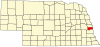 | |
| CDPs | ||
| Other communities | ||
Metropolitan area of Omaha–Council Bluffs | ||||||
|---|---|---|---|---|---|---|
| Primary cities |
|  | ||||
| Cities over 10,000 (per 2010 census) |
| |||||
| Cities of 5,000 to 10,000 (per 2010 census) |
| |||||
| Cities of 1,000 to 5,000 (per 2010 census) |
| |||||
| Census-designated places |
| |||||
| Cities and villages of fewer than 1,000 (per 2010 census) |
| |||||
| Counties |
| |||||
| International | |
|---|---|
| National | |
| Geographic | |
