


British Columbia Highway 5
.svg) Highway 5 | ||||
|---|---|---|---|---|
| Southern Yellowhead Highway Coquihalla Highway | ||||
 Highway 5 highlighted in red. | ||||
| Route information | ||||
| Maintained by the Ministry of Transportation and Infrastructure | ||||
| Length | 543.33 km[1] (337.61 mi) Coquihalla Highway: 185.6 km (115.3 mi) | |||
| Existed | 1941–present | |||
| Major junctions | ||||
| South end |  Highway 1 (TCH) near Hope Highway 1 (TCH) near Hope | |||
 Highway 3 near Hope Highway 3 near Hope   Highway 5A / Highway 8 / Highway 97C in Merritt Highway 5A / Highway 8 / Highway 97C in Merritt Highway 1 (TCH) / Highway 97 in Kamloops Highway 5A in Kamloops Highway 1 (TCH) / Highway 97 in Kamloops Highway 5A in Kamloops Highway 24 in Little Fort Highway 24 in Little Fort | ||||
| North end |  Highway 16 (TCH) near Tête Jaune Cache Highway 16 (TCH) near Tête Jaune Cache | |||
| Location | ||||
| Country | Canada | |||
| Province | British Columbia | |||
| Regional districts | Fraser Valley, Thompson-Nicola, Fraser-Fort George | |||
| Major cities | Merritt, Kamloops | |||
| Villages | Valemount | |||
| Highway system | ||||
|
| ||||
| ||||

Highway 5 is a 543 km (337 mi) north–south route in southern British Columbia, Canada. Highway 5 connects the southern Trans-Canada route (Highway 1) with the northern Trans-Canada/Yellowhead route (Highway 16), providing the shortest land connection between Vancouver and Edmonton. Despite the entire route being signed as part of the Yellowhead Highway, the portion of Highway 5 south of Kamloops is also known as the Coquihalla Highway, while the northern portion is known as the Southern Yellowhead Highway. The Coquihalla section was a toll road until 2008.
Although the Yellowhead Highway system is considered part of the Trans-Canada Highway network, Highway 5 is not represented with a Trans-Canada marker. Regardless, Highway 5 is designated as a core route of Canada's National Highway System.
Route description
[edit]Coquihalla Highway
[edit]

Between Hope and Kamloops, Highway 5 is known as the Coquihalla Highway (colloquially "the Coq", pronounced "coke"). It is a 186-kilometre-long (116 mi) freeway, varying between four and six lanes with a speed limit of 120 km/h (75 mph) for most of its length. The Coquihalla approximately traces through the Cascade Mountains the route of the former Kettle Valley Railway, which existed between 1912 and 1958. It is so named because near Hope, it generally follows the Coquihalla River, for about 60 km (37 mi), and uses the Coquihalla Pass. The pass is named Kwʼikwʼiya꞉la in the Halq̓eméylem language used by the Stó꞉lō, which means "stingy container" and refers specifically to a fishing rock near the mouth of what is now known as the Coquihalla River. According to Stó꞉lō oral history, the skw'exweq (water babies, underwater people) who inhabit a pool close to the rock would swim out and pull the salmon off the spears, allowing only certain fisherman to catch the salmon."[2]
Highway 5 begins south at the junction with Crowsnest Highway (Highway 3) at uninhabited Othello, 7 km (4 mi) east of Hope (named after a nearby siding on the Kettle Valley Railway, which used many Shakespearean names). Exit numbers on the Coquihalla are a continuation of those on Highway 1 west of Hope, as it is an extension of the freeway that starts in Horseshoe Bay. 35 km (22 mi) north of Othello, after passing through five interchanges, Highway 5 reaches the landmark Great Bear snow shed. The location of the former toll booth is 13 km (8 mi) north of the snow shed, passing through another interchange and the 1,244 m (4,081 ft) Coquihalla Pass. Highway 5 is the only highway in British Columbia to have had tolls; a typical passenger vehicle toll was $10.[3] Now free to drive, at the Coquihalla Lakes junction, the highway crosses from the Fraser Valley Regional District into the Thompson-Nicola Regional District. 61 km (38 mi) and five interchanges north of the former toll plaza. The Coquihalla Highway then enters the city of Merritt, which is accessed by two interchanges, both of which also provide access to Highway 5A, Highway 97C, and Highway 8.

The section of highway, between Merritt and Kamloops, is 72 km (45 mi) long. After exiting Merritt, the highway climbs up a long, steep hill toward another high point, the Surrey Lake Summit. It passes through three interchanges along this section. A diamond interchange at Exit 336 provides an important turnoff to Logan Lake on Highway 97D and Lac le Jeune. Shortly after the junction, the highway descends into the city of Kamloops, where it meets Highways 1 and 97 at a trumpet interchange.
Kamloops
[edit]Highway 5 continues east for 12 km (7.5 mi) concurrently with Highways 1 and 97, through Kamloops. This stretch of road, which carries 97 South and 5 North on the same lanes (and vice versa), is the only wrong-way concurrency in British Columbia. This section is mostly an urban freeway with a speed limit of 100 km/h (62 mph). It passes through five interchanges, connecting to the core area of Kamloops, before the concurrency splits and Highway 5 exits off the road to the north in a complex five-way interchange.
After separating from Highways 1 and 97, Highway 5 proceeds north for approximately 19 km (12 mi). For most of this section, it is a four-lane divided highway with several signalized intersections and a speed limit of 80 km/h (50 mph). After leaving the concurrency it immediately crosses the South Thompson River and enters a First Nations Reserve, temporarily leaving Kamloops city limits. A particularly important intersection is the signal lights at Halston Drive, which is one of only two access points to the north half of Kamloops. Highway 5 re-enters the city at the Rayleigh community, where it passes two busy at-grade, but not signalized intersections; traffic volumes steadily decrease as it gets farther from the core area of Kamloops. Heffley Creek indicates the northern boundary of Kamloops; the exit to Sun Peaks resort is at the same turnoff. Traffic volumes thin out at that exit, and shortly afterward Highway 5 narrows to a two-lane undivided road.
Southern Yellowhead Highway
[edit]The Southern Yellowhead highway is the northern section of Highway 5. This section is 314 km (195 mi) long. It is largely a two-lane undivided road, with some rare three- or four-lane sections for passing, although work has been constantly underway (especially in the Heffley Creek–Clearwater section) to create more passing opportunities. The speed limit is 100 km/h (62 mph) for the most part except in towns, where it can drop as low as 50 km/h (31 mph). Traffic volume on this section of highway is low compared to the Coquihalla and Kamloops sections of Highway 5. In its whole length there is only one traffic signal, which is in the town of Valemount. Services for drivers are provided in the major towns.
Highway 5 follows the North Thompson River north from Kamloops and Heffley Creek for approximately 54 km (34 mi), along a parallel course with the Canadian National Railway's main line. It passes an important junction for Adams Lake in the settlement of Louis Creek before entering the town Barriere. North of Barriere, it encounters a junction with Highway 24 in the village of Little Fort. 30 km (19 mi) north of Little Fort, while continuing to follow the North Thompson and the CN Railway, Highway 5 reaches the resort community of Clearwater, where a roundabout provides access to Wells Gray Provincial Park. Highway 5 proceeds northeast for another 107 km (66 mi), passing Vavenby and Avola en route to the community of Blue River, a popular heliskiing location. From there it proceeds 109 km (68 mi) farther north through the heart of the Columbia Mountains. It crosses a low divide between the Thompson River and Fraser River drainages, entering the Regional District of Fraser-Fort George. It soon passes through the community of Valemount, where a traffic signal is located. Next it passes Tête Jaune Cache and crosses the Fraser River, after which it immediately meets Highway 16 in a partial interchange, marking its northern terminus.
History
[edit]
.svg)
The current Highway 5 is not the first highway in B.C. to have this designation. From 1941 to 1953, the section of present-day Highway 97, Highway 97A, and Highway 97B, between Kaleden, just south of Penticton, and Salmon Arm, was formerly Highway 5. In 1953, the '5' designation was moved to designate Princeton-Merritt-Kamloops Highway (present-day Highway 5A) to north of Kamloops; by 1960, Highway 5 was extended north to Tête Jaune Cache and subsequently paved.[5] In 1970, Highway 5 between Kamloops and Tête Jaune Cache was designated as the South Yellowhead Highway and signed with the Yellowhead Highway shield, while the section south of Kamloops was still signed with the standard British Columbia highway shield.[6]
In the 1960s, the Merritt Board of Trade began lobbying the B.C. government for a new highway route to Hope, including a vehicle caravan that was staged eight times starting in 1963, over the abandoned Kettle Valley Railway grade, in order draw attention to the potential of this route.[7] Surveying commenced in 1973, and in 1979 the first construction contract was issued for a 4.5 km (2.8 mi) section of highway between Nicolum Creek and Peers Creek near Hope; however, work progressed slowly until 1984, when Premier Bill Bennett announced that the project would be fast-tracked so it could be completed to coincide with Expo 86.[7][8] To ensure the project was completed on time, more than 10,000 workers were needed, and more than 1,000 pieces of heavy equipment worked non-stop every day during the summer of 1985.[8] The project was divided into three phases, with Phase 1 being the 115 km (71 mi) section between Hope and Merritt, Phase 2 being the 80 km (50 mi) section between Merritt and Kamloops, and Phase 3 being a 108 km (67 mi) branch between Merritt and Peachland, south of Kelowna.[7] To offset the cost of fast-tracking construction, Phase 1 was made a toll highway, with a toll plaza constructed at the summit of Coquihalla Summit; it was designed to accommodate 13 toll booths for 14 lanes of traffic.[7]
On May 16, 1986, Phase 1 was officially opened, and Highway 5 was re-routed between Hope and Merritt; its construction required 31 bridges and underpasses and over 3.7 million tonnes (4,100,000 short tons) of gravel.[9] The opening celebrations featured a ceremony in Hope followed by a convoy led by Premier Bennett in an open-air convertible that smashed through paper banners strung across the new highway lanes, stopped at the Coquihalla Summit to dedicate a time capsule, and continued to Merritt for further celebrations.[7][10] The total cost for the highway between Hope and Merritt was approximately $848 million.[11] Phase 2, between Merritt and Kamloops, opened in September 1987, re-routing Highway 5, while Phase 3 was opened in October 1990 and designated as Highway 97C.[7] The three phases have been credited with transforming Merritt into an important transportation hub between the coast and interior, as well as significant growth in both Kamloops and the Okanagan due to improved accessibility.[8]
In 2003, Premier Gordon Campbell announced the Liberal government would turn over toll revenue to a private operator, along with responsibility for the operation and maintenance of the Coquihalla Highway.[12] In response to strong opposition from the public and numerous businesses in the Interior of British Columbia, the provincial government shelved the move three months later.[13]
On September 26, 2008, the provincial government permanently lifted the Coquihalla tolls, effective 1:00 pm that day.[11][14] Subsequently, the toll station and signs were dismantled.[15]
In 2011, the British Columbia government replaced the standard British Columbia Highway 5 shields with Yellowhead Highway 5 shields south of Kamloops, which at the time drew some concern that the Coquihalla Highway would be officially renamed.[16][17]
Effective July 2, 2014, the Ministry of Transport and Infrastructure increased the speed limit on the Coquihalla Highway from 110 km/h (68 mph) to 120 km/h (75 mph) after conducting an engineering assessment and province-wide speed review.[18] In June 2016, the province implemented a variable speed limit corridor around the Coquihalla Summit Park to increase safety during adverse conditions.[19]
Accidents and weather
[edit]Signs along the Coquihalla Highway frequently warn drivers to be aware of sudden changes in weather. The highway is particularly dangerous during winter seasons, with extreme snowfall that can exceed more than 10 centimetres (4 in) per hour.[20] While road maintenance strives to keep the roads as clear as possible, it is not unheard of for the highway to shut down, sometimes with travellers forced to stay overnight in their cars.
According to ICBC, there were 32 fatal crashes between 2004 and 2013, and an estimated 400–500 accidents occur during the winter seasons.[21] Global News listed the stretch between Merritt and Hope as one of the deadliest highways in BC.[22] DriveBC provides up-to-date reports on Coquihalla Highway conditions, including live webcams in several locations.[23]
Owing to its reputation, Highway 5 is featured predominantly in the reality docuseries Highway Thru Hell, which follows a group of towing companies that operate in the Interior and Highway 5.[24]
On November 14, 2021, a major storm in southern British Columbia damaged sections of the Coquihalla Highway and other routes in the area. Over the course of November 14 and 15, 200 millimetres (7.9 in) of rain fell along the Coquihalla route.[25][26] The heavy rain eventually caused several large washouts at multiple points along the highway, including the destruction of multiple bridges. Initial repair estimates included temporary reopenings consisting of temporary bridges, operational for early 2022, with full repair completed in September 2022.[citation needed] After the washouts, Canadian Forces Cormorant helicopters evacuated stranded motorists on the highway.[27] On December 20, the Coquihalla Highway was reopened to essential traffic, with non-essential traffic being diverted toward Highway 99. On January 19, 2022, the Coquihalla Highway was reopened to non-essential traffic from Hope to Merritt.[28] The highway has since been fully reopened, allowing full traffic from Hope to Kamloops.
Exit list
[edit]From south to north, the following intersections are observed along Highway 5:[29][30]
| Regional District | Location | km[1] | mi | Exit[31] | Name[31] | Destinations | Notes |
|---|---|---|---|---|---|---|---|
| Fraser Valley | Hope | 0.00 | 0.00 | — | — | Highway 1 (TCH) west – Vancouver | Freeway and exit numbers continue west |
| 170 | Hope | Highway 1 (TCH) east – Hope, Cache Creek, Prince George | Highway 3 / Highway 5 western terminus; west end of Hwy 3 concurrency; eastbound exit and westbound entrance | ||||
| 0.99 | 0.62 | 171 | To Highway 1 (TCH) east – Hope, Cache Creek | Westbound exit only | |||
| 3.08 | 1.91 | 173 | Thacker Creek | Highway 915:1300 west (Old Hope-Princeton Way) – Hope | No westbound entrance | ||
| | 6.67 | 4.14 | 177 | Othello | Highway 3 east (Crowsnest Highway) – Princeton, Penticton, Osoyoos | East end of Hwy 3 concurrency; south end of Coquihalla Highway | |
| 13.00 | 8.08 | 183 | Peers Creek | Othello Road – Coquihalla Canyon Provincial Park | |||
| 22.02 | 13.68 | 192 | Jessica | Sowaqua Creek Road | |||
| 25.77 | 16.01 | 195 | Carolin | Carolin Mines Road | |||
| 29.68 | 18.44 | 200 | Shylock | Shylock Road (U-turn route only) | Southbound exit and northbound entrance. | ||
| 31.19 | 19.38 | 202 | Portia | Portia, Old Coquihalla Road | No southbound exit. | ||
| 42.21 | 26.23 | Great Bear Snowshed | |||||
| 45.53 | 28.29 | 217 | Zopkios | Zopkios rest area | |||
| 48.93 | 30.40 | Coquihalla Pass – 1,244 m (4,081 ft) | |||||
| 51.35 | 31.91 | 221 | Falls Lake | Falls Lake Road | |||
| | 52.22 | 32.45 | Dry Gulch Bridge | ||||
| | 54.50 | 33.86 | Coquihalla Lakes Rest Area (former site of toll booths) | ||||
| Thompson-Nicola | | 58.11 | 36.11 | 228 | Coquihalla Lakes | Coquihalla Lakes Road – Britton Creek Rest Area | |
| 61.09 | 37.96 | 231 | Mine Creek | Mine Creek Road (U-turn route only) | Southbound exit and northbound entrance. | ||
| 61.2 | 38.0 | 238 | Juliet | Juliet Creek Road – Coldwater River Provincial Park | |||
| 79.69 | 49.52 | 250 | Larson Hill | Larson Hill | |||
| 86.46 | 53.72 | 256 | Kingsvale | Coldwater Road | |||
| 106.32 | 66.06 | 276 | Comstock | Comstock Road | |||
| Merritt | 115.99 | 72.07 | 286 | Coldwater | Highway 97C / Highway 5A south / Highway 8 west (Nicola Avenue) – Merritt City Centre, Kelowna | ||
| 119.96 | 74.54 | 290 | Nicola | Highway 5A north (Voght Street) – Merritt City Centre | |||
| | 145.31 | 90.29 | 315 | Helmer | Helmer Road | ||
| 152.60 | 94.82 | Surrey Lake Summit – 1,444 m (4,738 ft) | |||||
| 167.11 | 103.84 | 336 | Walloper |  Highway 97D south / Lac Le Jeune Road – Logan Lake Highway 97D south / Lac Le Jeune Road – Logan Lake | |||
| 185.48 | 115.25 | 355 | Inks Lake | Inks Lake Road | |||
| Kamloops | 192.22 | 119.44 | 362 | Afton |  Highway 1 (TCH) west / Highway 97 north to Highway 99 – Cache Creek, Lytton, Prince George, Lillooet Highway 1 (TCH) west / Highway 97 north to Highway 99 – Cache Creek, Lytton, Prince George, Lillooet | South end of Hwy 1 / Hwy 97 concurrency; north end of Coquihalla Highway | |
| 196.45 | 122.07 | 366 | Copperhead | Copperhead Drive, Lac le Jeune Road | |||
| 198.13 | 123.11 | 367 | Pacific Way | Pacific Way | |||
| 198.92 | 123.60 | 368 | Aberdeen | Highway 5A south / Hillside Way – Merritt | |||
| 200.22 | 124.41 | 369 | Sagebrush | Columbia Street – City Centre | Eastbound exit and westbound entrance | ||
| 200.80 | 124.77 | 370 | Springhill | Summit Drive – City Centre | Westbound exit and eastbound entrance | ||
| 204.29 | 126.94 | 374 | Yellowhead | Highway 1 (TCH) east / Highway 97 south – Salmon Arm, Banff, Vernon | North end of Hwy 1 / Hwy 97 concurrency; Hwy 5 exits freeway; exit numbers continue on Hwy 1 | ||
| Kamloops–Kamloops No. 1 boundary | 204.74 | 127.22 | Yellowhead Bridge over South Thompson River | ||||
| Kamloops No. 1 | 206.09 | 128.06 | Shuswap Road | Signalized, at-grade intersection | |||
| 208.16 | 129.34 | Mount Paul Way | Signalized, at-grade intersection | ||||
| 210.04 | 130.51 |  Halston Road (Highway 921:1771 west) / Paul Lake Road (Highway 921:1773 east) – North Shore, Kamloops Airport Halston Road (Highway 921:1771 west) / Paul Lake Road (Highway 921:1773 east) – North Shore, Kamloops Airport | Signalized, at-grade intersection | ||||
| Kamloops | 220.16 | 136.80 | Puett Ranch Road | ||||
| 228.74 | 142.13 | Tod Mountain Road (Highway 921:1776 east) – Sun Peaks | |||||
| Barriere | 267.64 | 166.30 | Barriere Town Road, Lilley Road | ||||
| 270.06 | 167.81 | Barriere North Thompson Bridge across North Thompson River | |||||
| Little Fort | 297.88 | 185.09 | Highway 24 west – Bridge Lake | ||||
| | 319.86 | 198.75 | Old North Thompson Highway (Highway 921:1765 north) | ||||
| Clearwater | 327.04 | 203.21 | Old North Thompson Highway (Highway 921:1765 south) / Clearwater Village Road | ||||
| 328.08 | 203.86 | Clearwater Valley Road, Park Drive – Wells Gray Provincial Park | Roundabout | ||||
| Avola | 395.43 | 245.71 | Avola North Thompson Bridge across North Thompson River | ||||
| | 423.68 | 263.26 | Six Mile Bridge across North Thompson River | ||||
| Blue River | 434.43 | 269.94 | Angus Horne Street, Shell Road | ||||
| | 474.40 | 294.78 | Lempriere Bridge across North Thompson River | ||||
| 477.34 | 296.61 | Moombeam Bridge across North Thompson River | |||||
| 478.91 | 297.58 | Gosnell Bridge across North Thompson River | |||||
| Fraser-Fort George | Valemount | 523.94 | 325.56 | 5th Avenue, Pine Road | Signalized, at-grade intersection | ||
| Tête Jaune Cache | 543.13 | 337.49 | Tête Jaune Bridge across Fraser River | ||||
| 543.33 | 337.61 | Tête Jaune |  Highway 16 (TCH/YH) – McBride, Prince George, Jasper, Edmonton Highway 16 (TCH/YH) – McBride, Prince George, Jasper, Edmonton | Interchange | |||
1.000 mi = 1.609 km; 1.000 km = 0.621 mi
| |||||||
Gallery
[edit]-
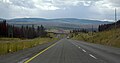 Highway 5 passing through Thompson Plateau, with tree damage from Pine Beetles visible (2007)
 -
 The toll booth once marked the halfway point of the formerly tolled Hope-to-Merritt portion of the highway (2006)
 -
 Passing Nicola Valley southbound (2007)
 -
 Downtown Valemount as seen from the west side of Highway 5 (2006)
 -
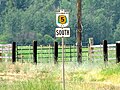 Southern Yellowhead Highway 5, southbound (2008)


References
[edit]- ^ a b Landmark Kilometre Inventory (PDF). British Columbia Ministry of Transportation and Infrastructure (Report). Cypher Consulting. July 2016. pp. 171–176, 202. Archived from the original (PDF) on 2017-03-11. Retrieved 2017-04-21.
- ^ B.C. Ministry of Transportation Archived August 25, 2007, at the Wayback Machine - Coquihalla Rates and Information
- ^ "Coquihalla Highway tolls dropped, says B.C. premier". CBC News. Canadian Broadcasting Corporation. September 26, 2008.
- ^ Example of road sign
- ^ Department of Highways (1960). Province of Alberta Official Road Map (PDF) (Map). Government of Alberta. §§ A-4, A-5, B-5, B-6.
- ^ Department of Travel Industry. Beautiful British Columbia Road Map & Provincial Campground Guide (Map) (1972-1973 ed.). Government of the Province of British Columbia. §§ O-7, P-6, P-7, Q-5.
- ^ a b c d e f Wilson, Inge (May 8, 2011). "New route changed the face of the province forever". Hope Standard. Archived from the original on May 25, 2019. Retrieved May 25, 2019.
- ^ a b c "Construction of the Coquihalla: Still Amazing After 30 Years". TranBC: Ministry of Transportation and Infrastructure. Government of British Columbia. Archived from the original on July 7, 2018. Retrieved May 25, 2019.
- ^ "Engineering Feat". The Province. May 16, 1986. p. 10. Retrieved December 8, 2022 – via Newspapers.com.
- ^ Bohn, Glenn (May 16, 1986). "Bennett's $50,000 breakthrough". The Vancouver Sun. p. A1. Retrieved December 8, 2022 – via Newspapers.com.
- ^ a b Rolfsen, Catherine (September 26, 2008). "Tolls taken off Coquihalla". Vancouver Sun. Archived from the original on November 1, 2008. Retrieved December 8, 2022.
- ^ Richards, Gwendolyn (May 6, 2003). "B.C. government privatizing toll highway". The Globe and Mail. Retrieved November 20, 2018.
- ^ Hume, Mark (July 23, 2003). "B.C. won't privatize Coquihalla Highway". The Globe and Mail. Retrieved November 20, 2018.
- ^ "Premier Announces End of Tolls". Archived from the original on 2008-09-30. Retrieved 2008-09-26.
- ^ "Campbell revs up to demolish Coquihalla tollbooths". CBC News. 2008-10-03. Archived from the original on 2021-10-20.
- ^ Reimer, Elmer (May 31, 2012). "Alberta highway shouldn't claim Coquihalla". Merritt Herald. Retrieved May 25, 2019.
- ^ Jason, Hewlett (November 14, 2012). "Called the Coquihalla no more?". Kamloops Daily News. Retrieved May 25, 2019.
- ^ "Actions to improve safety on B.C.'s rural highways". Archived from the original on 2014-07-07. Retrieved 2014-07-04.
- ^ "Variable Speed Limits". British Columbia Ministry of Transportation and Infrastructure. Retrieved November 18, 2021.
- ^ "What You Need to Know About Winter Weather on the "Coq"". TranBC. Ministry of Transportation and Infrastructure.
- ^ "Coquihalla Highway". dangerousroads.
- ^ McElroy, Justin (February 9, 2015). "British Columbia's 12 deadliest highways". Global News. Corus Entertainment Inc.
- ^ "B.C. Highway Cams". Drive BC. Government of British Columbia.
- ^ Doyle, John (2012-09-04). "Highway Thru Hell: tough, but Canadian-style tough". The Globe and Mail. Retrieved 2021-11-04.
- ^ Canadian Broadcasting Corporation (14 November 2021). "Highways closed around B.C. as rain batters province, leading to mudslides and flood warnings". CBC News. Retrieved 15 November 2021.
- ^ Canadian Broadcasting Corporation (15 November 2021). "Relentless rain causing flooding, road closures and evacuations across B.C." CBC News. Retrieved 15 November 2021.
- ^ Weichel, Andrew (15 November 2021). "Helicopter Rescue Efforts". CTV News. CTV News. Archived from the original on 2021-11-16. Retrieved 15 November 2021.
- ^ "Coquihalla Highway set to reopen to regular traffic | BC Gov News". 18 January 2022.
- ^ Tourism British Columbia. Super, Natural British Columbia Road Map & Parks Guide (Map) (2010-2011 ed.). Davenport Maps Ltd. §§ H-10, J-9, J-10, K-9, L-9.
- ^ British Columbia Road Atlas (2007 ed.). Oshawa, ON: MapArt Publishing Corp. 2010. pp. 37, 46, 47, 57, 58, and 69. ISBN 978-1-55368-018-5.
- ^ a b "Highway Exits & Landmarks - Coquihalla Highway 5 Starts (Yellowhead Route)". British Columbia Ministry of Transportation and Infrastructure. Archived from the original on 15 July 2016. Retrieved 13 July 2016.
External links
[edit] Yellowhead Highway travel guide from Wikivoyage
 Media related to British Columbia Highway 5 at Wikimedia Commons
- 7 Things You Need to Know BEFORE Driving the Coquihalla and High Mountain Passes

