


Closed graph theorem


![{\displaystyle [-4,4]}](https://wikimedia.org/api/rest_v1/media/math/render/svg/d2933acc5278ef7016396bfd3230387904ed5f0f)
![{\displaystyle [-2,2]}](https://wikimedia.org/api/rest_v1/media/math/render/svg/f94b820404eca2a458cb2c7d8c24be85fffccf90)
In mathematics, the closed graph theorem may refer to one of several basic results characterizing continuous functions in terms of their graphs. Each gives conditions when functions with closed graphs are necessarily continuous.
Graphs and maps with closed graphs[edit]
If is a map between topological spaces then the graph of is the set or equivalently,






Any continuous function into a Hausdorff space has a closed graph.
Any linear map, between two topological vector spaces whose topologies are (Cauchy) complete with respect to translation invariant metrics, and if in addition (1a) is sequentially continuous in the sense of the product topology, then the map is continuous and its graph, Gr L, is necessarily closed. Conversely, if is such a linear map with, in place of (1a), the graph of is (1b) known to be closed in the Cartesian product space , then is continuous and therefore necessarily sequentially continuous.[1]


Examples of continuous maps that do not have a closed graph[edit]
If is any space then the identity map is continuous but its graph, which is the diagonal , is closed in if and only if is Hausdorff.[2] In particular, if is not Hausdorff then is continuous but does not have a closed graph.




Let denote the real numbers with the usual Euclidean topology and let denote with the indiscrete topology (where note that is not Hausdorff and that every function valued in is continuous). Let be defined by and for all . Then is continuous but its graph is not closed in .[3]


Closed graph theorem in point-set topology[edit]
In point-set topology, the closed graph theorem states the following:
Closed graph theorem[4] — If is a map from a topological space into a Hausdorff space then the graph of is closed if is continuous. The converse is true when is compact. (Note that compactness and Hausdorffness do not imply each other.)

First part is essentially by definition.
Second part:
For any open , we check is open. So take any , we construct some open neighborhood of , such that .


Since the graph of is closed, for every point on the "vertical line at x", with , draw an open rectangle disjoint from the graph of . These open rectangles, when projected to the y-axis, cover the y-axis except at , so add one more set .


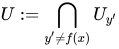
Naively attempting to take would construct a set containing , but it is not guaranteed to be open, so we use compactness here.
Since is compact, we can take a finite open covering of as .

Now take . It is an open neighborhood of , since it is merely a finite intersection. We claim this is the open neighborhood of that we want.

Suppose not, then there is some unruly such that , then that would imply for some by open covering, but then , a contradiction since it is supposed to be disjoint from the graph of .



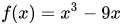
Non-Hausdorff spaces are rarely seen, but non-compact spaces are common. An example of non-compact is the real line, which allows the discontinuous function with closed graph .

For set-valued functions[edit]
Closed graph theorem for set-valued functions[5] — For a Hausdorff compact range space , a set-valued function has a closed graph if and only if it is upper hemicontinuous and F(x) is a closed set for all .


In functional analysis[edit]
If is a linear operator between topological vector spaces (TVSs) then we say that is a closed operator if the graph of is closed in when is endowed with the product topology.


The closed graph theorem is an important result in functional analysis that guarantees that a closed linear operator is continuous under certain conditions. The original result has been generalized many times. A well known version of the closed graph theorems is the following.
Theorem[6][7] — A linear map between two F-spaces (e.g. Banach spaces) is continuous if and only if its graph is closed.
See also[edit]
- Almost open linear map – Map that satisfies a condition similar to that of being an open map.
- Barrelled space – Type of topological vector space
- Closed graph – Graph of a map closed in the product space
- Closed linear operator – Graph of a map closed in the product space
- Discontinuous linear map
- Kakutani fixed-point theorem – Fixed-point theorem for set-valued functions
- Open mapping theorem (functional analysis) – Condition for a linear operator to be open
- Ursescu theorem – Generalization of closed graph, open mapping, and uniform boundedness theorem
- Webbed space – Space where open mapping and closed graph theorems hold
- Zariski's main theorem – Theorem of algebraic geometry and commutative algebra
Notes[edit]
References[edit]
- ^ Rudin 1991, p. 51-52.
- ^ Rudin 1991, p. 50.
- ^ Narici & Beckenstein 2011, pp. 459–483.
- ^ Munkres 2000, pp. 163–172.
- ^ Aliprantis, Charlambos; Kim C. Border (1999). "Chapter 17". Infinite Dimensional Analysis: A Hitchhiker's Guide (3rd ed.). Springer.
- ^ Schaefer & Wolff 1999, p. 78.
- ^ Trèves (2006), p. 173
Bibliography[edit]
- Bourbaki, Nicolas (1987) [1981]. Topological Vector Spaces: Chapters 1–5. Éléments de mathématique. Translated by Eggleston, H.G.; Madan, S. Berlin New York: Springer-Verlag. ISBN 3-540-13627-4. OCLC 17499190.
- Folland, Gerald B. (1984), Real Analysis: Modern Techniques and Their Applications (1st ed.), John Wiley & Sons, ISBN 978-0-471-80958-6
- Jarchow, Hans (1981). Locally convex spaces. Stuttgart: B.G. Teubner. ISBN 978-3-519-02224-4. OCLC 8210342.
- Köthe, Gottfried (1983) [1969]. Topological Vector Spaces I. Grundlehren der mathematischen Wissenschaften. Vol. 159. Translated by Garling, D.J.H. New York: Springer Science & Business Media. ISBN 978-3-642-64988-2. MR 0248498. OCLC 840293704.
- Munkres, James R. (2000). Topology (Second ed.). Upper Saddle River, NJ: Prentice Hall, Inc. ISBN 978-0-13-181629-9. OCLC 42683260.
- Narici, Lawrence; Beckenstein, Edward (2011). Topological Vector Spaces. Pure and applied mathematics (Second ed.). Boca Raton, FL: CRC Press. ISBN 978-1584888666. OCLC 144216834.
- Rudin, Walter (1991). Functional Analysis. International Series in Pure and Applied Mathematics. Vol. 8 (Second ed.). New York, NY: McGraw-Hill Science/Engineering/Math. ISBN 978-0-07-054236-5. OCLC 21163277.
- Schaefer, Helmut H.; Wolff, Manfred P. (1999). Topological Vector Spaces. GTM. Vol. 8 (Second ed.). New York, NY: Springer New York Imprint Springer. ISBN 978-1-4612-7155-0. OCLC 840278135.
- Trèves, François (2006) [1967]. Topological Vector Spaces, Distributions and Kernels. Mineola, N.Y.: Dover Publications. ISBN 978-0-486-45352-1. OCLC 853623322.
- Wilansky, Albert (2013). Modern Methods in Topological Vector Spaces. Mineola, New York: Dover Publications, Inc. ISBN 978-0-486-49353-4. OCLC 849801114.
- Zălinescu, Constantin (30 July 2002). Convex Analysis in General Vector Spaces. River Edge, N.J. London: World Scientific Publishing. ISBN 978-981-4488-15-0. MR 1921556. OCLC 285163112 – via Internet Archive.
- "Proof of closed graph theorem". PlanetMath.
| Spaces |
| ||||
|---|---|---|---|---|---|
| Theorems | |||||
| Operators | |||||
| Algebras | |||||
| Open problems | |||||
| Applications | |||||
| Advanced topics | |||||

Topological vector spaces (TVSs) | |
|---|---|
| Basic concepts | |
| Main results | |
| Maps | |
| Types of sets | |
| Set operations | |
| Types of TVSs |
|