


Gliese 832

  Gliese 832 Location of Gliese 832 in the constellation Grus | |
| Observation data Epoch J2000.0 Equinox J2000.0 | |
|---|---|
| Constellation | Grus |
| Right ascension | 21h 33m 33.97512s[1] |
| Declination | −49° 00′ 32.3994″[1] |
| Apparent magnitude (V) | 8.66[2] |
| Characteristics | |
| Evolutionary stage | main-sequence star |
| Spectral type | M2V[3] |
| B−V color index | 1.52[2] |
| Astrometry | |
| Radial velocity (Rv) | 12.72±0.13[1] km/s |
| Proper motion (μ) | RA: −45.917 mas/yr[1] Dec.: −816.875 mas/yr[1] |
| Parallax (π) | 201.3252 ± 0.0237 mas[1] |
| Distance | 16.200 ± 0.002 ly (4.9671 ± 0.0006 pc) |
| Absolute magnitude (MV) | 10.19[2] |
| Details | |
| Mass | 0.441 ± 0.011[4] M☉ |
| Radius | 0.442 ± 0.018[4] R☉ |
| Luminosity (bolometric) | 0.0276 ± 0.0009 [4] L☉ |
| Luminosity (visual, LV) | 0.007[note 1] L☉ |
| Surface gravity (log g) | 4.7[2] cgs |
| Temperature | 3,539+79 −74[4] K |
| Metallicity [Fe/H] | −0.06 ± 0.04[5] dex |
| Rotation | 37.5+1.4 −1.5 d[6] |
| Age | 6±1.5[6] Gyr |
| Other designations | |
| Database references | |
| SIMBAD | The star |
| planet c | |
| planet b | |
| Exoplanet Archive | data |
| Data sources: | |
| Hipparcos Catalogue, HD | |
Gliese 832 (Gl 832 or GJ 832) is a red dwarf of spectral type M2V in the southern constellation Grus.[8] The apparent visual magnitude of 8.66[2] means that it is too faint to be seen with the naked eye. It is located relatively close to the Sun, at a distance of 16.2 light years[1] and has a high proper motion of 818.16 milliarcseconds per year.[1] Gliese 832 has just under half the mass and radius of the Sun.[8] Its estimated rotation period is a relatively leisurely 46 days.[3] The star is roughly 6 billion years old.[6]
This star achieved perihelion some 52,920 years ago when it came within an estimated 15.71 ly (4.817 pc) of the Sun.[9]
Gliese 832 emits X-rays.[10] Despite the strong flare activity, Gliese 832 is producing on average less ionizing radiation than the Sun. Only at extremely short radiation wavelengths (<50nm) does its radiation intensity rise above the level of quiet Sun, but does not reach levels typical for active Sun.[11]
Planetary system[edit]
Gliese 832 hosts one known planet, with a second planet having been refuted in 2022.[6]
| Companion (in order from star) |
Mass | Semimajor axis (AU) |
Orbital period (years) |
Eccentricity | Inclination | Radius |
|---|---|---|---|---|---|---|
| b | 0.8+0.12 −0.11 MJ |
3.53+0.15 −0.16 |
9.88+0.34 −0.33 |
0.069+0.026 −0.027 |
54.9+6.6 −4.9 or 125.1+4.9 −6.6° |
— |
Gliese 832 b[edit]
In September 2008, it was announced that a Jupiter-like planet, designated Gliese 832 b, had been detected in a long-period, near-circular orbit around this star, with a false alarm probability of a negligible 0.05%. It would induce an astrometric perturbation on its star of at least 0.95 milliarcseconds and is thus a good candidate for being detected by astrometric observations. Despite its relatively large angular distance, direct imaging is problematic due to the star–planet contrast.[2] The orbital solution of the planet was refined in 2011.[13] In 2023, an astrometric detection of the planet was announced, determining its inclination and revealing a true mass 80% the mass of Jupiter.[12]
Gliese 832 c[edit]
Gliese 832 c was believed to be of super-Earth mass.[8] It was announced to orbit in the optimistic habitable zone but outside the conservative habitable zone of its parent star.[14] The planet Gliese 832 c was believed to be in, or very close to, the right distance from its sun to allow liquid water to exist on its surface.[8] However, doubts were raised about the existence of planet c by a 2015 study, which found that its orbital period is close to the stellar rotation period.[3] The existence of the planet was refuted in 2022, when a study found that the radial velocity signal shows characteristics of a signal originating from stellar activity, and not from a planet.[6]
The region between Gliese 832 b and where Gliese 832 c would be is a zone where additional planets are possible.[15]
Search for cometary disc[edit]
If this system has a comet disc, it is not "brighter than the fractional dust luminosity 10−5" according to a 2012 Herschel study.[16]
See also[edit]
Notes[edit]
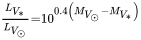
- ^ Using the absolute visual magnitude of Gliese 832 and the absolute visual magnitude of the Sun , the visual luminosity can be calculated by


References[edit]
- ^ a b c d e f g Vallenari, A.; et al. (Gaia collaboration) (2023). "Gaia Data Release 3. Summary of the content and survey properties". Astronomy and Astrophysics. 674: A1. arXiv:2208.00211. Bibcode:2023A&A...674A...1G. doi:10.1051/0004-6361/202243940. S2CID 244398875. Gaia DR3 record for this source at VizieR.
- ^ a b c d e f Bailey, J.; Butler, R. P.; Tinney, C. G.; Jones, H. R. A.; O'Toole, S.; Carter, B. D.; Marcy, G. W. (2009). "A Jupiter-like Planet Orbiting the Nearby M Dwarf GJ832". The Astrophysical Journal. 690 (1): 743–747. arXiv:0809.0172. Bibcode:2009ApJ...690..743B. doi:10.1088/0004-637X/690/1/743. S2CID 17172233.
- ^ a b c Suárez Mascareño, A.; et al. (September 2015), "Rotation periods of late-type dwarf stars from time series high-resolution spectroscopy of chromospheric indicators", Monthly Notices of the Royal Astronomical Society, 452 (3): 2745–2756, arXiv:1506.08039, Bibcode:2015MNRAS.452.2745S, doi:10.1093/mnras/stv1441, S2CID 119181646.
- ^ a b c d Pineda, J. Sebastian; Youngblood, Allison; France, Kevin (September 2021). "The M-dwarf Ultraviolet Spectroscopic Sample. I. Determining Stellar Parameters for Field Stars". The Astrophysical Journal. 918 (1): 23. arXiv:2106.07656. Bibcode:2021ApJ...918...40P. doi:10.3847/1538-4357/ac0aea. S2CID 235435757. 40.
- ^ Lindgren, Sara; Heiter, Ulrike (2017). "Metallicity determination of M dwarfs. Expanded parameter range in metallicity and effective temperature". Astronomy and Astrophysics. 604: A97. arXiv:1705.08785. Bibcode:2017A&A...604A..97L. doi:10.1051/0004-6361/201730715. S2CID 119216828.
- ^ a b c d e Gorrini, P.; Astudillo-Defru, N.; et al. (August 2022). "Detailed stellar activity analysis and modelling of GJ 832: Reassessment of the putative habitable zone planet GJ 832c". Astronomy & Astrophysics. 664: A64. arXiv:2206.07552. Bibcode:2022A&A...664A..64G. doi:10.1051/0004-6361/202243063. S2CID 249674385.
- ^ "Gliese 832". SIMBAD. Centre de données astronomiques de Strasbourg. Retrieved 2018-09-23.
- ^ a b c d "Nearby Alien Planet May Be Capable of Supporting Life", Mike Wall, Space.com, June 25, 2014, http://www.space.com/26357-exoplanet-habitable-zone-gliese-832c.html
- ^ Bailer-Jones, C. A. L. (March 2015), "Close encounters of the stellar kind", Astronomy & Astrophysics, 575: 13, arXiv:1412.3648, Bibcode:2015A&A...575A..35B, doi:10.1051/0004-6361/201425221, S2CID 59039482, A35.
- ^ Schmitt, J. H. M. M.; Fleming, T. A.; Giampapa, M. S. (1995). "The X-ray view of the low-mass stars in the solar neighborhood". The Astrophysical Journal. 450 (9): 392–400. Bibcode:1995ApJ...450..392S. doi:10.1086/176149.
- ^ Fontenla, J. M.; Linsky, Jeffrey L.; Garrison, Jesse; France, Kevin; Buccino, A.; Mauas, Pablo; Vietes, Mariela; Walkowicz, Lucianne M. (2016). "Semi-Empirical Modeling of the Photosphere, Chromopshere, Transition Region, and Corona of the M-Dwarf Host Star Gj 832". The Astrophysical Journal. 830 (2): 154. Bibcode:2016ApJ...830..154F. doi:10.3847/0004-637X/830/2/154. hdl:11336/21732. S2CID 119279568.
- ^ a b Xiao, Guang-Yao; Liu, Yu-Juan; et al. (March 2023). "The Masses of a Sample of Radial-Velocity Exoplanets with Astrometric Measurements". Research in Astronomy and Astrophysics. 23 (5). arXiv:2303.12409. Bibcode:2023RAA....23e5022X. doi:10.1088/1674-4527/accb7e. S2CID 257663647.
- ^ Bonfils, Xavier; Delfosse, Xavier; Udry, Stéphane; Forveille, Thierry; Mayor, Michel; Perrier, Christian; Bouchy, François; Gillon, Michaël; Lovis, Christophe; Pepe, Francesco; Queloz, Didier; Santos, Nuno C.; Ségransan, Damien; Bertaux, Jean-Loup (2011). "The HARPS search for southern extra-solar planets XXXI. The M-dwarf sample". Astronomy and Astrophysics. 549: A109. arXiv:1111.5019. Bibcode:2013A&A...549A.109B. doi:10.1051/0004-6361/201014704. S2CID 119288366.
- ^ Wittenmyer, R.A.; Tuomi, M.; Butler, R.P.; Jones, H. R. A.; O'Anglada-Escude, G.; Horner, J.; Tinney, C.G.; Marshall, J.P.; Carter, B.D.; et al. (2014). "GJ 832c: A super-earth in the habitable zone". The Astrophysical Journal. 1406 (2): 5587. arXiv:1406.5587. Bibcode:2014ApJ...791..114W. doi:10.1088/0004-637X/791/2/114. S2CID 12157837.
- ^ Satyal, S.; Griffith, J.; Musielak, Z. E. (2016), "Dynamics of a Probable Earth-mass Planet in GJ 832 System", The Astrophysical Journal, 845 (2): 106, arXiv:1604.04544, doi:10.3847/1538-4357/aa80e2, S2CID 118663957
- ^ B. C. Matthews; forthcoming study promised in Lestrade, J.-F.; Matthews, B. C.; Sibthorpe, B.; Kennedy, G. M.; Wyatt, M. C.; Bryden, G.; Greaves, J. S.; Thilliez, E.; Moro-Martín, A.; Booth, M.; Dent, W. R. F.; Duchêne, G.; Harvey, P. M.; Horner, J.; Kalas, P.; Kavelaars, J. J.; Phillips, N. M.; Rodriguez, D. R.; Su, K. Y. L.; Wilner, D. J. (2012). "A DEBRIS Disk Around The Planet Hosting M-star GJ581 Spatially Resolved with Herschel". Astronomy and Astrophysics. 548: A86. arXiv:1211.4898. Bibcode:2012A&A...548A..86L. doi:10.1051/0004-6361/201220325. S2CID 53704989.
