


Indianapolis Zoo
| Indianapolis Zoo | |
|---|---|
 | |
 Main Entrance | |
 | |
| 39°46′1″N 86°10′37″W / 39.76694°N 86.17694°W | |
| Date opened | April 18, 1964 (Washington Park site) June 11, 1988 (current site) |
| Location | White River State Park, Indianapolis, Indiana, U.S. |
| Land area | 64 acres (26 ha)[1] |
| No. of animals | 1,416[3] |
| No. of species | 235[3] |
| Annual visitors | 1.2 million[2] |
| Memberships | AZA,[4] AAM,[5] WAZA[3] |
| Major exhibits | Deserts, Flights of Fancy, Forests, Oceans, Plains, Simon Skjodt International Orangutan Center, White River Gardens |
| Owner | Indianapolis Zoological Society[1] |
| Director | Dr. Robert W. Shumaker (President & CEO)[1] |
| Public transit access |   8 8 |
| Website | www |
The Indianapolis Zoo is a 64-acre (26 ha) non-profit zoo, public aquarium, and botanical garden in Indianapolis, Indiana, United States. Incorporated in 1944, the Indianapolis Zoological Society established the first zoo at George Washington Park in 1964. The current zoo opened in 1988 at White River State Park near downtown Indianapolis. It is among the largest privately funded zoos in the U.S.[6][7]
The institution is accredited by the Association of Zoos and Aquariums and American Alliance of Museums and is a member of the World Association of Zoos and Aquariums.[3] It was the first in the U.S. to receive triple accreditation as a zoo, aquarium, and botanical garden.[7] The zoo is a leader in animal conservation and research, recognized for its biennial Indianapolis Prize and as home to the Global Center for Species Survival through its partnership with the International Union for Conservation of Nature.[8][9]
In 2020, the zoo housed more than 1,400 animals of 235 species while the adjoining White River Gardens contained more than 50,000 plants of nearly 3,000 species, respectively.[3] The Indianapolis Zoo is a significant economic driver in the city and among its most visited attractions. In 2021, the zoo employed 700 people and welcomed 1.2 million guests, contributing nearly $60 million annually to the city's economy.[2]
Site and access[edit]
The Indianapolis Zoo is situated within White River State Park, about 1 mi (1.6 km) west of Monument Circle on the eastern edge of the Near Westside neighborhood area. The White River hugs the zoo's northern and eastern boundaries, physically separating the facility from downtown Indianapolis.
Visitors arriving by car access the parking lot from West Washington Street, which forms the zoo's southern boundary. Parking is free for zoo members and $10 for non-members.[10] The zoo is accessible to pedestrians, bicyclists, or other non-motorists via the White River Trail which runs between its namesake river and the zoo's property. Public transportation serves the facility via IndyGo's Route 8.[11]
The former Washington Street Bridge spanning the White River was completed in 1916 as part of the National Road. In 1984, construction began on the realignment of Washington Street to the south to make way for the zoo's development.[12] The bridge was preserved and renovated in the 1990s to carry non-motorized traffic between downtown and the zoo's east entrance at White River Gardens.[13][14]
History[edit]
Beginnings[edit]
Limited in number and species, Indianapolis's earliest captive animals were located in small exhibits at various city parks. Brookside Park was home to a collection of birds, including cockatoos, parrots, and macaws. Garfield Park contained a bear and several monkeys. Riverside Park exhibited a pair of sea lions. By 1906, the Indianapolis Parks Department consolidated the various exhibits into a single site at Riverside.[15][16] The zoological garden's demise came amid wartime conservation efforts as the U.S. entered World War I.[15] The park board began selling the animals in 1916 and the zoo was officially closed in 1917.[17]
In 1944, Lowell Nussbaum, columnist for the Indianapolis Times, and later the Indianapolis Star, began to advocate for a zoo through his column "Inside Indianapolis", which inspired the incorporation of the Indianapolis Zoological Society in October 1944.[18] Soon after, members outlined plans for the zoo. Group members were adamant that "the zoo will rely on admissions, in-park sales, contributions, and memberships to support the zoo". However, it would not be until 20 years later, in 1964, that the zoo would open to the public.[18]
Washington Park[edit]
The Indianapolis Zoo opened as Washington Park Children's Zoo on April 18, 1964, at Washington Park on East 30th Street. In its first year, the new attraction drew more than 270,000 visitors. The zoo originally featured an Asian elephant, penguins, kangaroos, foxes, raccoons, camels, bison, deer, lambs, tortoises, llamas, prairie dogs, pygmy goats, and buffalo exhibits. In 1965, the zoo became one of few in the country to employ a full-time education staff. By the 20th anniversary of the zoo, its animal collection had doubled in size and it was determined that the zoo needed a new location where it could continue to expand.[18]
Move to White River State Park[edit]
In 1982, international zoo, aquarium, and wildlife authorities gathered to set goals for establishing the new zoo. It was determined that a zoo should not only be a place to see animals, but also an institution of conservation and education. That same year, White River State Park was announced as the new site of the zoo. The groundbreaking at the new downtown location was held in September 1985. The old zoo closed in 1987.[18] The current zoo at White River State Park opened on June 11, 1988, with a size of 64 acres (26 ha).[1]
Jeffrey Bonner began his tenure as the zoo's president and chief executive officer in January 1993.[19]
After the construction of the Waters building and the Dolphin Pavilion, the zoo earned AZA accreditation as an aquarium as well as a zoo. In 1996, the Indianapolis Zoo became the first institution to be triple-accredited as a zoo, aquarium, and botanical garden. White River Gardens was considered a separate facility from 1999 to 2006, but now is included as part of the zoo.[20]
The world's first successful artificial insemination of an African elephant occurred at the zoo in 2000.[21]
Time under Michael Crowther (2002–2019)[edit]
Michael Crowther was appointed president and chief executive officer of the zoo in June 2002.[22] During his tenure, the zoo experienced a nearly 240 percent increase in annual revenue, a 700 percent increase in the value of its endowment, a 27 percent increase in total assets, and a 34 percent rise in attendance. Under Crowther's leadership, numerous capital projects were undertaken and the Indianapolis Prize was established.[1]
A $10 million renovation of the Dolphin Pavilion opened in May 2005, including an underwater dolphin viewing dome and new programming.[23] The following season, a $400,000 renovation of the Deserts Dome was completed. The zoo invested nearly $10 million in a redesigned Oceans building, which debuted in 2007.[1]

In September 2012, the zoo broke ground on the $21.5 million Simon Skjodt International Orangutan Center, serving as both an exhibit and research hub to assist with orangutan conservation.[24] The project was partially funded by a $2 million donation from the family foundation of Dean and Barbara White.[25] The exhibit houses nine orangutans[26] and features a 90-foot (27 m)-tall viewing atrium. The Myrta Pulliam Hutan Trail, a series of cableways and platforms, allows the orangutans to travel throughout the zoo at their leisure.[26] The exhibit opened Memorial Day weekend 2014.[26]
In October 2019, the zoo acquired two parcels for a combined 28.2 acres (11.4 ha) south of Washington Street. One parcel, consisting of 12.2 acres (4.9 ha) of the former General Motors plant site, was donated to the zoo by Indianapolis-based developer Ambrose Property Group, while the second parcel—consisting of 16 acres (6.5 ha) of undeveloped land—was purchased from Ambrose for $3 million. Upon the announcement, zoo officials said the first parcel would "almost immediately" be used as an overflow parking lot. Further, a zoo spokesperson said the existing 13-acre (5.3 ha) surface parking lot would "likely be converted into new exhibits and other zoo programming," though years of planning were anticipated.[27]
Time under Robert Shumaker (2020–present)[edit]

Dr. Robert Shumaker was appointed president in 2016 and assumed the role of chief executive officer in January 2020, following Crowther's retirement.[1]
Since 2020, the zoo has debuted three exhibitions: Elephant Tembo Camp (2020), Alligators & Crocodiles: The Fight to Survive (2021), and Kangaroo Crossing (2022), with a total investment of nearly $4.8 million.[2]
In December 2022, officials announced a $53 million fundraising campaign, the largest in the zoo's history. The campaign will finance capital projects, including the construction of a $5 million entry plaza and welcome center and a $13 million home for the Global Center for Species Survival.[2] Construction began in September 2021[28] and is projected to conclude in May 2023.[2] A $25 million International Chimpanzee Complex is planned to open in May 2024.[2]
Biomes and exhibits[edit]
The Indianapolis Zoo is organized around the concept of biomes, or areas of the planet with similar climates, plants, and animals. Animals at the Indianapolis Zoo are clustered in groups with similar habitats, which define each biome. The "‡" symbol denotes animals that are part of the zoo's captive breeding program, as recognized by the Association of Zoos and Aquariums' Species Survival Plan.[3]
Deserts[edit]


As of June 2022[update], the Deserts biome contains the following:[29]
Deserts Dome
- Blue-tongued skink (Tiliqua multifasciata)
- Burmese star tortoise (Geochelone platynota)‡
- Central bearded dragon (Pogona vitticeps)
- Colorado River toad (Incilius alvarius)
- Common chuckwalla (Sauromalus ater)
- Desert tortoise (Gopherus agassizii)
- Eastern snake-necked turtle (Chelodina longicollis)
- Egyptian tortoise (Testudo kleinmanni)‡
- Grand Cayman blue iguana (Cyclura lewisi)‡
- Jamaican iguana (Cyclura collei)‡
- Leopard tortoise (Stigmochelys pardalis)
- Mali spiny-tailed lizard (Uromastyx dispar)
- Meerkat (Suricata suricatta)‡
- Northern bobwhite (Colinus virginianus)
- Radiated tortoise (Astrochelys radiata)‡
- Rhinoceros iguana (Cyclura cornuta)
- Spider tortoise (Pyxis arachnoides)‡
- Sudan plated lizard (Broadleysaurus major)
Size, Speed & Venom: Extreme Snakes
- Aruba Island rattlesnake (Crotalus unicolor)‡
- Banded rock rattlesnake (Crotalus lepidus klauberi)
- Black mamba (Dendroaspis polylepis)
- Brazilian rainbow boa (Epicrates cenchria)
- Burmese python (Python bivittatus)
- Cape cobra (Naja nivea)
- Cottonmouth (Agkistrodon piscivorus)
- Eastern copperhead (Agkistrodon contortrix)
- Eastern green mamba (Dendroaspis angusticeps)
- Eyelash bush viper (Atheris ceratophora)
- Gaboon viper (Bitis gabonica)
- Gila monster (Heloderma suspectum)
- Jamaican boa (Chilabothrus subflavus)‡
- Madagascar giant hognose (Leioheterodon madagascariensis)
- Eastern massasauga (Sistrurus catenatus)‡
- Mexican lance-headed rattlesnake (Crotalus polystictus)‡
- Red spitting cobra (Naja pallida)
- Reticulated python (Malayopython reticulatus)
- Santa Catalina Island rattlesnake (Crotalus catalinensis)‡
- Taylor's cantil (Agkistrodon taylori)
- Timber rattlesnake (Crotalus horridus)
Flights of Fancy[edit]


As of June 2022[update], Flights of Fancy contains the following:[30]
Budgie and Lorikeet Aviaries
- Blue-bellied roller (Coracias cyanogaster)‡
- Budgerigar (Melopsittacus undulatus)
- Cockatiel (Nymphicus hollandicus)
- Crested coua (Coua cristata)‡
- Crested wood partridge (Rollulus rouloul)‡
- Eastern yellow-billed hornbill (Tockus flavirostris)
- Green-naped lorkeet (Trichoglossus haematodus)
- Green wood hoopoe (Phoeniculus purpureus)‡
- Helmeted guineafowl (Numida meleagris)
- Indian peafowl (Pavo cristatus)
- Rainbow lorikeet (Trichoglossus moluccanus)
- Red lory (Eos bornea)
- Superb starling (Lamprotornis superbus)
- Taveta golden weaver (Ploceus castaneiceps)
- Vulturine guineafowl (Acryllium vulturinum)
- White-cheeked turaco (Menelikornis leucotis)
Flamingo Pool
- Caribbean flamingo (Phoenicopterus ruber)‡
- Chilean flamingo (Phoenicopterus chilensis)‡
Other animals
- Arctic fox (Vulpes lagopus)
- Great horned owl (Bubo virginianus)[31]
- Hoffmann's two-toed sloth (Choloepus hoffmanni)‡[32]
- Linnaeus's two-toed sloth (Choloepus didactylus)‡[32]
- Red-tailed hawk (Buteo jamaicensis)[31]
- Rock hyrax (Procavia capensis)‡
- Southern ground hornbill (Bucorvus leadbeateri)‡
- Turkey vulture (Cathartes aura)
Forests[edit]


As of June 2022[update], the Forests biome contains the following:[33]
Alligators & Crocodiles: The Fight to Survive
- American alligator (Alligator mississippiensis)
- Orinoco crocodile (Crocodylus intermedius)
Kangaroo Crossing
- Citron-crested cockatoo (Cacatua sulphurea citrinocristata)
- Goffin's cockatoo (Cacatua goffiniana)
- Koala (Phascolarctos cinereus)‡
- Little corella cockatoo (Cacatua sanguinea)
- Major Mitchell's cockatoo (Lophochroa leadbeateri)
- Red kangaroo (Osphranter rufus)
- Salmon-crested cockatoo (Cacatua moluccensis)
- Sulphur-crested cockatoo (Cacatua galerita)
- Yellow-crested cockatoo (Cacatua sulphurea)
Magnificent Macaws
- Blue-and-yellow macaw (Ara ararauna)
- Blue-throated macaw (Ara glaucogularis)‡
- Great green macaw (Ara ambiguus)
- Hyacinth macaw (Anodorhynchus hyacinthinus)‡
- Military macaw (Ara militaris)
- Red-and-green macaw (Ara chloropterus)
- Scarlet macaw (Ara macao)
Other animals
- Aardvark (Orycteropus afer)‡[32]
- Alaskan brown bear (Ursus arctos middendorffi)
- Bald eagle (Haliaeetus leucocephalus)
- Golden eagle (Aquila chrysaetos)
- Lar gibbon (Hylobates lar)‡
- Red panda (Ailurus fulgens)‡
- Ring-tailed lemur (Lemur catta)
Simon Skjodt International Orangutan Center
- Bornean orangutan (Pongo pygmaeus)‡
- Sumatran orangutan (Pongo abelii)‡
Tiger Forest
- Amur tiger (Panthera tigris altaica)‡
Oceans[edit]


As of June 2022[update], the Oceans biome contains the following:[34]
Aquaria
- Angelfish
- Butterflyfish
- Cardinalfish
- Clownfish
- Coral
- Cownose ray (Rhinoptera bonasus)
- Dusky smooth-hound (Mustelus canis)
- Green moray eel (Gymnothorax funebris)
- Pot-bellied seahorse (Hippocampus abdominalis)‡
- Red lionfish (Pterois volitans)
- Sea anemones
- Southern stingray (Hypanus americanus)
- Starfish
- Surgeonfish
- Unicornfish
Ascension St. Vincent Dolphin Pavilion
- Common bottlenose dolphin (Tursiops truncatus)
Penguin Hall
- Gentoo penguin (Pygoscelis papua)‡
- King penguin (Aptenodytes patagonicus)‡
- Southern rockhopper penguin (Eudyptes chrysocome)‡
Pinniped Shore
- California sea lion (Zalophus californianus)‡
- Gray seal (Halichoerus grypus)‡
- Harbor seal (Phoca vitulina)
Sharing One World: Long-Tailed Macaques
- Long-tailed macaque (Macaca fascicularis)
Walrus Complex
- Walrus (Odobenus rosmarus)
Plains[edit]


As of June 2022[update], the Plains biome contains the following:[35]
- Addra gazelle (Nanger dama)‡
- African bush elephant (Loxodonta africana)‡
- African lion (Panthera leo)‡
- Cape porcupine (Hystrix africaeaustralis)‡
- Cheetah (Acinonyx jubatus)‡
- Common ostrich (Struthio camelus)
- Common warthog (Phacochoerus africanus)‡
- East African crowned crane (Balearica regulorum)‡
- Eastern white-bearded wildebeest (Connochaetes taurinus)‡
- Eastern yellow-billed hornbill (Tockus flavirostris)
- Grant's zebra (Equus quagga boehmi)‡
- Greater kudu (Tragelaphus strepsiceros)‡
- Guinea baboon (Papio papio)
- Marabou stork (Leptoptilos crumenifer)
- Pygmy hippopotamus (Choeropsis liberiensis)
- Reticulated giraffe (Giraffa camelopardalis reticulata)‡
- Rüppell's griffon vulture (Gyps rueppelli)‡
- Southern white rhinoceros (Ceratotherium simum simum)‡
- Trumpeter hornbill (Bycanistes bucinator)
White River Gardens[edit]
- Hellbender (Cryptobranchus alleganiensis)
Gallery[edit]
-
 Lion (Panthera leo)
 -
 Red panda (Ailurus fulgens)
 -
 Grant's zebra (Equus quagga boehmi)
 -
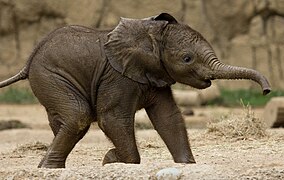 Baby elephant playing at the zoo
 -
 Ring-tailed lemur (Lemur catta)
 -
 Koala
Koala -
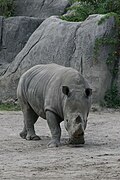 Rhinoceros
 -
 A macaw in flight
 -
 A butterfly on one of the many flowering plants at the zoo
 -
 Endangered species carousel

.jpg)


.jpg)


Other attractions[edit]

The Indianapolis Zoo offers several seasonal amusement rides, animal feedings, rotating exhibits, and presentations for zoo visitors. As of June 2022[update], general admission costs cover seven "featured attractions" at the zoo, including zookeeper-led presentations highlighting the zoo's dolphins, macaws (Magnificent Macaws), and African elephants (Tembo Camp); Shark/Ray Touch Pool; Kangaroo Crossing; Alligators & Crocodiles: The Fight to Survive; and Race A Cheetah. Tickets purchased at additional cost permit visitors to feed flamingos, budgerigars, lorikeets, or giraffes; and enjoy four rides, including the Endangered Species Carousel (carousel); Kōmbo Family Coaster (roller coaster); Skyline (gondola lift); and the White River Junction Train (train ride).[36][37]
Events[edit]
Since 1986, Zoobilation has served as the Indianapolis Zoo's annual black tie fundraiser. The outdoor event takes place each June on the zoo grounds, featuring live music and food and beverages from area restaurants. The 2010 event drew about 4,500 attendees and raised more than $1 million to support the zoo's animal care and conservation efforts.[38][39] The Indianapolis Zoo hosts popular holiday events throughout the year, notably ZooBoo and Christmas at the Zoo. Held annually each October, the Indianapolis Zoo is decorated in recognition of Halloween; ZooBoo encourages guests to wear costumes for trick-or-treating and special programming.[40] Christmas at the Zoo, held from November through December, is credited as the first holiday lights display at a U.S. zoo, having begun in 1967.[41][42]
Conservation and research[edit]

The Indianapolis Zoo has a multifaceted approach in its conservation and research efforts. The zoo participates in the Species Survival Plans (SSPs) and conservation programs of the Association of Zoos and Aquariums, the national zoo membership organization of the U.S. Under the auspices of the Polly H. Hix Institute for Conservation and Research, an initiative that supports the Society's current and future research and conservation programs, the zoo conducts research projects both in situ and ex situ on selected species. The Indianapolis Zoo also participates in three conservation and research foundations: the International Elephant Foundation (IEF), the International Iguana Foundation (IIF), and the International Rhino Foundation (IRF). The Hix Institute also supports the Tarangire Elephant Project in Tanzania to protect migration corridors between Tarangire National Park and the Ngorongoro Conservation Area. The zoo has a second partnership with the IUCN – The World Conservation Union, a conservation network. The Indianapolis Zoo, in partnership with the MacArthur Foundation, is supporting the IUCN's project documenting the known effects of climate change on wildlife habitats.
In March 2019, two female African elephants at the Indianapolis Zoo died from an outbreak of elephant endotheliotropic herpesvirus (EEHV3 strain). Mainly associated with Asian elephants, the EEHV outbreak was a rare instance of the virus infecting elephants of the African species, drawing national interest from researchers.[43] In February 2020, the Indianapolis Zoo hosted a conference convening veterinarians, scientists, and zookeepers from across the U.S. to learn from the case and advance research to benefit conservation efforts.[44]
Indianapolis Prize[edit]
The biennial Indianapolis Prize was established in 2004 to recognize conservationists who have made substantial contributions toward the sustainability of an animal species or group of species. Recipients are awarded the Lilly Medal and US$250,000.[1][45]
Notable animals[edit]
Azy[edit]
_at_the_Indianapolis_Zoo.jpg)
Azy, a male orangutan, has resided at the Indianapolis Zoo since 2010.[46] Born on December 14, 1977, at the National Zoo in Washington, D.C., Azy was a participant in the Smithsonian Institution's Orangutan Language Project, providing researchers and the public insight into great ape language. Dr. Robert Shumaker, current president and chief executive officer of the Indianapolis Zoo, has worked with Azy in cognitive learning since 1984.[47]
Rocky[edit]
Rocky, a male orangutan, has resided at the Indianapolis Zoo since 2010.[46] Rocky has been noted for his unique vocal demonstrations and ability to "speak". In 2017, Rocky's interactions with a zoo guest were captured in a viral video. The guest had recently suffered a burn and had a large bandage covering a portion of her arm and shoulder. The video captures Rocky expressing interest in the bandage, gesturing to it, and seemingly requesting she remove the bandage. The guest did so, and Rocky is seen inspecting her burn.[48]
Tahtsa[edit]
Tahtsa, a female polar bear, resided at the Indianapolis Zoo from 2006 to 2009. Born at the Denver Zoo on November 20, 1974, Tahtsa lived at the Louisville Zoo from March 1976 to October 2006, before her transfer to Indianapolis. Tahtsa died on August 12, 2009, at the age of 34. At the time of her death, she was the oldest polar bear known to be living in captivity or in the wild.[49]
Incidents and controversy[edit]
Since the introduction of common bottlenose dolphins to its collection in 1989, the Indianapolis Zoo has faced criticism from animal welfare advocates, including the Indiana Animal Rights Alliance and the Dolphin Project, founded by activist Ric O'Barry. Concerns about the health of the captive mammals, their use in entertainment, and the results of the zoo's dolphin breeding program have been chief among advocates' complaints. Zoo officials have maintained that the dolphins are cared for in accordance with best practices set forth by the Association of Zoos and Aquariums and serve as "ambassadors for their counterparts in the wild" by educating the public.[50][51][52]
On January 11, 1993, a wallaroo named Mookie escaped his enclosure and cleared the zoo's perimeter fence. Mookie roamed downtown Indianapolis for about 20 minutes before being recaptured unharmed by zoo officials.[53]
On November 8, 1998, a zookeeper cleaning a holding area for Cita—one of the zoo's African elephants—was "slammed" repeatedly by the elephant's trunk, knocking the zookeeper unconscious and breaking several ribs. The zookeeper was hospitalized in critical condition and was later upgraded to fair.[54] Another incident involving the zoo's African elephants occurred on July 18, 2003. Ivory struck and injured a trainer upon reacting to a call from her calf, Ajani. A zoo spokesperson said Ivory was "suffering from separation anxiety during training," as Ajani was in another holding area. The trainer underwent surgery to repair an injury to their lower left leg.[55]
On July 17, 2005, a pack of stray dogs breached the zoo's Australian Plains exhibit, killing two black swans, three magpie geese, and three emus. Indianapolis Police Department officers responded to the scene and attempted to corral the dogs, eventually capturing one but fatally shooting four, while a sixth dog escaped. It was not clear how or where the dogs were able to enter the grounds.[56]
On August 9, 2006, a truck carrying a shipment of 24 penguins, an octopus, and several exotic fish from the Indianapolis Zoo overturned near Marshall, Texas, en route to Moody Gardens in Galveston, Texas. Four penguins and several fish died in the crash.[57]
On November 10, 2007, a fire in the zoo's Critter Corner building killed at least three turtles, two birds, an armadillo, and a snake. Following the incident, People for the Ethical Treatment of Animals called on the U.S. Department of Agriculture (USDA) to investigate.[58] An internal inspection the month prior identified no violations, corroborated by the USDA's post-fire inspection. The likely cause of the fire was attributed to combustible bedding that had been moved too close to a heat lamp.[59]
On January 19, 2009, 15 bonnethead sharks in the zoo's Oceans exhibit died after staff failed to reopen a valve regulating ozone while the tank was undergoing routine maintenance. The incident prompted zoo officials to reevaluate staff training, repair procedures, and life-support system design.[60]
Since its debut in 2014, the zoo's Skyline gondola lift has experienced various technical malfunctions that have stranded passengers in midair on a number of occasions. None of the incidents resulted in injuries.[61][62]
On September 6, 2015, a cheetah named Pounce escaped his enclosure, prompting a one-hour lockdown of the zoo facility. Officials subdued Pounce with a tranquilizer dart before the animal was able to enter a publicly accessible area.[63] No zoo staff or visitors were harmed in the incident.[64][65] In the months following the incident, fencing was added to the cheetah exhibit as part of the zoo's ongoing investments in enclosure safety.[63]
Public art collection[edit]
The Indianapolis Zoo's public art collection is composed of several pieces, including American Bison,[66] North American Plains Animals,[67] and Traditional Chinese Lions.[68] Dedicated in 1999, artist Andrew Reid's Midwestern Panorama is a cylindrical mural located inside the Bud Schaefer Rotunda of White River Gardens.[69] Artist Arthur Kraft's Wynkin, Blynkin and Nod are three bronze penguin statues with a silver ball located in the zoo's Oceans building. Originally displayed at Glendale Town Center from October 1960 to July 2016, the sculptures were loaned to the zoo by owner Kite Realty Group.[70] On December 14, 2017, an Indiana limestone sculpture of Azy (by artist David Petlowany) was unveiled near the zoo's entrance in honor of the resident orangutan's 40th birthday.[71]
See also[edit]
- List of dolphinariums
- List of zoos in the United States
- List of WAZA member zoos and aquariums
- List of botanical gardens and arboretums in Indiana
- List of attractions and events in Indianapolis
- Washington Park (Indianapolis), the baseball field formerly occupying the current zoo site
References[edit]
- ^ a b c d e f g h Shuey, Mickey (December 20, 2019). "Incoming zoo CEO seeks to continue momentum". Indianapolis Business Journal. IBJ Media. Retrieved June 1, 2022.
- ^ a b c d e f Shuey, Mickey (December 1, 2022). "Zoo announcing $53M campaign to fund chimp exhibit, welcome center and more". Indianapolis Business Journal. Retrieved December 7, 2022.
- ^ a b c d e f "2020 Indianapolis Zoo Annual Report". Indianapolis Zoo. pp. 18, 21–22, 28, 138. Retrieved May 29, 2022.
- ^ "Currently Accredited Zoos and Aquariums". aza.org. AZA. Retrieved 19 January 2013.
- ^ "List of Accredited Museums" (PDF). aam-us.org. AAM. Retrieved 19 January 2013.
- ^ Hurst, Richard M.; Hillier-Geisler, Megan (2021) [1994]. "Indianapolis Zoo". Digital Encyclopedia of Indianapolis. Indianapolis Public Library. Retrieved May 29, 2022.
- ^ a b "Indianapolis Zoo Achieves Accreditation Through the Association of Zoos & Aquariums" (Press release). Indianapolis: Indianapolis Zoological Society. October 25, 2021. Retrieved June 1, 2022.
- ^ Hillier-Geisler, Megan (March 2021). "Indianapolis Prize". Digital Encyclopedia of Indianapolis. Indianapolis Public Library. Retrieved May 29, 2022.
- ^ "Indianapolis Zoo gets $4M grant to establish global center for species survival". Indianapolis Business Journal. IBJ Media. October 18, 2019. Retrieved June 1, 2022.
- ^ "Parking and Directions". Indianapolis Zoo. Retrieved June 3, 2022.
- ^ "Route 8 2022" (PDF). Indianapolis Public Transportation Corporation. Retrieved June 3, 2022.
- ^ "Washington Rerouting To Begin". The Indianapolis Star. April 27, 1984. p. 19. Retrieved June 2, 2022 – via Newspapers.com.
A groundbreaking ceremony has been set for May 4 for the $11.4 million rerouting of Washington Street, including a new bridge over the White River. The road is being relocated to make way for the new Indianapolis Zoo, which will be the largest feature in White River State Park.
- ^ Livers-Powers, Crystal (October 11, 1995). "Downtown Canal expansion begins". The Indianapolis News. p. 1. Retrieved June 3, 2022 – via Newspapers.com.
The canal will then turn south and feed into a basin near the Old Washington Street Bridge, which will be renovated during the project. The bridge will be transformed into a pedestrian crossing to the Indianapolis Zoo.
- ^ Swiatek, Jeff (March 20, 1997). "Floating toward the finish". The Indianapolis Star. p. 2. Retrieved June 2, 2022 – via Newspapers.com.
Designers also built a walkway atop the original roadbed of the National Road, which runs through the site to the river, where covered wagons carrying settlers once forded the water. The project also includes a $2.5 million conversion of the old Washington Street Bridge into a 950-foot-long plaza. It leads to the Indianapolis Zoo on the other side of the river.
- ^ a b "Indianapolis Never Really Had Big Zoo Before". The Indianapolis Star. April 15, 1964. p. 3A. Retrieved June 25, 2022 – via Newspapers.com.
The nearest early-day approach to a real zoo came in 1906 when the Indianapolis Park Department moved exhibits of animals from several other parks into one fairly sizable exhibit at Riverside Park. A bear, several monkeys and birds had been shown at Garfield Park. Brookside had an assortment of birds, such as cockatoos, parrots and macaws. Riverside itself had a pair of sea lions in a concrete basin. Within a year, the Riverside menagerie contained several horses, elk, deer, bears, wolves, raccoons, a flock of sheep, squirrels, ducks, rabbits, pheasants, a badger and a sea gull. In 1916, with the United States drawing near to participation in World War I, the Riverside zoo was abolished.
- ^ "Plans for a "zoo"". The Indianapolis Star. May 18, 1906. p. 11. Retrieved June 25, 2022 – via Newspapers.com.
Believed all animals will be housed at Riverside by end of summer.
- ^ "Park pet bear sold in steaks". The Indianapolis Star. December 21, 1917. p. 9. Retrieved June 25, 2022 – via Newspapers.com.
Her passing as bear steaks marks the end of the zoo at Riverside Park. War time economy lead the park board to sell Old Molly after she had been the park attraction for years and years. (...) One by one zoo attractions have been sold or have died until now not a single animal except horses is owned by the park board. Elk, deer, coyotes, pheasants, birds, monkeys and even a few snakes have been in the varied collection at Riverside and other parks, but now all are gone. War-time conservation has prevailed.
- ^ a b c d Indianapolis Zoological Society. "The History of the Indianapolis Zoo". Archived from the original on August 19, 2012. Retrieved November 8, 2012.
- ^ Ambrose, Eileen (March 3, 1993). "A man with a vision". The Indianapolis News. pp. A1–A2. Retrieved June 26, 2022 – via Newspapers.com.
Since taking over in January as president and chief executive officer of the Indianapolis Zoo, Bonner has plenty of ideas on how to take the zoo into the next century.
- ^ "The History of the Indianapolis Zoo". indianapoliszoo.com. Indianapolis Zoological Society. Archived from the original on 19 August 2012. Retrieved 19 September 2011.
- ^ a b Fleming, Marcella (March 9, 2000). "Baby elephant gains fame, awaits name". The Indianapolis Star. p. 21. Retrieved June 2, 2022 – via Newspapers.com.
Whatever her name, you can call her Number One: She is the first African elephant conceived via artificial insemination.
- ^ Rochon, Michael J. (June 7, 2002). "New zoo chief aims to make education fun". The Indianapolis Star. pp. B1, B6. Retrieved June 26, 2022 – via Newspapers.com.
Michael Crowther, who was named president and CEO of the Indianapolis Zoological Society on Thursday, helped make the New Jersey State Aquarium one of the top four tourist attractions in the Philadelphia region.
- ^ Penner, Diana (May 22, 2005). "Dolphin Adventure". The Indianapolis Star. pp. B1, B3. Retrieved June 26, 2022 – via Newspapers.com.
Indianapolis Zoo officials hope the reopening of the dolphin pavilion this week after a $10 million renovation will not only add some luster to the exhibit but also a little sparkle to the zoo's regional and national reputation. (...) An in-water program will be offered in a limited way this year, mostly in the fall.
- ^ "Indy Zoo Breaks Ground On International Orangutan Exhibit". The Indy Channel. Retrieved 30 October 2012.
- ^ Schouten, Cory (September 4, 2012). "Zoo breaks ground on $21M orangutan exhibit". Indianapolis Business Journal. IBJ Media. Retrieved November 6, 2012.
- ^ a b c Milz, Mary. "Indy Zoo breaks ground on new orangutan exhibit". WTHR.com. Retrieved 30 October 2012.
- ^ Shuey, Mickey (October 2, 2019). "Indianapolis Zoo secures 28 acres of land for expansion". Indianapolis Business Journal. IBJ Media. Retrieved June 20, 2022.
- ^ "Landscape Full of Changes in White River Gardens" (Press release). Indianapolis: Indianapolis Zoological Society. September 8, 2021. Retrieved June 20, 2022.
- ^ "Plains". Indianapolis Zoo. Retrieved June 25, 2022.
- ^ "Flights of Fancy". Indianapolis Zoo. Retrieved June 25, 2022.
- ^ a b "Two Remarkable Raptors Join Flights of Fancy Flock" (Press release). Indianapolis: Indianapolis Zoological Society. December 15, 2021. Retrieved June 28, 2022.
- ^ a b c "Animal Adventures". Indianapolis Zoo. Retrieved June 28, 2022.
- ^ "Forests". Indianapolis Zoo. Retrieved June 25, 2022.
- ^ "Oceans". Indianapolis Zoo. Retrieved June 25, 2022.
- ^ "Plains". Indianapolis Zoo. Retrieved June 25, 2022.
- ^ "Indianapolis Zoo Map" (PDF). Indianapolis Zoo. May 2022. Retrieved June 11, 2022.
- ^ "Discover Our Rides and Attractions". indianapoliszoo.com. Indianapolis Zoo. Retrieved June 11, 2022.
- ^ Kightlinger, Cathy (June 20, 2010). "Charity event was on the wild side". The Indianapolis Star. p. 11. Retrieved June 11, 2022 – via Newspapers.com.
Fashion followers are always assured an eyeful at Zoobilation, the Indianapolis Zoo's annual black-tie fundraiser presented by Indianapolis Power & Light Co. The first Zoobilation was held in 1986 when a few hundred people gathered at mall magnate Herb Simon's house. (...) Zoobilation is held outdoors on the grounds of the Indianapolis Zoo each June, forcing guests to find creative ways to look festive while staying comfortable. (...) This year, about 4,500 turned up for the colorful June 11 event, which brought in more than $1 million (a record) for the zoo's endeavors.
- ^ "Zoobilation". indianapoliszoo.com. Indianapolis Zoo. Retrieved June 11, 2022.
- ^ "ZooBoo". indianapoliszoo.com. Indianapolis Zoo. Retrieved June 11, 2022.
- ^ "Christmas at the Zoo". indianapoliszoo.com. Indianapolis Zoo. Retrieved June 11, 2022.
- ^ Mack, Justin L. (December 21, 2019). "6 sports to hang out with wild animals". The Indianapolis Star. pp. A3. Retrieved June 11, 2022 – via Newspapers.com.
The event dates back to 1967, making the Indianapolis Zoo the first zoo in the nation to hold a holiday lights event, according to the zoo officials.
- ^ Karimi, Faith (March 28, 2019). "2 female elephants die days apart after testing positive for herpesvirus at Indianapolis Zoo". CNN. Cable News Network (CNN). Retrieved June 6, 2022.
- ^ Villanueva-Almanza, Lorena (August 16, 2020). "Deaths of 2 elephants could help save others". The Indianapolis Star. pp. A27–A28. Retrieved June 6, 2022 – via Newspapers.com.
In March of 2019, the Indianapolis Zoo lost the two young females during an outbreak of Elephant Endotheliotropic Herpesvirus, or EEHV, Hemorrhagic Disease – a disease that was previously thought to affect mainly Asian elephants. (...) So in February of 2020, veterinarians, scientists, elephant managers and keepers from all over gathered in the Indianapolis Zoo auditorium for the African Elephant EEHV Workshop. The purpose of the conference was to hear what others had been learning from EEHV in Asian elephants, in hopes of being able to use that knowledge for combating the disease in the African species.
- ^ Gibson, London (September 23, 2021). "Want to hear from one of the world's greatest conservationists? Check out these events". The Indianapolis Star. Retrieved June 2, 2022.
- ^ a b Rudavsky, Shari (May 18, 2014). "Aptitude for apes". The Indianapolis Star. p. A17. Retrieved June 26, 2022 – via Newspapers.com.
Azy, Rocky, Knobi and Katy followed Shumaker to Indiana from Iowa in 2010.
- ^ Kean Tabor, Brenda (Autumn 2000). "At Zoo, orangutans use symbols, labels to communicate with humans" (PDF). Smithsonian Institution Research Reports. 102: 1, 6. Retrieved June 26, 2022.
- ^ Barack, Meredith (August 14, 2017). "Woman's unusual connection with Indy orangutan". WRTV. Retrieved February 28, 2020.
- ^ Penner, Diana (August 13, 2009). "Polar bear was world's oldest". The Indianapolis Star. pp. A17–A18. Retrieved June 5, 2022 – via Newspapers.com.
The 34-year-old was the oldest polar bear known to be living in captivity or the wild. (...) Tahtsa, born November 20, 1974, had been declining for years with age-related health problems. (...) Tahtsa had a sister, Becky, who died at age 30 in 2007 at the Denver Zoo. That's also where Tahtsa was born. She lived most of her life in Louisville, Ky., from March 1976 until October 10, 2006, when she came to Indianapolis on loan.
- ^ Clark, Andrew (May 11, 2019). "Protesters call for Indianapolis Zoo to free dolphins from captivity". The Indianapolis Star. Retrieved June 11, 2022.
- ^ "Empty the Tanks protest at Indianapolis Zoo". NUVO. June 3, 2014. Retrieved June 11, 2022.
- ^ Penner, Diana (August 29, 1993). "Protestors whale away at zoo for efforts to get more marine mammals". The Indianapolis Star. pp. A13. Retrieved June 11, 2022 – via Newspapers.com.
A dozen people got in about a half-hour protest between downpours Saturday, calling on the Indianapolis Zoo to abandon its plans to acquire four more false killer whales. (...) The zoo points to the pregnancies as evidence of the success of its breeding program; the protestors point to the death of the dolphin calf, as well as the two adult animals that have died, as evidence of the zoo's inability to ensure the animals' safety.
- ^ "Retro Indy: Heads turn Downtown as wallaroo hops on by". The Indianapolis Star. January 12, 1993. Retrieved June 20, 2022.
- ^ Fleming, Marcella (November 10, 1998). "Zoo keeper's ribs are broken in elephant attack". The Indianapolis Star. pp. B4. Retrieved June 11, 2022 – via Newspapers.com.
Mackie, 28, was listed in fair condition Monday at Wishard Memorial Hospital, upgraded from critical. (...) Mackie was cleaning the animal's area Sunday afternoon when she noticed the adult female elephant, Cita, raising her head in a threatening gesture toward another in the herd as they gathered around the pond. (...) The animal slammed Mackie several times with her trunk – a giant appendage powered by more than 40,000 muscles. Mackie lost consciousness briefly before awakening and calling other keepers for help.
- ^ Bird, Paul (July 20, 2003). "Protective elephant injures trainer at zoo". The Indianapolis Star. pp. A1. Retrieved June 11, 2022 – via Newspapers.com.
An Indianapolis Zoo trainer is recovering from surgery after being injured by a head thrust from a female African elephant. Zoo officials said the elephant, Ivory, was reacting to a call from her 2,000-pound calf. Officials said Ivory backed off on command after the attack that injured the trainer's lower left leg. 'She was suffering from separation anxiety during training,' said Judy Gagen, a zoo spokeswoman.
- ^ Kightlinger, Cathy; Schrader, Jordan (July 18, 2005). "City police gun down wild dogs that killed zoo birds". The Indianapolis Star. pp. A1–A9. Retrieved June 6, 2022 – via Newspapers.com.
In what officials are calling the first attack of its kinds at the city's zoo, the dogs destroyed all the birds in the Australian exhibit early Sunday morning, including two black swans, three magpie geese, and three emus. (...) Police arrived and used shotguns to kill four – three male Labrador-chow mixes and a female terrier mix – after efforts to corral them failed. An adult male pitbull was captured with a wire noose, and a sixth dog had not yet been captured late Sunday. (...) The zoo has a solid perimeter fence, cameras and security staff on duty around the clock, with police patrolling outside, so just how the dogs got in remains a mystery.
- ^ "Penguins, octopus and fish in highway crash". The Guardian. August 10, 2006. Retrieved June 11, 2022.
- ^ "Activists ask USDA to investigate zoo fire". The Indianapolis Star. November 15, 2007. pp. B1. Retrieved June 11, 2022 – via Newspapers.com.
People for the Ethical Treatment of Animals called on the U.S. Department of Agriculture to investigate the deaths of several animals after a fire at the Indianapolis Zoo. At least three turtles, two birds, an armadillo, and a snake died Saturday, and many more animals remain under observation, according to the animal rights group.
- ^ O'Neal, Kevin (November 29, 2007). "Bedding, heat lamp likely set off zoo fire". The Indianapolis Star. pp. B2. Retrieved June 11, 2022 – via Newspapers.com.
An armadillo at the Indianapolis Zoo likely rooted some of its bedding too close to a heat lamp, setting off a fire earlier this month that killed it and several other animals. (...) The Critter Corner building was inspected in October, and no problems were found, according to the zoo. A further post-fire inspection by the U.S. Department of Agriculture, which regulates animal care, showed no violations.
- ^ Ryckaert, Vic (January 21, 2009). "15 sharks die at zoo after staffer's error". The Indianapolis Star. pp. A31–A32. Retrieved June 11, 2022 – via Newspapers.com.
Fifteen bonnethead sharks in the Indianapolis Zoo's popular Oceans exhibit died Monday when a routine maintenance procedure went wrong. (...) The accident occurred after workers cut power to the tank's sophisticated life-support devices to repair a hole in the filtration system. When workers turned the power back on about 1 p.m., they did not reopen a valve regulating ozone, and the machine pumped too much into the tank. (...) Grayson said the zoo is evaluating its training, repair procedures and life-support system design to ensure the same kind of mistake does not happen again.
- ^ Robinson, Emilee (June 19, 2017). "Five rescued after being trapped mid-air in Indianapolis Zoo Skyline ride". The Indianapolis Star. Retrieved June 11, 2022.
- ^ Herrick, John (October 23, 2021). "Power outage forces rescue operation on Indianapolis Zoo Skyline". WIBC. Retrieved June 11, 2022.
- ^ a b Brilliant, Jeremy (June 2, 2016). "Indianapolis Zoo spent over $1M on safety of animal enclosures". WTHR. Retrieved June 20, 2022.
- ^ Shapiro, Emily (September 6, 2015). "Cheetah Escapes From Enclosure at Indianapolis Zoo". ABC News. Retrieved June 20, 2022.
- ^ Mack, Justin L. (September 6, 2015). "Indy Zoo corrals cheetah, investigation underway". The Indianapolis Star. Retrieved June 20, 2022.
- ^ "American Bison, (sculpture)". Smithsonian American Art Museum's Inventories of American Painting and Sculpture database. Smithsonian Institution Research Information System (SIRIS). 1993. Retrieved June 10, 2022.
- ^ "North American Plains Animals, (sculpture)". Smithsonian American Art Museum's Inventories of American Painting and Sculpture database. Smithsonian Institution Research Information System (SIRIS). 1993. Retrieved June 10, 2022.
- ^ "(Pair of Traditional Chinese Lions), (sculpture)". Smithsonian American Art Museum's Inventories of American Painting and Sculpture database. Smithsonian Institution Research Information System (SIRIS). 1992. Retrieved June 10, 2022.
- ^ "Midwestern Panorama". indyartsguide.org. Arts Council of Indianapolis. Retrieved June 10, 2022.
- ^ Rudavsky, Shari (July 22, 2016). "Where did Glendale penguins go? Answer is obvious". The Indianapolis Star. Retrieved June 19, 2022.
- ^ Clark, Andrew (December 14, 2017). "Beloved Indianapolis Zoo orangutan, Azy, gets a special birthday bash". The Indianapolis Star. Retrieved June 19, 2022.
External links[edit]

| International | |
|---|---|
| National | |
| Geographic | |
