


InterCity 225
| InterCity 225 | |||||||||||
|---|---|---|---|---|---|---|---|---|---|---|---|
 LNER InterCity 225 on the East Coast Main Line | |||||||||||
| |||||||||||
| |||||||||||
| |||||||||||
| |||||||||||

The InterCity 225 is an electric push-pull high speed train in the United Kingdom, comprising a Class 91 electric locomotive, nine Mark 4 coaches and a Driving Van Trailer (DVT). The Class 91 locomotives were built by British Rail Engineering Limited's Crewe Works as a spin-off from the Advanced Passenger Train project,[3][4] which was abandoned during the 1980s, whilst the coaches and DVT were constructed by Metro-Cammell in Birmingham and Breda (under sub-contract) in Italy, again borrowing heavily from the Advanced Passenger Train. The trains were designed to operate at up to 140 mph (225 km/h) in regular service, but are limited to 125 mph (200 km/h) principally due to a lack of cab signalling and the limitations of the current overhead line equipment. They were introduced into service between 1989 and 1991 for intercity services on the East Coast Main Line (ECML) from London King's Cross to Leeds, York and Edinburgh.
History[edit]
Background[edit]
The origin of the InterCity 225 is closely associated with the East Coast Main Line (ECML) that it has been primarily operated upon. During the 1950s, British Rail had considered electrification of the ECML to be of equal importance to the West Coast Main Line (WCML), but various political factors led to the envisioned electrification programme being delayed for decades; as an alternative, high-speed diesel traction, including the Deltic and InterCity 125, was introduced upon the route during the 1960s and 1970s.[5] During the 1970s, a working group of British Rail and Department for Transport officials determined that, out of all options for further electrification, the ECML represented the best value by far. Its in-house forecasts determined that increases in revenue and considerable reductions in energy and maintenance costs would occur by electrifying the line.[6]
Accordingly, between 1976 and 1991, the ECML was electrified with 25 kV AC overhead lines. The electrification was installed in two phases: The first phase between London (King's Cross) and Hitchin (including the Hertford Loop Line) was carried out between 1976 and 1978 as the Great Northern Suburban Electrification Project, using Mk.3A equipment,[7] covering 30 miles in total.[6][5] In 1984, the second phase commenced to electrify the Northern section to Edinburgh and Leeds. During the late 1980s, the programme was claimed to be the longest construction site in the world, spanning more than 250 miles (400 km).[6]
During 1989, the InterCity 225 was officially introduced to revenue service.[8][9] That same year, the ECML had been energised through to York;[6] two years later, electrification had reached Edinburgh, allowing electric services to begin on 8 July 1991, eight weeks later than scheduled. The ECML electrification programme was completed at a cost of £344.4 million (equivalent to £1,236 million in 2021), a minor overrun against its authorised expenditure of £331.9 million. 40 per cent of the total cost was on new traction and rolling stock and 60 per cent for the electrification of the line.[6]
Options and selection[edit]
The electrification of the ECML necessitated the procurement of new high speed electric traction. The options and requirements for this trainset were hotly deliberated for a number of years. On 7 June 1978, the electric-powered prototype Advanced Passenger Train (APT) was unveiled; it was at one point intended for the APT to be the next major intercity express train.[10] However, due to various factors including technical issues, the APT programme was curtailed during the summer of 1989. Shortly thereafter, two alternative options were explored, an electrified version of the InterCity 125 (known as the HST-E), and the Class 89 mixed-traffic locomotive; these were both intended to a peak service speed of 125 mph.[11]
Some officials within British Rail pushed for more demanding requirements for the future Intercity trainset; reportedly, BR's Director of Mechanical and Electrical Engineering (M&EE) was a strong proponent for increasing the top speed to 140 mph.[11] To facilitate this, tilting train technologies developed for the APT were explored. While BR's board had approved the ordering of a single Class 89 as a prototype, the Strategy Committee queried why the type had been favoured over a proposed 80-tonne Bo-Bo locomotive.[11] While the Class 89 was thought to be a low-risk option for multi-purpose traction, it offered little advantage over the existing Class 87 in terms of speed. At the time, the 1950s era Class 81 and Class 85 electric locomotives were nearing the end of their viable service lives and were quite unreliable, but their withdrawal was effectively ruled out by a national shortage of newer electric traction, in part caused by the APT's cancellation.[11]
A key advantage of the InterCity 225 concept over a Class 89-hauled consist was the lower weight of the former, resulting in less slippage and greater acceleration over the latter.[11] Appraisals also determined that the Class 89 was comparatively inferior in financial terms, in part due to the InterCity 225's prospective compatibility with WCML traction, reducing its development costs. A further cost-saving measure was the decision to base the InterCity 225's technologies on the APT, BR reportedly stated that it had derived 90% of the former's engineering from the latter.[11] Thus, the study group recommended that the InterCity 225 be pursued as the preferred option, while the Class 89 and HST-E initiatives serve as back-ups. Despite this, the HST-E effort was promptly aborted, while Brush Traction decided to de-prioritise work on the Class 89 after learning that it was unlikely to lead to volume production.[11]
By spring 1984, favour was being given towards the adoption of a tilting carriage, tentatively designated as the Mk 4; this was viewed as superior to the existing Mk 3 and enabled a single design to be shared between the ECML and WCML.[11] At one point, it was envisaged that the InterCity 225 would be ubiquitous, even potentially having the capability built into it to operate over the southern third-rail network and within the Channel Tunnel; by mid 1984, such fanciful ideas were curtailed. Furthermore, it was decided to reduce the freight haulage capabilities of the InterCity 225, as traction for this sector was instead intended to be served via other platforms.[11] The emergence of the Class 90, derived from the existing Class 87, somewhat reduced the pressure for the InterCity 225, reducing the prospective numbers to be built of the latter. Without tilting carriages, it had little speed advantage over the Class 90 on the WCML.[11]
It was decided to hold a competitive tender for the InterCity 225 programme; this measure was aimed at avoiding the difficulties experienced with the APT programme.[11] A pre-qualification document was formalised, in which various requirements for the type were laid out; these included the need to perform mixed-traffic duties (day and night passenger, parcel and mail, and overnight heavy freight services), the haulage of both tilting and conventional rolling stock, a top speed of 225 km/h, a maximum cant deficiency of 9° without the provision of tilt equipment, and that the maximum unsprung mass could not exceed 1.8 tonnes. Furthermore, BR stated its readiness to sub-contract with the successful bidder for the supply of technical information, advice and testing.[11] The prequalification document was issued to BREL, Brush Traction and the General Electric Company (GEC), as well as the French firm Alstom and Germany's Krauss Maffei. The inclusion of foreign manufacturers was in part due to the limited domestic experience with trainsets capable of such high top speeds.[11] A total of three companies, ASEA, Brush Traction and GEC, submitted tenders for the design and construction of the Class 91 locomotive.[12]
On 14 February 1985, the BR board approved the substitution of the Class 91 for Class 89 for the ECML programme.[11] The tendering process was relatively complex, but a decisive move appeared to have been GEC's offer of a sub-contracting arrangement to BREL for the construction of the locomotive's mechanical elements. It would be GEC's submission that would be selected as the winner; after which a contract for the construction of 31 Class 91 locomotives, along with an option for 25 more for the WCML, was awarded during February 1986.[6][11] Shortly thereafter, BREL established a production line for the type at its Crewe Works.[11]
Operations[edit]
The InterCity 225 entered service with InterCity on the East Coast Main Line (ECML) in 1989.[9] In service, the InterCity 225 sets were used alongside other rolling stock, including Class 90 locomotives and Class 317 electric multiple units. The displaced diesel trains were reallocated predominantly to the Midland Main Line.[6] The InterCity 225's introduction correlated with a significant increase in passenger numbers using the ECML within two years; one station recorded a 58 per cent increase in passengers.[6]
The InterCity 225 was designed to achieve a peak service speed of 140 mph (225 km/h); during a test run in 1989 on Stoke Bank between Peterborough and Grantham, an InterCity 225 was recorded at a speed of 162 mph (260.7 km/h).[9] Its high speed capabilities were again demonstrated via a 3hr 29mins non-stop run between London and Edinburgh on 26 September 1991.[6] British regulations have since required in-cab signalling on any train running at speeds above 125 mph (201 km/h) preventing such speeds from being legally attained in regular service.[13] Thus, except on High Speed 1, which is equipped with cab signalling, British signalling does not allow any train, including the InterCity 225, to exceed 125 mph (201 km/h) in regular service, due to the impracticality of correctly observing lineside signals at high speed.

The InterCity 225 has also operated on the West Coast Main Line (WCML). In April 1992, one trainset achieved a new speed record of two hours, eight minutes between Manchester and London Euston, shaving 11 minutes off the 1966 record.[14] During 1993, trials were operated to Liverpool and Manchester in connection with the InterCity 250 project.[15]
In 1996, as part of the privatisation of British Rail, all InterCity 225s were sold to Eversholt Rail Group. Since then, the trains have been leased to all operators of the InterCity East Coast franchise, which is presently operated by London North Eastern Railway. Between 2000 and 2005, with support from GNER, Bombardier Transportation, HSBC Rail funded a complete rebuilding and refurbishment programme for both the Class 91 and Mark 4 coaches, called Project Mallard.[16]
In July 2013, it was confirmed that the InterCity 225 fleet would be replaced as part of the Intercity Express Programme, a Department for Transport initiative to replace InterCity 125s and InterCity 225s on the East Coast Main Line and the Great Western Main Line.[17] Introduced in the programme were Class 800 bi-mode and Class 801 electric trains from the Hitachi A-train family, of which the ECML sets were nicknamed Azuma after the Japanese word for "East".
During their operation with Virgin Trains East Coast (VTEC) in 2016, there were plans to retain six to eight sets with shorter rakes for a new London to Edinburgh service, even with the Azuma takeover.[18][citation needed]
In June 2018, London North Eastern Railway (LNER) inherited all 31 InterCity 225 sets from VTEC as part of the franchise. At this point, LNER had no intentions to retain any of the InterCity 225 sets due to high maintenance costs on the fleet.[19] The first Class 800 entered service with LNER on 15 May 2019, allowing for the first withdrawal of an InterCity 225 set.[20][21] The withdrawals have gradually continued as more of the new Azuma trains entered service and at the beginning of 2020, it was planned that the final InterCity 225 sets would leave LNER's fleet by June 2020.[22] However, LNER decided to retain seven sets until 2023 to allow for services to be increased in December 2021.[23] From September 2020, they ceased operating north of York.[24]

With LNER returning the majority of their InterCity 225 sets to Eversholt Rail Group, it has been announced that other companies would be obtaining some of the Mark 4 carriages and Driving Van Trailers. Transport For Wales have leased twelve Mark 4 carriages to replace Mark 3 coaches on its Premier Service.[25] Prospective operator Grand Union is proposing to operate InterCity 225s on London Paddington to Cardiff Central services from December 2020 and London Euston to Stirling services from May 2021.[26][27]
From May 2020, Grand Central were planning to begin using Mark 4 carriages on its new London Euston to Blackpool North services with Class 90 locomotives hauling six-carriage sets.[28] However, these plans were subsequently axed as part of Grand Central's recovery plan due to the COVID-19 pandemic.[29] After losing the West Coast Partnership franchise, Virgin Rail Group had proposed using InterCity 225s on an open access service from London Euston to Liverpool.[30]
In September 2020, Eversholt Rail Group and London North Eastern Railway extended their lease of seven IC225 sets, including ten Class 91 locomotives, to summer 2023, with an option to extend to summer 2024. It will be overhauled at the Wabtec Doncaster plant.[31][32]
At the end of service on 15 January 2021, the remaining serviceable InterCity 225 sets went into storage temporarily as part of the East Coast Upgrade.[33] Originally, the plan was to return the sets to service for 7 June 2021 but instead the first set re-entered service on 11 May 2021 due to a number of Class 800 Azuma sets having to be taken out of service.[34]
Capacity and formation[edit]
The formation of the InterCity 225 sets is below:[35]
- Class 91 Electric Locomotive (North End)
- Coach B – Standard Class – 76 Seats – WC
- Coach C – Standard Class – 76 Seats – WC
- Coach D – Standard Class – 76 Seats – WC
- Coach E – Standard Class – 76 Seats – WC
- Coach F – Standard Class – 72 Seats – Accessible Toilet
- Coach H – Standard Class/Kitchen – 30 Seats – WC
- Coach K – First Class – 43 Seats – WC + 2 Crew Areas
- Coach L – First Class – 40 Seats – Accessible Toilet
- Coach M – First Class – 46 Seats – WC
- Coach P - Driving Van Trailer (London End)
The total numbers of seats are 406 Standard and 129 First, giving the train an overall capacity of 535 seats.
Scale models[edit]
One of the first models of the IC225 in the UK was by Hornby Railways, after previously releasing an OO Gauge BR Class 91 locomotive in 1988.[36] In 1990 Hornby Railways launched its first OO Gauge models of BR MK4 rolling coach stock, consisting of a BR Mk4 Driving Van Trailer (DVT), three BR MK4 coaches, a Tourist Open Coach (TSO), a First Open Coach (FO), and a Catering Service Car (RFM).[37] Hornby Railways launched its first full model version containing a BR Class 91 locomotive, a BR MK4 Driving Van Trailer (DVT), and two MK4 Tourist Open Coaches as a complete train set in 1991.[38]
Gallery[edit]
Exterior[edit]
-
 InterCity 225 set BR Class 91 91018 "Robert Louis Stevenson" at Doncaster with a MK4 coach in original BR InterCity Swallow livery.
 -
 An InterCity 225 at speed on the East Coast Main Line in Nottinghamshire, view on a Class 91 locomotive
 -
 A GNER liveried Mark IV standard coach
 -
 A GNER liveried Mark IV RSM coach
 -
 VTEC InterCity 225 arrives into London Kings Cross, view on a driving van trailer


.jpg)


Interior[edit]
-
 First Class interior on a VTEC InterCity 225 set
 -
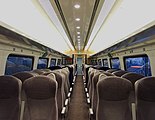 The interior of a refurbished GNER Mark IV TSOE vehicle, showing the small area at the rear of the carriage formerly dedicated for the use of smoking passengers (now no longer permitted on any British trains)
 -
 The interior of a refurbished GNER Mark IV TSO vehicle
 -
 The interior of a refurbished GNER Mark IV RSM vehicle, showing the new Standard Class saloon
 -
 The interior of a refurbished GNER Mark IV RSM vehicle, showing the Cafe-Bar buffet counter


References[edit]
- ^ thejunction.org.uk, rolling stock: class 91, Retrieved on 04-07-2007
- ^ "Oliver Keating, The Inter-city 225, Retrieved on 04-07-2007". Archived from the original on 17 June 2008. Retrieved 4 July 2007.
- ^ "The Design and Development of the Class 91 Locomotive", P J Donnison and G R West, Main Line Railway Electrification Conference 1989 - Proceedings of the Institute of Electrical Engineers, 1989.
- ^ "The design, manufacture and assembly of the British Rail Class 91, 25 kV 225 km/h locomotive", M L Broom and G W Smart, Proceedings of the Institute of Mechanical Engineers Vol. 205, 1990.
- ^ a b Stanton, Peter. "ECML Power Supply Upgrade." Rail Engineer, 23 November 2017.
- ^ a b c d e f g h i Shirres, David. "ECML: Electrification as it used to be". Rail Engineer. Archived from the original on 11 January 2018. Retrieved 10 January 2018.
- ^ "Your NEW Electric Railway, The Great Northern Suburban Electrification" (PDF). British Railways. 1973. Retrieved 18 March 2014.
- ^ Semmens, P.W.B. (March 1991). Electrifying the East Coast Route: Making of Britain's First 140m.p.h. Railway. Patrick Stephens Ltd. ISBN 978-0850599299.
- ^ a b c "Back to the future as history made with east coast rail icons". National Railway Museum. 24 April 2017. Retrieved 10 January 2018.
- ^ "First impressions of ATP-P". Modern Railways. Vol. 35, no. 359. Ian Allan. August 1978. pp. 354–358. ISSN 0026-8356.
- ^ a b c d e f g h i j k l m n o p "FROM THE ARCHIVES: Class 91s...promise unfulfilled". railmagazine.com. 27 July 2019.
- ^ Ford, Roger (April 1988). "Managing Electra". Modern Railways. ISSN 0026-8356.
- ^ Heath, Don (August 1994). "Electrification of British Rail's East Coast Main Line". Proceedings of the Institute of Civil Engineers (Transportation). Paper No. 105: 232.
- ^ New Record for West Coast Route The Railway Magazine issue 1094 June 1992 page 4
- ^ IC225 in West Coast Tests The Railway Magazine issue 1109 September 1993 page 8
- ^ "Bombardier opens refurbishment centre at Derby" (PDF). The Railway Herald. Vol. 1, no. 13. 1 July 2005. p. 6. Archived from the original (PDF) on 9 October 2011. Retrieved 30 June 2011.
Bombardier is also in the process of refurbishing GNER's Mark 4 fleet of coaches and DVTs, but this work which is now approaching completion will remain at the company's Horbury plant
- ^ 2013-07-18T10:03:00+01:00. "East Coast Main Line IEP train order confirmed". Railway Gazette International. Retrieved 6 October 2020.
{{cite web}}: CS1 maint: numeric names: authors list (link) - ^ VTEC and FirstGroup granted East Coast Main Line paths Railway Gazette International 12 May 2016
- ^ "More new trains on LNER wish list". www.railmagazine.com. Retrieved 29 January 2020.
- ^ "Hitachi Azuma Enters Service for LNER". Railway-News. 16 May 2019. Retrieved 29 January 2020.
- ^ First LNER Mk4s taken to Worksop for storage Rail issue 880 5 June 2019 page 29
- ^ "FROM THE ARCHIVES: Traction transition: HST to Azuma". www.railmagazine.com. Retrieved 29 January 2020.
- ^ Eversholt confirms IC225 LNER lease Railways Illustrated November 2020 page 8
- ^ Leeds and York only for LNER InterCity 225s Railways Illustrated September 2020 page 13
- ^ Service Improvements Government of Wales
- ^ "Cardiff – London open access plan - Railway Gazette". 22 June 2019. Archived from the original on 22 June 2019. Retrieved 24 February 2020.
- ^ "Grand Union London to Stirling application" (PDF). Office of Rail and Road. 27 August 2019.
- ^ 2020-02-20T16:48:00+00:00. "Grand Central prepares to launch London – Blackpool services". Railway Gazette International. Retrieved 24 February 2020.
{{cite web}}: CS1 maint: numeric names: authors list (link) - ^ "Grand Central axes Blackpool North to London Euston route as plans are 'unfeasible'". RailAdvent. 10 September 2020. Retrieved 28 September 2020.
- ^ Virgin proposes London-Liverpool open access service Rail issue 881 19 June 2019 page 16
- ^ IC225 Fleet Lease Extension and Overhaul - Eversholt Rail Limited. Retrieved 2020-12-25.
- ^ LNER to retain 10 Class 91s up to 2023, as overhaul contracts awarded - RailAdvent. Retrieved 2020-12-25.
- ^ Horne, David (15 January 2021). "Last day in service for our speed record-breaking #Class91 locomotives today... for a while". Twitter.
- ^ "LNER reintroduces stored InterCity 225 trains into service". Rail Technology Magazine. Retrieved 12 May 2021.
- ^ "Mallard Coach Layouts" (PDF). Archived from the original (PDF) on 9 November 2013.
- ^ "Class 91 Bo-Bo Electric Locomotive". Hornby Railways Collector Guide. Retrieved 31 January 2020.
- ^ "Hornby 1990 Passenger Rolling Stock". Retrieved 31 January 2020.
- ^ "1991 - InterCity 225 Express Train Set". Hornby Railways Collector Guide. Retrieved 31 January 2020.
Further reading[edit]
- Perren, Brian (October 1988). "Class 91 + Mk 4s = IC225". Rail. No. 85. EMAP National Publications. pp. 28–34. ISSN 0953-4563. OCLC 49953699.
External links[edit]
- Testing the InterCity 225
- Running to Time. Channel 4 documentary about the creation and manufacturing of InterCity 225 (1988)
 Media related to British Rail Class 91 at Wikimedia Commons
Media related to British Rail Mk4 coaches at Wikimedia Commons
Media related to British Rail Mk4 DVT at Wikimedia Commons