


Irani café

Irani cafés are Iranian-style cafés in the Indian subcontinent.[1][2] They were originally opened by Zoroastrian Irani immigrants to British India in the 19th century, fleeing Safavid persecution or looking for better economic prospects.[3] In India, Mumbai, Pune and Hyderabad boast a number of Irani cafés, which are very popular for Irani chai (tea).[4][5] In the 1950s, there were 350 Irani cafés; today, only 25 remain.[1] Karachi, Pakistan, was also home to many Irani cafés.[6][7]
History[edit]
They were originally opened by Zoroastrian Irani immigrants to British India in the 19th century after they fled from Safavid persecution in West and Central Asia.[8]
Writing for the Hindu Business Line, on "Mumbai's Irani hotspots", Sarika Mehta stated, "The classic format of these cafes is basic with a subtle colonial touch; high ceilings with black, bent wooden chairs (now cane in some cafes), wooden tables with marble tops and glass jars that allow a peek into the goodies they hold. With huge glass mirrors on the walls to create a feeling of space, visitors are greeted with eagerness and a whiff of baking. The speed of operations is impressive and service quite hassle-free."[9]
-

-
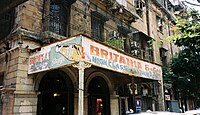 Britannia Café, an Irani café at Ballard Estate, South Mumbai
 -
 Interior of Kayani and Company, an Irani café


Fare[edit]
Irani cafés may serve bun maska (bread and butter)[10] or brun-maska (hard buttered croissants),[11][12] and paani kam chai (a strong Iranian tea, lit. 'tea with less water'), or khari chai (very strong tea), mutton samosas, and kheema pav (minced meat served in bread rolls), akuri (scrambled eggs and vegetables), berry pulao, vegetable puff, vegetarian/chicken dhansak (a spiced lentil dish with meat and vegetables) and biryani, cherry cream custard, cheese khari biscuits, plain khari biscuits, coconut jam and milk biscuits and Duke's raspberry drink.
Many Irani cafés offer sweet and salted biscuits[13] like rawa (semolina), til-rawa coconut, nankhatai (sweet, crisp flaky Irani biscuits), Madeira cake (tutti-frutti biscuits).
Cultural references[edit]
Nissim Ezekiel wrote a poem based on instruction boards found in his favourite Irani café: the defunct Bastani and Company in Dhobi Talao, Mumbai.[14]
In 2020 Neeraj Udhwani made the film Maska.
Footnotes[edit]
- ^ a b Jayshree Bajoria (27 April 2005). "India's Iranian cafes fading out". BBC News. Archived from the original on 8 October 2007. Retrieved 25 December 2007.
- ^ "Parsi Cafes, A Centuries-Old Tradition In India, Are Vanishing". NPR.org. Archived from the original on 12 July 2019. Retrieved 14 March 2020.
- ^ Masashi, Haneda (October 1997). "Emigration of Iranian Elites to India during the 16-18th centuries". Cahiers d'Asie Centrale (3/4): 129–143. Archived from the original on 14 July 2013. Retrieved 17 December 2013.
- ^ "Quintessentially Hyderabadi—Irani Tea". New Indian Express. 6 March 2015. Archived from the original on 24 September 2016. Retrieved 20 November 2017.
- ^ Naomi Lobo (May 20, 2007). "Irani cafés: Inheritance of loss". India Express. Archived from the original on February 6, 2012. Retrieved December 25, 2007.
- ^ "Where have the Iranian restaurants gone?". Dawn. 26 July 2015. Archived from the original on 28 July 2015. Retrieved 26 July 2015.
- ^ Noorani, Asif (10 September 2016). "Looking back at Karachi's Irani cafe culture". Dawn. Archived from the original on 10 September 2016. Retrieved 10 September 2016.
- ^ Krishna, Anubhuti (28 June 2018). "Irani cafes make a millenial comeback". The Hindu. ISSN 0971-751X. Archived from the original on 5 July 2018. Retrieved 31 May 2019.
- ^ "The Hindu Business Line : Mumbai's Irani hotspots". Archived from the original on 2 October 2007. Retrieved 24 December 2007.
- ^ Miguel, H.S. (2012). Mumbai. Intellect Books - World Film Locations Series (in Indonesian). Intellect Books. p. 58. ISBN 978-1-84150-632-6. Archived from the original on 11 August 2023. Retrieved 21 February 2018.
- ^ Koppikar, Smruti (28 March 2005). "Alvida, Brun-Maska | Outlook India Magazine". Outlook India. Archived from the original on 5 November 2022. Retrieved 14 March 2020.
- ^ Noronha, Paul (27 October 2012). "Bye-bye to Brun maska?". The Hindu. ISSN 0971-751X. Archived from the original on 30 August 2021. Retrieved 14 March 2020.
- ^ Damle, J.Y. (2011). Pune: Tradition to Market: a Study of Changing Trends in Consumption with Special Reference to Service Sector in Hotel Industry. Kalpaz Publications. p. 117. ISBN 978-81-7835-895-6. Retrieved 21 February 2018.
- ^ "Sunanda Sudhir". newsblog.aol. Archived from the original on 11 January 2008. Retrieved 25 December 2007.
Further reading[edit]
- India's Iranian cafes fading out by Jayshree Bajoria for BBC News, Mumbai[permanent dead link]
- Mumbai's Irani hotspots – Sarika Mehta in Hindu Business line
- AOL News Blog - Sunanda Sudhir Archived 11 January 2008 at the Wayback Machine
External links[edit]

- Irani (India) people
- Indian drinks
- Coffeehouses and cafés in India
- Coffeehouses and cafés in Pakistan
- Culture of Mumbai
- Culture of Pune
- Culture of Hyderabad, India
- Culture of Karachi
- Restaurants in Mumbai
- Restaurants in Pune
- Restaurants in Hyderabad, India
- Bakery cafés
- Indian fusion cuisine
- Pakistani fusion cuisine