


Jatropha
| Jatropha | |
|---|---|

| |
| Spicy Jatropha (Jatropha integerrima) | |
Scientific classification 
| |
| Kingdom: | Plantae |
| Clade: | Tracheophytes |
| Clade: | Angiosperms |
| Clade: | Eudicots |
| Clade: | Rosids |
| Order: | Malpighiales |
| Family: | Euphorbiaceae |
| Subfamily: | Crotonoideae |
| Tribe: | Jatropheae |
| Genus: | Jatropha L.[1] |
| Species | |
|
Approximately 170, see Section Species. | |


Jatropha is a genus of flowering plants in the spurge family, Euphorbiaceae. The name is derived from the Greek words ἰατρός (iatros), meaning "physician", and τροφή (trophe), meaning "nutrition", hence the common name physic nut. Another common name is nettlespurge.[2] It contains approximately 170 species of succulent plants, shrubs and trees (some are deciduous, like Jatropha curcas). Most of these are native to the Americas, with 66 species found in the Old World.[3] Plants produce separate male and female flowers. As with many members of the family Euphorbiaceae, Jatropha contains compounds that are highly toxic. Jatropha species have traditionally been used in basketmaking, tanning and dye production. In the 2000s, one species, Jatropha curcas, generated interest as an oil crop for biodiesel production and also medicinal importance when used as lamp oil; native Mexicans in the Veracruz area developed by selective breeding a Jatropha curcas variant lacking the toxic compounds, yielding a better income when used as source for biodiesel, because of its edible byproduct. Toxicity may return if edible Jatropha is pollinated by toxic types.
Uses
[edit]
The stems of haat (Jatropha cuneata) are used for basketmaking by the Seri people in Sonora, Mexico. The stems are roasted, split and soaked through an elaborate process. The reddish dye that is often used is made from the root of another plant species, Krameria grayi. Spicy jatropha (J. integerrima) is cultivated as an ornamental in the tropics for its continuously blooming crimson flowers. Buddha belly plant (J. podagrica) was used to tan leather and produce a red dye in Mexico and the southwestern United States. It is also used as a house plant.
The oil from Jatropha curcas is mainly converted into biodiesel for use in diesel engines.[4] It is also used for thermal energy storage or as heat transfer fluid at medium and high temperature.[5][6][7] The cake resulting from oil extraction, a protein-rich product, can be used for fish or animal feed (if detoxified). It is also a biomass feedstock to power electricity plants or to produce biogas, and a high-quality organic fertilizer.[8]
In 2007, Goldman Sachs cited Jatropha curcas as one of the best candidates for future biodiesel production.[9] It is resistant to drought and pests, and produces seeds containing 27-40% oil,[10] averaging 34.4%.[11] The remaining press cake of jatropha seeds after oil extraction could also be considered for energy production.[12] However, despite their abundance and use as oil and reclamation plants, none of the Jatropha species have been properly domesticated and, as a result, their productivity is variable, and the long-term impact of their large-scale use on soil quality and the environment is unknown.[13] 2009 research found that Jatropha biodiesel production requires significantly more water than other common biofuel crops, and that initial yield estimates were high.[14] Earlier, higher estimates from Worldwatch Institute had suggested that 1 acre of cultivation could yield 202 gallons (4.8 barrels) of biodiesel.[15]
Jatropha curcas is also being studied for use as a carbon sequestration plant in arid regions.[16]
Toxicity
[edit]Much like other members of the family Euphorbiaceae, members of the genus Jatropha contain several toxic compounds. The seeds of Jatropha curcas contain toxic lectin dimers and carcinogenic phorbol esters.[17] Despite this, the seeds are occasionally eaten after roasting, which reduces some of the toxicity. Its sap is a skin irritant, and ingesting as few as three untreated seeds can be fatal to humans. In 2005, Western Australia banned Jatropha gossypiifolia as invasive and highly toxic to people and animals.[18] It continues to be used as a medicine in certain geographic regions; however one study found the dried leaf to have no anti-fungal activity.[19]
Selected species
[edit]_in_Hyderabad,_AP_W_IMG_9219.jpg)

_in_Hyderabad_W_IMG_8812.jpg)
- Jatropha acanthophylla Loefgr.
- Jatropha bullockii E.J.Lott
- Jatropha cardiophylla (Torr.) Müll.Arg. – Sangre de Cristo
- Jatropha cathartica Terán & Berland. – Berlandier's nettlespurge
- Jatropha chamelensis Pérez-Jiménez
- Jatropha costaricensis G.L.Webster & Poveda
- Jatropha cinerea (Ortega) Müll.Arg. – Arizona nettlespurge
- Jatropha cuneata Wiggins & Rollins – Limberbush, haat (pronounced [ʔaːt])
- Jatropha curcas L. – Physic nut, piñoncillo, habb-el-melúk
- Jatropha dhofarica Radcl.-Sm.
- Jatropha dioica Sessé – Leatherstem
- Jatropha elliptica (Pohl) Oken
- Jatropha excisa Griseb.
- Jatropha gossypiifolia L. – Bellyache bush
- Jatropha hernandiifolia Vent. – Wild oilnut
- Jatropha integerrima Jacq. syn. J. pandurifolia – Spicy jatropha, called in Chinese "ri ri ying", which means "every-day-flowered cherry blossom"[20]
- Jatropha macrantha Mull. Arg – Huanarpo macho or Peruvian Viagra
- Jatropha macrorhiza Benth. – Ragged nettlespurge
- Jatropha multifida L. – Coralbush
- Jatropha nudicaulis Benth.
- Jatropha rivae pax
- Jatropha podagrica Hook. – Buddha belly plant, bottleplant shrub
- Jatropha unicostata Balf.f.[21][22]
Gallery
[edit]-
 Flowers of Jatropha multifida in El Crucero, Managua, Nicaragua.
 -
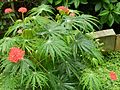 Jatropha multifida plant in El Crucero, Managua, Nicaragua.
 -
 Flowers of Jatropha multifida with blue butterfly in El Crucero, Managua, Nicaragua.
 -
 Flowers and leaves of Jatropha multifida in El Crucero, Managua, Nicaragua.
 -
 Jatropha integerrima
 -
 Jatropha podagrica
 -
 Jatropha pandurifolia
 -
 Close-up of Jatropha podagrica
 -
 Jatropha integerrima Jacq. in Thailand
 -
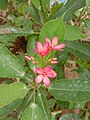 Jatropha integerrima in West Bengal, India.


.jpg)

Formerly placed here
[edit]- Aleurites moluccanus (L.) Willd. (as J. moluccana L.)
- Baliospermum solanifolium (Willd.) Müll.Arg. (as J. montana Willd.)
- Cnidoscolus aconitifolius (Mill.) I.M.Johnst. (as J. aconitifolia Mill.)
- Cnidoscolus angustidens Torr. (as J. angustidens (Torr.) Müll.Arg.)
- Cnidoscolus quercifolius Pohl (as J. phyllacantha Müll.Arg.)
- Cnidoscolus stimulosus (Michx.) Engelm. & A.Gray (as J. stimulosa Michx.)
- Cnidoscolus texanus (Müll. Arg.) Small (as J. texana Müll.Arg.)
- Cnidoscolus tubulosus (Müll. Arg.) I.M.Johnst. (as J. tepiquensis Costantin & Gallaud and J. tubulosa Müll.Arg.)
- Cnidoscolus urens (L.) Arthur (as J. urens L.)
- Hyaenanche globosa (Gaertn.) Lamb. (as J. globosa Gaertn.)
- Manihot esculenta subsp. esculenta (as J. dulcis J.F.Gmel. and J. manihot L.)
- Manihot carthagenensis subsp. carthagenensis (as J. carthagenensis Jacq.)
- Manihot tripartita subsp. tripartita (as J. tripartita Spreng.)[21]
Synonyms
[edit]- Adenorhopium Rchb.
- Adenoropium Pohl
- Castiglionia Ruiz & Pav.
- Collenucia Chiov.
- Curcas Adans.
- Jatropa Scop., orth. var.
- Loureira Cav.
- Mesandrinia Raf.
- Mozinna Ortega
- Zimapania Engl. & Pax[1]
References
[edit]- ^ a b "Genus: Jatropha L". Germplasm Resources Information Network. United States Department of Agriculture. 2007-10-05. Archived from the original on 2010-05-28. Retrieved 2010-08-13.
- ^ NRCS. "Jatropha". PLANTS Database. United States Department of Agriculture (USDA). Retrieved 27 May 2015.
- ^ Heller, Joachim (1996). Promoting the Conservation and Use of Underutilized and Neglected Crops Volume 1: Physic Nut, Jatropha Curcas L. Bioversity International. p. 7. ISBN 9789290432784.
- ^ Ajayebi, Atta (2013). "Comparative life cycle assessment of biodiesel from algae and jatropha: A case study of India". Bioresource Technology. 150: 429–437. Bibcode:2013BiTec.150..429A. doi:10.1016/j.biortech.2013.09.118. PMID 24140355.
- ^ Kenda, Eric Serge; N’Tsoukpoe, Kokouvi Edem; Ouédraogo, Igor W. K.; Coulibaly, Yézouma; Py, Xavier; Ouédraogo, Fabrice Marie Armel W. (2017-10-01). "Jatropha curcas crude oil as heat transfer fluid or thermal energy storage material for concentrating solar power plants". Energy for Sustainable Development. 40: 59–67. doi:10.1016/j.esd.2017.07.003. ISSN 0973-0826.
- ^ Gomna, Aboubakar; N’Tsoukpoe, Kokouvi Edem; Le Pierrès, Nolwenn; Coulibaly, Yézouma (2020-04-15). "Thermal stability of a vegetable oil-based thermal fluid at high temperature". African Journal of Science, Technology, Innovation and Development. 12 (3): 317–326. doi:10.1080/20421338.2020.1732080. ISSN 2042-1338.
- ^ N’Tsoukpoe, Kokouvi Edem; Le Pierrès, Nolwenn; Seshie, Yao Manu; Coulibaly, Yézouma (2021-02-23). "Technico-economic comparison of heat transfer fluids or thermal energy storage materials: A case study using Jatropha curcas oil". African Journal of Science, Technology, Innovation and Development. 13 (2): 193–211. doi:10.1080/20421338.2020.1838082. ISSN 2042-1338.
- ^ Heuzé V., Tran G., Edouard N., Renaudeau D., Bastianelli D., Lebas F., 2016. Jatropha (Jatropha sp.) kernel meal and other jatropha products. Feedipedia, a programme by INRA, CIRAD, AFZ and FAO. https://www.feedipedia.org/node/620 Last updated on April 15, 2016, 10:17
- ^ Jatropha Plant Gains Steam In Global Race for Biofuels
- ^ Achten WMJ, Mathijs E, Verchot L, Singh VP, Aerts R, Muys B 2007. Jatropha biodiesel fueling sustainability?. Biofuels, Bioproducts and Biorefining 1(4), 283-291.[1] doi:10.1002/bbb.39The Jatropha Archives
- ^ Achten WMJ, Verchot L, Franken YJ, Mathijs E, Singh VP, Aerts R, Muys B 2008. Jatropha bio-diesel production and use. (a literature review) Biomass and Bioenergy 32(12), 1063-1084.[2] doi:10.1016/j.biombioe.2008.03.003The Jatropha Archives
- ^ Jongschaap REE, Blesgraaf RAR, Boogaard TA, Van Loo EN, Savenije HHG. The water footprint of bioenergy from Jatropha curcas L. Proc Natl Acad Sci USA 106(35)E92. doi:10.1073/pnas.0907272106
- ^ World Agroforestry Centre (2007) When oil grows on trees[permanent dead link] World Agroforestry Centre press release. 26 April 2009.
- ^ Morrison, Chris (9 June 2009). "Miracle Biofuel Plant Jatropha Reveals Its Achilles Heel". CBS. CBS Money Watch. Retrieved 21 June 2016.
- ^ Cox, Craig. "After Oil". Vol. 5, no. 6, July/August 2007. Ode Magazine. p. 54.
- ^ K. Becker, V. Wulfmeyer, T. Berger, J. Gebel, and W. Münch: "K. Becker1, V. Wulfmeyer2, T. Berger3, J. Gebel4, and W. Münch", Earth system dynamics, 4, 237-251, 2013.
- ^ "Drugs and Poisons: Toxalbumins - Peas and beans gone bad". Archived from the original on 2010-03-26. Retrieved 2010-06-26.
- ^ MacIntyre, Ben (2007-07-08). "Poison plant could help to cure the planet". The Times. London. Archived from the original on September 6, 2008. Retrieved 2008-06-09.
- ^ Ilango, S. and David Paul Raj RS. 2015. Effect of Arbuscular Mycorrhizae on Jatropha curcas further its effect on tissue culture and leaf extract for antifungal property. url=http://www.annalsofplantsciences.com/index.php/aps/article/view/189
- ^ Staff, South China Botanical Garden, Chinese Academy of Sciences. Jatropha pandurifolia Archived 2011-08-18 at the Wayback Machine
- ^ a b "Species Records of Jatropha". Germplasm Resources Information Network. United States Department of Agriculture. Archived from the original on 2012-12-11. Retrieved 2011-03-19.
- ^ "Jatropha". Integrated Taxonomic Information System. Retrieved 2012-07-09.
External links
[edit]

- BBC News report of Jatropa Biofuel
- "Size does matter - The possibilities of cultivating Jatropha curcas for biofuel production in developing countries". Archived from the original on 2021-06-22. Retrieved 2012-10-13. Case study report on the relationship with food security, provides references and background information.
- Polgreen, Lydia (September 9, 2007). "Mali's Farmers Discover a Weed's Potential Power". The New York Times. Retrieved 2007-09-09.
- Any lessons for Ghana? India jatropha failure
- Jatropha not a miracle biofuel crop after all Archived 2011-06-10 at the Wayback Machine
- Jon R. Luoma (May 4, 2009). "Hailed as a Miracle Biofuel, Jatropha Falls Short of Hype". environment360. Yale School of Forestry & Environmental Studies. Archived from the original on October 4, 2011. Retrieved 2011-10-11.
| Authority control databases: National |
|---|
