


Phi meson
 Feynman diagram of the most common ϕ meson decay | |
| Composition | ϕ0 : s s |
|---|---|
| Statistics | Bosonic |
| Family | Mesons |
| Interactions | Strong, Weak, Gravity, Electromagnetism |
| Symbol | ϕ , ϕ0 |
| Antiparticle | Self |
| Theorized | J. J. Sakurai (1962) |
| Discovered | P.L. Connolly et al. (1962) |
| Types | 1 |
| Mass | 1019.461±0.020 MeV/c2 |
| Mean lifetime | (1.55±0.01)×10−22 s |
| Decays into | |
| Electric charge | 0 |
| Spin | 1 |
| Isospin | 0 |
| Hypercharge | 0 |
| Parity | −1 |
| C parity | −1 |
In particle physics, the phi meson or
ϕ
meson is a vector meson formed of a strange quark and a strange antiquark. It was the
ϕ
meson's unusual propensity to decay into
K0
and
K0
that led to the discovery of the OZI rule. It has a mass of 1019.461±0.020 MeV/c2 and a mean lifetime of 1.55±0.01 × 10⁻²²s.
Properties[edit]
The most common decay modes of the
ϕ
meson are
K+
K−
at 48.9%±0.5%,
K0
S
K0
L at 34.2%±0.4%, and various indistinguishable combinations of
ρ
s and pions at 15.3%±0.3%.[1] In all cases, it decays via the strong force. The pion channel would naïvely be the dominant decay channel because the collective mass of the pions is smaller than that of the kaons, making it energetically favorable; however, it is suppressed by the OZI rule.
| Particle name | Particle symbol |
Antiparticle symbol |
Quark content |
Rest mass (MeV/c2) | IG | JPC | S | C | B' | Mean lifetime (s) | Commonly decays to (>5% of decays) |
|---|---|---|---|---|---|---|---|---|---|---|---|
| Phi meson[2] | ϕ (1020) |
Self | s s |
1,019.461 ± 0.020 | 0− | 1−− | 0 | 0 | 0 | 1.55 ± 0.01 × 10⁻²²[f] | K+ + K− or K0 S + K0 L or ( ρ + π ) / ( π+ + π0 + π− ) |
The quark composition of the
ϕ
meson can be thought of as a mix between
s
s
,
u
u
, and
d
d
states, but it is very nearly a pure
s
s
state.[3] This can be shown by deconstructing the wave function of the
ϕ
into its component parts. We see that the
ϕ
and
ω
mesons are mixtures of the SU(3) wave functions as follows.
- ,
- ,


where
- is the nonet mixing angle,
- and
- .

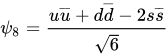
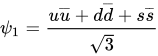
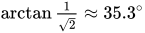
The mixing angle at which the components decouple completely can be calculated to be . The mixing angle of the
ϕ
and
ω
states is calculated from the masses of each state to be about 35˚, which is very close to maximum decoupling. Therefore, the
ϕ
meson is nearly a pure
s
s
state.[3]
History[edit]
The existence of the
ϕ
meson was first proposed by the Japanese American particle physicist, J. J. Sakurai, in 1962 as a resonance state between the
K0
and the
K0
.[4] It was discovered later in 1962 by P.L. Connolly, et al. in a 20-inch hydrogen bubble chamber at the Alternating Gradient Synchrotron (AGS) in Brookhaven National Laboratory in Uptown, NY while they were studying
K−
p+
collisions at approximately 2.23 GeV/c.[5][6] In essence, the reaction involved a beam of
K−
s being accelerated to high energies to collide with protons.
The
ϕ
meson has several possible decay modes. The most energetically favored mode involves the
ϕ
meson decaying into 3 pions, which is what would naïvely be expected. However, we instead observe that it decays most frequently into 2 kaons.[7] Between 1963 and 1966, 3 people, Susumu Okubo, George Zweig and Jugoro Iizuka, each independently proposed a rule to account for the observed suppression of the 3 pion decay.[8][9][10] This rule is now known as the OZI rule and is also the currently accepted explanation for the unusually long lifetimes of the
J/ψ
and
ϒ
mesons.[7] Namely, on average they last ~ 7 × 10⁻²¹ s and ~ 1.5 × 10⁻²⁰ s respectively.[7] This is compared to the normal mean lifetime of a meson decaying via the strong force, which is on the order of 10−23 s.[7]
In 1999, a
ϕ
factory named DAFNE (or DA
ϕ
NE since the F stands for "
ϕ
Factory") began operation to study the decay of the
ϕ
meson in Frascati, Italy.[6] It produces
ϕ
mesons via electron-positron collisions. It has numerous detectors, including the KLOE detector which was in operation at the beginning of its operation.
See also[edit]
References[edit]
- ^ Nakamura, K.; et al. "Particle listings –
ϕ
" (PDF). Retrieved 5 May 2017. - ^ Tanabashi, M.; et al. "Particle listings –
ϕ
". Retrieved 17 Feb 2019. - ^ a b Nakamura, K. "14. Quark Model" (PDF). Retrieved 3 June 2021.
- ^ Sakurai, J. J. (1 December 1962). "Possible Existence of a T=0 Vector Meson at 1020 MeV". Physical Review Letters. 9 (11): 472–475. Bibcode:1962PhRvL...9..472S. doi:10.1103/PhysRevLett.9.472. Retrieved 5 May 2017.
- ^ Connolly, P. L.; Hart, E. L.; Lai, K. W.; London, G.; Moneti, G. C.; Rau, R. R.; Samios, N. P.; Skillicorn, I. O.; Yamamoto, S. S.; Goldberg, M.; Gundzik, M.; Leitner, J.; Lichtman, S. (15 April 1963). "Existence and Properties of the
ϕ
Meson". Physical Review Letters. 10 (8): 371–376. Bibcode:1963PhRvL..10..371C. doi:10.1103/PhysRevLett.10.371. OSTI 12491318. Retrieved 5 May 2017. - ^ a b "K for KLOE... ...and Z for Zweig - CERN Courier". cerncourier.com. 30 August 1999. Retrieved 6 May 2017.
- ^ a b c d Griffiths, David (2008). Introduction to elementary particles (2nd rev. ed.). Weinheim: Wiley-VCH. ISBN 978-3-527-40601-2.
- ^ S. Okubo, Phys. Lett. 5, 1975 (1963).
- ^ G. Zweig, CERN Report No.8419/TH412 (1964).
- ^ J. Iizuka, Prog. Theor. Phys. Suppl. 37, 21 (1966).
| Elementary |
| ||||||||||||||||||||||||
|---|---|---|---|---|---|---|---|---|---|---|---|---|---|---|---|---|---|---|---|---|---|---|---|---|---|
| Composite |
| ||||||||||||||||||||||||
| Quasiparticles | |||||||||||||||||||||||||
| Lists | |||||||||||||||||||||||||
| Related | |||||||||||||||||||||||||

| Authority control databases: National |
|---|
