


Porte-cochère


A porte-cochère (/ˌpɔːrt koʊˈʃɛr/; French: [pɔʁt.kɔ.ʃɛʁ]; lit. 'coach gateway';[1] pl. porte-cochères or portes-cochères)[2] is a doorway to a building or courtyard, "often very grand," through which vehicles can enter from the street[3] or a covered porch-like structure at a main or secondary entrance to a building through which originally a horse and carriage and today a motor vehicle can pass to provide arriving and departing occupants protection from the elements.[4][5]
Portes-cochères are still found on such structures as major public buildings and hotels, providing covered access for visitors and guests arriving by motorized transport.[6]
A porte-cochère, a structure for vehicle passage, is to be distinguished from a portico, a columned porch or entry for human, rather than vehicular, traffic.
History
[edit]The porte-cochère was a feature of many late 18th- and 19th-century mansions and public buildings. A well-known example is at Buckingham Palace in London. A portico at the White House in Washington, D.C. is often confused with a porte-cochère, where a raised vehicle ramp gives an architectural portico the functionality of the latter.[7]
Today portes-cochères are found at both elaborate private homes and such public buildings as churches, hotels, health facilities, and schools. Portes-cochère differ from carports in that the vehicles pass through for passengers to board or exit rather than being parked beneath the covered area.
Guard stones are often found at the foot of portes-cochère, acting as protective bollards to prevent vehicles from damaging the structure.
Gallery
[edit]-
 The Hôtel Hesselin in Paris (built 1642)
 -
 The Lockwood–Mathews Mansion (built 1864)
 -
 The Briarcliff Lodge (built 1902)
 -
 The Briarcliff Manor railroad station (built 1906)
 -
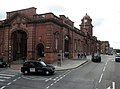 A typical railway porte-cochère at Nottingham station
 -
 Porte-cochère at Burleigh-Davidson Building, Berwick Academy, South Berwick, Maine
 -
 Guard stone beneath porte-cochère at the Burleigh-Davidson building, the Berwick Academy, South Berwick, Maine
 -
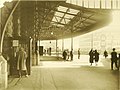 Porte-cochère at Central railway station, Sydney, 1924


.jpg)
See also
[edit]References
[edit]- ^ "porte-cochère". New Oxford American Dictionary.
- ^ "porte-cochère". Oxford English Dictionary (Online ed.). Oxford University Press. Retrieved 2019-12-02. (Subscription or participating institution membership required.)
- ^ James Curl (2017). The Oxford Dictionary of Architecture, third edition. Oxford, United Kingdom: Oxford University Press. ISBN 978-019-967498-5. "porte-cochère", p. 592. According to this source it is an "erroneous term for a projecting canopy or porch large enough to admit carriages."
- ^ "porte cochere". Merriam Webster Dictionary. Merriam-Webster, Incorporated. Retrieved 27 October 2019.
- ^ "porte-cochereor porte-co·chère". Dictionary.com. Dictionary.com, LLC. Retrieved 27 October 2019.
- ^ "Top 10 Design Tips to Dazzle Your Guests: The Porte Cochere". HKS Architecture. Archived from the original on 2017-10-17. Retrieved 2015-06-18.
- ^ "Shoptalk: Porte-Cochère". Treanor Architects. Retrieved 2015-09-18.


| Shared rooms | |
|---|---|
| Private rooms | |
| Spaces | |
| Technical, utility and storage |
|
| Great house areas | |
| Other | |
| Architectural elements | |
| Related | |
